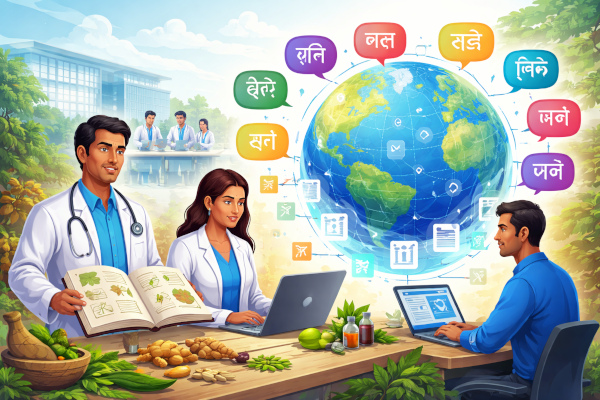
In a move aimed at widening public access to credible Ayurveda research, the Central Council for Research in Ayurvedic Sciences (CCRAS), under the Ministry of Ayush, has signed a Memorandum of Understanding with Anuvadini AI, an artificial intelligence-based translation platform developed by the All India Council for Technical Education (AICTE) under the Ministry of Education. The agreement, announced on March 30, 2026, is designed to make evidence-based Ayurveda knowledge available across linguistic barriers by translating CCRAS research outputs and educational material into 13 regional languages, including Hindi.
The collaboration brings together a major national Ayurveda research body and an AI-driven language technology platform at a time when accessibility of scientific information in Indian languages is becoming increasingly important. According to the official announcement, the MoU was signed by Prof. Vaidya Rabinarayan Acharya, Director General of CCRAS, and Dr. Buddha Chandrasekhar, CEO of Anuvadini AI. The initiative is intended to ensure that authenticated, research-backed Ayurveda knowledge reaches people in different regions of the country in languages they understand more comfortably.
CCRAS plays a central role in Ayurveda research in India, operating through a network of 30 institutes spread across 25 states. It conducts scientific studies in Ayurvedic sciences and publishes research findings through its quarterly CCRAS Bulletin as well as other information, education and communication materials. Much of this content has so far been available primarily in English, which has naturally limited its reach among wider sections of the population. Through the partnership with Anuvadini AI, these materials are set to become more accessible to non-English-speaking audiences, which could strengthen public awareness while also reducing the space for misinformation around Ayurveda.
Anuvadini AI has been positioned as a platform focused on translating technical, scientific and governance-related knowledge through artificial intelligence. Its broader purpose is to make credible knowledge available regardless of linguistic or regional background, and that objective aligns closely with CCRAS’s effort to democratise access to research-based Ayurveda information. The translation initiative is therefore not merely a language exercise; it is also a public knowledge and health communication intervention that seeks to connect formal research with ordinary citizens more effectively.
Speaking on the occasion, Prof. Rabinarayan Acharya said the partnership reflects CCRAS’s commitment to ensuring that the outcomes of Ayurveda research benefit not only scholars and institutions, but citizens across the country in their respective languages. Dr. Buddha Chandrasekhar, for his part, said Anuvadini AI had been developed precisely for such collaborations, where technology can make knowledge more accessible, equitable and socially empowering. Their remarks underline the broader policy direction behind the initiative: using digital tools to extend the reach of traditional knowledge systems, while keeping the focus on evidence-based and research-supported content.
The initiative may also gain an international dimension in the future. The official release notes that the translation effort could later expand into foreign languages, beginning with countries where the Ministry of Ayush and CCRAS have already established Ayush Chairs. That would open the possibility of taking authentic Ayurveda research beyond India’s linguistic diversity and into a wider global knowledge ecosystem. For now, however, the immediate significance of the MoU lies in its attempt to bridge one of the most persistent gaps in public communication in India: the gap between knowledge creation and knowledge accessibility. By placing evidence-based Ayurveda material into multiple Indian languages, CCRAS and Anuvadini AI are trying to ensure that scientific outreach is not confined by English alone.
Source: PIB
You may also like
-
Why Ayurveda Begins the Morning by Looking at the Tongue
-
High Blood Pressure Through an Ayurvedic Lens: Stress, Diet and Dosha Imbalance
-
IISc Develops Engineered Nanobody Antivenom With Broad Protection Against Indian Cobra Venoms
-
Indian MedTech Startup Periwinkle Takes Rapid AI Cervical Cancer Screening to BRICS
-
WHO Chief Praises India’s Gains in Maternal, Child Health and NCD Care
