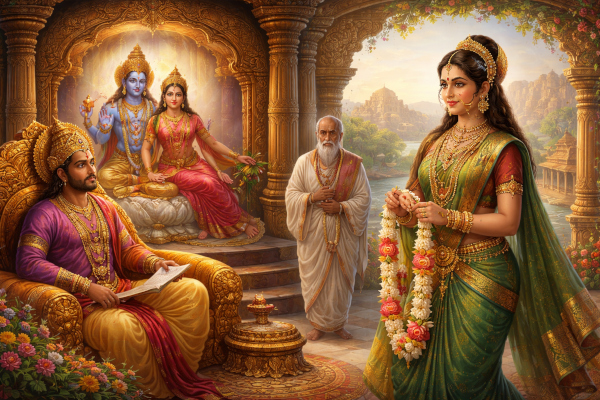
Āmuktamālyada is one of the most celebrated works of Telugu literature, composed in the early sixteenth century by the Vijayanagara emperor Krishnadevaraya. The title is usually understood as “the giver of the worn garland,” referring to Andal, the great Tamil Vaishnava saint-poet, who is said to have worn the flower garlands intended for Vishnu before they were offered to him. The poem is therefore not merely a literary work, but a devotional retelling of Andal’s love for the divine, written by a king who was also a poet of rare ambition and refinement. Modern scholarship describes it as a major Telugu epic of about 875 verses, while standard summaries note that it is simultaneously a devotional poem and a text with reflections on polity and administration.
At the heart of the book is the story of Andal, also called Goda Devi, the only woman among the twelve Alvar saints of the Sri Vaishnava tradition. According to tradition, she was found as an infant under a tulasi plant by Vishnuchitta, better known as Periyalvar, and was raised in an atmosphere of temple devotion. In Āmuktamālyada, Krishnadevaraya retells her journey of intense devotion to Vishnu, her inward longing, her bridal mysticism, and her eventual union with Ranganatha of Srirangam. The work is thus about divine love, longing, surrender, beauty, and bhakti, but it is also about the transformation of personal devotion into cosmic fulfillment.
The book is not a plain biography of Andal. It is a richly layered poetic composition. It contains descriptions of Andal’s viraha, the pain of separation from the divine; elaborate poetic passages on her beauty; theological and cultural material from the Sri Vaishnava tradition; and sections that reveal Krishnadevaraya’s own reflections on kingship and moral rule. One widely noted feature is the poem’s famous keśādi-pādam style of description, in which Andal’s beauty is described from head to foot in about thirty verses. Scholars also note that the text survives in differing chapter divisions, with some editions dividing it into six cantos and others into seven, which reflects its long commentarial and manuscript history.
One of the most famous lines associated with the work is the much-quoted: “దేశభాషలందు తెలుగు లెస్స” — “Among the languages of the land, Telugu is the finest.” This line became far bigger than the poem itself and entered cultural memory as a declaration of Telugu literary pride. Whether one reads it as linguistic affection, royal patronage, or cultural politics, it reveals something important about Krishnadevaraya: he was not simply using Telugu as a medium, he was elevating it into an imperial literary language. That matters greatly because the story he chose to tell was rooted in the Tamil Srivaishnava world of Andal, yet he cast it in stately Telugu poetry, thereby creating a literary bridge between Tamil devotion and Telugu court culture.
A few brief lines help capture the spirit of the work. The most famous, of course, is “దేశభాషలందు తెలుగు లెస్స.” Another important strand visible in translations and scholarly discussion is the poem’s moral and devotional depth. In Srinivas Reddy’s translated study of one embedded episode from Āmuktamālyada, a devotee asks, “Is the ocean lowered when a fish takes a gulp?” The line is simple but powerful: divine greatness is not diminished by grace, generosity, or inclusion. That same translated section also shows the poem’s emotional intensity and ethical force, which is one reason scholars value it not just as ornamental poetry but as a work of thought.
So what exactly is in the book? In broad terms, Āmuktamālyada contains the story of Andal/Goda, the devotional world of Vishnuchitta, the emotional and spiritual drama of longing for Vishnu, descriptions of sacred places and traditions, and embedded reflections on the duties of rulers and the structure of righteous governance. That is why it is often described as both a bhakti-kāvya and a work with political significance. It is devotional, but never naïve; literary, but never empty; royal, but not merely propagandistic. It reveals how a sixteenth-century emperor understood faith, language, ethics, and power as belonging to a single civilizational order.
This is what makes Āmuktamālyada extraordinary. Krishnadevaraya did not merely patronise poets; he himself entered the literary arena and produced a work that outlived his conquests. Through Andal’s story, he gave Telugu one of its crown jewels. Through the poem’s devotional intensity, he showed that royal authorship could be spiritually serious. And through its undertones of statecraft, he showed that poetry could also serve as a vehicle of political philosophy. Āmuktamālyada therefore stands not only as a masterpiece of Telugu literature, but as one of the finest examples in Indian history of a king using literature to unite devotion, language, and kingship into one enduring cultural achievement.
Reference:
Srinivas G. Reddy, The Āmuktamālyada of Kṛṣṇadevarāya
Srinivas Reddy Thesis PDF, Amukta Malyada of Krishna Deva Raya: Language, Power & Devotion in 16th Century South India
You may also like
-
Mandapala and the Bird Family of Khandava — The Four Chicks Who Faced a Forest of Fire
-
NBEMS Announces Additional FMGE by October
-
Nahusha as a Python: When Bhima’s Strength Failed and Yudhishthira’s Wisdom Prevailed
-
IICT and Netflix Launch Scholarships for 100 Students to Build India’s Next Generation of AVGC-XR Talent
-
Bhima Meets Hanuman: When Strength Bowed Before Strength
