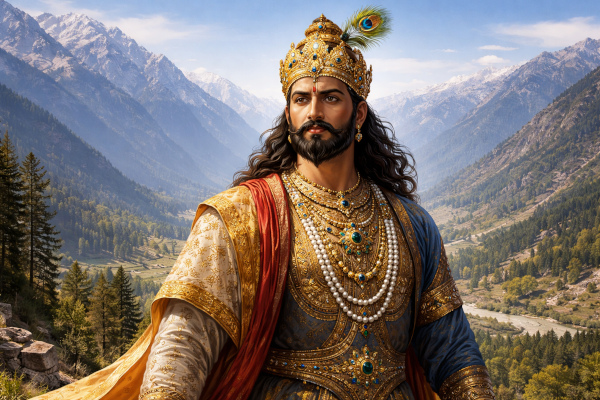
Lalitaditya Muktapida appears in the history of Kashmir like a sudden mountain sunrise—first touching the highest peaks, and then revealing how vast the landscape beneath him truly was.He emerged in the 8th century CE from the Karkota dynasty and became the most formidable ruler that early medieval Kashmir produced. Even today, his name stands at the uneasy border between history and legend. The chronicler Kalhana, writing in the Rajatarangini in the 12th century, presents him as a near-universal conqueror, a monarch whose armies moved across north India and deep into the lands beyond the Hindu Kush. Modern historians are more cautious. They accept him as a very powerful king, but they also warn that some of the grandest conquest stories were likely magnified over time. What remains beyond dispute is this: Lalitaditya was no ordinary ruler. He was an empire-builder, a temple-builder, a city-builder, and one of the most ambitious monarchs in the history of Kashmir.
He was born into a royal house already on the rise. The Rajatarangini identifies him as a son of king Durlabhaka and queen Narendraprabha, and names his elder brothers Chandrapida and Tarapida, both of whom ruled before him. Modern historians generally place Lalitaditya’s reign around c. 724/725 to c. 760 CE, rather than the earlier dates implied by Kalhana’s chronology, because Chinese Tang records help anchor Kashmir’s diplomatic activity more firmly in the mid-8th century. That may sound like a dry chronological correction, but it matters: it places Lalitaditya in one of the most turbulent geopolitical moments of Asia, when Tibet, Tang China, Turkic powers, and rising Arab forces were all contesting influence across the mountain world that touched Kashmir’s frontiers.
What made Lalitaditya remarkable was not simply that he inherited power, but that he seemed unwilling to think of Kashmir as a small valley kingdom enclosed by snow. In Kalhana’s telling, he thought in continental terms. Some of those conquest narratives are certainly inflated. Yet even skeptical scholarship does not reduce him to a local hill ruler. Tansen Sen’s work on Kashmir and Tang China argues that Lalitaditya’s fame likely grew out of real military strength and real participation in the politics of the southern Hindukush, especially in alliance systems directed against Tibetan expansion. In other words, even if he did not literally conquer the world, he almost certainly projected Kashmiri power far beyond the valley and made Kashmir a serious player in trans-Himalayan geopolitics.
One of the firmer military episodes linked to him is his conflict with Yashovarman of Kannauj, one of the most important north Indian rulers of the age. Britannica notes that Yashovarman “appears to have been defeated” by Lalitaditya. That single line is more important than it looks. Kannauj was not a minor power. To defeat or dominate its ruler was to announce oneself as a major force in north India. This is one reason Lalitaditya’s reign cannot be brushed aside as merely regional. Even when we strip away exaggeration, he still emerges as a king whose military reach was impressive enough to leave a mark on the political memory of the subcontinent.
His alleged campaigns into Central Asia are where history becomes more difficult and more fascinating. Kalhana gives him a conquest-arc that sweeps across vast territories, but modern historians do not accept this literally. What they do take seriously is the Chinese evidence showing that Kashmir under Muktapida sought alliance with Tang China against Tibet and operated in a wider strategic world stretching toward Baltistan, Gilgit, and Kashgar. The Rajatarangini tradition preserved in translation also notes a Chinese-linked embassy and a request connected to anti-Tibetan cooperation. So the safest historical judgment is this: Lalitaditya probably did not build the sort of stable universal empire imagined by later panegyric memory, but he very likely led campaigns and interventions that carried Kashmiri influence into the high Asian frontier in a way rare for Indian rulers of his time.
If war gave Lalitaditya his aura, architecture gave him immortality. His most famous surviving legacy is the Martand Sun Temple, one of the grand masterpieces of early Indian temple architecture. Kalhana credits him with building the temple, and the archaeological and architectural tradition firmly associates the site with his reign in the mid-8th century. Britannica describes Mārtanḍ as a ruined Sun Temple placed in a rectangular court enclosed by columns, a structure that still conveys the force of the Kashmiri style even in ruin. The Rajatarangini is even more vivid, saying he built the “marvellous temple of Martanda” with massive stone walls and encircling ramparts. Even in its broken state, the temple feels less like a monument and more like a declaration — that Kashmir under Lalitaditya saw itself as wealthy, sacred, artistically confident, and fully capable of creating architecture on an imperial scale.
But to reduce him to Martand alone would be to miss the width of his statecraft. Kalhana also credits him with founding or embellishing Parihasapura, one of his great urban projects, and with patronizing multiple shrines and institutions across religious lines. The same passage that mentions Martand also records a Vishnu shrine at Huskapura, a colossal vihara and stupa, a temple of Jyeshtha Rudra, and irrigation works at Chakradhara where the waters of the Vitasta were diverted and distributed through a series of water-wheels to villages. That is the signature not only of piety, but of governance. Lalitaditya appears as the kind of ruler who understood that empire was not just won by cavalry and banners. It had to be fixed into stone, water, roads, ritual, and urban life.
His governance style, as far as the sources allow us to infer, seems to have been expansive, theatrical, and materially interventionist. He built towns, endowed temples, sponsored major images and public works, and cultivated a courtly grandeur meant to radiate sovereignty. The Rajatarangini even links him with the distribution of enormous wealth and repeated temple-building across settlements. One should not take every number in a courtly chronicle literally, but the pattern is unmistakable: this was a king who ruled through spectacle, redistribution, sacred patronage, and visible works. He wanted power to be seen. He wanted the landscape itself to remember him.
His family line continued on the throne after him. Kalhana states that after Lalitaditya came Kuvalayapida, and after him Vajraditya, both sons of Muktapida. One passage specifically names Kamaladevi as the mother of Kuvalayapida. These dynastic details matter because they show Lalitaditya not as an isolated heroic figure but as part of a ruling house trying to preserve succession after a giant reign. Yet the irony of many great conquerors repeats itself here too: the brilliance of the father often throws a long shadow over the sons. In memory, Lalitaditya remained the blazing peak. His successors survived in the record, but he dominated it.
And then comes the strangest part of his story: his death. Here the sources refuse certainty. Kalhana says that after ruling for 36 years, 7 months, and 11 days, Lalitaditya “set” like a moon of the people. But he immediately gives multiple, conflicting reports. One tradition said he perished in heavy snowfall in Aryanaka, a name some later interpreters connected with Iran or a region to the northwest. Another said he entered the flames during a crisis to preserve his honor. Yet another suggested he passed into a remote northern land “easily accessible to the immortals.” This is not the kind of evidence from which a firm cause of death can be established. The most responsible conclusion is that his end is historically uncertain. Even in death, Lalitaditya was too large for memory to leave him ordinary.
That, perhaps, is the real reason he remains under-discussed yet unforgettable. Lalitaditya Muktapida sits in Indian history like a half-lit colossus: part emperor, part builder, part frontier strategist, part legend. Mainstream narratives often pass too quickly over Kashmir’s early medieval greatness, and in doing so they miss a ruler who pushed the political imagination of his kingdom far beyond its valley walls. He left behind not only the shattered magnificence of Martand, but the image of a Kashmir that was outward-looking, militarily ambitious, artistically daring, and fully entangled with the great contests of Asia. Whether every conquest tale is true is almost beside the point. The ruins, the chronicles, the diplomatic traces, and the stubborn afterglow of his name all tell the same story: in the 8th century, Kashmir produced a king who refused to think small.
Sources
Kalhana. Rajatarangini (translated by M. A. Stein).
Stein, M. A. Kalhana’s Rajatarangini: A Chronicle of the Kings of Kasmir, Vol. I.
Encyclopaedia Britannica. “Yasovarman.”
Encyclopaedia Britannica. “Martand.”
Tansen Sen. “Kasmir, Tang China, and Muktapida Lalitaditya.”
Wikipedia. “Lalitaditya Muktapida.”
Wikipedia. “Martand Sun Temple.”
https://en.wikipedia.org/wiki/Martand_Sun_Temple
You may also like
-
Mushika — The Northern Malabar Kingdom Beneath Ezhimala and Beside the Arabian Sea
-
Tosala — The Ancient Heartland of the Daya, Mahanadi and Odisha’s Coastal Plain
-
Odra — The Mahanadi Country of Forested Hills and River Valleys
-
Utkala — The River-Bound Eastern Land Between the Highlands and the Sea
-
Kalinga — The Eastern Kingdom Between Mahendra and the Sea
