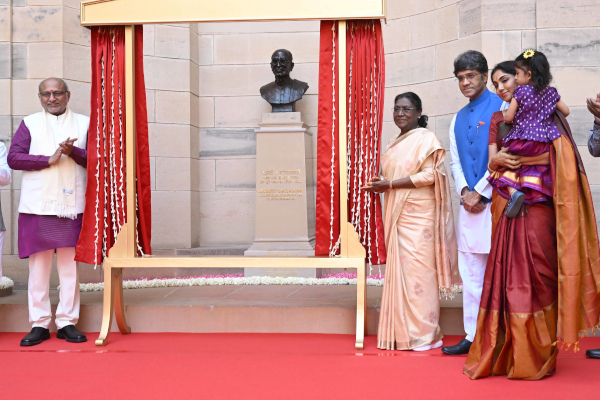
In a moment that resonates with both history and symbolism, the President of India, Smt. Droupadi Murmu, unveiled the bust of Chakravarti Rajagopalachari, the first and only Indian Governor-General of independent India, at Rashtrapati Bhavan on February 23, 2026, as part of the ongoing Rajaji Utsav celebrations. The event, attended by dignitaries including the Vice President of India, marked a significant step in highlighting India’s own icons and intellectual heritage within the nation’s foremost seat of state.
The newly unveiled bust, placed prominently at the Grand Open Staircase near Ashok Mandap opposite the statue of Mahatma Gandhi, replaces the bust of British architect Edwin Lutyens, whose work shaped much of New Delhi’s colonial-era architecture. This symbolic repositioning is part of a broader initiative to shed remnants of the colonial mindset and embrace the richness of India’s culture, heritage and traditions with pride.
In her remarks at the ceremony, President Murmu reflected on Rajagopalachari’s legacy, recalling that when he first stepped into what was then the Government House, he chose to place portraits of Ramakrishna Paramahamsa and Mahatma Gandhi in his room, sending a powerful message that true Swaraj, or self-rule, had taken root in Indians’ hearts even while formal structures were still evolving. She explained that Rajaji’s life and ideals have long inspired efforts toward mental decolonisation and continue to guide national campaigns aimed at taking pride in India’s historical and cultural identity.
After the unveiling, the President graced the Rajaji Utsav at the Rashtrapati Bhavan Cultural Centre, where she viewed a photo and book exhibition on Rajaji’s life and work, watched a film chronicling his contributions, and enjoyed cultural performances celebrating his enduring legacy. In his message for the occasion, read aloud at the event, Prime Minister Narendra Modi called the unveiling a moment of immense pride for the nation and a reflection of India’s democratic self-confidence rooted in its civilisational heritage. The Prime Minister noted that positioning Rajagopalachari’s bust where Lutyens’ once stood was a meaningful act of mental decolonisation, reinforcing the idea that Rashtrapati Bhavan is not merely a seat of power but a symbol of India’s sovereign identity.
Vice President C. P. Radhakrishnan also spoke at the function, describing Rajaji Utsav as a celebration befitting a towering figure in India’s history who championed economic freedom and upheld values of moral strength and integrity. He emphasised that Rajaji’s life reminds the nation that true greatness lies not in authority or position, but in inner refinement, commitment to ideals and steadfast dedication to the nation’s progress.
The unveiling of the bust and the ongoing Rajaji Utsav — featuring an exhibition open to the public from February 24 to March 1, 2026 — underscore India’s intent to honour its national icons not just as historical figures, but as inspirations for future generations. Rajagopalachari’s journey as a scholar, freedom fighter, thinker and administrator remains a testament to India’s rich legacy of leadership and self-determination, and his presence at Rashtrapati Bhavan now stands as a lasting tribute to those enduring ideals.
You may also like
-
Mushika — The Northern Malabar Kingdom Beneath Ezhimala and Beside the Arabian Sea
-
Why India Wants to Own the Technologies That Shape the Future
-
Tosala — The Ancient Heartland of the Daya, Mahanadi and Odisha’s Coastal Plain
-
Governing for the India That Can Be: India’s Political Shift From Managing Problems to Building Solutions
-
Odra — The Mahanadi Country of Forested Hills and River Valleys
