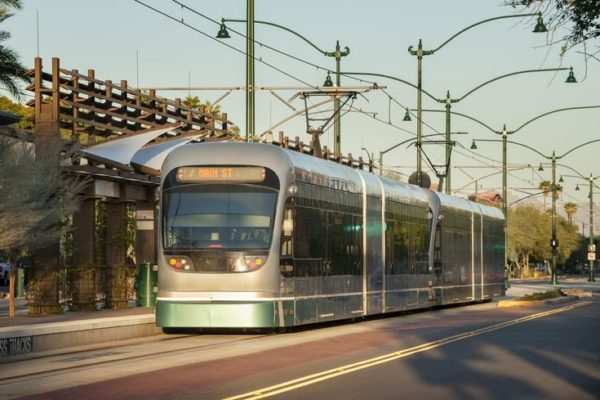
India bets on ‘Metrolite’ systems for smaller cities! Following the unprecedented success of Delhi Metro, several big cities across India have started their own rapid mass transit systems. There is no doubt that metro networks have changed the way common people travel in these cities. Now, the Narendra Modi government wants to take forward the “success of metro rail” to cities with less ridership. To provide the rail-based mass rapid transit system to people in these cities, the central government was planning to bring in Light Urban Rail Transit System named “Metrolite” with lesser capacity at much less cost.
Top details about light urban rail transit system ‘Metrolite’ project
- Cost-effective: The proposed Metrolite system involves less capital cost, operation and maintenance expenditures compared to a regular Metro network. These specifications can make the system more viable for smaller cities.
- The balance between road traffic, rail traffic: The proposed system will have a dedicated path. This dedicated path will separate the road traffic with Metro lite system. Apart from this, for segregation with road traffic, fencing would be provided on either side of the network.
- Proposals have been made for an integrated road and rail signaling system. This could be provided with priority for Metrolite system. Traffic marshals can be posted initially at crossings to enforce discipline.
- Municipal corporations of the concerned cities will be entrusted with the responsibility to identify all possible paths for providing at-least single-track operation of Metrolite trains between two parallel roads.
- If the road width in the cities does not permit to have both lines; one line can be provided on a particular road and the other line can be provided on a parallel road also. As an alternative, the entire road can be closed for road transport and the only train can be operated with pedestrian plazas, as per proposals made by the Central government.
- Proposals have been made that there won’t be any AFC gates, X-ray baggage scanner, Platform screen doors and DFMD (Door Frame Metal Detectorare) in the Metrolite shelter. Ticket validators could be installed inside the train and in shelters with NCMC (National Common Mobility Card) or another ticketing systems. There could be random checking and heavy penalty will be slapped on the passengers traveling without a valid ticket in the system.
- Standard gauge of 1435 mm width can be adopted for the Metrolite system. The ballast-less track has been proposed in elevated sections and embedded track on road for At-grade sections.
- Metrolite trains with a maximum 12T axle load is to be adopted for passenger peak hour peak direction traffic (PHPDT) capacity from 2,000 to 15,000. Up-to 300 number of Passenger loading for 3-coach train unit. Trains will be capable of travelling in elevated, at grade and tunnel sections, as per proposals.
Source: TFE
Image Courtesy:Urban Transport News
You may also like
-
INOX India Enters Semiconductor Fab Infrastructure With First Orbital-Welding Order
-
Raymond Enters Aircraft Structures Manufacturing Through Indigenous Fighter Aircraft Programme
-
From Sea to Fuel: How Indian Startups Are Building the Foundations of a Seaweed Bioenergy Industry
-
Prostarm Builds 1.2 GWh BESS Manufacturing Base in Haryana as Indian Grid-Storage Orders Expand
-
Hughes Precision Raises ₹250+ Crore to Expand Ammunition Manufacturing, Enters Medium-Calibre Segment
