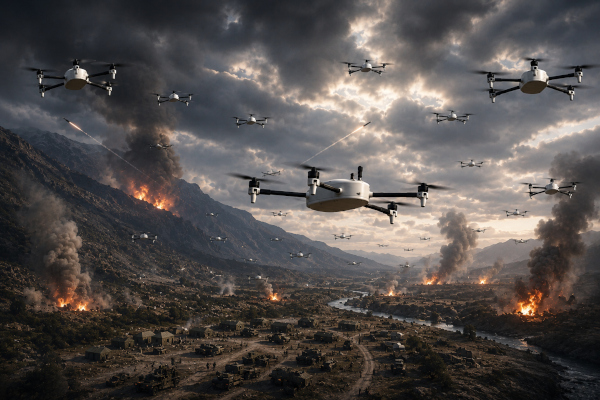
The Indian Army is preparing for a major expansion of its drone and remotely piloted aircraft capabilities, with Chief of Army Staff General Upendra Dwivedi announcing the raising of specialised Baaz Battalions to strengthen intelligence, surveillance and reconnaissance across the battlefield.
The move marks an important step in the Army’s transformation toward technology-driven warfare. Drones have moved from being supporting surveillance tools to becoming central battlefield assets for reconnaissance, target acquisition, logistics support, precision engagement, battlefield monitoring and counter-drone operations. The Indian Army’s plan to raise Baaz Battalions reflects this shift and gives unmanned systems a more structured, specialised and scalable role within military operations.
General Dwivedi said the Army will require continuous induction, upgrades and large-scale replenishment of drones to match future operational needs. The proposed Baaz Battalions will build upon existing Remotely Piloted Aircraft Flights and create a dedicated pool of trained personnel capable of operating and managing drone systems across the wider battlefield ecosystem.
The name “Baaz”, meaning hawk, is symbolically appropriate for formations built around aerial observation, speed, precision and battlefield awareness. These battalions are expected to improve the Army’s ability to maintain integrated aerial surveillance over large operational areas. Their role will include persistent battlefield monitoring, rapid response, intelligence collection, target tracking and real-time support to commanders.
The announcement also shows how rapidly unmanned systems have entered Army service. According to General Dwivedi, the Indian Army had only a few hundred drones around two years ago. Today, the number has grown beyond 50,000. Based on the Army’s current roadmap and operational requirements, this strength is expected to increase further and could potentially double within the next two to three years.
This is a major doctrinal shift. Earlier, drones were seen mainly as specialised assets operated by select units. The new approach treats drones as common battlefield equipment, similar to radios, night-vision devices and communication systems. As technology improves and costs reduce, drones are expected to become a routine part of military formations at different levels.
Baaz Battalions will help professionalise this transition. Instead of relying only on dispersed drone operators across units, the Army is moving toward specialised formations that can manage drone operations, maintenance, training, data flow and mission coordination in a more organised manner. This will allow commanders to receive faster, clearer and more actionable battlefield information.
The battalions are also expected to strengthen the Army’s ISR grid. Intelligence, Surveillance and Reconnaissance is one of the most important functions in modern warfare because speed of information often decides speed of action. A formation that can see deeper, track faster and relay information more accurately can strike with better precision and avoid operational delays.
Baaz Battalions can support multiple battlefield roles. In high-altitude areas, drones can monitor enemy movement, logistics routes and forward positions. In desert terrain, they can provide wide-area surveillance over open spaces. In counter-insurgency environments, drones can support patrols, track movement in difficult terrain and provide real-time overwatch. In conventional operations, they can assist artillery, armour, infantry and aviation units by improving target detection and battlefield coordination.
The creation of Baaz Battalions also has a strong counter-drone dimension. General Dwivedi made it clear that the Army is closely monitoring the drone and unmanned-system capabilities of adversaries. The larger priority is the ability to detect, track, neutralise and dominate the drone battlespace. This means the Army’s drone expansion is linked not only to surveillance but also to protection against hostile drones.
Modern battlefields have shown that drones can influence every phase of conflict. Small quadcopters can guide infantry units. Medium-range drones can monitor frontlines. Loitering munitions can strike targets with precision. Larger remotely piloted systems can support deep surveillance and long-endurance missions. Counter-drone systems are equally important because enemy drones can threaten troops, ammunition dumps, command posts, radar sites, vehicles and forward logistics nodes.
The Indian Army’s drone roadmap therefore appears to be moving along two parallel tracks. The first is large-scale drone induction for surveillance, reconnaissance and tactical use. The second is the creation of trained structures and counter-drone capability to control the unmanned battlespace. Baaz Battalions fit into this larger transformation by giving the Army dedicated manpower and organisational depth for drone operations.
The initiative also supports India’s broader defence modernisation and indigenous technology push. As the Army expands its drone inventory, Indian industry, start-ups and defence manufacturers are expected to play a larger role in supplying different classes of unmanned systems, sensors, control systems, communication links, batteries, payloads, anti-drone equipment and software solutions.
The operational value of Baaz Battalions will depend on training, integration and battlefield networking. Drone units must be connected with artillery fire-control systems, infantry commanders, air defence networks, electronic warfare units and intelligence cells. Their success will come from how effectively they convert aerial data into usable battlefield decisions.
This is where specialised drone battalions can make a major difference. A trained and dedicated formation can ensure better mission planning, disciplined airspace use, faster maintenance, safer operations, stronger data handling and more reliable support to combat formations. It can also help standardise drone tactics, techniques and procedures across the Army.
The decision to raise Baaz Battalions is therefore more than a procurement update. It represents a structural military reform. The Army is preparing for a future battlefield where unmanned systems will operate continuously, where surveillance will be persistent, where response time will be shorter and where every formation will need access to aerial intelligence.
For India, this is especially important because its military faces diverse terrain and varied operational challenges across mountains, deserts, plains, forests, riverine zones and urban areas. Drones provide flexibility across all these environments. A specialised drone force structure will allow the Army to adapt more quickly to each theatre.
Overall, General Upendra Dwivedi’s announcement signals a decisive move toward drone-enabled warfare. The expansion of the drone fleet, combined with the raising of Baaz Battalions, will strengthen the Indian Army’s surveillance capability, battlefield awareness, rapid response and counter-drone preparedness.
In the coming years, drones are expected to become one of the most widely used tools in the Indian Army’s operational ecosystem. Baaz Battalions will give that ecosystem a dedicated organisational backbone and help the Army dominate the aerial layer of the modern battlefield.
You may also like
-
DRDO’s Next Pinaka Leap: 370-mm Rocket Motor Points to Future 300-km-Class Guided Rocket
-
BDL Begins Localised Production of 5th-Generation Spike LR2 Missile in India
-
From Aero-Engine Parts to Jet-Powered Drones: How Raghu Vamsi Is Building an Integrated Indian Aerospace Company
-
Ramco Systems and Safran Build Direct Digital Link for Helicopter Engine Maintenance Data
-
IAF and IIT Bombay Join Hands for Master’s-Level Education of India’s Flight Test Crew
