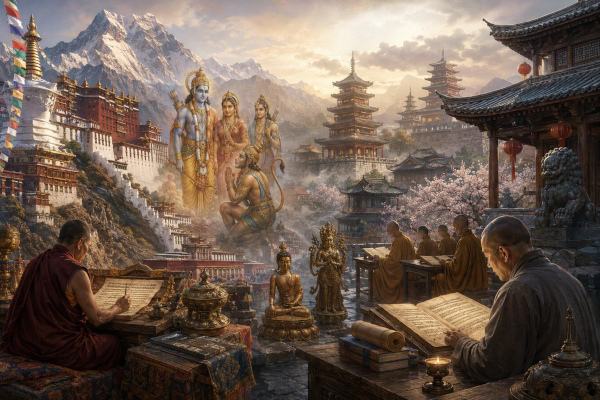
The Ramayana is one of Bharat’s greatest gifts to world civilisation. Born from the sacred imagination of India, the story of Rama, Sita, Lakshmana, Hanuman and Ravana travelled far beyond the Indian heartland through monks, scholars, traders, translators, monasteries and storytellers. Among the most fascinating chapters in this journey are the Ramayana’s links with China and Tibet, where Rama-related stories entered through Buddhist literature, Himalayan storytelling and classical translation traditions.
The Ramayana’s presence in China and Tibet shows the deeper meaning of Akhand Bharat as a civilisational idea. Here, Akhand Bharat is best understood as a sacred-cultural sphere shaped by dharma, knowledge, pilgrimage, literature, philosophy, language and memory. It is not merely a modern political expression. It is the story of how Indian civilisation touched neighbouring regions through wisdom, ethics, devotion and narrative power.
The Buddhist Bridge of the Ramayana
The most important route through which the Ramayana reached China and Tibet was Buddhism. As Buddhist monks carried Indian scriptures across Central Asia, the Himalayas and the Silk Road, they also carried stories connected with earlier Indian narrative traditions. Some of these stories were linked with Rama.
In Buddhist literature, Rama appears most famously in the Dasaratha Jataka. In this version, Rama is known as Rama-Pandita, a wise and restrained prince. The story is shaped as a Jataka, meaning a tale of a previous birth of the Buddha. This gave Rama’s story a Buddhist moral framework. The emphasis falls on patience, obedience, renunciation, self-control and kingly wisdom.
The Dasaratha Jataka differs from Valmiki’s Ramayana in many details. Its purpose is not to repeat the full epic story but to present Rama as a model of moral strength. This was one of the ways Indian epic memory entered Buddhist transmission. Through such narratives, the figure of Rama moved into regions where Buddhism became a major cultural force.
Ramayana in Chinese Culture
China’s connection with the Ramayana is quiet, textual and scholarly. Unlike Thailand or Cambodia, China did not develop a large public Ramayana performance tradition. Yet Rama-related material entered the Chinese cultural sphere through Buddhist scriptures and translated stories.
Chinese Buddhist literature became one of the greatest translation projects in world history. Indian monks, Central Asian scholars and Chinese translators worked for centuries to bring Buddhist texts into Chinese. During this process, many Indian stories, moral tales and Jataka narratives travelled with Buddhist teachings. Rama-related material was part of this broader movement.
The Chinese encounter with the Ramayana therefore happened mainly through Buddhist textual culture. Rama appeared not as a royal deity in temple performance, but as a moral prince within the Buddhist imagination. The story was valued for its ethical message: restraint in suffering, respect for duty, loyalty to family and dignified conduct under hardship.
Chinese scholarly discussions have noted that the earliest Ramayana-related content entered the Han cultural sphere primarily through Buddhist scriptures. This makes the Chinese Ramayana connection historically important. It shows that China received echoes of the Indian epic through the same channels that carried Buddhist philosophy, meditation, monastic discipline and Sanskrit-Pali narrative traditions into East Asia.
Rama as a Moral Figure in Chinese Buddhist Memory
In Chinese Buddhist-linked traditions, Rama is best understood as a righteous prince and ethical hero. His greatness lies in patience, discipline and moral clarity. The story’s value comes from his ability to obey dharma even when life becomes difficult.
This form of Rama is deeply compatible with Buddhist teaching. A prince who accepts exile, restrains anger, follows duty and acts with dignity becomes a perfect vehicle for moral instruction. The heroic energy of the epic is softened into a lesson on self-mastery.
Dasharatha, the royal father, also enters this moral world as part of the family and kingship setting. The exile of Rama becomes a lesson on obedience, patience and filial responsibility. These values had strong resonance in Chinese civilisation, where family ethics, respect for elders and ordered social conduct have long been important cultural ideals.
Hanuman’s presence in Chinese Ramayana memory is more limited than in India or Southeast Asia. He did not become a major popular deity in Chinese religious culture. Yet Chinese Buddhist discussions and comparative scholarship have recognised Hanuman as part of the wider Ramayana transmission. His role remains tied to the story-world rather than a developed devotional cult.
China and Bharat: A Shared Buddhist Corridor
The Ramayana’s presence in China must be viewed alongside the wider India-China Buddhist corridor. For centuries, Chinese pilgrims looked to India as the sacred land of the Buddha. Faxian and Xuanzang travelled to India in search of scriptures, monastic discipline and sacred sites. Indian texts shaped Chinese Buddhism, Chinese monasteries preserved Indian philosophical ideas, and translation centres created a bridge between Sanskrit, Central Asian languages and Chinese.
Within this great cultural movement, Rama-related stories represent one stream of Indian narrative influence. They show that Bharat’s civilisational reach was not limited to formal doctrine. Along with philosophy came stories. Along with scriptures came ethical legends. Along with monks came memory.
This is the positive cultural significance of the Ramayana in China. It stands as one more example of how Indian civilisation entered China through learning, translation, respect and spiritual exchange.
Ramayana in Tibetan Culture
Tibet’s Ramayana tradition is more vivid as a retelling tradition than China’s. Tibetan versions of the Ramayana have been found in manuscript traditions connected with Dunhuang, a major Buddhist and Silk Road centre. These manuscripts show that the story of Rama had travelled far into the Himalayan and Central Asian Buddhist world.
The Tibetan Ramayana is not a simple copy of Valmiki’s Ramayana. It is an adapted version shaped by Tibetan literary taste, Buddhist moral imagination and local storytelling. Names, scenes and narrative emphasis change, but the core world of Rama, Sita, Hanuman and Ravana-like figures remains visible.
This is the beauty of the Tibetan tradition. It received the Ramayana, honoured its moral power and reshaped it in its own cultural language. The result is a Himalayan Ramayana, one that belongs to the wider family of Rama stories while carrying its own emotional and literary identity.
Rama in Tibetan Retellings
In Tibetan traditions, Rama appears as a noble and righteous hero. He is a prince whose life is marked by exile, trial, separation and eventual moral resolution. The Tibetan Rama is not merely a warrior. He is a figure through whom ethical dilemmas are explored.
Tibetan versions often show deep interest in questions of trust, purity, justice and reconciliation. This gives the story a distinctive emotional quality. The focus is not only on victory over evil but also on healing within the family and restoration of harmony.
In some Tibetan retellings, Rama doubts Sita’s purity and sends her away. Hanuman then argues in defence of Sita and successfully restores her honour. Rama and Sita are reunited, and the story ends with reconciliation. This ending gives the Tibetan Ramayana a powerful tone of compassion and moral correction.
Sita in Tibetan Culture
Sita in Tibetan Ramayana tradition is a figure of dignity, endurance and purity. She carries the emotional heart of the story. Her suffering becomes a test of truth, and her final vindication becomes a moment of justice.
The Tibetan handling of Sita’s story is especially important because it highlights the ethical responsibility of the hero. Rama must recognise her innocence, and Hanuman plays a role in restoring truth. This gives Sita a powerful place in the narrative as a symbol of patience, honour and moral strength.
In the broader Akhand Bharat imagination, Sita represents the sacred feminine power of endurance and dharma. Her journey from Mithila to Ayodhya, forest, Lanka and later literary worlds across Asia shows how one Indian heroine became a figure of universal emotional resonance.
Hanuman in Tibetan Ramayana
Hanuman plays a remarkable role in Tibetan retellings. He is not only a messenger and servant of Rama. He becomes a defender of Sita’s honour and a voice of truth. This is one of the most striking features of the Tibetan Ramayana.
In the Indian tradition, Hanuman is already the supreme example of bhakti, strength, intelligence and fearless service. In Tibet, his role as advocate adds another layer to his greatness. He becomes the one who restores trust, protects the innocent and brings reconciliation.
This Tibetan Hanuman is deeply meaningful. He shows that devotion is not blind obedience. True devotion also protects dharma, speaks truth and repairs injustice. This makes Hanuman one of the most powerful bridges between Indian and Tibetan Ramayana imagination.
Ravana-Type Figures in Tibetan Tradition
Tibetan versions preserve the idea of a powerful adversary associated with pride, force and moral disorder. The names and narrative details may vary, but the larger role remains familiar. The Ravana-like figure represents the danger of ego, possession and misuse of power.
In Tibetan Buddhist interpretation, such figures can be understood as symbols of inner disturbance as well as outer opposition. The battle is therefore not only external. It becomes a moral and spiritual struggle between dharma and arrogance, restraint and desire, truth and domination.
Tibet and Bharat: A Himalayan Civilisational Link
Tibet’s Ramayana tradition reflects the larger Indo-Tibetan civilisational relationship. For centuries, India was the great source of Buddhist learning for Tibet. Tibetan monks translated vast bodies of Sanskrit Buddhist literature. Indian masters travelled to Tibet, and Tibetan scholars studied Indian philosophy, grammar, logic, medicine, tantra and monastic discipline.
The Ramayana’s presence in Tibet belongs to this broader stream. It shows that Indian narrative culture travelled with Indian spiritual knowledge. The Himalayan world was never only a barrier; it was also a bridge. Through this bridge, sacred stories moved along with scriptures, rituals, mantras and philosophical systems.
This is why Tibet has an important place in the Akhand Bharat cultural imagination. Its connection with Bharat was built through learning, sacred geography, Sanskritic memory and Buddhist transmission.
China and Tibet Compared
China and Tibet both received Rama-related traditions through Buddhist channels, but their expressions were different.
In China, the Ramayana connection was mainly textual and scholarly. Rama-related stories entered through Buddhist scriptures and Jataka literature. The emphasis was moral instruction, translation and scriptural memory.
In Tibet, the Ramayana became more of a retold story. Manuscripts and narrative traditions preserved a recognisable Rama-Sita-Hanuman world, adapted to Tibetan emotional and Buddhist sensibilities.
China preserved the Ramayana as an echo within Buddhist textual transmission. Tibet reshaped it as a living Himalayan narrative. Both forms are valuable. Both show how the Ramayana travelled through the world of dharma.
Akhand Bharat and the Ramayana’s Northern Journey
The China-Tibet chapter of the Ramayana shows the northern movement of Bharat’s sacred literature. It travelled through the Himalayas, monasteries, Silk Road centres and Buddhist translation traditions. It entered lands where Sanskrit learning was respected, Indian masters were revered, and moral stories were used to teach higher truths.
Akhand Bharat, in this context, becomes a map of civilisation. It includes the journeys of monks, the spread of manuscripts, the translation of sacred texts, the memory of Rama, the compassion of Sita and the service of Hanuman. It is a cultural universe shaped by dharma.
This vision is positive and inclusive. It does not diminish China or Tibet’s own cultures. Instead, it shows how both engaged creatively with ideas from Bharat. China absorbed Rama through Buddhist scripture. Tibet adapted Rama through Himalayan storytelling. Each preserved the story in its own way.
Why This Legacy Matters Today
The Ramayana’s journey into China and Tibet reminds us that civilisations grow through exchange. Stories travel when they speak to the human heart. Rama’s life spoke to Chinese Buddhist moral thought. Sita’s dignity touched Tibetan literary imagination. Hanuman’s devotion became a force of truth and reconciliation.
In a modern world often divided by politics and borders, these older cultural links offer a more generous memory. They show that Bharat, China and Tibet were connected through spiritual learning, literature and ethical storytelling long before modern geopolitics. The Ramayana becomes a bridge of memory.
This legacy also strengthens India’s civilisational identity. It shows that Indian thought was not confined to the subcontinent. It moved respectfully and powerfully through Asia. It entered new languages, took new forms and continued to carry the fragrance of dharma.
Conclusion
The Ramayana’s presence in China and Tibet is a beautiful chapter in the story of Bharat’s cultural journey beyond borders. In China, Rama-related stories entered through Buddhist scriptures and moral literature. In Tibet, the epic was retold through Himalayan Buddhist imagination, giving special emotional force to Sita’s dignity and Hanuman’s defence of truth.
Together, these traditions reveal the power of the Ramayana as a civilisational bridge. They show how Akhand Bharat can be understood as a living cultural sphere of dharma, memory, learning and sacred storytelling. The story of Rama crossed mountains and languages because it carried values that belong to all humanity: duty, courage, truth, compassion, loyalty and the final victory of righteousness.
China and Tibet preserved the Ramayana in their own ways. That is the greatness of the epic. It belongs to Bharat in origin, yet it became a shared light wherever seekers, monks and storytellers carried it.
You may also like
-
US Double Standards in Foreign Policy: 16 Recent Cases Involving India, Russia, China and Global Trade
-
Indian Navy Vice Chief Inspects Japan’s Mogami-Class Stealth Frigate as India-Japan Shipbuilding Cooperation Expands
-
Sindhu: The Indus Kingdom of Jayadratha in the Mahabharata
-
INS Trishul Arrives in UK for Exercise KONKAN 2026 as India and Royal Navy Expand Maritime Cooperation
-
INS Sahyadri Arrives in Russia for Exercise INDRA 2026 to Strengthen India-Russia Naval Cooperation
