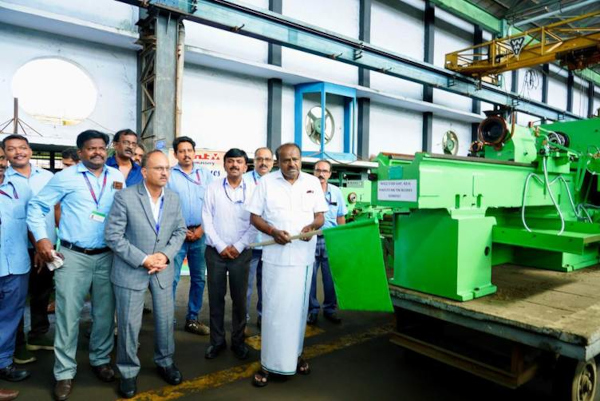
India’s public sector engineering ecosystem received a fresh boost as Union Minister for Heavy Industries and Steel H.D. Kumaraswamy visited HMT Machine Tools Limited, Kalamassery, and flagged off an NH Series machine manufactured at the Kerala facility for export to South Africa. The development highlights the growing international acceptance of Indian precision engineering and the continuing relevance of HMT in strategic manufacturing.
The export dispatch was the central highlight of the visit. For HMT Kalamassery, the shipment to South Africa is not merely a commercial order; it is a statement that Indian machine tools continue to find confidence in overseas markets. Machine tools form the backbone of industrial production because they are used to manufacture components for sectors such as defence, railways, aerospace, heavy engineering, automotive systems and general manufacturing. When an Indian public sector unit exports such equipment, it strengthens the country’s reputation as a producer of high-value industrial systems rather than only a consumer of advanced machinery.
During the visit, the Minister reviewed the operations of HMT’s Machine Tool Division, Foundry Division and strategic manufacturing sections. He also inspected manufacturing, assembly and testing processes related to CNC systems, precision machine tools, specialised engineering equipment and indigenously developed Sonar Directing Gear systems used for Indian Naval platforms. This defence-linked capability gives the visit a deeper strategic meaning, because HMT is not only serving commercial industry but also supporting India’s self-reliance in sensitive engineering domains.
The presence of indigenous naval systems at HMT Kalamassery shows how traditional public sector engineering units can remain relevant in the age of modern defence manufacturing. Sonar Directing Gear and other specialised systems require precision, reliability and the ability to meet demanding operational standards. Such capabilities are important for India’s larger Aatmanirbhar Bharat push, where domestic design, production and maintenance capacity are seen as critical for national security.
The Minister was briefed on HMT’s contribution to strategic sectors including defence, railways, aerospace, heavy engineering and advanced manufacturing. This broad industrial spread is significant because machine tool capability has a multiplier effect. A country that can build and upgrade its own machine tools gains greater control over its manufacturing base, reduces dependence on imports and strengthens the foundation for future industrial growth.
The visit also included detailed review meetings with the leadership of HMT Machine Tools Limited, the Fluid Control Research Institute and Instrumentation Limited. The discussions focused on operational performance, technology upgradation, modernisation, innovation-led growth, manufacturing capability and greater participation in strategic sectors. These areas are crucial for PSUs that are expected to compete in a fast-changing industrial environment while also supporting national development goals.
A major part of the engagement was also dedicated to the workforce. Kumaraswamy interacted with labour unions and employee representatives, listening to issues related to employee welfare, modernisation and the future growth of the institution. This is important because the revival and strengthening of public sector manufacturing cannot be achieved only through machines and infrastructure. It also depends on skilled workers, technicians, engineers and shop-floor knowledge accumulated over decades.
HMT’s Kalamassery unit carries particular importance for Kerala’s industrial landscape. At a time when India is trying to expand high-value manufacturing, facilities like HMT can become anchors for regional engineering ecosystems. They can support supplier networks, technical training, specialised fabrication, defence-linked manufacturing and export-oriented production. The South Africa dispatch therefore gives the unit a positive international marker and shows that Kerala-based industrial assets can contribute to India’s global manufacturing ambitions.
The larger message from the visit is clear: India is looking to modernise and strengthen its public sector manufacturing institutions instead of allowing legacy industrial capabilities to fade away. With technology upgrades, better market access, export orders and stronger links with strategic sectors, PSUs such as HMT can play an important role in India’s journey towards becoming a globally competitive manufacturing power.
The flagging off of the NH Series machine to South Africa is therefore more than a ceremonial export event. It reflects the coming together of public sector capability, indigenous engineering, export confidence and strategic manufacturing. For HMT Kalamassery, it is a reminder that India’s older industrial institutions still have the skill, infrastructure and technical depth to serve both domestic needs and international markets.
You may also like
-
India’s Startup Ecosystem Expands Beyond Bengaluru and Hyderabad as Tier-II Cities Gain Momentum
-
NABARD Report Highlights Growing Strength of Women-Led Farmer Producer Organisations in India
-
Indian Banks Expected to Record 25.4% Profit Growth in Q2 FY27 as Lending Expands and Margins Prepare for Recovery
-
India Targets 1 Billion 5G Users by 2030 as Telecom Sector Prepares for Global 6G Leadership
-
GHCL Begins Production at 2,800-Tonne Bromine Manufacturing Facility in Gujarat
