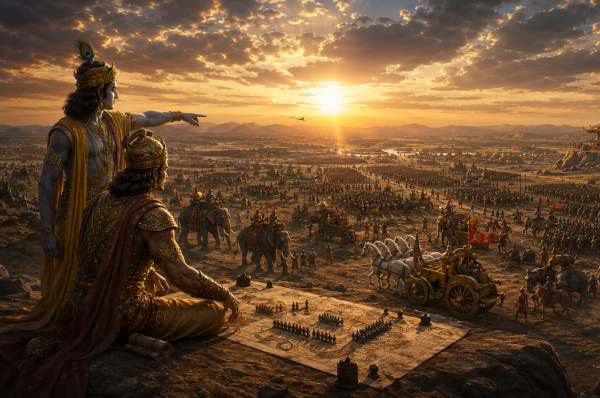
Kurukshetra is remembered as a sacred battlefield, but it can also be read as one of India’s oldest war-studies classrooms. Across eighteen days, the Mahabharata examines army organisation, command failure, battlefield formations, logistics, morale, deception, rules of war, special operations, deterrence and post-war exhaustion. Its value for modern defence readers lies in this: the epic does not reduce war to heroism alone. It shows that victory depends on leadership, intelligence, legitimacy, sustainment, disciplined violence and strategic clarity.
The epic describes the war as a clash of enormous scale, with eighteen Akshauhinis gathered at Samanta-panchaka and destroyed in the conflict. One Akshauhini itself was counted as 21,870 chariots, 21,870 elephants, 65,610 horses and 109,350 foot soldiers, giving the war a military scale that naturally invites comparison with modern corps-level and theatre-level planning.
What Modern Armies Can Learn from Kurukshetra
The first lesson is that war is a system. Kurukshetra was fought by famous warriors, yet it was sustained by command structures, camp organisation, intelligence, supply chains, morale management and political purpose. Arjuna’s archery mattered, but so did Krishna’s counsel. Bhima’s strength mattered, but so did Pandava alliance management. Bhishma’s command mattered, but so did the moral weakness of the cause he defended.
Modern doctrine says something similar in technical language. Contemporary military operations integrate combat power through command-and-control, movement, intelligence, fires, sustainment, protection and information. NATO describes modern ISR as a system that draws information from space, air, land and maritime assets, including surveillance aircraft and national ISR systems. NATO’s sustainment doctrine also treats sustainment as a key operational function in peace, crisis and conflict.
The Mahabharata teaches the same principle through narrative rather than manuals: a powerful army can weaken if its leadership is divided, its morale is shaken, its logistics are stretched, its ethics collapse and its political objective lacks legitimacy.
Why the Kauravas Lost Despite Having the Larger Army
The Kauravas entered the war with numerical superiority. Traditional reckoning gives them eleven Akshauhinis against the Pandavas’ seven. On paper, this should have given Duryodhana a decisive advantage. On the battlefield, numbers became only one part of combat power.
The Kaurava weakness lay in fragmented moral authority. Bhishma fought for the throne of Hastinapura, yet his heart was divided. Drona commanded with tactical genius, yet his emotional vulnerabilities shaped his decisions. Karna fought with fierce loyalty, yet his rivalry with Arjuna narrowed his strategic horizon. Duryodhana possessed willpower, but his political aim lacked the moral centre needed to inspire enduring unity.
Modern armies face the same truth. Numerical strength becomes decisive only when joined with unified command, clear political purpose, disciplined doctrine, reliable logistics and morale. A larger force can still lose momentum if senior commanders distrust one another, political leadership misreads reality, or soldiers sense that the cause lacks legitimacy.
The Kaurava side had mass. The Pandava side had cohesion.
Why the Pandavas Won: Strategy, Alliances and Moral Centre of Gravity
The Pandavas won because they built a stronger strategic system. Their army was smaller, but their leadership was more coherent. Yudhishthira provided moral legitimacy. Bhima gave shock power. Arjuna gave precision and battlefield dominance. Nakula and Sahadeva added specialised support, discipline and royal cohesion. Dhrishtadyumna served as commander. Satyaki, Abhimanyu and Ghatotkacha supplied elite battlefield effects. Above all, Krishna gave strategic direction.
In modern terms, the Pandavas maintained a superior moral centre of gravity. Their claim to justice, their willingness to negotiate before war, and Krishna’s diplomatic mission helped frame the conflict as a reluctant war after failed settlement. That matters because legitimacy shapes morale internally and perception externally.
Modern coalition warfare works in a similar way. Coalitions survive when members share a clear objective, trust leadership, allocate roles intelligently and maintain political legitimacy. The Pandavas were not merely five brothers fighting an inheritance dispute; they became the centre of a coalition bound by grievance, honour, alliance and dharma.
Bhima, Arjuna, Nakula and Sahadeva: Different Roles in One Fighting Force
The Pandavas are often remembered as individuals, but from a defence perspective they can be read as specialised arms within a joint force.
Bhima represents shock power. He is the heavy assault element, the breaker of lines, the close-combat specialist and the warrior whose physical presence affects morale. His role resembles heavy infantry, assault troops or armoured shock formations.
Arjuna represents precision, mobility and high-skill strike capability. With Gandiva, his chariot, his training and Krishna’s guidance, he becomes a warrior-system. Modern comparison can be made with fighter pilots, missile operators, special mission commanders or elite manoeuvre units whose effectiveness depends on skill, platform, sensors, command clarity and timing.
Nakula and Sahadeva are often less discussed, yet they are essential to the idea of force completeness. They represent disciplined support, cavalry culture, swordsmanship, royal administration and the stabilising structure around the more spectacular warriors. In modern forces, victory depends on such quieter arms: staff officers, logistics planners, cavalry scouts, signals officers, engineers and sustainment professionals.
The lesson is simple: a successful army needs multiple kinds of excellence. Shock power, precision strike, command discipline, intelligence, logistics and morale must operate together.
Satyaki, Abhimanyu and Ghatotkacha: Elite Battlefield Specialists
The Mahabharata also shows the importance of elite battlefield specialists.
Satyaki is the loyal, high-skill warrior who performs under pressure and supports critical operations. He resembles a dependable special mission leader inside a larger campaign.
Abhimanyu is the breakthrough fighter. His entry into the Chakravyuha shows courage, speed and technical knowledge, while his isolation shows the danger of sending elite capability into a layered enemy system without guaranteed follow-on support. In modern terms, a penetration force requires extraction planning, reinforcement, communications and supporting fires.
Ghatotkacha is the special asset used under special conditions. His night battle creates psychological shock and forces Karna to spend the divine dart that Krishna wanted removed from the battlefield before Arjuna’s final duel. This resembles the modern use of special operations, decoys, drones, electronic bait or high-risk assets to force an enemy to reveal or expend a scarce strategic capability.
Together, these characters show that elite troops can shape campaigns far beyond their numbers. Their value lies in timing, terrain, morale effect and mission suitability.
Kurukshetra and Modern Joint Warfare
Ancient Kurukshetra was organised through Chaturanga Bala — chariots, elephants, cavalry and infantry. Modern warfare is organised through land, air, sea, space, cyber, electronic warfare, drones, missiles, logistics and information dominance. The technological distance is vast, but the command logic remains recognisable.
Chariots gave mobility and precision fire. Elephants gave shock and psychological pressure. Cavalry gave speed, scouting and pursuit. Infantry held ground. Modern armies perform the same broad functions through tanks, mechanised infantry, artillery, helicopters, UAVs, ISR networks, air defence, naval assets and cyber-electronic systems.
The deeper lesson is integration. A chariot unsupported by infantry could be isolated. Elephants without control could become a liability. Cavalry without intelligence could ride into traps. Infantry without mobility could be overwhelmed. Modern joint warfare follows the same principle: air power, armour, infantry, drones, satellites, electronic warfare and logistics become decisive only when synchronised.
Kurukshetra therefore teaches combined-arms thinking in epic language.
Mahabharata and Deterrence: Why Power Must Be Controlled by Wisdom
The Mahabharata’s astras are among its most important strategic symbols. They should be read carefully, as concepts of supreme destructive capability rather than as direct equivalents of modern weapons. Their relevance lies in the question they raise: what kind of person is fit to hold power that can exceed the battlefield?
The Brahmashira episode makes this clear. The Sauptika Parva describes the Brahmashira weapon as capable of consuming the whole world and shows the danger of such power in the hands of a warrior driven by rage and grief.
The modern comparison is deterrence and escalation control. Nuclear weapons, according to the United Nations, are the most dangerous weapons on earth because one can destroy a city, kill millions and create long-term environmental and humanitarian consequences.
The Mahabharata’s lesson is mature: power without restraint becomes civilisational danger. Krishna, Arjuna and the Brahmashira episode show that possession of ultimate force demands discipline, command authority, moral clarity and the ability to withdraw from escalation. A warrior proves greatness not only by using power, but also by knowing when to hold it back.
The Mahabharata as India’s Oldest War Studies Text
The Mahabharata is literature, philosophy, sacred memory and political thought. It is also a war-studies text because it examines how wars begin, how armies are organised, how commanders fail, how morale collapses, how deception works, how rules break, how logistics sustains violence, and how victory can still leave a civilisation wounded.
Its defence lessons are remarkably wide:
Leadership without moral clarity becomes unstable.
Numbers without cohesion become fragile.
Weapons without doctrine become wasteful.
Elite courage without support becomes tragedy.
Strategy without legitimacy becomes brittle.
Power without restraint becomes dangerous.
Victory without reconstruction becomes grief.
Modern international humanitarian law seeks to limit destruction and suffering in armed conflict through principles such as distinction, proportionality and precaution. The Mahabharata reaches a related moral concern through the language of dharma: war may become necessary, but war must never be allowed to consume the very values it claims to defend.
That is why Kurukshetra remains relevant. It does not glorify war as spectacle. It studies war as duty, failure, sacrifice, discipline, tragedy and responsibility. For modern defence readers, the epic’s final lesson is this: the strongest military power is the one guided by intelligence, sustained by organisation, protected by ethics and controlled by wisdom.
You may also like
-
Structural Optimisation Reportedly Cuts HAL LUH Vibration by Up to 50%
-
Rare Stone Features Emerge as Kerala Archaeology Department Restores Megalithic Kudakkals at Karivellur
-
IAF Opens Race to Develop Indigenous High-Altitude Pseudo Satellite for Persistent Surveillance
-
BDL Confirms ASRAAM Missile Facility Fully Operational as Major IAF Requirement Looms
-
DRDO’s Junput Missile Test Facility Back on Track as Bengal Clears 8.73-Acre Coastal Range
