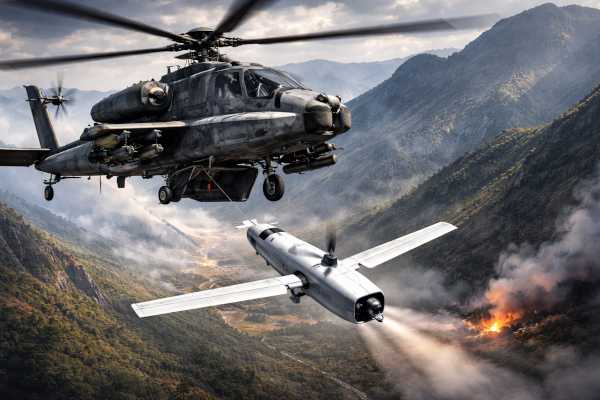
Operation Sindoor may eventually be remembered not merely as a military operation, but as the moment India’s armed forces decisively accelerated their transition into the age of AI-enabled, network-centric, multi-domain warfare. While previous conflicts in South Asia were dominated by conventional troop movements, artillery duels, and limited air campaigns, Operation Sindoor demonstrated how future warfare is increasingly shaped by artificial intelligence, autonomous systems, drones, precision strike ecosystems, electronic warfare, integrated intelligence networks, cyber operations, and real-time data fusion.
The operation, launched in response to the deadly terror attack in Pahalgam in April 2025, rapidly evolved into one of the most technologically significant military confrontations between India and Pakistan in recent decades. The strikes themselves reportedly lasted only minutes, but the broader operational and strategic consequences are continuing to reshape India’s military doctrine, procurement priorities, and battlefield philosophy.
Indian military planners appear to have drawn one major conclusion from Operation Sindoor: future wars will be won not simply through firepower alone, but through information dominance, speed of decision-making, integrated sensor networks, autonomous platforms, and AI-assisted battlefield coordination. The conflict reinforced lessons already visible in Ukraine, the Middle East, and the Indo-Pacific — that modern warfare increasingly revolves around who can process information faster, detect threats earlier, coordinate assets more efficiently, and overwhelm adversaries across multiple domains simultaneously.
One of the most striking aspects of Operation Sindoor was the extensive use of drones, loitering munitions, surveillance systems, precision-guided weapons, and integrated air defence networks. Reports indicate that India deployed Rafale fighters equipped with SCALP cruise missiles and HAMMER precision bombs alongside loitering drones, ISR systems, satellite support, and electronic warfare assets. The operation highlighted how modern battlefields are increasingly becoming ecosystems of interconnected platforms rather than isolated military units operating independently.
Artificial intelligence plays a central role in enabling such warfare architectures. AI systems are now critical for:
- Sensor fusion,
- Target recognition,
- Predictive analysis,
- Autonomous navigation,
- Drone swarming,
- Threat prioritisation,
- Battlefield mapping,
- Electronic warfare management,
- Rapid decision support.
In practical terms, AI reduces the time between detection and response — one of the most decisive factors in modern conflict.
The Indian military appears to be moving toward what defence strategists increasingly describe as “multi-domain operations” or MDO. This concept involves seamless integration of:
- land warfare,
- air power,
- naval assets,
- cyber operations,
- space-based intelligence,
- electromagnetic warfare,
- and information operations
into a unified combat network. Indian Army Chief General Upendra Dwivedi recently emphasised the importance of “domain integration and fusion,” stating that future conflicts will require forces to operate across interconnected battle spaces rather than traditional service-specific silos.
Operation Sindoor reinforced the urgency of this transformation. The conflict demonstrated that drones, satellites, cyber networks, electronic warfare systems, and AI-assisted targeting are no longer supplementary tools — they are becoming the central nervous system of modern warfare.
One of the most important lessons India appears to have absorbed involves the economics of warfare. Recent conflicts globally have shown that relatively inexpensive drones can inflict disproportionate damage against high-value targets. This has forced militaries worldwide to rethink defence spending and interception strategies. Indian defence planners now appear increasingly focused on layered, AI-enabled air defence systems capable of countering low-cost drone swarms without relying exclusively on expensive missile interceptors.
India’s emerging “Mission Sudarshan Chakra” and the integration of systems such as:
- Akashteer,
- IACCS,
- TRIGUN,
- and AI-assisted air-defence networks
reflect this shift toward intelligent, integrated defence ecosystems. Defence Minister Rajnath Singh recently described the Sudarshan air-defence network as an example of exemplary AI application within India’s evolving military architecture.
The rise of unmanned systems has become another defining post-Sindoor trend. The Indian Army is now reportedly deploying dedicated drone platoons within infantry formations while expanding institutional drone training infrastructure across military academies and operational units. These drone units are expected to handle:
- reconnaissance,
- precision strikes,
- loitering munition deployment,
- target acquisition,
- logistics support,
- and electronic warfare support.
This represents a profound doctrinal evolution. Infantry units are no longer merely troop formations; they are increasingly becoming data-enabled combat nodes integrated into larger AI-assisted networks.
The role of indigenous defence startups has also expanded dramatically after Operation Sindoor. India’s military establishment now appears far more willing to collaborate with:
- drone startups,
- AI developers,
- autonomous systems firms,
- electronic warfare innovators,
- and private-sector defence technology companies.
This reflects a broader transformation underway under the Atmanirbhar Bharat defence push. Rather than depending exclusively on traditional state-controlled procurement ecosystems, India is gradually building a hybrid military-industrial ecosystem where startups and private firms contribute directly to battlefield innovation.
Electronic warfare and cyber warfare emerged as equally important dimensions during Operation Sindoor. Reports and later analyses indicate that cyber intrusions, malware campaigns, communications disruption attempts, and information warfare operations formed part of the wider conflict environment. This reflects a global reality: future wars will increasingly involve simultaneous combat across physical and digital battle spaces.
India therefore appears to be moving toward integrated warfare doctrines where:
- cyber resilience,
- AI-assisted intelligence,
- electronic spectrum dominance,
- and autonomous systems
become inseparable from conventional military operations.
Space and surveillance systems are also receiving greater emphasis post-Sindoor. Persistent ISR — Intelligence, Surveillance and Reconnaissance — has become critical in modern conflicts where precision strikes depend on real-time battlefield visibility. India is reportedly expanding satellite-based surveillance capabilities, high-altitude monitoring systems, and AI-assisted reconnaissance architectures as part of broader military modernisation efforts.
The deeper strategic significance of Operation Sindoor lies in how it appears to have altered India’s broader military philosophy. Earlier Indian doctrines often emphasised mobilisation timelines, large-force deployment, and gradual escalation. The emerging doctrine increasingly prioritises:
- rapid precision strikes,
- integrated tri-service coordination,
- autonomous systems,
- persistent surveillance,
- and technology-enabled deterrence.
Several analysts have therefore described Operation Sindoor as a shift from older “Cold Start” concepts toward what some now call a “Cold Strike” doctrine — rapid, precise, technology-driven punitive action with compressed timelines and integrated force application.
The transformation underway also reflects larger global military trends. The world’s major militaries are now racing toward AI-enabled combat ecosystems involving:
- autonomous drones,
- battlefield AI,
- robotic logistics,
- algorithmic targeting,
- cognitive warfare,
- and machine-assisted command systems.
India’s military modernisation after Operation Sindoor indicates that New Delhi does not intend to remain behind in this technological transition.
At its core, Operation Sindoor revealed that warfare itself is changing fundamentally. Victory in future conflicts may depend less on the size of armies and more on:
- Network integration,
- Algorithmic speed,
- Sensor dominance,
- Autonomous systems,
- Cyber resilience,
- Information superiority.
The battlefield of the future is no longer merely physical terrain. It is a constantly shifting digital ecosystem where satellites, drones, AI systems, cyber networks, electronic warfare suites, and human operators function together inside a unified combat architecture.
Operation Sindoor may therefore come to be seen as India’s first major glimpse into that future.
You may also like
-
India’s Indigenous Sonar Ecosystem Powers New Generation of Indian Navy Warships
-
Murshidabad Becomes First West Bengal District to Complete Land Handover for India-Bangladesh Border Fencing
-
India’s LR-AShM Family Could Reach 3,500 Km as DRDO Develops Extended-Range Hypersonic Variants
-
Indian Composite Manufacturing Gets BrahMos Boost With ₹60-Crore Order to Allen Reinforced Plastics
-
HAL-Samtel Opens New Gurugram Facility to Expand Indigenous Defence Avionics and Display Manufacturing
