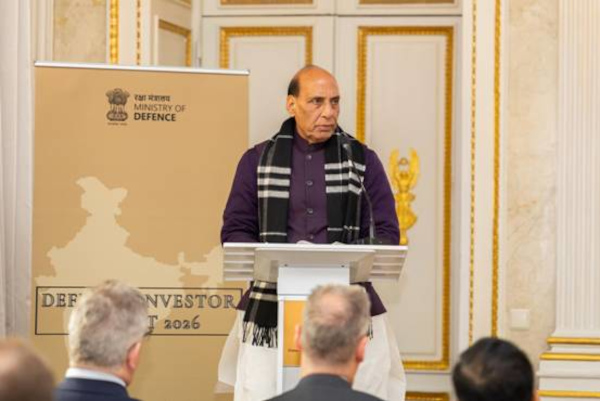
Defence Minister Rajnath Singh on Wednesday invited German industry leaders to co-develop and co-produce advanced defence technologies with India, pitching the country as a reliable long-term partner amid geopolitical volatility, supply-chain disruptions and rapid technological change. Speaking at the Defence Investor Summit in Munich during his visit to Germany, Singh said partnerships built on trust and shared interests had become essential in an increasingly uncertain world.
He said India offers a combination of a growing market, a young and skilled workforce, a fast-evolving industrial base, policy stability and a commitment to the rule of law, making it an attractive destination for strategic investment. Stressing that India’s defence industrial transformation is designed for long-term collaboration, Singh told German industry captains that the opportunity before them was “not a short-term proposition” but a durable strategic opening.
Highlighting the convergence between Europe’s rearmament push and India’s Aatmanirbhar Bharat agenda, the Defence Minister said Indian companies are keen to work with German firms in specialised areas such as advanced radar and sensor technologies, multi-sensor systems, AI-enabled unmanned aerial systems, sonobuoys and high-power low-frequency underwater transmitters. He said India’s self-reliance drive should be seen as an effort to design, develop and manufacture in India with trusted global partners rather than as an inward-looking policy.
Singh also said the defence sector has been placed at the centre of India’s industrial and technological strategy, with collaboration among industry, academia and research institutions helping create start-ups, niche technologies and stronger supply chains. According to him, a stronger domestic defence base contributes not only to national security but also to economic resilience, competitiveness and strategic autonomy.
Making a broader economic pitch, he said India’s defence needs will continue to expand over the coming decades, while its manufacturing ecosystem offers cost-effective production, engineering talent and access to a wide supplier base. He also pointed to India’s large start-up ecosystem and initiatives such as Start-Up India, Digital India and Skill India as factors that strengthen the case for German participation in co-development and production partnerships.
The Munich address came on the final day of Singh’s maiden visit to Germany. A day earlier, on April 22, he visited the TKMS submarine-building facility in Kiel to discuss advanced maritime capabilities and possible cooperation in naval technologies. He also held bilateral talks in Berlin with German Defence Minister Boris Pistorius, during which the two sides exchanged a Defence Industrial Cooperation Roadmap and an implementing arrangement on cooperation in UN peacekeeping trainin
You may also like
-
India’s Indigenous Sonar Ecosystem Powers New Generation of Indian Navy Warships
-
Murshidabad Becomes First West Bengal District to Complete Land Handover for India-Bangladesh Border Fencing
-
India’s LR-AShM Family Could Reach 3,500 Km as DRDO Develops Extended-Range Hypersonic Variants
-
Indian Composite Manufacturing Gets BrahMos Boost With ₹60-Crore Order to Allen Reinforced Plastics
-
HAL-Samtel Opens New Gurugram Facility to Expand Indigenous Defence Avionics and Display Manufacturing
