
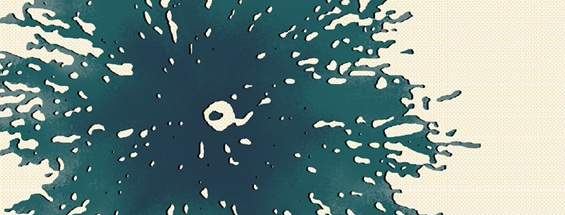
Scientists at the Raman Research Institute (RRI) have identified two previously unreported flow patterns—zig-zag and skewering—that emerge when water pushes through clay suspensions, a finding that could improve understanding of oil recovery and clay transport in confined systems. The study was highlighted by the Ministry of Science and Technology on 22 April 2026 and centres on how the mechanical behaviour of clay changes when its elasticity is altered.
represented by yellow
The research looks at what happens when a less viscous Newtonian fluid such as water displaces a non-Newtonian clay suspension inside a confined space. While earlier work had examined the large-scale patterns created in such systems, the new study focused on the microstructures and the way these branch-like flow paths develop. According to the PIB release, the researchers found that the newly observed zig-zag and skewering modes had not been reported in previous studies.
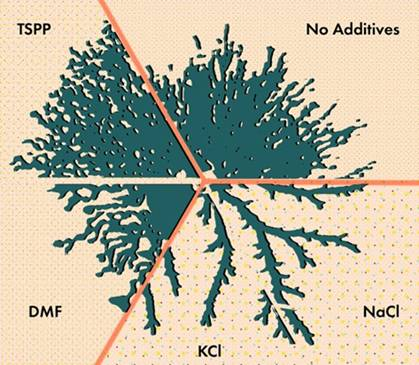
To carry out the experiment, the team first dried the clay, then mixed it into water to form a suspension. They also prepared separate clay suspensions using additives such as dimethylformamide (DMF), tetrasodium pyrophosphate (TSPP), sodium chloride, and potassium chloride. These additives changed how the clay particles interacted with one another and, in turn, altered the material’s elasticity and fracture behaviour. The clay particles themselves were described as coin-like nanoparticles about 1 nanometre thick and 30 nanometres in diameter.
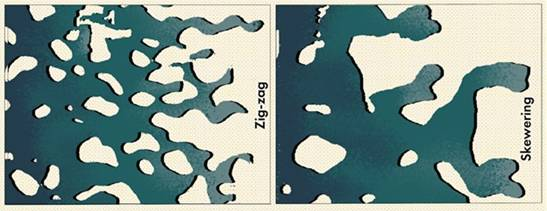
The experiments were performed in a Hele-Shaw cell, a narrow gap between two glass plates through which the clay and water were injected. In ordinary clay prepared with pure water, the advancing water formed patterns through tip-splitting, where one branch divides into two. But when the clay had lower elasticity because of DMF and TSPP, the channels became unevenly distributed and produced the newly observed skewering and zigzagging patterns.
The behaviour changed sharply when NaCl or KCl was added. In those cases, the clay became highly elastic and brittle, behaving more like a solid sheet that cracked under stress when water tried to move through it. This showed that by tuning elasticity with additives, researchers could effectively control how the clay deforms, branches, or fractures under flow.
The findings could have practical relevance beyond the laboratory. The PIB release notes that such instabilities can reduce efficiency in oil recovery, where one fluid is used to displace another through porous rock. Better control over these flow instabilities may therefore help improve extraction processes, while also offering insights into transport phenomena in complex materials.
Publication link: DOI 10.1088/1367-2630/ae27ec
Reference: PIB
You may also like
-
IIT Hyderabad Develops Lung-Derived Bioink for 3D Bioprinting and Regenerative Medicine
-
Indian Scientists Discover Molecular Switch That Can Regulate Cellular Autophagy
-
Scientists Map Earliest Glow of Hydrogen, Opening A New Window to the Universe
-
Indian Researchers Study RAD51 DNA-Repair Gene Variant in Prostate Cancer
-
TDB Backs Multi Nano Sense With ₹37.51 Crore to Build Indigenous Multi-Gas Sensor Platform
