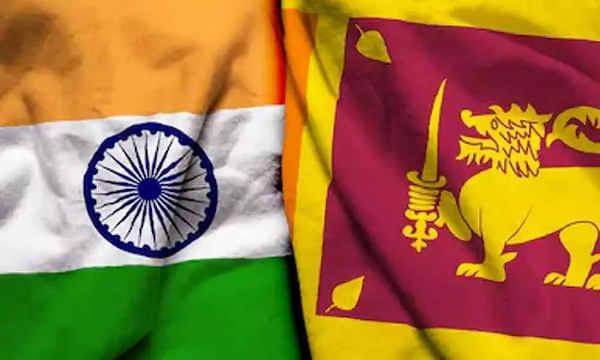
India-Sri Lanka relations received another high-level boost on Sunday as Vice President C.P. Radhakrishnan arrived in Colombo for a two-day official visit, marking the first-ever bilateral visit by an Indian Vice President to Sri Lanka. The visit comes at a time when both countries are trying to convert political goodwill into stronger economic, connectivity, community and strategic cooperation.
According to the official Indian schedule, the Vice President is set to call on President Anura Kumara Disanayaka and meet Prime Minister Harini Amarasuriya, while also engaging with leaders of the Indian-origin Tamil community and Tamil representatives from Sri Lanka’s Northern and Eastern regions. He is also scheduled to address the Indian diaspora in Colombo and virtually hand over homes built with Indian assistance under the Indian Housing Project. PIB says that with this phase, the total number of houses delivered to Tamil communities will reach 50,000, while 10,000 more are under construction in the fourth phase.
The visit is significant because it builds on a period of unusually dense India-Sri Lanka engagement. Sri Lankan President Disanayaka had chosen India for his first overseas visit in December 2024, and Prime Minister Narendra Modi’s April 5, 2025 visit to Sri Lanka further widened the bilateral agenda. In his official press statement, Modi highlighted progress on the Sampur Solar Power Plant, the plan for a multi-product pipeline, development of Trincomalee as an energy hub, a grid interconnection agreement, support for Sri Lanka’s digital identity project, and cooperation on defence and maritime security.
India also framed the relationship in economic-support terms. During the April 2025 visit, Modi said India had converted more than USD 100 million in loans into grants in the preceding six months and had concluded a bilateral debt restructuring agreement to ease Sri Lanka’s recovery. He also announced support for the Eastern Provinces, rail and port connectivity projects, and additional training programmes for Sri Lankan stakeholders. These measures show that the current relationship is being shaped as much by reconstruction and development as by diplomacy.
From the business side, the backdrop is equally important. MEA’s latest bilateral brief says India-Sri Lanka merchandise trade reached USD 5.54 billion in FY 2023-24, and stood at USD 3.67 billion during April-November FY 2024-25. It also notes that talks on the proposed Economic and Technology Cooperation Agreement (ETCA) have resumed after a five-year gap. That gives the Vice President’s visit a wider economic context beyond ceremonial diplomacy.
That is why business representatives in Sri Lanka have welcomed the visit. Media reports quoting Indian CEO Forum president Kishore Reddy say he expects the visit to strengthen people-to-people, business and economic ties between the two countries. While that remark is not itself an official government statement, it reflects how the visit is being viewed by sections of the Indian business community active in Sri Lanka.
Overall, the updated reading of the story is that this is more than a symbolic diplomatic stop. The visit appears designed to reinforce three parallel tracks in India-Sri Lanka ties: high-level political trust, support for Sri Lanka’s economic recovery, and deeper engagement with Tamil and diaspora communities. With energy, connectivity, housing, trade and security already on the bilateral agenda, the Vice President’s trip adds another layer of momentum to a relationship that both sides are trying to keep broad-based and strategically steady.
You may also like
-
PM Modi Begins Central Asia Visit With Uzbekistan State Visit and SCO Summit in Kyrgyzstan
-
PM Modi to Meet Vladimir Putin at SCO Summit in Bishkek as India-Russia Engagement Intensifies
-
India and Kuwait Hold Inaugural Joint Defence Committee Meeting in New Delhi
-
India-Canada Economic Partnership Gains Momentum as Both Sides Target C$70 Billion Trade by 2030
-
India-Russia Partnership Broadens Across Energy, Industry and Technology as Both Sides Pursue $100 Billion Trade Goal
