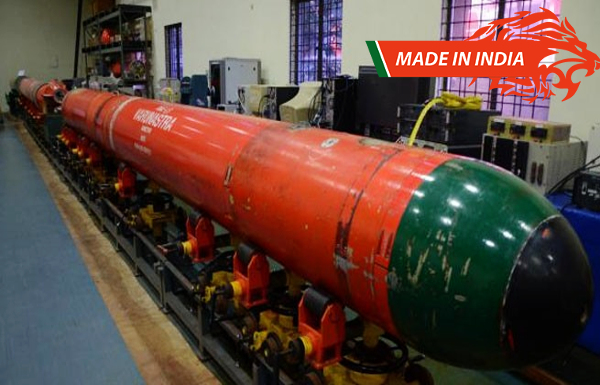
Indian naval torpedo warfare has matured into a layered architecture built around mission geometry, launch platform, seeker logic, propulsion philosophy, and battlespace depth. In practical terms, the fleet now fields an indigenous ship-launched heavyweight weapon in Varunastra, an indigenous lightweight anti-submarine torpedo for ships, helicopters, and fixed-wing aircraft, an imported Mk 54 airborne line for long-range maritime patrol and shipborne helicopter operations, and a legacy support ecosystem that still services earlier foreign-origin torpedo families. A further transition is now visible in the submarine arm, where a new wire-guided heavyweight stream is moving into focus for conventional boats. That mix gives the Indian Navy multiple kill chains against submarines across blue water, littoral waters, and aviation-led prosecution envelopes.
Varunastra sits at the centre of the indigenous heavyweight segment. DRDO describes it as a ship-launched, electrically propelled heavyweight anti-submarine torpedo designed to engage quiet submarines in deep and shallow waters under intense countermeasure conditions, and records its induction into Indian Navy service in 2016. BDL’s current product page places the weapon at 7.780 m length and 533.4 mm diameter, with quoted speeds of 27 and 40 knots, an operating-depth envelope of 8 to 600 m, and combat weight of about 1850 kg. The same page highlights its wide-look-angle acoustic homing, advanced counter-countermeasure features, multiple signal tracking, and autonomous guidance algorithms. DRDO’s 2025 export compendium adds several deeper technical markers: a 250 kW CRDC motor, silver-zinc battery, insensitive munitions warhead, and a depth figure in the 500 m band. Taken together, these details place Varunastra in the class of modern electric heavyweight torpedoes optimized for acoustic search, endurance, and terminal lethality rather than brute-speed alone.
What gives Varunastra extra operational weight is the way it fits the surface fleet. The 2016 induction note stated that the weapon could be fired from Rajput-class destroyers, Delhi-class destroyers, and future ASW ships configured for heavyweight torpedo launch. Later official records show that the Navy kept pushing the weapon forward after induction. In June 2023, Indian Navy carried out a live-warhead firing of Varunastra against an undersea target, an event DRDO described as a first-of-its-kind demonstration in the country and perhaps beyond. In March 2025, the Defence Acquisition Council cleared procurement of additional Varunastra Torpedoes (Combat), showing that the weapon has moved beyond technology demonstration into wider fleet stocking. In technical force-structure terms, that matters because a surface combatant armed with heavyweight torpedoes can prosecute a contact after sonar localization with a far larger payload and deeper-water attack geometry than the lightweight class usually offers.
The indigenous Advanced Light Weight Torpedo, produced by BDL as TAL, occupies a very different niche. This weapon is a 324 mm class lightweight torpedo built for launch from ships, helicopters, and fixed-wing aircraft. BDL lists a length of 2752 mm, warshot weight of 220 kg, maximum speed of 33 knots, endurance of 6 minutes, and an operating-depth window from 10 m to 450 m. DRDO’s export compendium places the same family in the 40–42 kg explosive band with electrical propulsion and sea-water-activated battery architecture. Operationally, that means a compact torpedo intended for rapid local prosecution after a sonar, dunking sonar, sonobuoy, or cueing chain has already boxed the target. Its mission set is explicitly anti-submarine, and the Defence Acquisition Council’s October 2025 approval note adds a key combat descriptor by stating that the ALWT is designed to engage conventional, nuclear, and midget submarines.
This lightweight line is already feeding directly into new ASW [ Anti Submarine Warfare ] platforms. The Arnala-class ASW Shallow Water Craft has official confirmation for embarkation of lightweight torpedoes alongside ASW rockets and shallow-water sonar, which means the Navy’s littoral hunter-killer craft will carry a compact underwater punch tailored for coastal surveillance and search-and-attack missions. A second technical jump comes from SMART—the Supersonic Missile-Assisted Release of Torpedo system. DRDO’s 2024 flight-test note states that SMART carries an advanced light-weight torpedo as payload with a parachute-based release system, extending torpedo delivery far beyond the range of a conventional ship or helicopter drop. In effect, ALWT serves two geometries inside Indian naval doctrine: classic short-range terminal prosecution from ships and helicopters, and a much larger standoff engagement envelope when paired with SMART.
Alongside the indigenous lines, the Navy also fields the imported Mk 54 lightweight torpedo in its airborne ASW chain. U.S. DSCA records show a 2011 case for 32 Mk-54 all-up-round torpedoes for the Indian Navy’s P-8I maritime patrol aircraft, followed by a 2020 case for 16 additional Mk 54 all-up-round torpedoes plus 3 exercise torpedoes for the same aircraft. The MH-60R helicopter package included 30 Mk 54 torpedoes, and a 2024 DSCA case approved 53 additional Mk 54 Mod 0 torpedoes to expand the anti-submarine stockpile for the Romeo fleet. Technically, that gives India a two-tier airborne torpedo architecture: the P-8I for broad-area search, localization, and attack over long oceanic distances, and the MH-60R for shipborne, mobile, close-in prosecution in support of carrier groups, surface action groups, and independent frigate or destroyer operations.
A deeper look at official indigenisation documents also shows that Indian naval underwater armament still carries a multi-origin legacy layer. The Swavlamban 2.0 list published by the Department of Defence Production includes support and indigenisation items for SUT torpedo exploder components, A244S Mod 0 torpedo electronic-rack PCBs, and TEST-71ME torpedo towed reels. That set of references points to a sustainment ecosystem that still supports German, Italian, and Russian torpedo families inside the broader naval inventory. From a technical-management perspective, this matters because launcher standards, test equipment, cable reels, battery sections, exploder logic, and fire-control interfaces demand separate maintenance philosophies. India’s current underwater weapon posture therefore combines front-line indigenous growth with a sustained engineering effort around legacy imported lines.
The next decisive shift lies in the submarine-centric heavyweight stream. DRDO’s February 2026 newsletter states that its Bharat Parv tableau for combat submarines displayed an Integrated Combat Suite, Wire Guided Heavy Weight Torpedo (WGHWT), and Air Independent Propulsion as a combined underwater technology stack for Indian Navy conventional submarines. That public pairing is strategically revealing. A wire-guided heavyweight torpedo gives the submarine command team mid-course control, deeper tactical flexibility, and better synergy with onboard combat management logic. Parallel to that, the Defence Acquisition Council in February 2024 cleared procurement of Heavy Weight Torpedoes for Kalvari-class submarines, a move intended to sharpen the attack capability of the Scorpene line. The broad direction is clear: Indian surface combatants are consolidating around Varunastra, aviation assets are strengthening the Mk 54 and ALWT branches, and the submarine force is moving toward a more modern heavyweight torpedo architecture tightly coupled with indigenous combat systems and underwater endurance technologies.
In pure technical terms, the Indian Navy’s torpedo story is about a carefully distributed underwater strike ecosystem. Varunastra provides heavy acoustic punch from surface combatants. ALWT/TAL brings a compact, flexible kill vehicle for ships, helicopters, fixed-wing aircraft, and missile-assisted delivery. Mk 54 gives the Navy a mature airborne ASW round already integrated into the P-8I and MH-60R force structure. Legacy lines such as SUT, A244S, and TEST-71ME remain part of the sustainment map. The coming wire-guided heavyweight line for submarines could complete the next stage of Indian underwater weapon integration. That architecture gives the fleet reach, depth, platform flexibility, and a steadily rising indigenous share in one of naval warfare’s most demanding domains.
Reference:
DRDO Varunastra
https://www.drdo.gov.in/drdo/en/offerings/products/varunastra
BDL Varunastra
https://bdl-india.in/en/varunastra
BDL TAL
https://bdl-india.in/en/tal
DRDO Products for Export 2025
https://www.drdo.gov.in/drdo/sites/default/files/schemes_services/CompendiumProductforExport2025.pdf
PIB — RM Hands Over Varunastra Torpedo to Indian Navy
https://www.pib.gov.in/newsite/printrelease.aspx?relid=146647
PIB — DRDO celebrates 66th Foundation Day
https://www.pib.gov.in/PressReleseDetailm.aspx?PRID=1992193
PIB — DAC clears capital acquisition proposals worth over Rs 54,000 crore
https://www.pib.gov.in/PressReleaseIframePage.aspx?PRID=2113268
PIB — DAC clears proposals worth about Rs 79,000 crore
https://www.pib.gov.in/PressReleseDetailm.aspx?PRID=2181814
PIB — SMART flight test
https://www.pib.gov.in/PressReleasePage.aspx?PRID=2019266
PIB — Commissioning of INS Arnala
https://www.pib.gov.in/PressReleasePage.aspx?PRID=2137224
DSCA — India MK-54 Lightweight Torpedoes, 2011
https://media.defense.gov/2024/Dec/11/2003607945/-1/-1/0/INDIA_11-15_0.PDF
DSCA — India MK 54 Lightweight Torpedoes, 2020
https://media.defense.gov/2024/Dec/11/2003607936/-1/-1/0/INDIA_20-08.PDF
DSCA — India MH-60R Multi-Mission Helicopters
https://media.defense.gov/2024/Dec/11/2003607943/-1/-1/0/INDIA_19-15.PDF
DSCA — India MK 54 MOD 0 Lightweight Torpedoes, 2024
https://media.defense.gov/2024/Dec/11/2003607959/-1/-1/0/PRESS%20RELEASE%20-%20INDIA%2024-101%20CN.PDF
DRDO Newsletter February 2026
https://drdo.gov.in/drdo/sites/default/files/publication-document/NL_Feb2026.pdf
Swavlamban 2.0
https://www.ddpmod.gov.in/sites/default/files/2024-08/swavlamban-2.0_0_0.pdf
You may also like
-
India’s Indigenous Sonar Ecosystem Powers New Generation of Indian Navy Warships
-
Murshidabad Becomes First West Bengal District to Complete Land Handover for India-Bangladesh Border Fencing
-
India’s LR-AShM Family Could Reach 3,500 Km as DRDO Develops Extended-Range Hypersonic Variants
-
Indian Composite Manufacturing Gets BrahMos Boost With ₹60-Crore Order to Allen Reinforced Plastics
-
HAL-Samtel Opens New Gurugram Facility to Expand Indigenous Defence Avionics and Display Manufacturing
