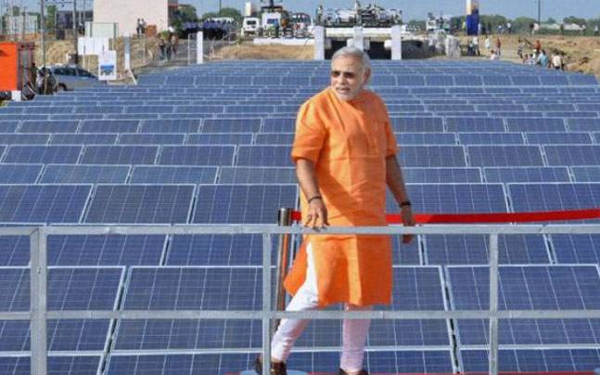
India’s clean-energy transition has entered a new phase of scale. The country has now emerged as the world’s third-largest solar power producer, with cumulative installed solar capacity reaching 143.6 GW as of February 2026, underlining both the speed and depth of its renewable-energy buildout. The achievement comes alongside a rapid rise in rooftop solar adoption under the PM Surya Ghar: Muft Bijli Yojana, which has crossed three million household installations, turning distributed solar into one of the most visible faces of India’s energy transition.
The broader momentum is being driven by record annual additions. According to JMK Research, India added 37.8 GW of new solar capacity in calendar year 2025, including 28.6 GW of utility-scale solar, 7.9 GW of rooftop solar, and 1.35 GW of off-grid systems. That pace has significantly widened India’s solar base and strengthened its position in the global renewable-energy rankings. The government has also highlighted that India’s total installed power capacity crossed 500 GW in September 2025, with non-fossil fuel sources contributing more than half of total installed capacity, a milestone that gives solar growth added strategic significance in the country’s longer-term decarbonisation pathway.
What makes this phase particularly important is the rising role of households. The PM Surya Ghar: Muft Bijli Yojana, launched with a total outlay of ₹75,021 crore, aims to support rooftop solar for one crore households by FY2027. Official data released by the government in March 2026 showed rooftop solar capacity additions of 9.56 GW by March 2026, with the scheme accelerating residential adoption across states. Earlier official data had already shown more than 20.85 lakh rooftop systems installed and over 26 lakh households benefited till December 2025, with subsidy disbursal crossing ₹14,771 crore. The crossing of the three-million-installation mark therefore signals that the scheme has moved from early rollout into genuine mass uptake.
This rooftop push is reshaping the energy conversation beyond utility-scale generation. For many households, solar is no longer only about sustainability; it is increasingly about electricity savings, backup resilience, and protection against tariff pressures. That has boosted demand for rooftop systems paired with inverters, battery backup, and hybrid configurations that can continue supplying power during outages. In effect, India’s solar journey is beginning to shift from a grid-level capacity story to a consumer-energy story, where households and small businesses are becoming active participants in generation rather than passive users of electricity.
Policy support is reinforcing that shift. In the Union Budget 2026-27, the allocation for the Ministry of New and Renewable Energy was increased sharply, with a large share directed toward rooftop solar expansion under PM Surya Ghar. The budget also extended customs duty exemptions on select capital goods for battery energy storage systems, signalling that policymakers are no longer treating generation and storage as separate silos. That is important because the next stage of solar growth will depend not just on capacity additions, but on the ability to integrate variable renewable energy more effectively into homes, businesses and the wider grid.
The industrial side of the story is equally significant. Government fact sheets released in 2025 noted a sharp increase in domestic solar manufacturing capacity, with module manufacturing expanding strongly over the previous year. That matters for two reasons. First, it supports India’s effort to reduce import dependence in a strategically important sector. Second, it aligns with a broader industrial policy push that sees renewable energy not only as a climate imperative, but also as a manufacturing, jobs and supply-chain opportunity.
Looking ahead, the growth curve remains steep. JMK Research projects that India could add around 42.5 GW of new solar capacity in 2026, including 32.5 GW utility-scale, 8.5 GW rooftop, and 1.5 GW off-grid. If that trajectory holds, India’s solar expansion will increasingly be judged not merely by gigawatt numbers, but by how effectively the country can combine utility-scale generation, rooftop adoption, storage systems, manufacturing capacity, and grid integration into a coherent clean-energy ecosystem.
In strategic terms, that is the larger story. India’s rise to the third position in global solar production is not just a ranking milestone. It reflects the emergence of solar power as a central pillar of national energy security, industrial policy and household economics. With rooftop adoption gathering speed and utility-scale additions continuing at record levels, solar is no longer a supplementary component of India’s power mix. It is becoming one of its defining engines.
Reference:
https://www.tribuneindia.com/news/india-becomes-worlds-third-largest-solar-producer-as-pm-surya-ghar-crosses-three-million-household-installations/
https://mnre.gov.in/en/physical-progress/
https://www.pib.gov.in/PressReleasePage.aspx?PRID=2245159
https://www.pib.gov.in/PressReleasePage.aspx?PRID=2222476
https://www.pib.gov.in/PressReleasePage.aspx?PRID=2199729
https://www.pib.gov.in/PressNoteDetails.aspx?ModuleId=3&NoteId=155063&id=155063
https://jmkresearch.com/wp-content/uploads/2026/03/Q4-2025-RE-Report-Oct-Dec_JMK-Research.pdf
https://jmkresearch.com/renewable-sector-published-reports/q4-2025-oct-dec-india-re-update/
https://www.pv-magazine-india.com/2026/02/27/india-expected-to-install-about-42-5-gw-of-new-solar-capacity-in-2026-jmk-research/
You may also like
-
India’s Indigenous Sonar Ecosystem Powers New Generation of Indian Navy Warships
-
Murshidabad Becomes First West Bengal District to Complete Land Handover for India-Bangladesh Border Fencing
-
India’s LR-AShM Family Could Reach 3,500 Km as DRDO Develops Extended-Range Hypersonic Variants
-
Indian Composite Manufacturing Gets BrahMos Boost With ₹60-Crore Order to Allen Reinforced Plastics
-
HAL-Samtel Opens New Gurugram Facility to Expand Indigenous Defence Avionics and Display Manufacturing
