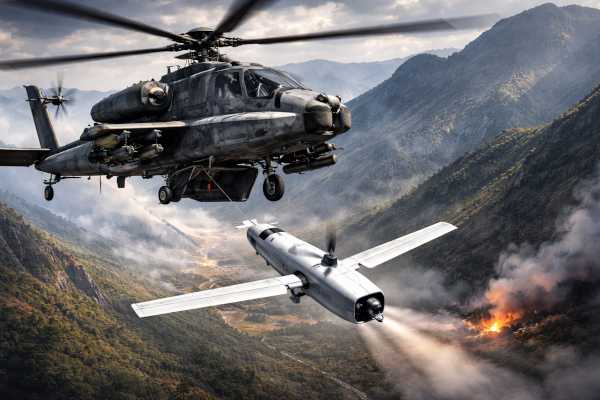
The Indian Air Force has moved to develop an indigenous air-launched drone system called Vayu Baan, a project that signals a notable shift in how India may use rotary-wing platforms in future combat. Rather than relying only on onboard guns, rockets or missiles, the concept behind Vayu Baan is to let a helicopter release a compact autonomous drone in flight, which can then continue toward a target area for surveillance, target confirmation or terminal attack. The strongest official evidence for the programme comes from a March 2026 tender-linked RFP issued through GeM under the IAF’s Regional Aerospace Innovation Division, which describes it as the “design and development of helicopter dropped targeting drone (VAYU-BAAN).”
At a doctrinal level, Vayu Baan appears designed to give helicopters a stand-off edge in contested environments. Instead of pushing the manned platform deep into dangerous air-defence or small-arms envelopes, a crew could release the drone from safer distance and use it to search, identify, track or strike a target. That aligns with the broader military trend toward air-launched effects and distributed kill chains, where manned aircraft and expendable unmanned systems operate together rather than separately. An older Ministry of Defence release on India-US defence technology cooperation also noted a project agreement on an Air-Launched Unmanned Aerial Vehicle, showing that the idea of air-launched unmanned systems has already featured in India’s defence technology discussions.
The open-source technical picture is unusually detailed because the RFP itself lays out the desired performance envelope. According to the document, Vayu Baan is being envisioned as an electric-powered drone with a payload capacity above 500–1000 grams, a minimum control range of over 10 km, and an autonomous range of more than 50 km with 30 minutes endurance. The same requirement also refers to an 80 km reach with 15 minutes endurance, suggesting the IAF is willing to trade persistence for reach depending on payload and mission profile. The specified launch altitude and operational altitude both run from 150 feet to 8,000 feet, indicating the system is intended for flexible use from low-level tactical flight up to higher release profiles.
Its mission design points clearly to a hybrid ISR-strike role. The drone is expected to carry an EO/IR payload capable of live video transmission and recording, while also supporting pre-designated surveillance and target destruction missions. The RFP further calls for target designation through GPS-based methods, AI-based target identification, and live surveillance inputs. That makes Vayu Baan more than a simple loitering munition concept; the IAF appears to be asking for a compact airborne system that can find, confirm and, when required, attack.
The strike requirement is especially noteworthy. The RFP says the system should be able to carry at least a 500-gram warhead for attack missions, and it also mentions the ability to carry a 57 mm or 80 mm rocket, though rocket supply itself is not part of the initial package. That opens the possibility that Vayu Baan could evolve either as a direct one-way attack drone or as a compact precision delivery platform for existing battlefield munitions. If that integration path matures, it would give Indian attack helicopters a new layer of flexible firepower between conventional rockets and larger dedicated missiles. This is still an inference from the requirement set rather than a declared operational doctrine, but the RFP wording clearly points in that direction.
Just as important are the survivability and networking requirements. The IAF wants the drone to retain functionality in GNSS-denied conditions, resist jamming and GPS spoofing, and use an anti-jam secure real-time datalink with minimum AES-256 encryption. The document also calls for operation in a selectable non-ISM frequency band, which is another sign that the system is being designed for real battlefield conditions rather than permissive test environments. In practical terms, this suggests Vayu Baan is meant for use in an electronically contested battlespace, where navigation interference and datalink disruption are expected risks.
The control concept is also tactically significant. The RFP specifies that the system should be controllable by both an aerial platform and a ground system, with separate portable airborne and ground control stations. That means a helicopter crew could launch and initially supervise the drone, while ground operators could also receive telemetry, control inputs and video feeds. In battlefield terms, that creates room for cooperative employment: the aircraft becomes the launch node, while control and exploitation of the drone’s feed can be shared more widely.
The initial procurement scale suggests Vayu Baan is still at a prototype or user-evaluation stage rather than full operational induction. The tender-linked requirement covers 10 drones, two airborne control stations, two ground control systems, EO/IR payloads, warhead payloads, ballast equivalents and dummy 80 mm rocket rounds for integration and testing. Media reports describing the programme as India’s first helicopter-dropped drone initiative match the broad shape of the RFP, but the procurement document remains the most authoritative source for what the IAF is actually asking industry to build.
The RFP outlines a fast development arc running from documentation and design submission to AI target-identification work, electronic-resilience measures, helicopter drop testing, payload trials and high-altitude mission testing within roughly 12 months. That pace suggests the IAF is treating Vayu Baan as a near-term capability experiment with operational potential. If the programme progresses smoothly, it could become one of the more interesting indigenous examples of India blending manned aviation, autonomous systems and precision battlefield networking into a single tactical architecture.
In strategic terms, Vayu Baan hints at how India sees the next phase of air combat at the tactical edge. Helicopters operating near mountain fronts, hostile armour concentrations or fleeting battlefield targets often face a difficult trade-off between staying safe and getting close enough to act decisively. A helicopter-dropped autonomous drone offers a way to reduce that dilemma. It extends the sensor and strike arm of the launch platform, potentially lowers risk to aircrew, and fits neatly into the Indian military’s larger push for indigenous, networked and electronically resilient systems. Vayu Baan is still a programme under development, but even at this stage, it stands out as a serious marker of where Indian aerial warfare thinking is headed.
Key technical parameters in the open domain
- Type: Helicopter-dropped targeting drone / air-launched unmanned system.
- Launch modes envisaged: Helicopter drop, transport-aircraft drop, barrel launch from vehicle, pallet carriage.
- Propulsion: Electric.
- Payload capacity: More than 500–1000 grams.
- Control range: More than 10 km.
- Autonomous range/endurance: More than 50 km with 30 minutes endurance; alternate profile mentions 80 km with 15 minutes endurance.
- Altitude envelope: 150 ft to 8,000 ft for launch and operation.
- Payloads: EO/IR, live video, minimum 500 g warhead, possible 57/80 mm rocket integration.
- Electronic resilience: GNSS-denied navigation, anti-jam datalink, spoofing resistance, AES-256 minimum encryption.
- Initial package: 10 drones, 2 airborne control stations, 2 ground control systems.
Sources:
https://mod.gov.in/sites/default/files/Press%20Releases%20-%20October%202021_0.pdf
You may also like
-
Rolls-Royce Deepens India Engagement as Reliance Partnership Targets Indigenous AMCA Fighter Engine
-
Larsen & Toubro and Spain’s Navantia Partner to Develop Four Amphibious Assault Ships for Indian Navy
-
Gujarat’s Svaayatt Systems Proposes Nine-Drone Autonomous Swarm for Indian Armed Forces
-
EndureAir and Maraal Aerospace Partner to Develop Indigenous High-Altitude Pseudo-Satellite for India
-
Larsen & Toubro Selects Australian Orbital’s 350HFE Heavy-Fuel Engines for Indian Tactical UAV Programme
