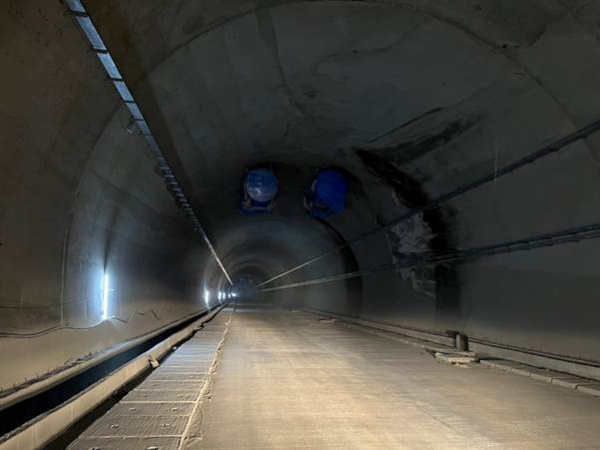
A major infrastructure transformation is nearing completion in Jammu and Kashmir, where the four-lane Digdol–Panthyal Twin Tube Tunnels on the Ramban–Banihal section of National Highway 44 are expected to significantly improve safety, reduce travel time, and strengthen year-round connectivity between the Kashmir Valley and the rest of India. According to the Ministry of Road Transport and Highways, the project has reached 87.2 percent of its planned construction and is being developed at a cost of ₹866.37 crore, making it one of the most important ongoing highway upgrades on this strategically vital Himalayan corridor.
For decades, the stretch between Ramban, Digdol and Panthyal had a dangerous reputation because of falling rocks, landslides, heavy rainfall and frequent traffic disruptions. The area, locally associated with the feared Khooni Nallah belt, often left commuters and truckers stranded for hours and sometimes even for days while debris was cleared and the road reopened. The new tunnel system is designed to bypass these landslide-prone and accident-prone stretches, replacing a hazardous mountain road with a safer and more reliable passage through the hills.
The project consists of twin tube tunnels in the Ramban–Banihal section, with the northbound tunnels measuring 2.6 km and 0.619 km, and the southbound tunnel measuring 3.08 km. These are being built as part of the broader four-laning of NH-44, the highway that serves as the principal road lifeline linking Jammu with Srinagar and beyond the Kashmir Valley. In geographical and strategic terms, this corridor is far more than a regional road: it is a critical civilian, commercial and security artery through one of the most difficult mountain terrains in the country.
The engineering challenge has been considerable. The tunnels are being constructed using the New Austrian Tunnelling Method (NATM), a technique widely used in complex geological conditions where flexibility and continuous monitoring are essential. Work began in 2022, and excavation has been carried out using a heading-and-benching approach to maintain stability and safety in fragile Himalayan rock formations. The method is particularly suited to this terrain, where slope instability, water ingress and changing geological conditions demand careful sequential excavation rather than a one-size-fits-all tunnelling process.
The practical benefits are already being felt by residents even before full completion. According to the official release, locals say journeys that once took long hours under uncertainty are now expected to shrink dramatically, with some sections becoming reachable in about five minutes. For daily commuters, schoolchildren, traders and emergency services, that kind of time reduction is not just a matter of convenience; it fundamentally changes how people live, study, work and access services in this mountainous region. The project is expected to reduce delays, improve predictability, and sharply cut exposure to road closures caused by weather or shooting stones.
The wider economic and strategic implications are equally significant. Faster and safer movement on the Jammu–Srinagar highway will directly benefit goods transporters, tourists, local residents and security agencies, while also lowering travel time and vehicle operating costs. Since the corridor is vital for the movement of supplies and personnel, the tunnel project is also expected to improve the speed and reliability of logistical support for the Army and other security forces, especially during emergencies or adverse weather conditions. In a region where terrain and climate often dictate mobility, all-weather connectivity has a direct bearing on both economic resilience and strategic readiness.
Once operational, the Digdol–Panthyal Twin Tube Tunnels are expected to become one of the most important safety upgrades on NH-44. By routing traffic away from exposed mountain slopes and into controlled tunnel infrastructure, the project is meant to reduce accidents, prevent long traffic snarls, and create a more dependable corridor through a section long regarded as one of the toughest on the Jammu–Srinagar route. With ₹866.37 crore invested and completion now well advanced at 87.2 percent, the project stands as a clear example of how transport infrastructure in the Himalayas can reshape everyday life, economic movement and national connectivity all at once.
Reference:PIB
You may also like
-
DoT and C-DOT to Establish End-to-End Optical Network Testbed for Indigenous Telecom Technologies
-
MTAR Technologies Wins ₹126.74 Crore NPCIL Order for Critical Nuclear Reactor Assemblies
-
India’s Small Reactor Ambition Expands From Industrial Power to Future Nuclear Shipping
-
India Begins ₹472-Crore T-72 and T-90 Tank Overhaul Facility at Jabalpur to Strengthen Armoured Readiness
-
Hindalco Brings Superfine PPT ATH Manufacturing to India With 30,000-Tonne Belagavi Plant
