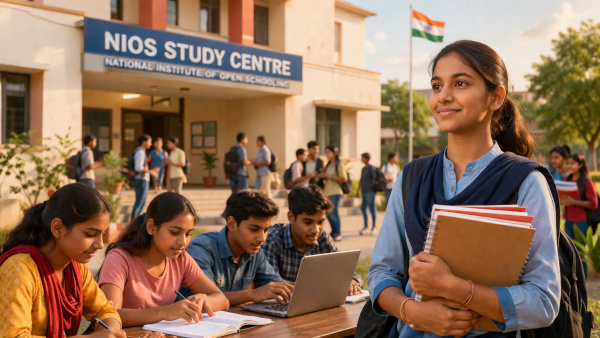
In a major push to bring more children back into education, the Department of School Education and Literacy (DoSEL) is strengthening India’s open schooling system through the National Institute of Open Schooling (NIOS). The move is part of the government’s wider effort to achieve a 100 percent Gross Enrolment Ratio (GER) from pre-school to secondary level by 2030, a target laid down in the National Education Policy (NEP) 2020.
The urgency behind the initiative is hard to ignore. According to the PIB release, nearly 2 crore children in the 14–18 age group are not attending school, around 11 percent of children in Classes 3 to 8 remain out of school, and more than 50 lakh students fail board examinations every year. These numbers underline a difficult reality: India has expanded access to schooling over the years, but a large number of children still slip through the cracks because of poverty, migration, social barriers, geography, family pressures, or academic setbacks.
That is where open schooling comes in. For many children, returning to a conventional classroom is not easy. Some have to work, some move frequently with migrant families, some live in remote areas, and others leave school after repeated exam failure or personal hardship. Open schooling offers a second pathway — one that is more flexible, less rigid, and often more realistic for those whose lives do not fit the standard school calendar. The government is now trying to use that pathway at scale.
At the centre of this effort is the National Institute of Open Schooling, an autonomous institution under the Ministry of Education and widely described by the government as the world’s largest open schooling board. NIOS allows learners to study through open and distance learning, offers flexible admission windows, gives multiple opportunities to clear examinations, runs an On-Demand Examination System, and provides vocational and skill-oriented courses in addition to academic programmes. Its certificates are recognised on par with those of other national and state boards, making it an important instrument for educational inclusion rather than merely a fallback option.
The policy logic behind the new drive is rooted in NEP 2020 itself. The policy explicitly calls for tracking children who are not in school, helping them re-enter the education system, and ensuring that they have suitable opportunities to catch up. It also set the ambitious goal of achieving 100 percent GER from preschool to secondary level by 2030. In that sense, this latest initiative is not just an administrative announcement; it is part of a larger structural attempt to make universal school participation a practical reality rather than a distant aspiration.
To make the enrolment drive work on the ground, the Ministry plans to rely on district-level survey data from states and Union Territories to identify and contact out-of-school and dropout children. NIOS officials will work with states and UTs to deepen institutional collaboration and build a more credible and accessible open schooling framework across the country. This matters because dropout is not a uniform national problem; it varies sharply by district, by income level, by gender, by social group, and by geography. A targeted response based on local data may prove more effective than a broad one-size-fits-all campaign.
One of the more notable features of the new plan is the rollout of the “NIOS Mitra” programme. This is being presented as a technology-enabled outreach initiative that will use trained facilitators to identify out-of-school children, counsel them, support their enrolment, and offer academic guidance. The stated focus will be on marginalised groups, including tribal communities, migrant children, minority groups, Divyang learners, and economically disadvantaged families. The programme is expected to function through a digitally monitored system to improve accountability and track outcomes more transparently.
The scale of the platform is also significant. According to the PIB release, NIOS already operates through more than 10,800 Study and Examination Centres across states and Union Territories. The government now wants to take this further by working with states and UTs to establish at least one NIOS Study and Examination Centre in every block. That is an important signal: this is not being treated as a limited urban or supplementary intervention, but as a nationwide infrastructure push aimed at last-mile access.
Several institutional steps have also been outlined to support this expansion. These include designating PM SHRI schools, Kendriya Vidyalayas, Navodaya Vidyalayas and government senior secondary schools as NIOS Study and Examination Centres; encouraging State Open School Boards to use government schools and recognised examination centres for NIOS exams; and promoting the idea of government senior secondary schools in every panchayat and municipality serving as NIOS centres. Put simply, the government appears to be trying to embed open schooling within the existing public education network instead of leaving it at the margins.
This is important for another reason too. In India, educational exclusion is often not just about initial access to school, but about continuity. A child may enrol in school at the right age and still fall out later because of financial stress, poor learning outcomes, caregiving responsibilities, migration, disability, or repeated exam failure. Open schooling cannot solve every structural problem, but it can serve as a crucial re-entry bridge for those who would otherwise remain permanently outside the system. That makes it especially relevant to the larger goals of equity, employability, and social mobility. The official description of NIOS also reflects this broader role, highlighting not only academic education but vocational, life-enrichment and community-oriented courses.
In the bigger picture, the success of this initiative will depend not only on enrolment numbers but on retention, learning support, exam preparedness, and recognition of the diverse realities children face. Getting a child back into the system is one step; helping that child stay, learn and complete schooling is the real challenge. But the present move clearly shows that the government sees open schooling as a central pillar in the journey toward universal school participation by 2030.
For India, the message is clear: if the country wants to reach every learner, it cannot rely only on the traditional classroom. It also needs flexible, credible, and inclusive alternatives for those whose lives have already been interrupted. In that sense, the strengthening of NIOS is not just an education reform story. It is also a story about second chances.
Source: PIB
You may also like
-
Mandapala and the Bird Family of Khandava — The Four Chicks Who Faced a Forest of Fire
-
NBEMS Announces Additional FMGE by October
-
Nahusha as a Python: When Bhima’s Strength Failed and Yudhishthira’s Wisdom Prevailed
-
IICT and Netflix Launch Scholarships for 100 Students to Build India’s Next Generation of AVGC-XR Talent
-
Bhima Meets Hanuman: When Strength Bowed Before Strength
