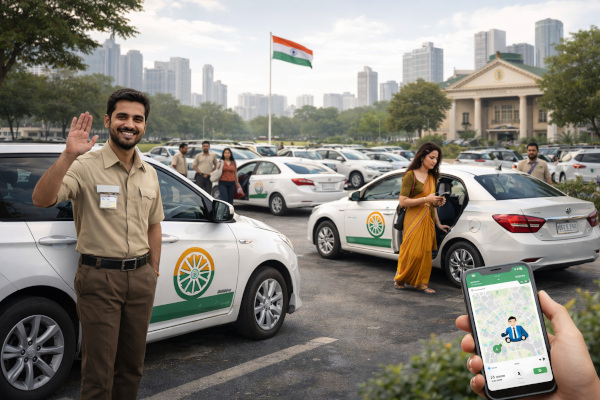
In a significant move that blends public policy, cooperative economics, and digital mobility, the Government of India has positioned Bharat Taxi as the country’s first cooperative-led ride-hailing platform, designed to place drivers—not investors or aggregators—at the heart of ownership and value creation. The initiative, backed by the Ministry of Cooperation, is being presented as a practical expression of the larger vision of “Sahkar se Samriddhi”, where cooperative institutions become engines of employment, dignity, and grassroots prosperity.
What makes Bharat Taxi stand out is its attempt to fundamentally alter the familiar ride-hailing model. Instead of treating drivers merely as “driver-partners,” the platform adopts a “Sarathi-owner” framework. Under this structure, drivers can become members and owners of the cooperative society, gain representation in its Board of Management, and participate in profit sharing. The platform also operates on a zero-commission model, which the government says is intended to offer a more sustainable and dignified alternative to investment-driven aggregator systems.
Bharat Taxi was established on 6 June 2025 under the Multi-State Cooperative Societies Act, 2002, with support from eight national-level cooperative institutions, and it was officially launched on 5 February 2026. At the time of launch, Union Home and Cooperation Minister Amit Shah described it as a major experiment in bringing cooperative ownership into the transport sector, arguing that it could become an important welfare platform for taxi drivers across India in the coming years.
From a user perspective, the platform is being built to compete not merely on ideology but also on functionality. According to the government, Bharat Taxi offers a transparent fare structure, a mobile app-based booking interface, real-time vehicle tracking, multilingual support, and 24/7 customer care. These features are meant to make the cooperative model viable in a market where convenience, pricing clarity, and safety are crucial.
A notable social inclusion component is the “Sarthi Didi” feature, aimed at encouraging women’s participation as drivers while also improving safety choices for women passengers. The feature allows women to opt for women-driven taxi services and is supported by safety tools such as SOS support, live location tracking, and round-the-clock assistance. In policy terms, this adds an important gender dimension to what might otherwise have remained only an economic reform in the gig-mobility sector.
At present, Bharat Taxi is operational in Delhi NCR—including Delhi, Gurugram, Noida, Faridabad, and Ghaziabad—as well as in parts of Gujarat, including Ahmedabad, Rajkot, Somnath, and Dwarka. The government says the rollout will expand in phases over the next three years, with a stated aim of moving into Tier 2 and Tier 3 cities and eventually extending services down to the tehsil level.
The early numbers suggest that the platform is trying to scale quickly. As of 1 March 2026, Bharat Taxi had 21.34 lakh registered users and 2.31 lakh registered Sarathis, according to a written reply by Amit Shah in the Lok Sabha on 17 March 2026. Earlier official communication from February also indicated that the platform had already begun attracting a substantial customer and driver base soon after launch, showing that the cooperative model is at least gaining early traction in the market.
Perhaps the most interesting question is whether Bharat Taxi can do more than just exist as a symbolic alternative. If it succeeds, it could become one of the rare examples of a digital platform in India where workers are not merely service providers but economic stakeholders. That would make it more than a taxi app—it would become a test case for whether the cooperative movement can adapt to the platform economy and offer a viable, Indian answer to global aggregator models.
Source: PIB
You may also like
-
Tata Power Renewables Commissions 72.5 MW Solar Project in Rajasthan to Support Tata Steel’s Decarbonisation
-
NTPC Targets 244 GW by 2037 With ₹16.86-Lakh-Crore Expansion Across India’s Energy Sector
-
UPI Completes a Decade as Transaction Value Surges More Than 4,000-Fold
-
AGNIT Semiconductors: Building India’s Gallium-Nitride Chip Capability for Radar, Communications and Power Electronics
-
India and Canada Target Comprehensive Trade Agreement by End of 2026
