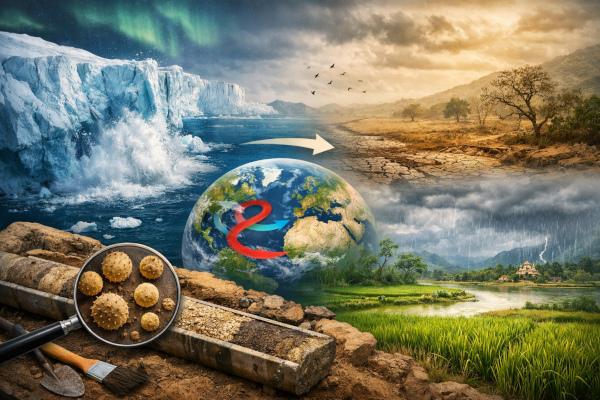
A dramatic cooling event in Greenland around 8,200 years ago appears to have weakened the Indian summer monsoon, according to new research conducted by Indian scientists. The findings highlight how climatic disturbances in one part of the world can influence weather patterns thousands of kilometres away.
The study was carried out by researchers from the Birbal Sahni Institute of Palaeosciences (BSIP), an autonomous institute under India’s Department of Science and Technology (DST). Their research provides new evidence that abrupt climate shifts in the North Atlantic region were capable of altering rainfall patterns across the Indian subcontinent during the early Holocene period.
The 8.2 Thousand-Year Cooling Event
Scientists refer to this phenomenon as the “8.2 ka cooling event,” one of the most significant climatic disturbances during the Holocene epoch, which began roughly 11,700 years ago after the last Ice Age.
During this period, temperatures in Greenland dropped by about 3°C, while atmospheric methane levels declined by approximately 80 parts per billion by volume (ppbv). These changes indicate a major disruption in the Earth’s hydrological cycle.
Researchers believe the cooling was triggered by a massive glacial outburst flood. Large volumes of freshwater from the prehistoric Lake Agassiz in North America flowed into the North Atlantic Ocean through Hudson Bay. This sudden influx of freshwater disrupted ocean circulation patterns, which in turn altered global climate systems.
Evidence Found in Central India
To understand how this event affected the Indian monsoon, the research team analysed sediment samples from Tuman Lake in Korba District, Chhattisgarh, located in the Core Monsoon Zone (CMZ) of India.
The scientists extracted a 1.2-metre-long sediment core from the lake bed. Within these sediments, they examined fossilised pollen grains that had accumulated over thousands of years.
Pollen analysis is a powerful tool in palaeoclimate research because each plant species produces distinctive pollen shapes. By identifying and counting around 300 terrestrial pollen grains per sample, scientists can reconstruct ancient vegetation patterns. Since vegetation is closely linked to rainfall and temperature, this method allows researchers to infer past climate conditions with remarkable precision.
Reconstructing Ancient Monsoon Patterns
The study revealed that tropical moist deciduous forest pollen increased during periods of strong monsoon rainfall, while drier deciduous and herbaceous pollen dominated during weaker monsoon phases.
By analysing these pollen patterns and combining them with radiocarbon dating and statistical age-depth modelling, the researchers reconstructed a detailed climate record spanning more than 8,200 years.
Their analysis clearly showed a distinct weakening of the Indian summer monsoon during the 8.2 ka cooling interval.
A Global Climate Connection
The findings suggest the existence of a powerful teleconnection—a climate link between distant regions of the planet.
Cooling in Greenland likely disrupted Atlantic Ocean circulation systems, which altered atmospheric circulation patterns and shifted global wind belts. These changes ultimately weakened the monsoon system across parts of the Northern Hemisphere, including India.
The results also align with other geological and climate records from India, including:
- Oxygen isotope data from Riwasa Lake in northwest India
- Speleothem (cave mineral) records from Kotumsar Cave in Chhattisgarh
- Sediment records from the Kanwar wetland
Together, these independent records strengthen the conclusion that the 8.2 ka event had widespread climatic impacts across the Indian subcontinent.
Implications for Understanding Climate Systems
The research underscores the sensitivity of the Indian Summer Monsoon, one of the world’s most important climate systems that supports agriculture and water resources for over a billion people.
Even thousands of years ago, the monsoon appears to have been strongly influenced by high-latitude ocean changes in the North Atlantic as well as tropical Pacific climate variability.
Understanding these ancient climate interactions can help scientists better predict how modern climate change might affect future monsoon patterns.
Publication link: https://doi.org/10.1016/j.quaint.2025.110103
Reference: PIB
You may also like
-
Indian Researchers Study RAD51 DNA-Repair Gene Variant in Prostate Cancer
-
TDB Backs Multi Nano Sense With ₹37.51 Crore to Build Indigenous Multi-Gas Sensor Platform
-
IISER Berhampur and NIT Rourkela Researchers Explore Cotarnine Derivatives for Wound Healing and Biomedical Applications
-
IISER Tirupati Develops pH-Responsive DNA Nanostructures for Controlled Drug Delivery
-
India and France Expand Space Cooperation Into Human Spaceflight, TRISHNA and Start-up Ecosystem
