
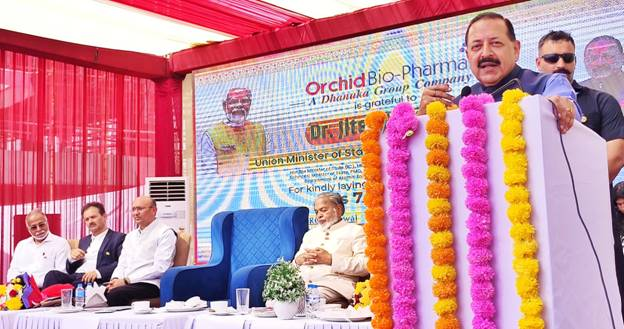
Union Minister of State (Independent Charge) for Science & Technology, Earth Sciences and several other key portfolios, Jitendra Singh on Friday laid the foundation stone for a major multinational pharmaceutical manufacturing facility in the town of Kathua in the Union Territory of Jammu and Kashmir. The new facility, being established at Village Gadadhar with an estimated investment of ₹600–700 crore, marks one of the most significant pharmaceutical investments in the region in recent years.
The project is being developed by Orchid Pharma with facilitation support from the Biotechnology Industry Research Assistance Council (BIRAC), which operates under the Department of Biotechnology, Government of India. The initiative is being supported through the Government’s Production Linked Incentive (PLI) scheme aimed at strengthening domestic manufacturing capacity in critical sectors.
Addressing the gathering at the foundation ceremony, Singh said the scale of investment reflects growing industry confidence in the region’s industrial ecosystem. According to him, the project is expected to generate direct employment for around 400 people, while creating a similar number of indirect jobs across logistics, suppliers and ancillary services.
The Minister noted that Kathua’s rapidly developing industrial infrastructure positions it well to emerge as an important node in India’s pharmaceutical manufacturing network. With new investments flowing into the sector, the district could soon find a place on India’s expanding pharmaceutical export map.
Singh described the facility as a major breakthrough for the pharmaceutical sector in the region. The plant will manufacture Amino Cephalosporanic Acid (ACA), a crucial intermediate used in the production of cephalosporin antibiotics—one of the most widely used classes of antibiotics globally.
At present, India relies heavily on imports of this critical intermediate, largely sourced from China. Such dependence, the Minister noted, creates vulnerabilities in supply security, pricing stability and healthcare access. By establishing domestic manufacturing capability for ACA, the Kathua facility is expected to significantly strengthen India’s strategic pharmaceutical capacity and reduce reliance on overseas suppliers.
“Antibiotics are foundational to modern healthcare,” Singh said, adding that the global disruptions witnessed during the pandemic clearly demonstrated how dependence on a single geography for essential pharmaceutical inputs can quickly turn into a national vulnerability.
He further linked the initiative to the broader vision of Prime Minister Narendra Modi to build a self-reliant India in critical healthcare technologies and pharmaceutical supply chains. Singh also highlighted the recently announced ₹10,000-crore “Biopharma Shakti” initiative introduced in the Union Budget, which seeks to accelerate the growth of India’s biotechnology and biopharmaceutical ecosystem.
India, he noted, is steadily emerging as a major player in the global biotechnology and pharmaceutical landscape. The country currently ranks third in biomanufacturing in the Asia-Pacific region and 30th globally. Establishment of advanced pharmaceutical manufacturing units such as the one in Kathua could further strengthen India’s position as a reliable global supplier of medicines.
Singh emphasized that the project represents India’s move toward climbing higher in the pharmaceutical value chain. Beyond simply manufacturing finished drugs, the focus is now on producing critical intermediates and complex ingredients domestically—an important step toward strengthening the country’s health security and supply resilience.
“Such initiatives are not merely about reducing imports,” he said. “They represent a long-term strategy to build strategic capability where it matters most.”
The Minister also stressed that bringing advanced pharmaceutical manufacturing to regions such as Jammu & Kashmir signals a new development model—one centered on knowledge-driven industries, skill development and high-value employment opportunities. Projects like the Kathua facility help integrate emerging regions into India’s broader growth story by linking them to advanced manufacturing ecosystems.
The new facility is also expected to strengthen India’s ability to ensure the availability and affordability of essential medicines, even during periods of global disruption.
Speaking on the occasion, Rajesh Gokhale, Secretary of the Department of Biotechnology, said the country’s growing bioeconomy plays a critical role in strengthening both scientific capability and economic resilience. He noted that science-led biomanufacturing initiatives such as the Kathua project demonstrate how India is building the capacity to compete strongly in global biotechnology and advanced manufacturing sectors.
Several senior officials and industry leaders attended the ceremony, including Jitendra Kumar, Managing Director of BIRAC; Ram Gopal Agarwal, Chairman of Dhanuka Group; Manish Dhanuka, Managing Director of Orchid Biopharma; and Rajesh Sharma, Deputy Commissioner of Kathua.
The Kathua facility is being developed by Orchid Bio Pharma, one of the world’s largest manufacturers of cephalosporin antibiotics. The company operates in more than 60 countries and serves over 200 global customers through international partnerships. Once operational, the new plant is expected to significantly enhance India’s pharmaceutical manufacturing capabilities while reinforcing the country’s role as a trusted supplier of essential medicines worldwide.
Source:
You may also like
-
PMAY-U Crosses One Crore Delivered Homes as Urban Housing Programme Expands
-
India Targets One Crore AI-Trained Youth as Semiconductor Ecosystem Expands
-
Lam Research Deepens India Semiconductor Push With ₹10,000-Crore Silicon Manufacturing and R&D Expansion
-
PM Vishwakarma Reaches 30-Lakh Artisan Registration Target as Scheme Completes Three Years
-
Oil India Turns to Advanced Technology to Unlock Historic Heavy-Oil Discovery North of Brahmaputra
