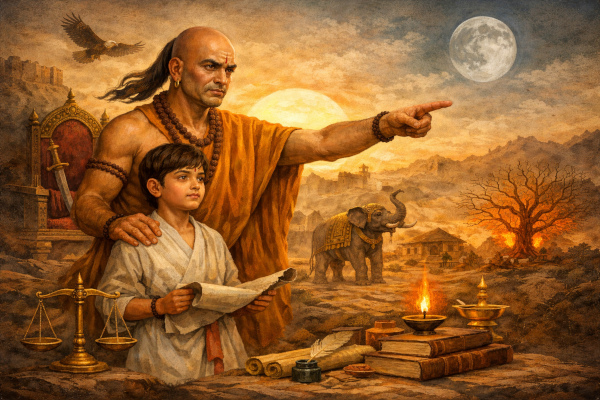
Chapter 3 of Chanakya Niti is like entering a chamber lined with the wisdom of centuries, where each verse is a polished gem—cut by the sharp blade of experience and set in the gold of unflinching truth. This chapter is not content with surface morality; it peers beneath the façade of human interactions to reveal the pulse of real intent. Chanakya speaks here as both philosopher and strategist, blending the serenity of moral law with the urgency of survival in an uncertain world.
The teachings traverse the full spectrum of life: from the private sphere of family bonds to the grand theatre of political maneuvering. We find counsel on how to read the hearts of men and women, the folly of judging worth by outward beauty, and the subtle power of aligning one’s actions with the tides of fortune and time. In these verses, virtue is not presented as a delicate ornament but as a sword—shining, decisive, and necessary for the defense of both dignity and destiny.
Chanakya warns of the inevitability of imperfection: no household is without its flaws, no life without its trials, and no man without his weaknesses. Yet, rather than despair, he offers pathways to rise above these limitations—whether through the discipline of children, the protection of alliances, or the measured handling of enemies. His words strike with the clarity of iron on stone, urging decisiveness in moments of threat and restraint in moments of temptation.
Here, moral beauty is given greater weight than mere physical charm, for wisdom without goodness is dangerous, and beauty without wisdom is empty. Excess, whether of virtue or vice, is cautioned against, for imbalance invites ruin. Even so, Chanakya reminds us that a single person of pure conduct and sharp intellect can redeem and elevate an entire lineage, becoming a beacon for generations to follow.
This is a chapter that does not flinch from reality—it walks unafraid into the complexities of human conduct, carrying in one hand the lamp of virtue and in the other, the shield of practicality. Its wisdom is as relevant to the household as to the state, as instructive to the modern professional as to the ancient king. In Chapter 3, Chanakya speaks to all who seek to navigate life with open eyes and steady hands, warning that survival and honor come not from wishful thinking, but from the marriage of clarity, courage, and timing.
Chapter 2 of Chanakya Niti continues the sage’s sharp, unapologetic exploration of human nature, relationships, and the moral compass necessary for stable personal and political life. With each verse, Chanakya blends practicality with timeless wisdom, offering blunt truths about behavior, loyalty, discipline, and survival.
This chapter reflects a deep understanding of how power, affection, deceit, and ambition interact in daily life. It warns against superficial appearances and emphasizes the need for discernment—be it in choosing friends, managing children, dealing with spouses, or maintaining secrecy in plans. Chanakya repeatedly advocates for discipline over indulgence, showing that unchecked affection, laziness, or misplaced trust can lead to destruction.
The verse on educating children and disciplining students reveals a belief in constructive sternness as a tool for cultivating strong character. Verses on friendship highlight the importance of sincerity and caution against sweet talkers with hidden malice. Others reflect on the pain of poverty, betrayal, humiliation, and misfortune—stating plainly how these can burn the spirit more than fire itself.
One of the most enduring themes in this chapter is the impermanence of life. Chanakya reminds us that beauty fades, wealth is fleeting, and even kings fall if devoid of strategy and wisdom. Yet he doesn’t advocate fatalism. Instead, he teaches resilience—urging individuals to choose their companions wisely, remain rooted in knowledge, and act with clear foresight.
Ultimately, Chapter 2 is not just a critique of human flaws—it’s a survival guide. It instructs readers to live with alertness, to place value on virtue over emotion, and to recognize the subtle dynamics that govern families, societies, and kingdoms. In Chanakya’s world, wisdom is not luxury—it is necessity, and ignorance is the greatest danger of all.
What is Chapter 3 About
In Chapter 3, Chanakya sharpens his focus on the dual art of self-preservation and purposeful living. His approach is neither rigid moralism nor cold opportunism; rather, it is the seamless weaving of both into a code that withstands the unpredictable turns of life. The verses pulse with the awareness that human dealings—whether within a family or across kingdoms—are arenas of constant negotiation, where intentions are not always visible and loyalty is rarely absolute. His warnings are not abstract ideals, but practical firewalls against betrayal, folly, and complacency.
Each teaching in this chapter is crafted like a tactical move on a chessboard—measured, deliberate, and with an eye on long-term consequences. Here, restraint is valued as much as action; knowing when not to act can be as decisive as striking at the right moment. Chanakya’s words carry an undercurrent of vigilance, urging the reader to keep both heart and mind engaged, for a lapse in either can be costly.
Underlying the counsel is a quiet but persistent recognition of legacy. Actions taken in the present are not isolated—they ripple forward, shaping the character of descendants and the fortunes of a household. Discipline in rearing the young, vigilance in choosing companions, and precision in forming alliances are not mere duties, but investments that can guard against the erosion of values and strength over generations.
The chapter does not shy away from the harsher truths of existence. It acknowledges that some threats cannot be reasoned with, only neutralized; that appearances often mask intent; and that survival sometimes demands an unflinching response. In this balance of compassion and calculation, Chanakya offers a living framework—one that can guide a sage in meditation, a merchant in negotiation, or a ruler in the midst of political storm.
Chapter 3- Sloka 1
कस्य दोषः कुले नास्ति व्याधिना को न पीडितः ।
व्यसनं केन न प्राप्तं कस्य सौख्यं निरन्तरम्॥ ०३-०१
Kasya doṣaḥ kule nāsti vyādhinā ko na pīḍitaḥ |
Vyasanaṁ kena na prāptaṁ kasya saukhyaṁ nirantaram || 3-1
Line 1
- कस्य (kasya) – whose
- दोषः (doṣaḥ) – fault, defect, flaw
- कुले (kule) – in a family, lineage
- नास्ति (nāsti) – does not exist
- व्याधिना (vyādhinā) – by disease, with illness
- कः (kaḥ) – who
- न (na) – not
- पीडितः (pīḍitaḥ) – afflicted, troubled
Line 2
- व्यसनं (vyasanaṁ) – calamity, misfortune, adversity
- केन (kena) – by whom
- न (na) – not
- प्राप्तं (prāptaṁ) – attained, experienced
- कस्य (kasya) – whose
- सौख्यं (saukhyam) – happiness, comfort
- निरन्तरम् (nirantaram) – unbroken, constant, continuous
Chanakya Says
कस्य दोषः कुले नास्ति (Kasya doṣaḥ kule nāsti)
“Whose family is free from faults?”
Chanakya begins with a rhetorical reflection that humbles the ego. Every family—no matter how noble, powerful, or virtuous—carries some stain, some burden, some imperfection. A lineage might be royal yet scarred by betrayal, saintly yet marred by pride. The question isn’t whether flaws exist, but whether we have the grace to acknowledge them. In every kula (family or clan), there’s a shadow beneath the lamp—a past mistake, a misdeed, or a silent grief. To deny this is to deny reality.
व्याधिना को न पीडितः (Vyādhinā ko na pīḍitaḥ)
“Who has not been afflicted by illness?”
Here, Chanakya touches on the most universal equalizer: suffering. No body is perfect. No life escapes pain. Disease—whether of the flesh, mind, or heart—visits everyone. Kings in silken robes and ascetics under trees have both groaned under fever. This truth breaks our illusion of invincibility and reminds us of our shared mortality. It teaches empathy, patience, and acceptance.
व्यसनं केन न प्राप्तं (Vyasanaṁ kena na prāptaṁ)
“Who has not faced misfortune?”
No soul walks untouched by calamity. Whether it’s the loss of a loved one, the ruin of wealth, the betrayal of trust, or the collapse of dreams—every life has tasted sorrow. Even avatars in epics—Rama, Krishna, Yudhishthira—were not spared. Life’s storms are not punishments, but passages. They forge character, chisel ego, and test resolve. Chanakya reminds us: don’t be arrogant in fortune, nor broken in loss—because both are part of the same wheel.
कस्य सौख्यं निरन्तरम् (Kasya saukhyaṁ nirantaram)
“Whose happiness is uninterrupted?”
Happiness is not a permanent state—it flickers, flows, and fades. It arrives in waves: brief, brilliant, and often unexpected. No one—no emperor, sage, or god—has lived in unbroken joy. Even the heavens have wars, and the wisest minds have restless nights. What matters is not uninterrupted bliss, but the ability to find peace amid chaos. The wisest don’t chase eternal joy—they build inner resilience.
“Whose family is free from faults? Who has never been afflicted by illness? Who has not faced misfortune? And whose happiness is uninterrupted forever?”
Explanation
In the ancient verse—“कस्य दोषः कुले नास्ति, व्याधिना को न पीडितः, व्यसनं केन न प्राप्तं, कस्य सौख्यं निरन्तरम्”—Chanakya strips down human pride with four simple questions that thunder with eternal truths. Whose lineage is without flaw? Who has never suffered illness? Who has not faced calamity? And who, in this shifting world, enjoys happiness without interruption?
These are not mere rhetorical musings. They are the foundations of wisdom—timeless observations that remain just as relevant in our modern age of diplomacy, geopolitics, and real-world struggle. In our daily lives, these lines are a salve for ego and a call for compassion. No one, regardless of wealth, status, or power, escapes the shadows of imperfection. Every family—however noble—has a secret stain. There are past betrayals buried under medals, whispered regrets behind titles. No body remains unaffected by illness. Be it mental, physical, or emotional—pain is the most democratic experience in existence. We see it in the tired eyes of a CEO and the trembling hands of a beggar. Misfortunes spare no one; they enter palaces and slums alike. A collapsed business, a broken relationship, a betrayal, or a sudden fall from grace—these are not exceptions, but the rule of life. And happiness? It comes, glows, and passes—like sunlight through forest leaves. No joy is eternal, no triumph permanent.
Chanakya’s insight echoes loudly in the corridors of international diplomacy. Nations, like individuals, carry the weight of past sins. No state can boast of a spotless record. Empires were built on conquest, revolutions bathed in blood, democracies emerged through struggle and compromise. When diplomats posture with moral righteousness, wise statesmen recall Chanakya’s voice: engage not on imagined purity, but on practical terms. Flawed nations must still cooperate. Allies must be chosen not for perfection, but shared interests. The United States, champion of liberal democracy, carries the scars of slavery, Vietnam, Iraq. China, rising superpower, has unleashed immense economic growth while battling internal repression. India, with its proud pluralism, still stumbles through communal tensions. No country is pure—and diplomacy cannot wait for sanctity.
Illness in this context becomes a metaphor for internal instability—recessions, corruption, political chaos, public health failures. During COVID-19, even the most powerful nations were brought to their knees. Italy’s hospitals overflowed, India gasped for oxygen, and the United States, for all its might, saw over a million lives lost. These moments remind us that the body politic, too, is vulnerable. Misfortunes strike in the form of terror attacks, market crashes, coups, famines. Sri Lanka’s financial implosion, Afghanistan’s collapse, the shockwaves of Russia’s invasion—none of these were fully predictable, and all are part of the cyclical nature of global life.
And as for uninterrupted happiness? History proves it is a myth. Friendships between nations wax and wane. The US once armed Pakistan, now it watches with suspicion. Russia was once welcomed by the West, now it stands in confrontation. India and China shared spiritual bonds, now they face off at icy borders. No alliance, no peace, no golden era lasts forever. What matters is not chasing eternal bliss, but preparing for the inevitable downturn. The real diplomat, like the wise man Chanakya describes, doesn’t panic when the storm comes—he anticipates it.
This verse, then, is not only a philosophical whisper but a strategic warning. It teaches emotional realism—the grounding required for statesmanship and survival alike. Realpolitik, often seen as cold pragmatism, finds here its ancient Indian voice. Deal with the world as it is, not as it should be. Don’t expect perfect allies. Don’t collapse under crisis. Don’t build dreams on the illusion of permanent joy. This is not cynicism—it is resilience, forged in the understanding that human and national existence are inherently flawed, fragile, and fleeting.
Chanakya’s four piercing questions are, in essence, a manual for maturity—for individuals and empires alike. Accept imperfection, endure suffering, survive misfortune, and stay steady in the flux of joy and sorrow. Whether you’re navigating personal turmoil or international treaties, this wisdom stands unshaken: nothing lasts, no one is spared, and everyone must prepare.
Chanakya Meets Krishna: A Mirror of Life’s Unavoidable Truths
Even in the divine life of Sri Krishna, born as an incarnation of Vishnu himself, the four questions posed by Chanakya find their answers—not in denial, but in confirmation. Krishna’s story doesn’t defy suffering; it embraces it with transcendence.
He was born in a prison cell—a child of prophecy, a marked enemy to a tyrant king. His family, the Yadavas, though glorious, was riddled with internal divisions, pride, and eventually self-destruction. Chanakya asks, “कस्य दोषः कुले नास्ति?” (Whose family is without flaws?)—and Krishna’s own lineage stands as a testimony. Despite his divinity, his clan was fractured by ego and drunken arrogance, eventually ending in mutual slaughter on the shores of Prabhasa. Krishna did not intervene to stop this destruction. He accepted it as fate, as the unraveling of karma.
As for suffering, “व्याधिना को न पीडितः?” (Who has not suffered from illness?)—Krishna, the protector of dharma, suffered deeply—not from bodily illness alone, but from the burdens of destiny. He bore the anguish of war, the cries of dying soldiers, the weight of moral compromise. He watched friends perish, children die, cities burn. Even the righteous war of Kurukshetra brought him no celebration—only a silent resolve.
Then comes the line: “व्यसनं केन न प्राप्तं?” (Who has not faced misfortune?)—Krishna, the orchestrator of the Mahabharata, saw every twist of fate. From being hunted as a child by Kamsa’s assassins, to enduring accusations, curses, betrayals, and the ruin of Dwaraka—his life was marked not just by victories, but by profound personal losses. Even the curse of Gandhari and the destruction of his people is part of this arc—Krishna never resists the outcome. He walks into it with clarity, knowing that even avatars must pay the price of leela.
And finally, “कस्य सौख्यं निरन्तरम्?” (Whose happiness is uninterrupted?)—not even Krishna, the embodiment of joy, had uninterrupted peace. He danced with the gopis, yes, but he also walked away from Vrindavan, from Radha, from the idyllic innocence of his youth. As a statesman, he chose strategy over sentiment. As a friend to Arjuna, he gave counsel in the face of terrible destruction. And in his own death—struck by the humble arrow of a hunter, lying beneath a tree in solitude—we see the ultimate truth of impermanence.
Krishna’s life, thus, does not contradict this Chanakya verse—it fulfills it. It shows that even the divine must experience family flaws, human suffering, tragic misfortune, and the fleeting nature of joy. But what sets Krishna apart is not immunity from suffering—it is the way he carries it: with detachment, clarity, and cosmic perspective.
In the context of realpolitik, Krishna is the master strategist, often seen as Machiavellian before Machiavelli. He navigated diplomacy, war, and alliance with shrewd realism. Yet even he couldn’t prevent the collapse of dynasties or preserve eternal peace. The lesson is sobering: perfection is a myth, suffering is universal, and happiness is transient. What remains is dharma—the unwavering commitment to act rightly, no matter the outcome.
So yes, Chanakya’s verse is not just a reflection of human reality—it is a lens through which even the life of the Divine can be understood in all its luminous complexity.
A Modern Realpolitik Reflection: The United States and the Fallibility of Power
In just a single shloka, Chanakya delivers a timeless blow to human pride. His words cut through the illusion of permanence and perfection. “Whose family is without flaws? Who has not suffered illness? Who has escaped misfortune? Whose happiness is uninterrupted?” These aren’t questions seeking answers—they are truths masquerading as queries. Together, they form a mirror that forces individuals, societies, and empires to see themselves without the veil of ego. At its core, this verse is a declaration of realism: that perfection is a myth, suffering is universal, and fortune is forever fleeting.
The resonance of this verse extends far beyond personal introspection. It applies equally to empires and nations, reminding them that history does not favor arrogance. Even the loftiest thrones are balanced precariously over pits of vulnerability. From ancient Indian kingdoms to modern global superpowers, the shloka’s truth echoes with uncanny accuracy.
For instance, the United States, often regarded as the modern embodiment of power and innovation, has shown time and again that might does not grant immunity from failure or suffering. For decades, America projected the image of a nation destined to lead the world: militarily supreme, economically vast, and culturally magnetic. Yet behind this global image are internal fractures that align perfectly with Chanakya’s cautionary verse.
The idea of a faultless lineage collapses when one confronts America’s deep-rooted struggles: racial injustice, gun violence, income disparity, and historical interventions abroad that have had unintended consequences. “Whose lineage is without fault?” Chanakya asks—and the answer, in the modern context, is obvious. No country, however powerful, is beyond reproach.
Then came the COVID-19 pandemic, and with it, a humbling experience. Despite having world-class institutions and infrastructure, the United States witnessed one of the highest death tolls globally. The disease didn’t discriminate. It swept through cities and towns alike, hitting the vulnerable, the rich, the powerful, the old, and the young. As Chanakya puts it—“Who has not been afflicted by illness?”—the pandemic laid bare a truth hidden behind walls of privilege: suffering spares no one.
The verse further speaks of misfortune, and here again, the U.S. experience is instructive. The 2008 financial collapse, triggered by a bubble in the housing market, wiped out trillions in wealth and destabilized global markets. Giant institutions that once symbolized financial invincibility crumbled like paper. Jobs were lost, homes foreclosed, dreams shattered. Misfortune, Chanakya reminds us, does not knock politely—it breaks down doors. And then there’s the Afghan war, a twenty-year saga that ended in scenes of chaos and despair. After two decades, the sudden and messy withdrawal underlined the harsh truth that not even the most expensive and extended military operations can promise lasting control. The lesson? Power without wisdom is not security—it’s vulnerability in disguise.
Happiness, the final pillar of Chanakya’s verse, is perhaps the most illusory. “Whose happiness is uninterrupted?” he asks—and the modern world struggles to answer. Even the most affluent societies battle mental health crises, loneliness, addiction, and anxiety. Beneath shiny skylines and booming tech empires lie layers of emotional exhaustion and existential dread. No empire, no individual, can claim an unbroken chain of joy. The rhythm of happiness, as Chanakya insists, is always interrupted by the beats of pain, confusion, and change.
This same pattern is visible across nations, including India. The nation that birthed Chanakya has itself traversed a journey of faults and triumphs. From colonial subjugation to economic resurgence, from partition trauma to space exploration, India embodies the duality of suffering and success. The 1991 financial crisis nearly crippled the nation, but it also forced an awakening—leading to liberalization, growth, and greater global engagement. The COVID-19 crisis revealed cracks in healthcare and policy, yet also triggered innovation, vaccine development, and community mobilization. Chanakya’s wisdom, born in India’s soil, seems to hover over its destiny even today.
Interestingly, modern India’s approach to global diplomacy has also reflected this grounded wisdom. Avoiding entanglement in rigid alliances, India walks a careful path—cooperating with powers like the U.S. and Russia while maintaining its own strategic autonomy. It understands, perhaps more than many, that fortune shifts, alliances falter, and permanence is a delusion. In doing so, it echoes the realpolitik of Chanakya: value self-reliance, accept imperfection, and adapt without losing sovereignty.
Even in the ancient world, these truths held sway. The life of Lord Krishna is an embodiment of this verse. Born into a cursed family lineage, hunted from infancy, Krishna saw betrayal, war, and the collapse of an entire dynasty. Despite his divine wisdom, he could not prevent the fratricidal Mahabharata war or the downfall of his own Yadava clan. His personal life was filled with loss, sacrifice, and sorrow—hardly a tale of unbroken bliss. And yet, Krishna remained the orchestrator of cosmic balance, reminding us that enlightenment does not mean escape from sorrow, but the strength to act through it.
The wheel of fate does not spin selectively. It turns for kings and beggars alike. That is the brutal and beautiful equality Chanakya points out. No one—neither emperors in palaces nor monks in forests—escapes suffering, flaws, or loss. And in accepting this, we cultivate humility, empathy, and endurance.
In a world driven by image, ambition, and ego, Chanakya’s verse stands as a quiet revolution. It asks nations to reflect rather than boast, to remember rather than forget, and to prepare rather than presume. Its wisdom is not merely ancient—it is eternally modern. Whether read under the lamplight of a gurukul or under the fluorescent glow of a United Nations summit, its message holds: even the mightiest must bow before the laws of reality.
Chapter 3 – Sloka 2
आचारः कुलमाख्याति देशमाख्याति भाषणम्।
सम्भ्रमः स्नेहमाख्याति वपुराख्याति भोजनम्॥ ०३-०२
Āchāraḥ kulam ākhyāti deśam ākhyāti bhāṣaṇam।
Sambhramaḥ sneham ākhyāti vapuḥ ākhyāti bhojanam॥ 2-22
Line 1
- आचारः (ācāraḥ) – conduct, behavior
- कुलम् (kulam) – family, lineage
- आख्याति (ākhyāti) – reveals, indicates, discloses
- देशम् (deśam) – region, country
- आख्याति (ākhyāti) – reveals
- भाषणम् (bhāṣaṇam) – speech, manner of speaking
Line 2
- सम्भ्रमः (sambhramaḥ) – respect, eager attention, affectionate anxiety
- स्नेहम् (sneham) – affection, love
- आख्याति (ākhyāti) – reveals, shows
- वपुः (vapuḥ) – body, appearance, form
- आख्याति (ākhyāti) – reveals
- भोजनम् (bhojanam) – food, eating habits
Chanakya Says
आचारः कुलमाख्याति (ācāraḥ kulam ākhyāti) –
“One’s conduct reveals their family (lineage).”
The way a person behaves—how they walk, speak, sit, treat others, and respond to challenges—often reflects the values they’ve absorbed from their upbringing. A person from a noble lineage or a cultured family doesn’t need to announce it; their conduct itself becomes a silent ambassador of their roots. Chanakya highlights here that virtue, courtesy, and dignity are often inherited and cultivated across generations—and they inevitably show.
देशमाख्याति भाषणम् (deśam ākhyāti bhāṣaṇam) –
“Speech reveals the region (one comes from).”
Our language, accent, vocabulary, and even our style of speaking carry unmistakable imprints of where we come from. The dialects, proverbs, idioms, and expressions used in conversation act as linguistic footprints, leading back to one’s homeland. Beyond geography, this also speaks to intellectual and cultural conditioning—as a person’s thinking and articulation mirror the environment that shaped them.
सम्भ्रमः स्नेहमाख्याति (sambhramaḥ sneham ākhyāti) –
“Eager attention reveals affection.”
When someone takes extra care, shows nervous excitement, or behaves with exaggerated politeness or concern, it is often a sign of deep affection or emotional investment. Be it a parent fussing over a child’s meal or a friend anxiously checking in—the emotion behind the effort is love or care, and it cannot be hidden for long. Chanakya points out this subtle yet profound behavioral truth.
वपुराख्याति भोजनम् (vapuḥ ākhyāti bhojanam) –
“The body reveals one’s food habits.”
A person’s physical appearance—whether robust or weak, radiant or dull—often indicates their diet, lifestyle, and discipline. Health is not merely skin deep; it reflects years of choices. Chanakya emphasizes that our food (bhojana) is not just a source of survival, but a builder of the very vessel we live in. Thus, what you eat not only shapes your body but also announces itself through it.
“A person’s conduct reveals their family, their speech reveals their nation; their attentiveness reveals their love, and their hospitality reveals their refinement.”
Explanation
In our daily lives, we often encounter people from varied backgrounds—some polished, others rough around the edges. We don’t always know their biographies, but we instinctively sense their origins. Why? Because our conduct is a reflection of our upbringing. The way a person holds the door open for others, listens before responding, or handles conflict quietly shows the values instilled in them by their family or cultural background. Chanakya’s first line, “ācāraḥ kulam ākhyāti”, means just that: behavior speaks louder than surnames. In modern life, it’s not the pedigree that defines you, but how you carry yourself in everyday situations.
In diplomacy, this is equally true. A nation’s foreign policy “conduct” reflects its national character and historical DNA. For instance, India’s non-alignment movement during the Cold War echoed its civilizational ethos of balance and independence. Just as a cultured person may avoid loud confrontations, a diplomatically mature country resists knee-jerk reactions, showing steadiness instead. A diplomat might wear a suit and smile, but their nation’s true values are revealed in their decisions—how they treat the weak, how they keep their word, how they wield power.
“Deśam ākhyāti bhāṣaṇam”—Speech reveals one’s land. In personal interactions, we often guess where someone is from just by the way they talk—their accent, idioms, or tone. But it’s not just geography; speech also reveals one’s intellectual and moral landscape. A person’s choice of words can signal education, empathy, or even arrogance. Similarly, in diplomacy, every statement issued by a nation—every press briefing, every carefully worded resolution—signals not just policy, but character. A belligerent tone, even if veiled in diplomacy, betrays aggression. A calm, reasoned tone, even during crisis, signals strategic depth. Think of how China’s soft-spoken yet firm diplomatic tone (“wolf warrior diplomacy”) reveals not just the message but the intent behind it.
“Sambhramaḥ sneham ākhyāti”—Anxious eagerness reveals affection. In real life, when someone fusses over you—asks if you’ve eaten, worries about your well-being—it shows they care, even if awkwardly. Love often doesn’t express itself in grand speeches but in small, sometimes clumsy gestures. The same is true in geopolitics. When a nation goes out of its way—sends aid swiftly after a disaster, or lobbies hard for another’s security at the UN—it reveals its deeper strategic alignment or affection. For example, India’s swift humanitarian and strategic assistance to its neighbors—be it during Nepal’s devastating earthquake in 2015, the COVID-19 crisis in Bhutan and Maldives, or the economic meltdown in Sri Lanka—is more than just regional duty or political calculus. It reflects deep-rooted civilizational ties, shared histories, and an enduring commitment to regional stability. India’s outreach, often done without excessive fanfare, reveals not just strategic foresight but genuine concern and a sense of familial responsibility towards its neighbors. On the other hand, when a nation remains passive during its neighbor’s suffering, or limits aid to symbolic gestures, it exposes a lack of emotional investment or deeper trust, regardless of the diplomatic platitudes spoken in official channels.
“Vapuḥ ākhyāti bhojanam”—The body reveals one’s diet. Just as someone’s physique, glow, or sluggishness tells you about their eating habits, a nation’s infrastructure, public health, and innovation reveal what it’s been feeding itself over decades—not in calories, but in policies, education, and priorities. A healthy civil society, robust institutions, and creativity suggest a well-nourished system. Conversely, corruption, inefficiency, or unrest reveal the consumption of toxic ideas, poor governance, or neglect. No amount of external glamor—whether luxury cars or skyscrapers—can hide what a nation is really made of, just as expensive clothes can’t mask malnourishment.
Taken together, this verse is not just a poetic musing—it is a sharp observational tool. In life, it reminds us to observe before we judge, to recognize that surface impressions are often reflections of deeper truths. In diplomacy and realpolitik, it is a subtle art: knowing how to read people, policies, and countries—not by what they say, but by how they act, speak, care, and appear over time.
Like Chanakya, a wise strategist or leader understands that what is visible is often a clue to what is hidden—and that no one, whether person or nation, can ever fully disguise their essence.
When Kindness Crossed Borders: The Maharaja Who Sheltered Polish Refugees
In the turbulent shadows of World War II, as much of the world was engulfed in violence, destruction, and human displacement, a forgotten act of nobility lit a quiet flame of compassion. Far from the battlefields of Europe, in princely India, Maharaja Digvijaysinhji Ranjitsinhji Jadeja of Nawanagar made a decision that would immortalize his legacy—not by force, but through achara—noble conduct, as Chanakya emphasizes:
“Ācāraḥ kulam ākhyāti“—“A person’s conduct reveals their family.”
At a time when over 1.5 million Polish citizens had been exiled from their homeland due to Nazi and Soviet aggression, and many nations hesitated to accept these refugees, the Maharaja opened his doors. In 1942, over 1000 Polish children, orphaned and scarred by trauma, reached Bombay after escaping the Soviet Union. Most countries—bound by political calculations or wartime constraints—declined to offer them shelter. Yet the Maharaja, driven not by strategy but by moral instinct, transformed his summer palace in Balachadi, Gujarat, into a sanctuary. This act reflected not only his personal virtue but the greatness of his lineage—ācāraḥ kulam ākhyāti—and the enduring compassion of Indian civilization.
He did not offer mere shelter. The children were housed in dignity, taught in their own language, allowed to sing their national anthem, and celebrate Polish customs. The Maharaja ensured Polish staff and instructors were available. He would regularly visit the camp, interact with the children, and reassure them, saying:
“You are no longer orphans. I am your father now.”
Such words reflected “bhāṣaṇam deśam ākhyāti“—“speech reveals one’s nation.” In the Maharaja’s soft, dignified utterances, the children felt not just comfort but also a glimpse of India’s soul—a civilization rooted in Dharma, karuṇā, and selfless duty. His voice became the voice of Bharat, not as a colony but as an eternal moral force. Through the dignity of his words, India spoke for all of humanity.
When the children first arrived, pale and malnourished, the Maharaja and his staff did not treat them as burdens or foreigners. There was no hesitation, no cold calculation, only care delivered with urgency and grace. This was true “sambhramaḥ sneham ākhyāti“—“Eagerness and attentiveness reveal genuine affection.” The Maharaja’s quick and compassionate response, well ahead of formal directives from the British Raj, showed that his care was rooted in real love—not obligation. That sambhrama, that thoughtful haste, became the signature of his character.
The quality of the hospitality offered—the food, clothing, education, and dignity—reflected the final part of the verse:
“Vapuḥ ākhyāti bhojanam“—“One’s inner beauty is shown through the way one feeds or hosts others.”
In Balachadi, these Polish children didn’t just survive. They healed. Their meals were thoughtfully prepared, their customs respected, and their spirits revived. They weren’t just given calories—they were given culture, love, and a chance at normalcy. It was not a refugee camp. It was a home.
In the realm of modern diplomacy—often ruled by realpolitik and calculated alliances—this act of princely kindness cuts through like a rare gem. Unlike many nations whose responses to crises are based on transactional gain, Digvijaysinhji’s actions aligned with an ethical, civilizational diplomacy guided by ancient Indian values. As Chanakya teaches, appearances can deceive, but conduct, speech, attentiveness, and hospitality never lie. These qualities expose a leader’s true self and a nation’s soul.
It would take decades for the world to properly recognize this gesture. Poland has since honored the Maharaja with schools and squares bearing his name. The Polish Parliament officially commemorated his legacy in 2011. His statue now stands in Warsaw. Survivors and their descendants still recall him as their “Indian father.”
In every moment of that saga—from the moment he said “yes” to receiving the children, to the dignity he preserved in their lives—the Maharaja unknowingly lived out the very essence of Chanakya Niti . His conduct revealed his noble ancestry, his words reflected the soul of Bharat, his attentiveness was proof of sincere love, and his hospitality demonstrated his inner nobility.
India’s Character in Crisis: A Reflection of Chanakya Niti Through Humanitarian Action
In times of darkness, when nations are tested not by prosperity but by how they treat the vulnerable, the true character of a civilization emerges. India, with its civilizational depth and cultural continuity, has often responded to global crises in ways that go beyond diplomacy or strategic calculus. Its actions seem to flow from a deeper reservoir—of values, of dharma, and of a timeless sense of responsibility toward humanity.
Chanakya wrote:
“Ācāraḥ kulam ākhyāti, deśam ākhyāti bhāṣaṇam |
Sambhramaḥ sneham ākhyāti, vapuḥ ākhyāti bhojanam ||”
(Chanakya Niti 3.2)
A person’s conduct reveals their lineage, their speech reveals their nation; eagerness shows affection, and hospitality reveals the beauty of the soul.
This verse, though ancient, finds astonishing relevance in India’s modern responses to crises—not just for its own citizens, but for the citizens of the world. Whether during wars, pandemics, or civil unrest, India has consistently stepped in—not with loud declarations, but with action rooted in conduct (ācāraḥ), compassion (sneha), and graciousness (sambhramaḥ).
When the war in Ukraine erupted in 2022, chaos consumed cities and airspace closed down. Amid sirens, bunkers, and collapsing infrastructure, India launched Operation Ganga, not only to bring back over 20,000 Indian students but to evacuate citizens from Bangladesh, Nepal, and even Pakistan. Despite diplomatic tensions with some of these countries, India chose not to see passports but people—frightened, displaced, and deserving of rescue. Indian embassies in neighboring countries coordinated with military and civilian flights, road convoys, and humanitarian aid in a seamless operation of empathy. This was not political expediency; it was conduct revealing the nature of the nation—āchāraḥ kulam ākhyāti.
The grace with which Indian authorities spoke during this crisis, even as global powers traded blame, reflected another layer of the verse: “deśam ākhyāti bhāṣaṇam”. A nation’s speech—its tone, its tact, and its language—unveils the maturity of its soul. India’s measured diplomacy was quiet, thoughtful, and rooted in service, not showmanship.
Again in 2023, during the civil war in Sudan, India launched Operation Kaveri. Over 3,800 Indian nationals were rescued, but what stood out was how India also assisted citizens from other nations—offering them safe transit, shelter, and even medical aid. In the heat and confusion of war, when bullets didn’t discriminate, India chose to act with sambhramaḥ—with dignified attention, revealing not strategy but genuine sneha—affection without agenda.
Similar acts of silent nobility have long dotted India’s recent history. During the COVID-19 pandemic, when wealthy nations hoarded vaccines and supplies, India began Vaccine Maitri, dispatching millions of doses to over 90 countries. Even at the height of its own suffering during the second wave, India didn’t withdraw its helping hand. It remembered the vows of its culture, that the world is one family—Vasudhaiva Kutumbakam—and that hunger, disease, or distress anywhere must invoke concern here.
In the ancient Mahabharata, Karna says:
“One must give even when one has little, for it is the will to give that defines nobility.”
India’s vaccine diplomacy wasn’t generosity from abundance; it was sharing from scarcity—a true test of āchāraḥ.
This character was also evident during natural disasters abroad. When Nepal was devastated by an earthquake in 2015, India launched Operation Maitri, sending planes full of doctors, tents, medicines, and food. Hospitals were set up in less than 48 hours. Similarly, during the Yemen crisis, India’s Operation Rahat evacuated not only Indians, but also nationals of 41 other countries, including Americans, Europeans, and Pakistanis. That was not policy. That was vapuḥ ākhyāti bhojanam—a culture’s soul revealed through hospitality in action.
Even historically, this character has been part of India’s moral compass. In 1939, as Hitler’s war consumed Europe and Polish civilians—especially children—fled persecution, it was Maharaja Digvijaysinhji Ranjitsinhji Jadeja of Nawanagar who opened his princely treasury and heart to over 1,000 Polish refugees. He offered them a home in Balachadi, near Jamnagar, Gujarat. “You are no longer orphans. You are now my children,” he told the Polish youth.
These children were not part of his kingdom, nor of his race, language, or religion. But the sambhramaḥ—the attentiveness with which he received them—revealed the sneham, the affection of a ruler rooted in dharma.
This consistent pattern—from ancient kings to modern governments—shows that India doesn’t merely react to disaster. It responds with soul, with a code of conduct drawn from texts, culture, and an inner compass that values seva (service) over shakti (power).
India’s diplomacy, when viewed through this lens, is not just strategic—it is deeply civilizational. The tone it uses in statements, the rituals of welcome at its embassies, the way it prepares food for evacuees, the blankets it provides on night flights out of danger zones—all of this is bhaṣaṇam, bhojanam, vapuḥ—all signs of a soul not corrupted by power, but elevated by purpose.
In a world increasingly cynical and transactional, India stands as an ancient paradox: a nation modern in form, yet timeless in values. It lives, breathes, and enacts verses that others merely quote. In this, Chanakya’s verse isn’t a relic of the past—it’s a living script that India continues to perform, in airlifts, in vaccines, in quiet heroism.
And so, when the next crisis arrives—and it will—the world now knows something certain:
India will speak softly, act quickly, and embrace widely.
Because that is who she is. That is her ācāraḥ. That is her bhāṣaṇam.
That is her ātma-vṛtti—her way of being.
Chapter 3- Sloka 3
सुकुले योजयेत्कन्यां पुत्रं विद्यासु योजयेत्।
व्यसने योजयेच्छत्रुं मित्रं धर्मेण योजयेत्॥ ०३-०३
sukule yojayet kanyāṁ putraṁ vidyāsu yojayet |
vyasane yojayec chatruṁ mitraṁ dharmeṇa yojayet||2-23
Line 1
- सुकुले – (sukule) – in a noble / virtuous family
- योजयेत् – (yojayet) – should place / arrange / engage
- कन्याम् – (kanyām) – daughter
- पुत्रम् – (putram) – son
- विद्यासु – (vidyāsu) – in learning / education
- योजयेत् – (yojayet) – should engage / place
Line 2
- व्यसने – (vyasane) – in vice / bad habits / ruinous indulgences
- योजयेत् – (yojayet) – should involve / lead into
- शत्रुम् – (śhatrum) – enemy
- मित्रम् – (mitram) – friend
- धर्मेण – (dharmeṇa) – with righteousness / virtue / justice
- योजयेत् – (yojayet) – should bind / unite / engage
Chanakya Says
सुकुले योजयेत् कन्याम् (sukule yojayet kanyām)
“Place the daughter in a noble family.”
In real life, “noble family” doesn’t always mean royal blood or ancient lineage — it means stability, influence, and a healthy environment. Even today, marrying your daughter into a family with good values, reputation, and social capital is a safeguard for her future. In politics and business, such alliances can be game-changers: a marriage into a network of power can bring protection, opportunities, and status. But Chanakya’s undertone is cautionary — don’t get blinded by wealth alone. A rich but toxic family can destroy peace; a respectable but modest one can provide a foundation of trust and honor. In power circles, this is less about romance and more about strategic alliance.
पुत्रम् विद्यायसु योजयेत् (putram vidyāsu yojayet)
“Engage the son in learning.”
In Chanakya’s time, sons were the ones expected to run the family’s affairs, defend its interests, and keep the lineage alive — so his advice focuses on them. Education wasn’t just about books; it meant training in survival skills, negotiation, money management, diplomacy, and even war. A son without education was a liability — easy to manipulate, wasteful, and unable to protect what the family had built.
Today, the same rule applies to all children, not just sons. In real life, if you don’t give your children the skills, discipline, and exposure to handle the world, you’re leaving them at the mercy of others. A degree alone won’t cut it — they need the ability to think critically, manage people, adapt to change, and spot threats before they arrive. In families that run businesses or hold influence, this means grooming the next generation to carry the weight without cracking under it.It’s not about stuffing their heads with information; it’s about shaping them into competent, self-reliant, and strategic-minded individuals who can hold their ground in a competitive, often ruthless world.
In a pragmatic sense, “learning” is not limited to academic degrees — it’s about competence, adaptability, and networks. A child trained in critical skills, diplomacy, finance, and leadership becomes an asset in both family and state affairs. Historically, rulers sent their heirs to study under seasoned mentors or even foreign courts to learn diverse skills. Today, that translates to giving children real-world exposure — internships, apprenticeships, travel, and practical problem-solving. In realpolitik, an educated heir isn’t just a scholar; he’s a strategist who can preserve power and adapt to threats.
व्यसने योजयेत् शत्रुम् (vyasane yojayet śhatrum)
“Involve the enemy in vice.”
This is pure political chess. If you can’t defeat a rival head-on, let them defeat themselves. Throughout history, rivals have been neutralized not with swords, but with temptations: luxuries that drained their treasury, flattery that inflated their ego, or addictive habits that dulled their discipline. Modern politics still uses this — leaking favorable press to make an opponent overconfident, luring them into risky ventures, or encouraging them to waste energy on distractions. Chanakya’s brilliance lies in understanding that a weakened enemy often falls without a fight, leaving no public blame on your hands.
मित्रम् धर्मेण योजयेत् (mitram dharmeṇa yojayet)
“Bind the friend with righteousness.”
Here, “dharma” in realpolitik means mutual benefit backed by trust. Friendships in power, business, or personal life can collapse if they’re built solely on gain. But when bound by consistent fairness, transparent dealings, and shared principles, they can survive even when fortunes turn. In politics, think of strategic partners who remain loyal despite regime changes — because the relationship is based on mutual respect and reliability, not opportunism. In life, it’s the friend who stands by you when you have nothing to offer but integrity.
“Place the daughter in a noble family, the son in learning, the enemy in vice, and the friend in righteousness.”
Explanation
In this verse, Chanakya offers four pieces of advice that appear domestic at first glance but, when viewed through the lens of real life and realpolitik, reveal themselves as universal rules for both personal survival and statecraft. “Place the daughter in a noble family, engage the son in learning, involve the enemy in vice, and bind the friend with righteousness.”
When Chanakya speaks of placing the daughter in a noble family, he is not simply referring to marriage as a private affair — he is talking about alliances. In a household, this means ensuring that your daughter enters a home where her dignity, safety, and happiness are protected, and where her new family’s values strengthen her own. In politics, this is the art of choosing partners carefully. Some nations may appear dazzlingly wealthy yet unstable, their promises unreliable; others may be modest in resources but steadfast in loyalty. Just as a poor choice in marriage can bring decades of silent suffering, a poorly chosen ally can entangle a nation in conflicts, economic traps, or diplomatic isolation. India’s long-standing partnership with Japan, built on mutual respect, stability, and shared goals, mirrors this principle — an alliance akin to marrying into a “noble family,” where both sides gain security without hidden venom.
When Chanakya says to engage the son in learning, in his time he meant preparing the male heir to carry forward the family’s name, responsibilities, and influence. But the essence is broader: train your successors, whoever they may be, so that they can hold their ground in a world that does not forgive weakness. In a family, this means not just formal education, but the practical lessons of finance, negotiation, adaptability, and discipline. In the sphere of nations, it means grooming future leaders, diplomats, and military minds who can protect and advance national interests. Countries that invest in elite training—think of the U.S. Foreign Service, Singapore’s public policy schools, or India’s National Defence College—embody exactly what Chanakya advised: raising heirs capable of shouldering power with competence and vision. India, too, has institutions that mirror this strategic foresight. For instance, the National Defence College in New Delhi annually trains top-tier civil servants, defence officers, and diplomats—both domestic and international—through a rigorous 47-week program in national security and strategic studies. Similarly, the Sushma Swaraj Institute of Foreign Service equips Indian Foreign Service officers with intensive training in diplomacy, foreign policy, and cross-cultural negotiation. On the grassroots side, the Institute of Political Leadership in Delhi arms aspiring public leaders with hands-on training in election strategy, campaign management, and public speaking
The third counsel — involve the enemy in vice — is where Chanakya’s strategist’s mind sharpens to a razor’s edge. In personal life, this is the rival you tempt into wasting their time, money, or energy on self-destructive habits, until they are too weakened to challenge you. In the great game of diplomacy, this translates to making your adversary bleed resources without direct conflict. The Cold War remains a masterclass in this tactic: the United States nudged the Soviet Union into an arms and space race that consumed its economy until it collapsed under its own weight. No great battle was needed; the enemy was undone by their own overextension. Chanakya knew that the most elegant victories are the ones where your foe falls by their own hand, leaving you unscathed.
Finally, he speaks of binding a friend with righteousness. In a household, this means keeping friendships anchored in fairness and trust, so that they endure beyond convenience. In international diplomacy, this is the foundation of lasting alliances. A friendship based only on mutual gain collapses the moment someone offers a better deal. But when a partner knows you are dependable, principled, and consistent — when they see you honor treaties, stand by them in crisis, and share both burdens and benefits — they will stay even when the political winds change. NATO’s survival for over seven decades is not because its members are always in harmony, but because the bond of mutual defense has been honored enough to inspire trust. That trust is diplomacy’s version of dharma — not merely moral conduct, but the discipline to uphold one’s commitments even when tempting shortcuts appear.
In this one verse, Chanakya has distilled the survival code for both families and nations: forge alliances wisely, prepare your successors with skill, weaken your rivals without wasting your own strength, and keep your friends loyal through unwavering fairness. These are not abstract ideals; they are the rules by which empires rise, households endure, and leaders keep their thrones in a world where sentiment without strategy is a luxury few can afford.
Forging Strength for the Future: Chanakya’s Wisdom from the Family to the Battlefield
In this verse, Chanakya distills a lifetime of political cunning and practical wisdom into four sharp instructions — marry a daughter into a noble family, educate your son in the highest arts, entangle your enemy in their own vices, and guide your friends with righteousness. It is advice that operates at every level — household, kingdom, and empire. The second instruction, putram vidyāsu yojayet, “engage the son in learning,” strikes particularly deep, because it is not merely about literacy or polite education; it is about grooming the next generation to bear the weight of leadership when the time comes. In a world where legacies could be lost in a single generation of incompetence, the mind of the heir was the most important battlefield.
The ancient Indian epics offer vivid proof of this. In the Mahabharata, Drona, the greatest martial guru of his age, understood this truth better than most. His own son, Ashwatthama, was not destined to be a prince, yet Drona ensured that he was schooled alongside the heirs of Hastinapura — Arjuna, Bhima, Duryodhana — so that he would stand among the elite in skill and strategy. The training was relentless, involving not only mastery of the bow and celestial weapons but also the tactical thinking and discipline required to shape wars. Drona’s aim was clear: a son who could command respect in the council chamber and fear on the battlefield. But Drona’s sharpest move was not in training his son alone; it was in making Arjuna — not of his blood — the best archer in the world. In doing so, he strengthened his own position in the court and created an ally whose skill could turn the tide of battle. This was vidyāsu yojayet in its most strategic form — preparing talent not only for family continuity but also for political leverage.
The same principle repeats itself in the modern world. Countries that invest in elite training — from the United States’ diplomatic corps to Singapore’s Lee Kuan Yew School of Public Policy — are executing the same timeless strategy. They know that when the mantle of leadership passes, it must land on shoulders capable of carrying it. Even India, with its Indian Institute of Public Administration and the Lal Bahadur Shastri National Academy of Administration, grooms civil servants and potential political leaders in the arts of governance, negotiation, and statecraft, echoing Chanakya’s principle in an institutional form. Just as Drona ensured his successors were ready for the Kurukshetra battlefield, these academies prepare leaders for the complex global arena where economics, diplomacy, and national security intertwine.
Chanakya’s advice in this verse is not gentle moralizing; it is a blueprint for survival and dominance. Educate the heir so thoroughly that they can not only maintain what they inherit but expand it.
In a family, this secures the lineage; in a state, it secures the realm. Whether in the dusty training grounds of Hastinapura or the quiet lecture halls of a modern academy, the principle remains the same — the future belongs to those who prepare their successors before the storm comes.
When Japan Set the Trap: The Realpolitik Behind the Russo–Japanese War
In the early years of the 20th century, Japan was a rising power with ambitions that far exceeded the narrow islands it called home. Across the Sea of Japan lay Manchuria and Korea — territories coveted for their resources, ports, and strategic depth. But standing in the way was the Russian Empire, vast and confident, with ambitions of its own. To the casual observer, Russia seemed an unassailable giant. Yet Japan, under leaders like Prime Minister Katsura Tarō and Foreign Minister Komura Jutarō, understood that giants could be made to stumble — if their own weight was used against them. This was the essence of “व्यसने योजयेत् शत्रुम्” — placing your enemy into difficulty before striking.
The tension between the two nations had been brewing for years. Russia had pushed deep into Manchuria during the suppression of the Boxer Rebellion (1900) and then failed to withdraw, as it had promised in multiple international agreements. Instead, it fortified its hold, expanded the Chinese Eastern Railway, and strengthened its naval presence in the Pacific. Japan, watching closely, understood that the longer Russia extended itself into the remote and frigid reaches of Asia, the more brittle its control would become. The Trans-Siberian Railway — the empire’s lifeline to the Far East — was still incomplete in places, a single-track line that could take weeks to move troops and supplies across. This was not just a logistical vulnerability; it was a strategic noose waiting to tighten.
Rather than rushing to war, Japan bided its time. Diplomatically, it kept up negotiations with Russia over spheres of influence, particularly in Korea, but these talks were as much about buying time as they were about finding compromise. Each delay allowed Russia to pour more troops and resources into Manchuria, stretching its supply lines thinner. Japanese intelligence kept careful records of troop movements, railway bottlenecks, and the isolation of the Russian Pacific Fleet at Port Arthur — a fortress port hemmed in by geography and vulnerable to blockade.
By the winter of 1903–1904, Russia had taken the bait. Tsar Nicholas II’s government, confident in its size and resources, had overcommitted. Vast sums were spent building up forces thousands of miles from the empire’s heartland, in terrain where winter froze the ground solid and summer turned roads into swamps. The railway could not handle the surge of men and equipment without causing delays that ran into weeks. Communication was equally slow; orders from St. Petersburg could take days to reach commanders, giving Japan the advantage of speed and initiative.
Then, in February 1904, Japan struck — and it did so with precision. Without a formal declaration of war, Japanese torpedo boats attacked the Russian fleet at Port Arthur under cover of night, crippling several battleships. Within days, Japanese troops landed in Korea and cut off Russian reinforcements from moving south. The Pacific Fleet, bottled up and damaged, could not break free. Russia, already entangled in its own overextension, now found itself fighting on terms entirely dictated by Japan. The war that followed — marked by Japanese victories at the Battle of Mukden and the destruction of the Russian Baltic Fleet at Tsushima — stunned the world. For the first time in modern history, an Asian power had decisively defeated a major European empire.
But the real brilliance lay not just in the battles fought, but in the months and years before them. Japan had engineered a situation in which Russia was already weakened by its own choices. It had used diplomacy to delay conflict while encouraging the enemy’s overreach. By the time the first shot was fired, Russia was fighting uphill — logistically strained, strategically cornered, and psychologically unprepared for the ferocity of the Japanese assault.
It was a masterclass in realpolitik, a living demonstration of Chanakya’s maxim: do not face your enemy at his strongest; instead, guide him — gently, invisibly — into a place where he is weakest, and then strike without hesitation. Japan did not merely win the Russo–Japanese War; it shaped the very battlefield on which it was fought.
Chapter 3- Sloka 4
दुर्जनस्य च सर्पस्य वरं सर्पो न दुर्जनः ।
सर्पो दंशति काले तु दुर्जनस्तु पदे पदे ॥ ०३-०४
durjanasya ca sarpasya varaṁ sarpo na durjanaḥ|
sarpo daṁśati kāle tu durjanas tu pade pade || 03-04
Line 1
- दुर्जनस्य (durjanasya) – of a wicked/evil person
- च (ca) – and
- सर्पस्य (sarpasya) – of a snake
- वरम् (varam) – better / preferable
- सर्पः (sarpaḥ) – a snake
- न (na) – not
- दुर्जनः (durjanaḥ) – the wicked person
Line 2
- सर्पः (sarpaḥ) – a snake
- दंशति (daṁśati) – bites / stings
- काले (kāle) – at the appropriate time / when the time comes
- तु (tu) – but
- दुर्जनः (durjanaḥ) – an evil person
- तु (tu) – indeed / however
- पदे पदे (pade pade) – at every step / constantly
Chanakya Says
दुर्जनस्य च सर्पस्य (Durjanasya ca sarpasya) –
“Of an evil person and a snake”
In politics, business, or even family disputes, there are two kinds of threats — open and visible (like the snake), and hidden and scheming (like the evil person). The snake’s threat is obvious; you can prepare for it. The evil person blends in, smiles, and shakes your hand while plotting your downfall.
वरं सर्पो न दुर्जनः (Varaṁ sarpo na durjanaḥ) –
“The snake is preferable, not the evil person”
A snake’s motives are simple — survival or self-defense. The evil person’s motives can be greed, envy, revenge, or sheer habit of manipulation. In real life terms, a straightforward enemy can be managed; a deceitful ally can destroy you from the inside without you even knowing.
सर्पो दंशति काले तु (Sarpo daṁśati kāle tu) –
“The snake bites only at a certain time”
A snake strikes when there’s a trigger — step on it, trap it, or threaten it. You can predict the risk and avoid it. In political or corporate environments, this is like an opponent who attacks only when you threaten their interests. They can be negotiated with if you avoid crossing their line.
दुर्जनस्तु पदे पदे (Durjanastu pade pade) –
“But an evil person strikes at every step”
A truly malicious person doesn’t need provocation — they act whenever an opportunity arises. They thrive on instability and distrust. In statecraft, this is the dangerous minister who leaks secrets, the corporate insider who sabotages projects, or the “friend” who stirs trouble just to weaken you. You can’t predict their strike because it’s a habit, not a reaction.
Better the company of a snake than that of an evil person. A snake bites only at a certain time, but an evil person strikes at every step.
Explanation
In the world of human dealings, the danger of a snake is almost comforting compared to the peril of an evil person. A snake’s nature is clear — it strikes only when provoked, cornered, or seeking survival. Its venom is a single, concentrated act; once it has bitten and if you could avoid it the danger has passed until the next encounter. You can see its warning signs, you can plan your movements to avoid its coil, and you can prepare yourself to evade it. But an evil person — the durjana — is infinitely more treacherous. Their venom is not stored in fangs but in the mind and tongue. They do not need provocation; they act from habit, from a restless itch to weaken, control, or destroy. They are not satisfied with one strike; they follow you step after step, planting doubts, distorting truths, creating invisible traps. Unlike the snake, whose attack you can anticipate and defend against, the durjana works invisibly, eroding trust and stability until you suddenly find yourself surrounded by a crisis you never saw coming.
In the realm of diplomacy, the same truth unfolds with chilling precision. The “snake” on the global stage is the openly hostile nation — the rival whose opposition is declared, whose military drills, border skirmishes, and sharp rhetoric are out in the open. Such an adversary, however dangerous, operates within the visible spectrum of statecraft. You can counter them with deterrence, intelligence gathering, and measured negotiations because you know exactly where they stand. But the durjana in international relations is far more corrosive — the nation that smiles in joint press conferences while quietly funding the armed opposition within your borders; the strategic “partner” who backs you in public statements but votes against you in closed-door sessions of global institutions; the economic ally who signs trade pacts with one hand and manipulates supply chains to cripple your industries with the other. Their strikes are not single events but a constant campaign, eroding your position in ways that are hard to detect until the damage is woven deep into the fabric of your security and influence.
History, both ancient and modern, overflows with such examples. The fall of empires, the collapse of alliances, and the erosion of influence rarely come from the obvious enemy at the gate; they come from the rot that spreads inside the walls, often carried by those once welcomed as friends.
Chanakya’s warning is not poetic exaggeration but a survival code: a snake can be avoided or killed, but an evil person must be kept at a distance entirely, for they carry the war with them in every breath, in every step, in every opportunity they find to strike
The Silent Strike: Chanakya’s Wisdom and the Assassination of Julius Caesar
In the grand saga of history, few betrayals resonate as powerfully as the assassination of Julius Caesar on the Ides of March, 44 BCE — a turning point that echoes the wisdom of Chanakya’s verse about the durjana, the evil person who strikes not once, but step by step, from within. Caesar was no ordinary man; a military genius, celebrated conqueror, and shrewd politician, he had expanded Rome’s territories through campaigns in Gaul, amassing wealth, power, and the loyalty of legions numbering over 50,000 men. Yet, despite his triumphs, it was not the fierce armies of distant lands that brought him down, but the slow poison of envy, fear, and conspiracy brewing among those he once trusted.
The Roman Senate was a battleground of competing ambitions, and many senators felt threatened by Caesar’s rising power, especially after he was declared “dictator for life” — a title that suggested the end of the Republic’s centuries-old traditions. Among the conspirators were men like Gaius Cassius Longinus and Marcus Junius Brutus, the latter rumored to be Caesar’s illegitimate son or at least a close confidant, whose very presence masked a lethal intent. Their betrayal was not a sudden impulse but a crescendo of careful plotting, whispered alliances, and political maneuvering that stretched over months.
On March 15, 44 BCE, as Caesar entered the Theatre of Pompey to attend a Senate meeting, the trap was sprung. Surrounded by some 60 conspirators, each armed with daggers hidden beneath their togas, they stabbed him 23 times. According to historical accounts by Suetonius and Plutarch, Caesar’s final words—whether “Et tu, Brute?” or a silent resignation—captured the sting of betrayal by a trusted friend. The blow was not just physical; it was the culmination of relentless internal erosion — a series of subtle, repeated strikes of mistrust, fear, and political rivalry that no amount of military prowess could withstand.
This assassination plunged Rome into chaos, sparking a series of civil wars that eventually ended the Republic and birthed the Roman Empire under Augustus. Caesar’s fall teaches a timeless lesson: while a snake’s bite is dangerous and sudden, the durjana strikes repeatedly, stealthily, and from within the circle of trust, weakening the foundation until collapse is inevitable.
Chanakya’s ancient wisdom—“A snake bites only at the right time, but an evil person strikes at every step”—rings true across millennia. The conspirators, cloaked in friendship and political decorum, delivered fatal wounds not just to a man but to a system. Their treachery reminds leaders, diplomats, and individuals alike to beware of those who mask envy and malice behind smiles and loyalty, for their poison is slow, deep, and often fatal.
Whispers of Deceit: How Aringodar Betrayed Kerala’s Warrior Queen”
Unniyarcha, the legendary warrior of Kerala’s Vadakkan Pattukal (Northern Ballads), is celebrated not only for her unparalleled mastery of Kalaripayattu but also for her indomitable spirit and fierce dedication to justice. Born into the noble Puthooram family, she was trained rigorously from childhood in the ancient martial art, specializing in the use of the urumi—a whip-like flexible sword that few dared to wield. Her reputation as a fearless fighter and wise leader spread far and wide, earning her both respect and admiration across Malabar.
But greatness often breeds envy, and no tale of heroism is complete without shadows of treachery lurking nearby. Aringodar, once a close confidant and trusted warrior within Unniyarcha’s circle, allowed jealousy to corrode his loyalty. His resentment festered as Unniyarcha’s legend grew, overshadowing his own ambitions and stirring dark thoughts of betrayal.
Unlike a direct enemy, Aringodar’s betrayal was a slow poison, a series of carefully concealed strikes designed to undermine Unniyarcha’s strength from within. Aware of her formidable combat skills, he knew he could never defeat her openly. Instead, he resorted to subterfuge and manipulation.
He began by whispering doubts among the local chieftains and influential families, questioning Unniyarcha’s motives and decisions. Aringodar painted her as arrogant and uncompromising, suggesting that her growing power threatened the traditional order. These insinuations created subtle fissures in the community, prompting some to hesitate in offering their full support during critical moments.
Aringodar’s schemes deepened when he conspired secretly with rival clans, the enemies of the Puthooram family. By promising them strategic advantages and rewards, he orchestrated betrayals that sabotaged Unniyarcha’s plans. For example, during key battles or martial gatherings, reinforcements would arrive late or not at all, supplies would mysteriously vanish, and misinformation would spread—turning what should have been victories into precarious struggles.
He also sought to damage her personal relationships. Through manipulation and rumor, he attempted to create distrust between Unniyarcha and her brothers and allies. The resulting tension threatened to isolate her, weakening the social fabric that had supported her rise.
Despite these repeated internal assaults, Unniyarcha’s sharp intellect and profound awareness of human nature helped her discern the web of deceit. Her understanding that true enemies are not only those who fight openly but those who strike repeatedly in silence echoes Chanakya’s profound insight into the nature of treachery.
With courage and strategy, Unniyarcha confronted Aringodar and exposed his duplicity to the community. This revelation restored trust and unity among her supporters, while Aringodar’s influence crumbled. Her story became a lasting lesson in Kerala’s cultural memory, a testament to resilience in the face of betrayal and the power of truth over deceit.
Unniyarcha’s legend, as celebrated in Vadakkan Pattukal and preserved in collections like Aitihyamala, continues to inspire generations—not only as a tale of martial excellence but also as a profound narrative on loyalty, betrayal, and the strength required to overcome treachery from within.
Chapter 3- Sloka 5
एतदर्थे कुलीनानां नृपाः कुर्वन्ति सङ्ग्रहम्।
आदिमध्यावसानेषु न ते गच्छन्ति विक्रियाम्॥ ०३-०५
Etadarthe kulīnānāṃ nṛpāḥ kurvanti saṅgraham,|
Ādimadhyāvasāneṣu na te gacchanti vikriyām.|| 03-05
Line 1
- एतदर्थे (etadarthe) – for this reason / for this purpose
- कुलीनानाम् (kulīnānām) – of the noble / of good family / of high character
- नृपाः (nṛpāḥ) – kings / rulers
- कुर्वन्ति (kurvanti) – do / make
- सङ्ग्रहम् (saṅgraham) – patronage / support / collection / gathering
Line 2
- आदि-मध्य-अवसानेषु (ādi-madhya-avasāneṣu) – in the beginning, middle, and end
- न (na) – not
- ते (te) – they
- गच्छन्ति (gacchanti) – go / fall into
- विक्रियाम् (vikriyām) – change / instability / deviation
Chanakya Says
एतदर्थे ( Etadarthe)
For this reason / For this purpose
Chanakya begins by saying, “For this reason…” — pointing to the benefit or principle he is about to explain. In leadership, the “reason” here is the need for reliable, unshakable allies. Just like in personal life, we choose friends we can depend on in both calm and crisis, rulers too need people whose loyalty and character are beyond question.
कुलीनानां नृपाः कुर्वन्ति सङ्ग्रहम् ( Kulīnānāṃ nṛpāḥ kurvanti saṅgraham)
Kings gather and support the noble.
Rulers seek the company of people from noble families, not just because of birth, but because noble lineage here implies cultivated virtues — honesty, loyalty, courage, and steadiness. In today’s terms, think of how CEOs or leaders surround themselves with trustworthy advisors, not “yes-men” who change their tone with every meeting, but those who speak truth even when it is uncomfortable.
आदिमध्यावसानेषु (Ādi-madhya-avasāneṣu/)
In the beginning, in the middle, and at the end.
A truly noble person’s integrity is consistent — at the start of a friendship, during the height of success, and even at the closing of a chapter. Many people begin relationships with great enthusiasm, but waver when challenges or temptations arise. The noble remain the same from first handshake to last farewell. In life, you’ll notice the rare friends who stand with you in early struggles, stay in your success, and remain after the glory fades — these are your “kulīna.”
न ते गच्छन्ति विक्रियाम् ( Na te gacchanti vikriyām)
They do not waver or change.
This is the crux — noble people do not bend their morals, even under pressure, reward, or fear. They are the same in all situations. In politics, such steadiness can mean the survival of a kingdom; in personal life, it can mean having someone you can trust with your deepest vulnerabilities.
Kings extend their patronage and support to noble and virtuous people because such individuals remain steady and unchanged in their character — in the beginning, in the middle, and in the end.
Explanation
This verse from Chanakya Niti speaks of a quality that is as relevant today as it was in the political courts of ancient India — the unshakable constancy of character. It says that rulers gather noble people for a reason, for in the beginning, in the middle, and in the end, such individuals do not waver. Chanakya’s insight is rooted in the understanding that human relationships, whether in governance, business, or personal life, are tested over time. The charm of a promising beginning often fades under the strain of challenges, the temptations of success, or the disillusionment of decline. In such moments, those who remain steady in their values are rare and invaluable.
For a ruler, or any leader, stability in allies is not merely a matter of comfort — it is a matter of survival. In politics, history is filled with examples where empires collapsed not due to foreign invasion, but because the inner circle shifted loyalties at critical moments. Noble individuals, in Chanakya’s definition, are not simply those of high birth but those with cultivated virtues — honesty, loyalty, courage, discretion — and the discipline to maintain them consistently. Such people are the human pillars upon which political strategies and statecraft can stand.
In the realm of international diplomacy, this principle translates into the cultivation of relationships with nations or leaders whose stance remains consistent over decades, regardless of changing circumstances. Consider the Anglo-American relationship during the 20th century: through two World Wars, the Cold War, and numerous shifts in leadership, the “special relationship” endured because both sides saw value in maintaining trust and mutual support, even when their immediate interests occasionally diverged. This is precisely what Chanakya would advise — align with those whose commitment is not contingent upon momentary gain, but is anchored in shared principles and long-term vision.
In realpolitik, where self-interest is often the guiding star, such constancy might seem naïve. Yet the greatest political successes often come from partnerships where predictability and loyalty allow for calculated risk-taking. When India and the Soviet Union signed the Treaty of Peace, Friendship and Cooperation in 1971, it was during a period of international tension and impending conflict in the subcontinent. The USSR’s steadfast backing in the Indo-Pakistani War that followed was not born out of sudden opportunity but from an established pattern of mutual trust and strategic alignment. Such reliability can alter the balance of power, as it did in that conflict.
In personal life, too, the truth of this verse becomes evident. People are often surrounded by acquaintances who enjoy their company when fortunes are good, but when trials come, the crowd thins. True friends — those who stand in the early struggle, celebrate in your triumph, and remain in your decline — are few. These are the “kulīna” Chanakya describes, and they are as precious as gold in both private and public spheres.
Chanakya’s counsel is not only for kings but for anyone who must choose companions, partners, or allies. In politics, in diplomacy, in business, and in our personal lives, the principle holds: seek those who are steady from start to finish, who do not shift with the winds of circumstance, for in their constancy lies the foundation of lasting success and enduring trust.
Hanuman: The Unwavering Heart of the Ramayana
Chanakya, with his unblinking eye for human nature, distilled into a single verse one of the most enduring truths of leadership and life — that rulers gather noble men and women around them because such people do not waver, whether it is the beginning of a relationship, the height of its prosperity, or the shadows of its end. This is not the nobility of birth alone, but the nobility of spirit: steadfastness, loyalty, and the ability to hold true to one’s values when every external force urges change. It is a quality that, in the corridors of power or in the quiet dealings of everyday life, separates the rare from the common.
Most relationships — whether between kings and ministers, friends and companions, or teacher and disciple — begin with a spark. In the warmth of shared purpose, everything seems certain. But as time moves on, when challenges arise and the allure of easier paths tempts the heart, many falter. The ones who stand firm in the freshness of the beginning, in the trials of the middle, and in the quiet close of the end, are few indeed.
The Ramayana gives us perhaps the most perfect embodiment of this truth in the figure of Hanuman. When he first meets Rama in Kishkindha, there is no grand oath, no request for reward — only a moment of recognition. Hanuman sees in Rama a man of dharma, and in that instant, his loyalty is complete. This is the ādi — the beginning — and his resolve is already set. As the story moves forward into its madhya — the middle — the strength of his constancy is tested. When Sita is taken by Ravana, Hanuman steps forward without hesitation. He crosses the vast ocean in a single bound, braves the enemy’s city, and seeks Sita with unwavering focus. When he finds her, he delivers Rama’s message with tenderness and respect, offering hope without arrogance. Even in Ravana’s court, surrounded by enemies, Hanuman’s courage and clarity do not waver. Captured and mocked, his tail set aflame, he uses the insult as an opportunity to send a warning to Lanka, burning the city’s pride but sparing its innocent lives. Every act reflects the same heart he had when he first met Rama.
And then comes the avasāna — the end. The war is won, Ravana is defeated, and Rama returns to Ayodhya. Many allies would take their leave here, their duty fulfilled, their service complete. But Hanuman asks for nothing — no gold, no titles, no recognition. All he desires is to remain in Rama’s service, to speak his name, to carry out his will, for as long as life remains. His constancy is not bound by circumstance; it is the nature of his soul.
This is the ideal Chanakya praises — the noble person who is the same in the first handshake, in the heat of trial, and in the quiet of the journey’s end. In Hanuman, the Ramayana offers not just a hero, but the living embodiment of unwavering loyalty, a reminder that in the ever-changing tides of life, there is nothing rarer, and nothing more powerful, than a heart that does not change.
“From Friendship to Freedom: The Unbroken Bond of Mandela and Tambo”
In the mid-1940s, Johannesburg was a city simmering under the heat of racial segregation, where the law was not a shield for all but a weapon of control for a few. It was in this climate that two young men, Nelson Mandela and Oliver Tambo, first crossed paths at Fort Hare University and later as law students in Johannesburg. Both were sharp-minded, ambitious, and deeply aware of the injustices that surrounded them. What began as a friendship quickly deepened into a shared mission — to dismantle the apartheid system and build a South Africa where the law served everyone. This was the ādi, the beginning, the point Chanakya would say is easiest for loyalty to flourish. In these early days, Mandela and Tambo co-founded South Africa’s first black-owned law firm in 1952, a bold move that challenged the very architecture of racial exclusion. Clients often could not afford legal fees, but that never stopped them from taking cases. Each success in court was a small crack in the fortress of apartheid, and each loss a reminder of the mountain still ahead.
The madhya, the middle, tested their bond in a way few could endure. In 1960, following the Sharpeville Massacre where 69 unarmed protesters were killed by police, the African National Congress (ANC) was banned. The struggle had entered a dangerous new phase. Mandela was arrested in 1962 and sentenced to life imprisonment during the Rivonia Trial in 1964. While Mandela faced the long shadow of Robben Island, the ANC’s survival in the outside world fell to Tambo. He was sent into exile with a monumental task — keep the anti-apartheid movement alive, secure international backing, and prevent the world from forgetting the prisoners who had become the moral conscience of the nation.
For 27 years, Tambo was the movement’s voice beyond South Africa’s borders. He moved from country to country — London, Lusaka, Stockholm, Moscow — tirelessly lobbying governments, addressing the United Nations, and rallying support from civil society groups, trade unions, and churches. It was not glamorous work; it was exhausting, often lonely, and constantly under threat from South African intelligence operations. Yet Tambo’s loyalty never faltered. He refused to compromise the movement’s core principles, even when offered conditional deals that might have secured him personal safety or limited reforms at home. He remained, in every sense, the Hanuman to Mandela’s Rama — far from his leader but utterly committed to his cause.
The avasāna, the end, came with the crumbling of the apartheid system. By the late 1980s, international pressure and internal resistance had pushed the regime to the negotiation table. In February 1990, Mandela walked out of Victor Verster Prison a free man. The world watched, expecting perhaps that decades of separation might have cooled old alliances or shifted loyalties. But when Mandela addressed the nation and the world, he spoke of Oliver Tambo with deep gratitude, calling him “the man who kept the ANC alive.” Tambo, by then in fragile health after a stroke, had carried the weight of the struggle in exile for nearly three decades without wavering, without seeking the spotlight, and without allowing the movement to fracture.
Their story is a living embodiment of Chanakya’s principle. In the beginning, they stood together with hope and vision. In the long, grueling middle, they endured separation, danger, and immense pressure, yet their bond held fast. And in the end, their loyalty remained as strong as it was on the day they first resolved to fight injustice together.
Leaders of kingdoms, movements, and even nations dream of such allies — those whose constancy is not for a season, but for a lifetime.
Chapter 3- Sloka 6
प्रलये भिन्नमर्यादा भवन्ति किल सागराः ।
सागरा भेदमिच्छन्ति प्रलयेऽपि न साधवः ॥ ०३-०६
Pralaye bhinnamaryādā bhavanti kila sāgarāḥ ।
Sāgarā bhedam icchanti pralaye’pi na sādhavaḥ ॥ 03-06
Line 1
- प्रलये (pralaye) – at the time of dissolution / great flood
- भिन्नमर्यादा (bhinna-maryādā) – boundaries broken / limits destroyed
- भवन्ति (bhavanti) – become / occur
- किल (kila) – indeed / truly
- सागराः (sāgarāḥ) – oceans
Line 2
- सागराः भेदम् इच्छन्ति (sāgarāḥ bhedam icchanti) – the oceans desire to breach / overflow
- प्रलयेऽपि (pralaye’pi) – even at the time of dissolution
- न साधवः (na sādhavaḥ) – not the righteous
- साधवः (sādhavaḥ) – the virtuous, noble people
Chanakya Says
प्रलये (pralaye)
At the time of dissolution or great crisis.
This is not just about the cosmic destruction from scriptures — it can mean any massive crisis in real life: war, natural disasters, economic collapse, or even a personal life catastrophe. It’s the moment when the usual stability is shaken to its core.
भिन्नमर्यादा भवन्ति किल सागराः (bhinna-maryādā bhavanti kila sāgarāḥ)
The oceans indeed break their boundaries.
When a crisis hits, even strong, reliable systems or institutions can fail. For example, during floods, dams break; in financial crashes, trusted banks collapse; in pandemics, entire healthcare systems get overwhelmed. Boundaries we thought were fixed can vanish overnight.
सागरा भेदमिच्छन्ति (sāgarā bhedam icchanti)
The oceans desire to breach (their limits).
Sometimes in chaos, people or systems don’t just fail passively — they actively push limits. For example, in political turmoil, some leaders may exploit the crisis to grab more power. In corporate collapses, some may use loopholes to profit while others suffer. The chaos becomes an excuse for opportunism.
प्रलयेऽपि न साधवः (pralaye’pi na sādhavaḥ)
Even at the time of dissolution, the noble do not abandon righteousness.
Truly good people hold on to their principles even when everything is falling apart. They refuse to exploit the situation, they help others instead of taking advantage, and they keep their integrity intact. Think of a doctor who keeps working for free during a disaster, or a leader who refuses to misuse emergency powers.
During a great flood, the oceans lose their boundaries and overflow their limits — but even in such catastrophic times, noble people never cross the boundaries of righteousness.
Explanation
In everyday life, we all live within boundaries — ethical, social, and legal lines that keep order in society. These boundaries are like the shores that contain an ocean. Most of the time, people and institutions operate within these limits without much thought. But when a crisis hits — a natural disaster, a financial collapse, a war — these lines can dissolve with alarming speed. Businesses may abandon fair practices to survive, individuals might cut moral corners, and governments may suspend laws in the name of emergency. This is what Chanakya meant when he said that in times of dissolution, the oceans break their boundaries. The “ocean” here is a metaphor for any powerful force — be it nature, an institution, or a state — that usually respects limits but may overflow when the pressure is immense.
In realpolitik, the same holds true on a larger scale. Nations, like individuals, have agreed-upon rules — treaties, trade agreements, maritime borders. But in times of global crisis, those agreements can be tossed aside. Consider the early months of the COVID-19 pandemic. Countries that had long championed open trade suddenly blocked exports of medical equipment and vaccines, prioritizing national stockpiles over international commitments. The global supply chain — much like the breached shoreline — could no longer hold back the surge of national self-interest.
The verse’s second insight is that in such turmoil, some forces actively seek to take advantage. In personal life, this might be a company exploiting a shortage to gouge prices, or a politician using a crisis to push unpopular policies. In geopolitics, it can be seen when states use instability to make territorial gains. A striking example is Russia’s annexation of Crimea in 2014. The move came when Ukraine was politically unstable and international attention was divided. This is akin to Chanakya’s imagery of the ocean not just overflowing by accident, but “desiring to breach” — consciously pushing past boundaries because the moment allows it.
Yet the heart of Chanakya’s teaching is in the contrast: “Even in dissolution, the noble do not abandon righteousness.” In real life, this is the person who keeps paying employees during a business downturn, the neighbor who shares resources during a blackout, or the public servant who refuses bribes despite being in a corrupt environment. In diplomacy, it is the nation that continues to honor humanitarian commitments, even when strategically inconvenient. The Indus Waters Treaty between India and Pakistan is one such example. Even after multiple wars and intense hostility, India countries continued to abide by the treaty, allowing water sharing to continue for decades. This steadfastness earned both a certain credibility in the eyes of the world — a reminder that restraint can be a strategic strength, not a weakness.
The realpolitik perspective acknowledges that crises tempt actors to exploit chaos for advantage. History rewards some of these opportunists in the short term, but their gains often fade when legitimacy erodes. Those who hold the line — the “noble” in Chanakya’s terms — tend to play a longer game. They understand that credibility, trust, and the predictability of honoring one’s word are currencies in international relations just as valuable as military or economic power. In the calm after the storm, allies remember who kept their promises, just as communities remember the neighbor who did the right thing when no one was watching.
Thus, whether in the life of an individual or in the chessboard of global diplomacy, Chanakya’s lesson is timeless: power may tempt us to overflow our boundaries in moments of crisis, but true strength lies in the discipline to stay within them. Opportunistic breaches may win battles, but principled restraint wins the war for lasting respect.
The Ocean’s Shore and the Crown’s Honour – Amoghavarsha’s Restraint in the Tripartite Struggle
The late 9th century in India was an age of crowns and claws. From the frost-tipped Himalayas to the monsoon-soaked coasts of the south, every ambitious ruler kept one name on his tongue — Kannauj. It was not just a city; it was a throne of thrones, the pulse of prestige, the symbol of supremacy over the vast tapestry of Bharat. Yet for over a hundred years, three great powers — the Pratiharas of the west, the Palas of the east, and the Rashtrakutas of the Deccan — had locked horns over it in an unending tempest called the Tripartite Struggle. Victories were fleeting, treaties fragile, and the Ganga’s waters often ran red with the price of ambition.
In this age strode Amoghavarsha I, the Rashtrakuta emperor — a ruler as famed for the pen as for the sword, for he was both poet and king. His court was a meeting place of philosophers, artists, and warriors; his mind sharpened as much by verse as by strategy. But fate, as if testing the soul behind the crown, brought him to a moment that would echo through history.
One monsoon morning, when the clouds rolled heavy like armies of the sky and the Deccan earth steamed with the scent of wet soil, messengers arrived breathless from the east. The Palas of Bengal were in crisis — their ports harassed by seaborne raiders, their elephants weary from endless marches, their stores straining under famine. The great elephant of the east had stumbled, and the road to Kannauj lay temptingly unguarded.
In the war council, the atmosphere crackled with opportunity. Generals leaned over maps, tracing swift, decisive routes to glory. Veteran commanders thumped their spears in approval, eyes gleaming at the thought of victory songs and overflowing tribute. Merchants dreamt of new trade flowing through Rashtrakuta ports; chroniclers prepared ink for tales of conquest. The logic was brutal but clear — strike now, while the enemy bleeds.
But at the head of the assembly sat Amoghavarsha, still as a carved idol, his gaze not on the painted lines of the map but on the rain beyond the palace windows. The Chanakya Niti verse whispered through his mind like the monsoon wind:
“Samudraḥ pratipannāyāḥ na kṣobhyaḥ, na vilanghitaḥ.”
(A king’s honour is like the ocean’s shore — it must not be breached.)
He knew what his advisers did not: that there is a kind of victory that poisons the very roots of power. To attack the Palas now, while their might was bent elsewhere, would be to breach the sacred boundary of fair contest — like the mighty ocean breaking its own shoreline to swallow the land in greed. Such floods destroy not only the enemy, but the moral foundation of the throne itself.
And so, against the fevered urgings of his council, Amoghavarsha chose stillness over the march. The Rashtrakuta war drums were silent that season. Elephants stayed in their stables, spears remained sheathed. The monsoon passed, and with it, the chance for a swift and easy conquest. Some called it weakness. Others whispered of indecision. Yet in the quiet currents of diplomacy, it was a masterstroke. The Palas, spared humiliation when they were most vulnerable, would not turn their full wrath on the Rashtrakutas when the Pratiharas pressed them in years to come. Balance endured where ruin could have reigned.
In this, Amoghavarsha embodied the wisdom of Chanakya’s verse — that true statecraft is not the endless pursuit of advantage, but the restraint to hold one’s ground when the tide tempts one to surge beyond it. A lesser king would have seized the moment for short-lived glory; a greater king sees beyond the horizon. The ocean, in its might, can flood the world — but its majesty lies in keeping to its bounds.
History remembers Amoghavarsha not as the king who took Kannauj in a storm, but as the ruler who chose to keep the shore unbroken. His choice is a reminder that there are battles a ruler must win on the battlefield — and battles he must win within himself.
Blood and Water: A Modern Echo of an Ancient Maxim
In the stillness of dawn, when the Himalayan winds sweep across the Indus valley, the waters begin their timeless journey. They carve through mountains and plains, feeding millions, sustaining civilizations. But these waters are not merely nature’s gift—they are a living vein of the subcontinent’s destiny, a current binding histories and futures alike. For decades, under the Indus Waters Treaty of 1960, India and Pakistan had maintained an uneasy truce—an agreement so enduring that even during the wars of 1965, 1971, and the Kargil conflict, the rivers continued to flow across borders, unbroken and untainted. It was the rare lifeline untouched by hostility, a living embodiment of the principle that some boundaries must remain sacred.
Yet, in the wake of the 2016 Uri terrorist attack and later the Pulwama massacre in 2019, the air between New Delhi and Islamabad turned heavy with accusation and rage. The blood of soldiers stained the nation’s conscience, and in that charged moment, Prime Minister Narendra Modi’s voice cut through the diplomatic haze like the unsheathing of a blade: “Blood and water cannot flow together.” It was a statement that resonated far beyond its immediate context, a thunderclap in the theatre of global diplomacy.
This was not mere rhetoric; it was a signal, a deliberate shift in tone and policy. In the corridors of South Block, the Indian government began reviewing the treaty provisions, tightening controls, and fast-tracking projects to utilize India’s full share of waters under the agreement. For decades, India had let vast volumes of water slip into Pakistan, unexploited, almost as an unspoken gesture of goodwill. Now, goodwill had drowned in the currents of betrayal. The rivers would still flow, for treaties are not easily broken, but the mood had changed—India would harness what was hers by right, letting less generosity seep across the frontier.
The Chanakya Niti verse—“At the time of the flood, seas cross their boundaries; yet even then, the virtuous do not abandon their nature”—echoes eerily here. The Indus Treaty was the ocean, its boundaries set not by tides but by ink on parchment. For over half a century, it had held firm despite the storms of war and the surges of political provocation. Yet, just as a flood can press against the shores, the violence and bloodshed strained the treaty’s sanctity. Modi’s declaration was the shoreline pushing back—not destroying the ocean, but reminding it that limits exist, that virtue is not blind to repeated injury.
In the theatre of realpolitik, this was a masterstroke. It placed psychological pressure on Pakistan, signaled strategic resolve to the international community, and stirred nationalist sentiment at home without crossing into reckless brinkmanship. Like a seasoned king from the ancient courts of Pala or Pratihara times, it was a reminder that treaties are not chains, but choices—choices that can be reshaped when survival and dignity demand it.
Water, after all, is life; blood is sacrifice. In a world where rivers have sparked wars and settled civilizations, the refusal to let both flow together was more than metaphor—it was a declaration of sovereignty. It was the modern echo of Chanakya’s wisdom: oceans may swell and press against their limits in times of storm, but those who guard their dharma, their duty, must hold the line. And so, as the Indus kept flowing under the shadow of snow peaks and watchtowers, the message was carved into the annals of history—India would not be the ocean that forgot its own shores.
Chapter 3- Sloka 7
मूर्खस्तु प्रहर्तव्यः प्रत्यक्षो द्विपदः पशुः ।
भिद्यते वाक्य-शल्येन अदृशं कण्टकं यथा ॥ ०३-०७
mūrkhas tu prahartavyaḥ pratyakṣo dvipadaḥ paśuḥ |
bhidyate vākya-śalyena adṛśaṁ kaṇṭakaṁ yathā || 03-07
Line 1
- मूर्खः (mūrkhaḥ) – fool
- तु (tu) – indeed / however
- प्रहर्तव्यः (prahartavyaḥ) – should be struck, disciplined, or dealt with firmly
- प्रत्यक्षः (pratyakṣaḥ) – visible, in front of the eyes
- द्विपदः (dvipadaḥ) – two-legged
- पशुः (paśuḥ) – animal, beast
Line 2
- भिद्यते (bhidyate) – is pierced, broken, removed
- वाक्य-शल्येन (vākya-śalyena) – by the thorn/needle of words, by sharp speech
- अदृशम् (adṛśam) – unseen, invisible
- कण्टकं (kaṇṭakam) – thorn
- यथा (yathā) – just as, like
Chanakya Says
मूर्खस्तु प्रहर्तव्यः (mūrkhas tu prahartavyaḥ)
A fool must indeed be disciplined or dealt with firmly.
In the workplace, in politics, or even in a family, there are people who simply refuse to learn or listen. You can spend hours explaining a process to a stubborn colleague, but if they won’t accept facts or reason, their ignorance can stall progress and spread confusion. In such cases, gentle persuasion often fails — decisive action is needed. It might mean removing them from a position of responsibility, limiting their influence, or giving them clear boundaries that can’t be crossed. Chanakya isn’t advocating cruelty, but he is saying that when logic fails, firmness must take over, because inaction lets foolishness fester and infect others.
प्रत्यक्षो द्विपदः पशुः (pratyakṣo dvipadaḥ paśuḥ)
For he is nothing more than a visible two-legged animal.
This is harsh, but think of it as a metaphor for people who possess human form but not human discernment. A reckless driver who endangers lives for thrill, a mob that destroys property without thought of consequence, or a leader who makes impulsive decisions without grasping the bigger picture — they act purely on instinct and emotion, not reason. Chanakya is essentially stripping away the polite illusions — without wisdom, self-control, and empathy, a human is just an animal that walks on two legs.
भिद्यते वाक्य-शल्येन (bhidyate vākya-śalyena)
He can be pierced by the thorn of words.
Words can achieve what force cannot. A foolish person may resist logic but can be jolted into awareness by the right statement, delivered at the right time. Think of a sports coach whose one sharp sentence changes a lazy player’s attitude, or a diplomat who uses a cutting remark to publicly corner an irresponsible leader without firing a single shot. The “thorn” here is not insult for insult’s sake — it’s a precise verbal strike that lodges in the mind, forcing reflection or at least preventing further folly.
अदृशं कण्टकं यथा (adṛśaṁ kaṇṭakaṁ yathā)
Just as an unseen thorn is removed with care.
Foolishness is like a hidden thorn — you can’t always see it, but its effects are painful and disruptive. Removing it isn’t a task for brute force but for skill. A surgeon doesn’t hack away at flesh to get a splinter out; he uses steady hands and the right tools. Similarly, dealing with a fool requires patience and strategy — spotting the hidden root of their behavior, finding the right words or actions to neutralize the harm, and doing so in a way that prevents the damage from recurring.
A fool is nothing but a two-legged animal standing before you, and he must be dealt with firmly. An unseen thorn can be removed by the piercing shaft of words—so too, a fool can be corrected through sharp speech.
Explanation
There are times when reasoned dialogue feels like trying to light a fire in the rain — no matter how much effort you pour in, it will not kindle the fire. Chanakya’s warning about the fool is not an insult born of arrogance but a diagnosis rooted in human experience. The stubbornly ignorant are not merely uninformed; they are dangerous, for they often occupy positions where their actions ripple outward. A misguided bureaucrat can stall an entire policy, a reckless officer can compromise the safety of hundreds, and a populist leader with no grasp of nuance can drag nations into crises. In such moments, persuasion and patience give way to decisive firmness — for letting folly roam unchecked is an invitation to chaos.
Chanakya calls such a person a “two-legged animal” — stripping away the politeness of language to reveal the truth. Wisdom is what elevates humanity above instinct, but when wisdom is absent, a man behaves little differently from a beast, guided by impulse rather than foresight. In the corporate world, this might be the executive who ignores market research and launches a doomed project simply because his ego demands it. In governance, it could be the minister who dismisses expert warnings and doubles down on policy errors out of pride. The shape is human, but the mind functions on primal reflex.
And yet, Chanakya offers a subtle weapon — the thorn of words. In politics, diplomacy, and leadership, there are moments when sheer force would cause more harm than good. A perfectly timed remark can accomplish what armies cannot. Consider the sharp, calculated statements leaders sometimes make on the world stage — not mere insults, but barbed truths designed to corner an adversary into reflection or concession. When Indira Gandhi told Richard Nixon during the 1971 crisis, “We are not in the habit of taking threats,” it was not only defiance — it was a verbal thorn meant to pierce his assumption of dominance without escalating to direct conflict. The right words, wielded with precision, can cripple the confidence of the fool far more effectively than open confrontation.
Finally, Chanakya likens the fool to an unseen thorn lodged beneath the skin. The thorn’s presence is invisible at first, but it irritates, festers, and eventually impedes movement. Rash removal risks deeper injury; the operation must be delicate. In realpolitik, this is the art of neutralizing a harmful but entrenched player — the minister who blocks reform, the ally who secretly undermines agreements, the bureaucrat who sabotages change. They cannot always be removed in a single strike; sometimes they must be isolated, their influence gradually diminished, their network dismantled until they become irrelevant. Just as a surgeon works carefully to extract a splinter without damaging the flesh, a strategist works to excise the fool’s influence without destabilizing the entire system.
In the end, this verse is a manual not only for dealing with foolish individuals but for navigating the politics of power — whether in the corridors of statecraft, the boardrooms of business, or the smaller kingdoms of everyday life. The fool is a constant across eras and arenas, but so too are the tools Chanakya offers: firmness, clarity, precision in speech, and the patient removal of harm before it spreads beyond control.
The Thorn in the Ashok Vatika
Ashok Vatika lay bathed in the molten gold of the late afternoon sun.
The blossoms swayed gently, their fragrance carried on a breeze that could not reach the one who sat beneath the ancient shimshapa tree.
Sita — her form draped in the simplicity of exile, yet bearing the quiet majesty of a queen — sat still as a stone.
Every leaf, every shadow seemed to listen to the unspoken strength in her silence.
Then came the sound that broke the peace — Karkati, the brash and sharp-tongued rakshasi, stomping across the grass, anklets jingling like iron chains. Her shadow loomed long as she approached, her voice booming with arrogance.
“Enough of this stubbornness, woman! Ravana offers you the throne of Lanka! Accept, and the world will bow before you. Refuse, and even the vultures will turn away from your bones!”
Her words were meant to pierce. The other rakshasis chuckled darkly, emboldened by her venom.
But Sita — daughter of Janaka — slowly rose. She did not glare, nor did she shout. Instead, her eyes found Karkati’s with a calm so deep it felt like the pause before a storm.
Her voice was soft, yet carried like the note of a veena string plucked in a silent hall.
“Karkati… the deer will not drink from a stream that smells of poison, no matter how brightly it sparkles in the sun. The bee will not rest upon a flower drenched in snake venom. And I… I will not drink from the poisoned cup you bring.”
A hush swept the garden. The breeze stilled. The rakshasis shifted uneasily.
Sita stepped forward — one measured step, then another. The sunlight caught the faint dust on her feet, turning it to a halo of gold.
“You think yourself wise when you echo your master’s will. But a torch, carried into dry grass, does not choose what it burns. It destroys the one who bears it first. Be wary, Karkati… your tongue is such a torch.”
Karkati’s jaw trembled. Her eyes darted to the others, but no one laughed now. The laughter had been stolen — like a thorn plucked before it could fester.
From a distance, Trijata watched with knowing eyes.
This was not rage. This was not brute defiance.
This was the precise strike of words, removing the unseen thorn that threatened to grow deeper.
And far away, in his palace, Ravana remained unaware that in the garden he so proudly kept, a battle had just been fought — and lost — without a single weapon drawn.
The Thorn and the Blade of Speech
New York, September 2016. The United Nations General Assembly shimmered under the cold glow of its ceiling lights, a vast cathedral of glass and marble where nations tested each other’s resolve with words instead of weapons. Yet on this day the air was tense, charged with the same electric stillness that precedes a clash. From the Pakistani side of the podium came a torrent of words — accusations, laments, and carefully sharpened barbs. The Prime Minister’s voice rose and fell with dramatic cadence, portraying Pakistan as the wronged party, India as the silent aggressor, and Kashmir as the bleeding heart of the world’s conscience. The speech was a performance, a deliberate construction for cameras and headlines.
In India’s row, the delegation listened without outward reaction. Pens tapped faintly against notepads, eyes stayed fixed ahead, their restraint almost unnerving. They were waiting. Backstage, Eenam Gambhir, young yet battle-hardened in the quiet wars of diplomacy, reviewed her notes with an expression of composure that bordered on surgical coldness. The muffled hum of simultaneous translation floated through the corridor like distant drums. She was not here to match rhetoric with rhetoric; she was here to make a single, precise incision. Chanakya’s ancient counsel might as well have been carved into the air around her: A fool must be struck, for though he walks on two legs, he is but a beast. And as an unseen thorn is removed with a sliver of speech, so must folly be pierced by words.
When her turn came, she stepped to the podium without haste, letting the echo of the previous address fade into the vast chamber. Cameras swiveled, their lenses drinking in her calm poise. “Mr. President,” she began, her voice steady, her tone almost conversational, “what we have just heard is a litany of falsehoods, a fantasy narrative from a country that has established itself as the host to the Ivy League of terrorism.” The first strike landed not as a shout but as a scalpel. Heads turned, murmurs rose in the gallery. She continued, each phrase sharpened to a point, drawing attention to the safe havens offered to terrorists, the presence of Osama bin Laden in Abbottabad, the hypocrisy of a nation exporting extremism while pretending to champion human rights.
Her words were neither hurried nor hesitant. They flowed with the precision of arrows loosed from a bow, each finding its mark. The Pakistani delegation shifted in their seats; the confident mask from moments before had begun to slip. The room had transformed — no longer a neutral stage, but an arena where every syllable could wound. Gambhir did not indulge in flourish or overstatement. Instead, she closed with icy composure, her voice unyielding as she declared, “A country that has established itself as a global epicentre of terrorism attempting to lecture others on human rights is like a criminal lecturing the police.”
The chamber fell still. There was no thunderous applause, only the quiet weight of words that had found their target. Cameras flashed, pens scratched against paper, and somewhere in the shifting undercurrent of global perception, a tide turned. The thorn had been removed. The fool had been struck. And as Chanakya might have smiled to see, it had all been done with nothing more than the blade of speech.
Chapter 3- Sloka 8
रूपयौवनसम्पन्ना विशालकुलसम्भवाः ।
विद्याहीना न शोभन्ते निर्गन्धाः किंशुका यथा ॥ ०३-०८
rūpa-yauvana-sampannā viśāla-kula-sambhavāḥ ।
vidyā-hīnā na śobhante nir-gandhāḥ kiṁśukā yathā ॥ 03-08 ॥
Line 1
- रूप (rūpa) – beauty, physical appearance
- यौवन (yauvana) – youth, youthful vigor
- सम्पन्नाः (sampannāḥ) – endowed with, possessing
- विशाल (viśāla) – great, vast
- कुल (kula) – family, lineage
- सम्भवाः (sambhavāḥ) – born in, originating from
Line 2
- विद्या (vidyā) – knowledge, learning, education
- हीनाः (hīnāḥ) – without, devoid of
- न (na) – not
- शोभन्ते (śobhante) – shine, appear attractive, command respect
- निर्गन्धाः (nirgandhāḥ) – without fragrance
- किंशुकाः (kiṁśukāḥ) – the Kimshuka flower (Butea monosperma, also called flame of the forest)
- यथा (yathā) – just as, like
Chanakya Says
रूपयौवनसम्पन्नाः (Rūpa-yauvana-sampannāḥ) –
Endowed with beauty and youth
Chanakya starts with two qualities often celebrated in society — physical beauty and the vitality of youth. Beauty can capture attention, and youth carries the energy to act and achieve. However, Chanakya is setting the stage to show that even these prized qualities are not enough to earn lasting respect without something deeper. It’s like a brilliant sunrise — dazzling but fleeting if not followed by the warmth of a full day.
विशालकुलसम्भवाः (Viśāla-kula-sambhavāḥ) –
Born into a great and noble family
A noble lineage can open doors and provide opportunities that others may not easily get. In ancient India, belonging to a respected family was considered an asset, as it implied a heritage of culture, values, and influence. But here again, Chanakya subtly warns: inherited status is not an achievement in itself — it’s only a starting point. Without personal merit, even the proudest lineage fades into irrelevance.
विद्याहीना न शोभन्ते (Vidyā-hīnā na śobhante) –
Those without knowledge do not shine
Here lies the core of the verse — knowledge (vidyā) is what truly illuminates a person’s worth. Beauty fades, youth passes, and lineage is not self-earned. But knowledge and wisdom are enduring qualities that sustain respect. Wisdom or intelligence is knowledge applied in real terms. Without them, all other attributes are like ornaments on an empty shell — decorative, but hollow. Chanakya’s choice of “na śobhante” — “do not shine” — is deliberate: real radiance comes from intellect and learning.
निर्गन्धाः किंशुका यथा (Nir-gandhāḥ kiṁśukā yathā) –
Like the kimshuka flower without fragrancekokilānāṁ svaro rūpaṁ strīṇāṁ rūpaṁ pativratam |
vidyā rūpaṁ kurūpāṇāṁ kṣamā rūpaṁ tapasvinām || 03-09 ||
The kimshuka (Butea monosperma), known as the “Flame of the Forest,” bursts into bright scarlet blooms in spring, catching every eye. Yet, despite its beauty, it has no fragrance — symbolizing superficial appeal without deeper substance. Chanakya’s metaphor drives the point home: without the “fragrance” of knowledge, outer beauty and high birth are as incomplete as a lovely but scentless flower.
Those endowed with beauty and youth, and born into great families, yet devoid of knowledge, do not shine — just like the kimshuka flower that has a beautiful appearance but no fragrance.
Explanation
The verse from Chanakya Niti beautifully captures a timeless truth: outward appearance and inherited status, no matter how impressive, are not enough to command respect or achieve lasting success. It says that those who are endowed with beauty and youth and born into great families do not truly shine if they lack knowledge—just like the kimshuka flower that blooms bright but lacks fragrance.
In real life, this is a lesson about substance over superficiality. Physical beauty and the energy of youth often attract admiration and open doors. Think about how societies everywhere celebrate youth and aesthetics—from art and literature to popular culture. However, these qualities are fleeting. Beauty fades with time, and youth inevitably gives way to age. Likewise, a prestigious family background, which in traditional societies provided an aura of respect and a platform for opportunities, cannot substitute personal merit and wisdom. Many individuals throughout history born into noble or influential families failed to rise because they lacked the insight and learning to lead effectively.
The core message here is that knowledge and wisdom form the true “fragrance” that allows a person to shine enduringly. Without learning and intellect, outer beauty and high birth are hollow, like a striking flower that leaves no scent. This applies beyond individuals—governments, organizations, and nations also must internalize this truth.
When we look at the arena of international relations, the parallel is striking. Countries often possess natural advantages—abundant resources, strategic geographic locations, or a celebrated historical legacy. These are akin to physical beauty and noble lineage. But such advantages, while valuable, do not guarantee influence or success on the global stage. Without strategic foresight, diplomatic skill, and adaptability—the “knowledge” of international affairs—a country’s potential remains unfulfilled.
History provides vivid examples. Empires like the Mughals and Ottomans once commanded vast territories and respect but gradually declined when their rulers rested on their historical prestige without evolving governance or diplomacy. Conversely, smaller nations like Singapore, with limited natural resources but a wealth of knowledge-driven policy-making, have carved out significant global influence. Their “fragrance” lies in their wisdom, not just their size or history.
Even today, global powers face challenges when military strength or economic power alone do not solve complex diplomatic puzzles. Missteps in understanding local dynamics or ignoring the importance of cultural and political knowledge can erode influence and respect. This shows that the kimshuka flower’s lesson is alive: outer grandeur is meaningless without inner substance.
In essence, whether in personal life or the complex world of international relations, this verse from Chanakya reminds us that true respect and success come from cultivating knowledge and wisdom. Beauty and birth may draw attention, but only knowledge makes that attention meaningful and lasting. It is the “fragrance” that lingers, influencing and inspiring long after the initial bloom has passed.
Samudragupta: The Perfect Harmony of Birth, Beauty, and Wisdom
In the tapestry of ancient Indian history, few figures shine as brightly and enduringly as Samudragupta, the great emperor of the Gupta dynasty. His story perfectly embodies an age-old truth expressed in a timeless Sanskrit verse: “रूपयौवनसम्पन्ना विशालकुलसम्भवाः । विद्याहीना न शोभन्ते निर्गन्धाः किंशुका यथा ॥” — those who possess beauty, youth, and noble birth but lack knowledge are like musk deer without fragrance, their splendor incomplete and fleeting.
Born into the illustrious Gupta lineage, Samudragupta entered the world adorned with every external gift that a king could desire. His royal blood coursed with the legacy of generations, his youthful frame brimming with vigor and promise, and his appearance radiated the majesty befitting a monarch destined for greatness. Yet, history shows us that it was not these mere outward qualities that carved his name into the annals of time. Instead, it was the seamless fusion of these attributes with deep wisdom, strategic brilliance, and cultural sophistication that made him a legend.
Ascending the throne at a tender age, Samudragupta faced a world teeming with rival kingdoms, shifting alliances, and the relentless dance of power. His youthful energy fueled countless military campaigns, but it was his mind that truly set him apart. With a strategist’s eye and a philosopher’s heart, he navigated the complex web of warfare and diplomacy with an artistry that was as subtle as it was devastating. The famous Allahabad Pillar inscription, etched in stone, celebrates not just his victories on the battlefield but also his discerning intellect and patronage of the arts, painting the picture of a ruler who wielded both the sword and the pen with equal mastery.
As the “Napoleon of India,” Samudragupta’s conquests were swift and decisive, yet they were governed by more than just brute strength. His campaigns were underpinned by a keen intelligence network, diplomatic finesse, and an uncanny ability to understand the pulse of his adversaries. Like a masterful chess player, he anticipated moves, forged alliances, and subdued foes not only through force but through wit and wisdom. This strategic depth was the ‘fragrance’ that elevated his youthful vigor and noble birth to the heights of imperial glory.
Beyond the clamor of conquest, Samudragupta’s court was a beacon of culture and learning. Poets, musicians, and scholars flourished under his patronage, weaving a golden age that would illuminate India’s cultural heritage for centuries. This celebration of intellect and art was no mere embellishment but a conscious extension of his belief that true power rests not just in dominion over lands but in the nurturing of knowledge and virtue. In this, he was a living testament to the verse’s enduring wisdom.
Samudragupta’s legacy is a vibrant mosaic of youthful energy tempered by profound insight, royal grandeur enlivened by intellectual depth. His life story teaches us that noble birth and physical beauty, though admired, are hollow without the illuminating presence of knowledge, strategy, and cultural richness. Like the musk deer whose true worth lies in its elusive fragrance, a king’s true shine comes from the wisdom that guides his reign and the virtue that defines his rule.
In the echoes of history, Samudragupta stands not just as a conqueror of kingdoms but as a conqueror of knowledge, embodying the eternal truth that the glow of wisdom is what truly adorns and sustains greatness.
The Brilliant Mind of Madhava: How Wisdom Outshines Lineage
In the lush, verdant landscapes of medieval Kerala, amidst the gentle hum of rivers and the whispering palms, there lived a mind so radiant that it would illuminate the annals of history long after his time. Madhava of Sangamagrama was not born into wealth, nor did he carry the banner of royal lineage, yet his brilliance outshone the brightest crowns of his era. His story brings to life an ancient Sanskrit verse that teaches a profound truth: “रूपयौवनसम्पन्ना विशालकुलसम्भवाः । विद्याहीना न शोभन्ते निर्गन्धाः किंशुका यथा ॥” — beauty, youth, and noble birth without knowledge are like a musk deer stripped of its fragrance, empty of true splendor.
Imagine a world where majestic empires rose and fell, where kings adorned themselves in gold and jewels, their courts echoing with pomp and ceremony. Into this world stepped Madhava—not draped in regal robes but cloaked in quiet humility and an insatiable hunger for understanding. His village, Sangamagrama, was far from the marble palaces of emperors; it was a humble hamlet where the wonders of the cosmos called out to this prodigious soul.
Madhava’s mind was a universe unto itself, swirling with numbers and infinite possibilities. With the meticulous patience of a master craftsman, he chiseled away at the mysteries of mathematics, unlocking secrets that would puzzle and astound scholars for centuries. Most remarkably, Madhava discovered the fundamental principles of calculus—centuries before the European pioneers Newton and Leibniz. Long before calculus was formally developed in Europe during the 17th century, Madhava had already developed infinite series expansions for trigonometric functions—the sine, cosine, and arctangent—and used these to calculate π (pi) to extraordinary precision.
This revolutionary work from a small village in Kerala laid the foundation for a branch of mathematics that would become the cornerstone of modern science, engineering, and technology. Madhava’s pioneering discoveries in infinite series and calculus mark him not merely as a mathematician of his time but as a visionary whose insights were far ahead of the global curve.
His work was a symphony of intellect and imagination, a dazzling interplay of logic and creativity that transcended the confines of his modest surroundings. The fragrance of Madhava’s knowledge permeated beyond Sangamagrama, inspiring a lineage of mathematicians and astronomers who carried forward his groundbreaking legacy.
His story vibrates with the same resonance as the verse—without the fragrance of knowledge, even the most dazzling external attributes are hollow. Madhava had no royal bloodline to boast, no lavish appearance to captivate the world, but he possessed something infinitely more precious: an inner light of wisdom that made his name eternal. Like the musk deer whose very essence lies in its elusive scent, Madhava’s greatness was woven into the fabric of his intellect and the legacy of his discoveries.
In celebrating Madhava, we glimpse the timeless message that greatness is not confined to palaces or pedigrees but is born in the fertile soil of curiosity, perseverance, and insight. His life invites us to look beyond the surface, to value the unseen fragrance of knowledge that gives life its deepest meaning and brightest glow.
Centuries have passed, yet the brilliance of Madhava of Sangamagrama continues to illuminate the path of seekers and scholars. His legacy is a vibrant testament that true splendor arises from the marriage of humble origins and boundless wisdom, a living proof that knowledge is the eternal fragrance that adorns and uplifts the soul.
Chapter 3- Sloka 9
कोकिलानां स्वरो रूपं स्त्रीणां रूपं पतिव्रतम्।
विद्या रूपं कुरूपाणां क्षमा रूपं तपस्विनाम्॥ ०३-०९
kokilānāṁ svaro rūpaṁ strīṇāṁ rūpaṁ pativratam |
vidyā rūpaṁ kurūpāṇāṁ kṣamā rūpaṁ tapasvinām || 03-09 ||
Line 1
- कोकिलानां (kokilānām) – of cuckoos
- स्वरः (svaraḥ) – the sound or voice
- रूपं (rūpam) – form or beauty
- स्त्रीणां (strīṇām) – of women
- पतिव्रतम् (pativratam) – devoted to their husband, chaste
Line 2
- विद्या (vidyā) – knowledge, learning
- रूपं (rūpam) – beauty, form
- कुरूपाणां (kurūpāṇām) – of the ugly, unattractive
- क्षमा (kṣamā) – forgiveness, patience
- रूपं (rūpam) – form, beauty
- तपस्विनाम् (tapasvinām) – of ascetics, those who practice austerity
Chanakya Says
कोकिलानां स्वरः रूपम्।(kokilānāṁ svaraḥ rūpam)
The voice of the cuckoo is its beauty.
The cuckoo’s charm lies in its melodious voice rather than its physical appearance. Similarly, in human life, one’s talents, skills, or the way they express themselves often become their defining beauty. For example, a person with a kind and soothing voice, or someone gifted in art, music, or speech, can captivate and inspire others. This teaches us to value inner gifts and unique qualities, not just external looks, as these qualities leave a lasting impression and create meaningful connections.
स्त्रीणां रूपं पतिव्रतम्। (strīṇāṁ rūpaṁ pativratam)
The beauty of women is their devotion to their husband.
This verse highlights that a woman’s true beauty is her faithfulness and dedication to her spouse, which builds the foundation of a strong relationship. In practical life, this principle extends to all committed relationships, where loyalty, trust, and respect matter far more than physical attractiveness. Such devotion nurtures emotional security and deep bonds that withstand challenges, reminding us that true beauty is reflected in our values and commitments, not just appearances.
विद्या रूपं कुरूपाणां।(vidyā rūpaṁ kurūpāṇām)
For the unattractive, knowledge is their beauty.
People who may not possess conventional physical beauty can shine brightly through their intellect, education, and wisdom. In society, knowledge is a powerful tool that opens doors and commands respect. Think of historical figures, scholars, or leaders who, regardless of their looks, earned admiration and influence through their learning and insight. This teaches us to cultivate our minds and value inner growth as a form of lasting and meaningful beauty.
क्षमा रूपं तपस्विनाम्।(kṣamā rūpaṁ tapasvinām)
Forgiveness is the beauty of ascetics.
Ascetics or those who pursue spiritual disciplines are admired for their patience, forgiveness, and inner peace. In everyday life, practicing forgiveness is crucial for maintaining harmony and emotional well-being. It allows individuals to rise above anger, resentment, and conflicts, reflecting true strength of character. Such qualities make a person spiritually radiant and deeply respected, proving that real beauty often lies in how we handle adversity and relate compassionately to others.
The voice of the cuckoo is its beauty,
The beauty of women is their devotion to their husband,
The beauty of the unattractive is their knowledge,
The beauty of ascetics is their forgiveness.
Explanation
The verse from Chanakya Niti emphasizes that true beauty or value lies beyond mere physical appearance and manifests through unique intrinsic qualities relevant to different beings or roles. Just as the cuckoo bird is admired not for its looks but for its melodious voice, in life, what often defines a person’s worth is their distinct talent or the power of their expression. Whether it is a leader’s compelling speech or an artist’s creativity, these inner gifts leave a lasting impact and command respect. This reminds us that superficial qualities may attract attention momentarily, but it is the substance beneath that builds enduring influence.
Similarly, the verse highlights the virtue of loyalty and devotion as the real beauty of women, particularly in the context of marital relationships. Chanakya’s choice to mention women specifically here can be seen as a reflection of the values and norms of his era rather than a universal prescription. His teachings often aimed to guide social behavior within the existing cultural framework, highlighting qualities that were especially praised or expected of different groups.
This ideal can be extended to all relationships and social contracts where steadfastness and faithfulness are essential despite gender. In practical terms, trust and commitment are foundational to long-lasting partnerships, whether personal or political. In realpolitik, for instance, the strength of alliances often depends not on fleeting appearances or promises but on enduring loyalty and mutual respect. Nations or leaders who demonstrate consistent dedication to their allies build more reliable and stable partnerships, which prove crucial during crises.
The verse then points out that knowledge and wisdom serve as the beauty for those who may lack physical attractiveness. This is a powerful reminder that intellectual capital can outweigh superficial traits in shaping a person’s or a nation’s reputation and power. Historically, many leaders or diplomats without imposing physical presence gained respect and influence through their wisdom, strategic thinking, and mastery of knowledge. In today’s world, soft power—derived from culture, education, and diplomacy—often shapes international relations more effectively than brute force or appearances alone.
Finally, the beauty of ascetics is said to be forgiveness and patience, virtues that resonate deeply in both personal life and governance. The ability to forgive and practice tolerance is essential for resolving conflicts and sustaining peace. In the realm of realpolitik, a statesman’s strength is often demonstrated not by aggression but by strategic restraint and the capacity to reconcile differences. Patience and forgiveness enable a leader or a nation to weather challenges, build coalitions, and turn adversaries into partners. This spiritual strength forms the bedrock of long-term stability and moral authority.
In essence, this verse teaches that true power and beauty emerge from qualities that are often intangible but immensely potent — the unique voice or skill one brings, unwavering loyalty, the wisdom to navigate complexity, and the grace to forgive and endure. Whether in personal relationships, social interactions, or the chessboard of international diplomacy, these values create a foundation for respect, trust, and influence that outlasts mere appearances or transient gains.
Gandhara: The Ancient Crossroads of Diplomacy, Tolerance, and Strategic Restraint
Nestled at the crossroads of ancient trade routes between the Indian subcontinent, Central Asia, and the West, the kingdom of Gandhara emerged as a remarkable cradle of culture, commerce, and political sagacity. Flourishing roughly between the 6th century BCE and the 11th century CE in the fertile valleys around the Peshawar basin and the Kabul River, Gandhara was a melting pot of peoples, religions, and ideas. Its knowledgeble rulers, especially under the Kushan Empire, masterfully demonstrated the power of strategic restraint, tolerance, and diplomacy to sustain a diverse and prosperous realm amid the volatile currents of history.
One of Gandhara’s most illustrious rulers, King Kanishka the Great (reigned circa 127–150 CE) like an ascetics, exemplifies this ethos (क्षमा रूपं तपस्विनाम्।). Ascending the throne of the Kushan Empire at its zenith, Kanishka presided over a domain stretching from the Indus Valley to Central Asia, encompassing over a million square kilometers and controlling vital segments of the Silk Road. While famed for his military prowess—consolidating and expanding his empire through decisive campaigns—Kanishka’s lasting legacy lies in his enlightened governance rooted in religious tolerance and cultural patronage.
In a realm where Buddhists, Hindus, Zoroastrians, and other communities coexisted, Kanishka chose the path of inclusion rather than domination. He commissioned majestic Buddhist stupas and monasteries, including the renowned Kanishka Stupa near Peshawar, said to be over 100 meters tall and a marvel of ancient engineering. Yet, he simultaneously respected and supported other faiths, ensuring no sect felt marginalized. This policy was more than spiritual magnanimity; it was political brilliance. By embracing diversity, Kanishka prevented sectarian strife and unified his heterogeneous subjects under a shared canopy of peace—a vivid illustration of Chanakya’s teaching that patience and forgiveness are the true marks of strength.
Kanishka’s diplomatic acumen further elevated Gandhara’s stature on the world stage. Situated at the nexus of the Silk Road, Gandhara became a vibrant hub for merchants, pilgrims, and envoys from Rome to Han China. Historical records and archaeological finds reveal embassies exchanged between the Kushan court and distant powers, fostering alliances that secured trade routes and political stability. These diplomatic overtures, underscored by negotiation and mutual respect rather than coercion, showcased strategic restraint that allowed Gandhara to thrive economically without costly conflicts.
This spirit of cultural synthesis permeated Gandharan society. The unique Greco-Buddhist art style, blending Hellenistic realism with Indian iconography, symbolizes Gandhara’s harmonious blending of East and West. Sculptures of the Buddha adorned in Greek robes and serene expressions became a hallmark of the region. Such cultural fusion was actively encouraged by Gandharan rulers, understanding that art could bridge differences and forge a collective identity—a soft power strategy par excellence that enhanced social cohesion and political stability.
Militarily, Gandhara and the Kushan Empire practiced prudent defense rather than relentless conquest. Fortifications in key cities like Taxila and Peshawar were strengthened, and buffer zones maintained to shield the heartland from nomadic invasions. This measured approach avoided the pitfalls of overextension, conserving resources while deterring enemies. By securing trade arteries and protecting cultural centers, Gandhara ensured sustained prosperity in a turbulent era.
Thus, the saga of Gandhara unfolds as a testament to the enduring wisdom espoused by Chanakya. Through knowledge, tolerance, patience, and diplomacy, its rulers wove a resilient fabric of unity amid diversity. Gandhara’s legacy endures not only in its breathtaking art and archaeological marvels but also in its example of how strategic restraint and enlightened governance can nurture civilizations that withstand the tests of time.
The European Union’s Diplomatic Integration
In the aftermath of two devastating world wars that tore Europe apart, leaving scars of destruction and deep-seated enmity, the continent faced an existential question: How could nations with centuries of rivalry, bloodshed, and mistrust come together to forge a lasting peace? The answer lay not in force or domination but in the deliberate, patient weaving of diplomatic ties and shared economic interests—a strategy that resonates with the ancient wisdom of Gandhara’s cultural synthesis and Chanakya’s teachings on restraint and alliance-building.
The birth of the European Union was a bold experiment in strategic restraint. Instead of seeking revenge or continuing cycles of conflict, European leaders recognized that cooperation was the path to survival and prosperity. Starting with the European Coal and Steel Community in 1951, which pooled essential war resources to make future conflicts materially impossible, the foundation was laid for a broader union.
One of the EU’s greatest moments of diplomatic restraint was during the reunification of Germany in 1990. Rather than allowing nationalist fervor or external pressures to destabilize the region, EU leaders, alongside global powers, navigated the process carefully. They ensured that reunification proceeded peacefully, managing fears of upheaval in Eastern Europe. This calm, measured diplomacy prevented what could have escalated into renewed tensions in a fragile post-Cold War landscape.
Similarly, the EU’s handling of the Yugoslav Wars in the 1990s showcased both challenges and eventual success in diplomatic restraint. Initially criticized for slow intervention, the EU gradually took a lead role in brokering peace through negotiations, culminating in the Dayton Agreement of 1995. The EU’s commitment to dialogue, sanctions, and peacekeeping efforts helped contain and resolve a brutal ethnic conflict that threatened to engulf the continent.
The EU’s enlargement policy—welcoming countries from Eastern and Central Europe—also exemplifies strategic patience. Rather than imposing rapid, forceful integration, the EU set clear criteria related to democracy, rule of law, and human rights. This measured approach encouraged reforms and helped stabilize post-communist states, preventing potential unrest or authoritarian backslides.
Furthermore, the EU’s emphasis on multilateralism and institutions like the European Court of Justice, the European Parliament, and the European Commission provides platforms for peaceful dispute resolution. These bodies mediate conflicts among member states through law and negotiation, reducing the risk of escalation.
This union mirrors Gandhara’s historical role as a crossroads where diverse cultures blended, and where rulers balanced power through tolerance and diplomacy. Just as King Kanishka maintained harmony among religious and ethnic groups, modern Europe thrives on the coexistence of its varied languages, traditions, and political systems under a shared commitment to peace and prosperity.
The EU’s success lies in its ability to reconcile differences, manage disputes through dialogue, and build institutions that transcend narrow nationalism—exemplifying Chanakya’s ideal that real strength is found not in aggression but in the capacity to harmonize interests and sustain alliances over time.
Today, the European Union stands as a beacon of what diplomatic integration and strategic patience can achieve—a testament that echoes the lessons from Chanakya and timeless statesmanship.
Chapter 3- Sloka 10
त्यजेदेकं कुलस्यार्थे ग्रामस्यार्थे कुलं त्यजेत्।
ग्रामं जनपदस्यार्थे आत्मार्थे पृथिवीं त्यजेत्॥ ०३-१०
Tyajed ekaṃ kulasyārthe grāmasyārthe kulaṃ tyajet।
Grāmaṃ janapadasyārthe ātmārthe pṛthivīṃ tyajet॥03-10
Line 1
- त्यजेत् (tyajet) — should abandon / give up
- एकम् (ekam) — one (person)
- कुलस्यार्थे (kulasya arthe) — for the sake of the family
- ग्रामस्यार्थे (grāmasya arthe) — for the sake of the village
- कुलम् (kulam) — the family
- त्यजेत् (tyajet) — should give up
Line 2
- ग्रामम् (grāmam) — the village
- जनपदस्यार्थे (janapadasya arthe) — for the sake of the country/region
- आत्मार्थे (ātmārthe) — for the sake of the self
- पृथिवीम् (pṛthivīm) — the whole world/kingdom/earth
Chanakya Says
त्यजेदेकं कुलस्यार्थे — “Tyajed ekaṁ kulasyārthe”
“Give up one individual for the sake of the family.”
If one member’s actions threaten the unity, safety, or reputation of the family, their interests must be sacrificed for the larger good of the family unit. Chanakya’s saying literally advises that if removing one person will save the family, then do it. Practically, this can mean ostracizing or giving up a harmful or unyielding member (the Sanskrit words “Tyajet ekam” suggest “let one go”). A modern reader might think of a family “scapegoat” – someone blamed or cut off to preserve family unity. This highlights selflessness: “individual interests are often sacrificed for the greater good”
It should be noted that sacrifice occurs when values conflict: “two valuable things cannot both be had, and one must be given up for the sake of the other”. Here the values are family harmony versus the well-being of a toxic member. Chanakya’s first rule confronts an extreme: it says the good of the family can outweigh the life or well-being of one member. It resonates with utilitarian reasoning (save five by losing one). It forces us to ask: can we ever justify sacrificing one loved person to save the rest? Chanakya bluntly implies we might, though we would pay a heavy emotional price to do so.
ग्रामस्यार्थे कुलं त्यजेत् — “Grāmasyārthe kulaṁ tyajet”
“Give up the family for the sake of the village.”
When the well-being of the entire community is at stake, even family loyalties must take second place to protect the collective welfare. Whole family may be sacrificed to save the community (grama or village). In effect, if the welfare of neighbors or society demands it, personal ties come second. Here Chanakya suggest communal duty overrides private bond. In modern terms, this can look like a leader or citizen putting public needs above kinship. Sacrificing a family for the community tests our sense of justice. Chanakya’s verse would endorse burdening the one for the many. The losing family may feel abandoned or resentful if not recognized; hence healthy communities seek to acknowledge sacrifices and reciprocate. Emotionally, each family member must reconcile personal loss with the belief that they did it for a higher purpose. This is why such decisions are ethically weighty: they mix altruism with personal hurt.
ग्रामं जनपदस्यार्थे — “Grāmaṁ janapadasyārthe”
“Give up the village for the sake of the country (or larger region).”
In times of crisis, sacrificing a smaller unit (like a village) to safeguard the stability and prosperity of the broader nation or state is justified. The third part of the verse calls for subordinating one’s local group to the larger national interest. A village, however beloved, must yield if it endangers or obstructs the state (janapada). For a ruler this meant that a troublesome region could be forsaken to save the kingdom.It means nationalism over parochialism. Chanakya’s verse here is stark: a whole local life can be forfeited for the country’s sake. In ethical philosophy this mirrors debates about communal vs. individual rights: when does the good of the nation justify overriding the will of a local group? There is no easy answer. But leaders echo this verse when they ask citizens to set aside regionalism — for example, during crises like natural disasters or wars, when neighborhoods collectively pool scarce resources or manpower. The nation’s survival is cast as the ultimate goal above all smaller bonds.
आत्मार्थे पृथिवीं त्यजेत् — “Ātmārthe pṛthivīṁ tyajet”
“Give up the whole earth for the sake of oneself.”
Ultimately, self-preservation is paramount — if a choice comes down to the survival of the individual versus the entire world, one must safeguard their own life and integrity, because without the self, nothing else can be pursued. The final and most surprising line elevates the individual above all: “Atma – oneself – is the ultimate priority; even the entire world may be cast aside to protect the self”
. On one level this is harsh: it seems to endorse pure selfishness.Chanakya (a political realist) likely means that if you, the leader or individual, perish, then neither family, community, nor country can exist. Thus self-preservation is paramount. “Nothing is more important than you,” he says– effectively giving permission to save oneself even at the cost of all else. In modern terms, it’s akin to saying “secure your own life and well-being first. This is like the idea that we cannot pour from an empty cup: caring for yourself is not shameful.
Chanakya’s tiered verse is not a cold rulebook, but a lens on our choices. In modern life it reminds us of the scales of loyalty we juggle – to a spouse or child, to our community, to our nation, and to our own growth. Each line forces a question: For what am I willing to sacrifice lesser ties? The emotional cost is always heavy: grief, guilt, pride, or purpose burn through these decisions. Yet the verse’s enduring power is that it compels leaders and families alike to consider the greater good – and yet not forget the self. In conflict resolution and daily leadership, this wisdom remains timely: sometimes we must forgo personal comfort or even family bonds for wider goals, but we must also preserve our own integrity. Navigating these layers of sacrifice – with compassion and reflection – is the practical, ethical challenge Chanakya set before us.
“One should sacrifice an individual for the sake of the family, the family for the sake of the village, the village for the sake of the country, and the whole earth for the sake of oneself.”
Explanation
In Chanakya Niti, the acharya writes, “त्यजेदेकं कुलस्यार्थे ग्रामस्यार्थे कुलं त्यजेत्। ग्रामं जनपदस्यार्थे आत्मार्थे पृथिवीं त्यजेत्॥” — one should give up an individual for the sake of the family, the family for the sake of the village, the village for the sake of the nation, and the whole world for the sake of the self. At first glance, this may appear as a simple hierarchy of loyalty, but its implications run deep — not just in personal ethics, but also in the ruthless calculations of statecraft. Chanakya is describing the chain of sacrifice required to protect the greater whole, but also reminding us that at the ultimate level, survival of the self is the foundation of all other duties. In personal life, this can mean taking the painful decision to distance oneself from a loved one who threatens the unity or honor of the family, because preserving the collective fabric sometimes demands cutting away the thread that unravels it. In realpolitik, this often takes the form of a leader dismissing a trusted minister or loyal general to protect the credibility of the government; the individual is lost, but the system survives.
The verse then demands that the family itself be sacrificed for the village — a concept that tests the limits of loyalty. Here, “family” can mean one’s clan, core supporters, or political base. In daily life, it might require giving up the security of one’s immediate circle for the greater harmony of the wider community. In politics, it could mean alienating one’s own faction to maintain a coalition government, or making compromises that anger the home constituency to preserve national stability. Leaders have done this throughout history — setting aside the grievances of their own region or loyal cadre to prevent unrest or collapse in the broader polity. The loss is personal, but the gain is strategic, and in the language of power, the latter outweighs the former.
The third layer — sacrificing the village for the nation — speaks to the hardest choices in governance. A “village” is symbolic of a part of the whole — a province, a border territory, or a specific interest group. In times of war or crisis, leaders may abandon certain regions to the enemy or deprioritize their needs in order to protect the heartland and secure the survival of the larger state. History is filled with such decisions, from defensive retreats to diplomatic concessions. In realpolitik, the principle is clear: better to lose a peripheral asset than to endanger the entire nation’s existence. This is the logic behind ceding territory in peace treaties to secure long-term survival, a move often misunderstood by the public but recognized by statesmen as a grim necessity.
Finally, Chanakya delivers the most controversial assertion — “for the sake of oneself, one should give up the whole world.” Here lies the essence of political survival. For an individual, this means recognizing that if your own life, integrity, and agency are destroyed, you cannot serve family, village, or nation. For a ruler, it means safeguarding the sovereign authority or the core state above all else. In realpolitik, this translates to leaders abandoning expansive empires, foreign possessions, or global influence to protect their domestic power base or avoid complete annihilation. The survival of the seat of power becomes the primary goal, for without it, there is no capacity to rebuild, retaliate, or revive the lost dominion. History has seen emperors abdicate thrones, prime ministers dissolve governments, and leaders sign humiliating treaties — not because they wanted to, but because losing everything was preferable to losing themselves and the core of their state.
Chanakya’s teaching here is not one of blind sentiment, but of strategic prioritization. Each sacrifice is a calculated step in preserving the larger structure, until finally, when all else fails, the preservation of the self becomes the last fortress. This verse resonates in every sphere where leadership and survival intersect, from family disputes to global diplomacy. It tells us that the art of preservation often lies not in clinging to everything, but in knowing precisely what to let go — and when. In the brutal arena of realpolitik, this is not merely wisdom; it is the difference between endurance and extinction.
Chanakya’s verse is therefore less about cold abandonment and more about disciplined prioritization. It is about understanding that you cannot save everything, and that clinging to everything will sometimes lead to losing it all. Whether it is ending a friendship that endangers your family, siding with fairness over family bias, supporting national unity over local favoritism, or preserving your own well-being at the cost of others’ approval, these decisions demand clarity, courage, and the ability to accept discomfort. Life will always present moments where you must choose — and this ancient wisdom is a reminder that survival and integrity often depend on choosing the greater good, step by step, until only the self remains to be preserved.
The Choice That Won a War: Krishna, Arjuna, and the Wisdom of Sacrificeself
The first light of dawn spilled like molten gold across the city of Dwaraka, its marble palaces and coral-tinted towers glistening under the sun’s first glance. A sea breeze whispered through the coconut groves, carrying the scent of salt and jasmine into the royal chambers. Inside, Lord Krishna rested in serene silence, his breath steady, his form aglow with the peace of one who carried the weight of worlds without flinching.
At the gates, two chariots arrived almost together, the sound of hooves striking the flagstones like drumbeats of fate. Duryodhana, the Kaurava prince, stepped down first, his armor gleaming, his confidence as polished as the gold on his bracelets. He entered swiftly, and finding Krishna asleep, positioned himself at the head of the bed, certain that proximity would secure priority. Moments later, Arjuna arrived — unhurried, eyes lowered, his dusty travel cloak draped loosely over his shoulders. Seeing Krishna resting, he quietly took a seat at the Lord’s feet.
When Krishna awoke, his gaze naturally fell on Arjuna first. With a smile, he greeted them both and asked their purpose. Each explained that they had come to seek his support in the war to come — the Kurukshetra War, a conflict that would decide the fate of Bharatavarsha.
Krishna, bound by fairness, declared, “Since I saw Arjuna first, he shall choose first.” The corner of Duryodhana’s mouth twitched — he had arrived earlier, but destiny seemed to favor the Pandava.
Then Krishna placed before them a choice that would decide the war before the first arrow was loosed:
“One of you may have me alone — unarmed, not lifting a weapon in battle. The other may have my Narayani Sena, a vast host of warriors unmatched in valor.”
Duryodhana barely waited for Krishna to finish before claiming the army. His mind measured war in sheer numbers — spears, swords, chariots, elephants. What good was a single man, even one as revered as Krishna, if he would not fight?
Arjuna, however, bowed and said, “I choose you, Madhava.” His voice was calm, almost gentle, but within it lay the weight of Chanakya’s wisdom:
“त्यजेदेकं कुलस्यार्थे ग्रामस्यार्थे कुलं त्यजेत्। ग्रामं जनपदस्यार्थे आत्मार्थे पृथिवीं त्यजेत्॥”
Sacrifice the lesser for the greater; sacrifice the greater for the sake of the highest.
Arjuna understood what Duryodhana did not: a war is not won by numbers alone, but by wisdom, timing, and the subtle shaping of events. Krishna’s presence would mean unshakable morale, flawless strategy, and a moral compass that would turn even the blood-soaked fields of Kurukshetra into a battlefield of dharma.
When the drums of Kurukshetra finally thundered, the truth of that choice unfolded. On the tenth day, as Bhishma’s chariot cut through Pandava ranks like a ship through water, it was Krishna who urged Arjuna forward, knowing the only way to halt the grandsire was to bring him down through a loophole in his own vows. When Arjuna faltered in killing the revered elder, Krishna leapt from the chariot, whip in hand, ready to break his own vow of non-combat to protect dharma — a gesture that jolted Arjuna into action.
When Drona seemed invincible, it was Krishna’s cunning that devised the stratagem of proclaiming “Ashwatthama is dead” — referring to an elephant, but shattering the old warrior’s will. When Karna’s chariot wheel sank into the mud and dharma itself seemed to pause, it was Krishna who reminded Arjuna of every injustice suffered, clearing the fog of mercy in a moment that could decide the war’s fate.
Day after day, Krishna’s counsel was the difference between survival and annihilation. Duryodhana’s Narayani Sena fought with ferocity, but they were a blunt blade against the Pandavas’ sharpened purpose. Like the king in Chanakya’s verse who sacrifices a village to save the kingdom, Arjuna had given up the visible advantage to secure the invisible hand of victory.
The final dawn over Kurukshetra was a red haze, the air thick with the smell of ash, sweat, and the iron tang of blood. Corpses of kings and commoners alike lay scattered, the once-proud chariots now splintered and smoking. Amid this ruin, the Pandavas stood victorious — not because they had the largest force, but because they had made the wiser choice.
History remembers the Pandavas as the victors of Kurukshetra, but the war was truly won on that quiet morning in Dwaraka, when one man chose wisdom over numbers, foresight over might, and the eternal over the immediate. Arjuna’s choice was not simply the choice of a warrior — it was the choice of a statesman, the very embodiment of Chanakya’s timeless truth.
The Pass That Saved a Kingdom: Thimayya at Zojila
In the winter-chilled highlands of late 1948, the war for Jammu and Kashmir had reached a point where the fate of Ladakh teetered on the edge. For over a year, since October 1947, tribal lashkars and Pakistan-backed forces had been pushing through the mountains, seizing towns, cutting roads, and aiming to bring the entire princely state under their control. Now their eyes were on Zojila Pass, the only lifeline between Srinagar and Leh. If that pass fell before the snows came, Ladakh would be lost, perhaps forever. It was here that Brigadier Kodandera Subayya Thimayya, a tall, soft-spoken officer from Coorg with an unshakable calm, took command of the 19th Infantry Division and faced a decision that demanded not only courage, but Chanakyan clarity.
Chanakya’s ancient counsel whispered through the situation as though written for this very moment: “त्यजेदेकं कुलस्यार्थे ग्रामस्यार्थे कुलं त्यजेत्। ग्रामं जनपदस्यार्थे आत्मार्थे पृथिवीं त्यजेत्॥” — one must be ready to sacrifice the lesser for the greater, a part for the whole, the whole for the nation, and even the nation for the self. Holding every position in the mountains was impossible; the enemy was entrenched, winter was closing in, and supply lines were stretched to the breaking point. Smaller posts, manned with great bravery, were in danger of being swallowed one by one. Thimayya made the ruthless but necessary choice to abandon some of these outlying positions in order to concentrate his forces on the single most critical point — Zojila. It was a bitter pill, for each of those abandoned posts had been fought for and held with blood and sacrifice. Yet in the harsh arithmetic of realpolitik, sentiment could not override strategy; it was better to lose a finger than an arm.
The enemy believed Zojila was secure in their hands. Its icy slopes at over 11,000 feet were considered impossible for mechanised forces, the terrain too treacherous for anything beyond mules and weary infantry. But Thimayya thought differently. He conceived a plan so audacious it seemed like folly — to bring tanks to Zojila. M5 Stuart light tanks would have to be dismantled in the plains, hauled in pieces by truck along treacherous roads, then reassembled in freezing winds where metal turned brittle and engines choked on thin air. It was not just a military manoeuvre but a psychological weapon; no one on the enemy side could imagine armour roaring up in those frozen heights.
On the morning of 1 November 1948, Operation Bison began. Dawn light crept over the mountains, the snow reflecting a cold, pale glow. Soldiers of the 77 Para Brigade advanced alongside the rumbling tanks of the 7th Light Cavalry. In that rarefied air, every sound carried — and the mechanical growl of tank engines reverberated through the valleys like a herald of doom. Enemy bunkers fell quickly; disbelief and shock shattered their resistance. The pass was taken, the road to Leh reopened, and within days Drass and Kargil were back in Indian hands. The snows came soon after, sealing the passes and locking in the gains.
Thimayya’s gamble had worked. In the logic of Chanakya’s verse, he had sacrificed the smaller posts to save the pass, saved the pass to protect Ladakh, and in doing so preserved the sovereignty of the nation’s farthest frontier. Had Zojila fallen, India’s position in Ladakh would have been impossible to reclaim until the next summer, and by then, the political map — and perhaps the UN ceasefire lines — would have been written to India’s disadvantage. By holding it, Thimayya not only secured a military victory but strengthened India’s hand in the diplomatic battles to come.
The ceasefire in January 1949 froze the lines roughly where they stood, the earliest outline of today’s Line of Control. Ladakh remained with India because a commander had chosen strategy over sentiment, audacity over caution. In the biting wind and swirling snow of Zojila, tanks stood black against white, their gun barrels like frozen spears, and soldiers in woollen greatcoats huddled together for warmth, their breath steaming in the thin air. It was not only a battle won but a lesson etched into military history: that the survival of a nation sometimes depends on the willingness to give up something precious for something more vital.
It was a scene that could have been pulled from an epic — the clash of men and machines against mountains and winter, the cold calculus of command played out in snow and steel. And somewhere in the quiet resolve of Brigadier Thimayya that day, the voice of an ancient strategist could almost be heard, reminding him that in the grand game of survival, the wisdom of sacrifice is the sharpest weapon of all.
Chapter 3- Sloka 11
उद्योगे नास्ति दारिद्र्यं जपतो नास्ति पातकम्।
मौनेन कलहो नास्ति नास्ति जागरिते भयम्॥ ०३-११
Udyoge nāsti dāridryaṃ jāpato nāsti pātakam।
Maunena kalahō nāsti nāsti jāgaritē bhayam॥ 03-11
Line 1
- उद्योगे (udyoge) — in effort / hard work
- नास्ति (nāsti) — there is not
- दारिद्र्यम् (dāridryam) — poverty
- जपतः (japataḥ) — for one who chants (divine name / mantra)
- नास्ति (nāsti) — there is not
- पातकम् (pātakam) — sin / wrongdoing
Line 2
- मौनेन (maunena) — through silence
- कलहः (kalahah) — quarrel / conflict
- नास्ति (nāsti) — there is not
- जागरिते (jāgarite) — in wakefulness / alertness
- नास्ति (nāsti) — there is not
- भयम् (bhayam) — fear
Chanakya Says
उद्योगे नास्ति दारिद्र्यम् (Udyoge nāsti dāridryam)
In hard work, there is no poverty.
Chanakya emphasizes that poverty is not permanent; it can be overcome through consistent effort. A student who studies with dedication, even without expensive coaching, can achieve great success. An entrepreneur who works tirelessly, even starting with nothing, can build a thriving business. In modern times, we see countless self-made individuals—people who rose from humble beginnings to wealth—proving that hard work is the greatest wealth. Laziness, procrastination, and lack of initiative, on the other hand, keep people in poverty even if they have resources.
जपतो नास्ति पातकम् ( Japato nāsti pātakam)
For one who chants, there is no sin.
Here “chanting” doesn’t just mean repeating mantras mechanically; it means cultivating mindfulness, prayer, or a daily discipline that keeps the mind pure. For example, a person who meditates or prays regularly develops self-control and resists temptations that could lead him into wrongdoing. In daily life, someone who begins the day with gratitude or prayer is less likely to indulge in harmful actions because their mind is anchored in positive values. Just like a compass keeps a ship on course, chanting or spiritual practice keeps a person aligned with righteousness.
मौनेन कलहो नास्ति ( Maunena kalahō nāsti)
Through silence, there is no quarrel.
Most arguments escalate because people don’t know when to stop speaking. Silence can often end a fight before it even begins. For instance, in family disputes, sometimes one person’s calm silence diffuses the situation and prevents relationships from breaking. In the workplace, choosing not to reply harshly to provocation avoids unnecessary conflicts and maintains professionalism. Even in politics and diplomacy, silence or restraint is often more powerful than reaction. Chanakya is teaching that silence is not weakness but a tool of wisdom that prevents chaos.
नास्ति जागरिते भयम् (Nāsti jāgaritē bhayam)
In wakefulness, there is no fear.
Fear comes when we are unprepared. A student who has studied thoroughly does not fear exams; a soldier who remains alert in battle does not fear surprise attacks; a businessman who keeps track of finances does not fear losses. Wakefulness here means both physical alertness and mental foresight. In personal life too, a vigilant person avoids danger—like locking doors at night or driving carefully. Awareness and preparation remove fear, while negligence breeds insecurity.
Poverty never troubles a hardworking person; sin does not touch one who engages in chanting and spiritual remembrance; quarrels do not arise for one who practices silence; and fear never comes to one who remains vigilant and alert.
Explanation
Chanakya in this verse condenses the wisdom of survival, success, and statecraft into four powerful truths: “In hard work there is no poverty, in chanting there is no sin, in silence there is no quarrel, and in wakefulness there is no fear.” At first glance these may appear as simple moral instructions for individual conduct, but a deeper reflection shows how profoundly they apply not only to personal life but also to governance, diplomacy, and the realpolitik of nations.
The first part, “In hard work there is no poverty,” emphasizes the transformative power of effort. Poverty, Chanakya suggests, is not merely the absence of resources but the absence of initiative. A person who remains industrious, constantly seeking opportunities and refusing to succumb to lethargy, gradually overcomes want. In the modern world, countless examples bear this out: entrepreneurs who built empires from scratch, students from humble backgrounds who rose to prominence through study and dedication, or nations like South Korea and Singapore that transformed themselves from struggling economies to global powers within a generation by sheer focus on industrious growth. In realpolitik, hard work translates to the state’s investment in infrastructure, innovation, and discipline. A nation that works tirelessly towards development, regardless of present hardship, never remains poor for long.
The second idea, “In chanting there is no sin,” may sound purely spiritual, but its practicality is evident when understood as the discipline of grounding oneself. Chanting, prayer, or meditation represents constant self-remembrance and alignment with higher principles. A person who practices such mindfulness is less likely to drift into wrongdoing, for his mind is trained to resist temptation and focus on the greater good. In practical terms, chanting is about cultivating inner order that reflects in outward action. For a diplomat or statesman, this means having a guiding principle—be it national interest, ethical diplomacy, or a constitution—that keeps them from straying into destructive or reckless decisions. We see how leaders who hold to a steady compass of values tend to avoid scandal and corruption, while those who lack such grounding slip easily into moral decay. Just as chanting purifies the individual, adherence to guiding principles purifies governance.
The third truth, “Through silence there is no quarrel,” is perhaps the most strikingly relevant in real life and diplomacy. Most quarrels escalate because people cannot control their tongues; a single sharp word can ignite a lasting feud. By choosing silence at the right moment, one prevents disputes from spiraling out of control. This wisdom applies to family arguments, office politics, and especially international relations. In diplomacy, restraint is often the mark of maturity. When nations face provocations—border skirmishes, trade disputes, or political insults—sometimes silence and non-engagement achieve more than retaliation. A sharp reaction may inflame tensions, while silence can defuse them. History offers examples such as the Cuban Missile Crisis where restraint and careful communication, bordering on silence, prevented nuclear catastrophe. Silence is not weakness; it is strategic patience. It allows tempers to cool and reason to prevail, turning potential conflicts into opportunities for negotiation.
Finally, Chanakya declares, “In wakefulness there is no fear.” Fear arises not from reality but from negligence and unpreparedness. A vigilant student has no fear of exams, a prepared soldier has no fear of battle, and a cautious driver has no fear of the road. Wakefulness here is not simply staying awake but remaining alert, foresighted, and aware of both threats and opportunities. Nations that maintain vigilance in intelligence, defense, and economic preparedness do not fear surprises. Israel, for example, despite being surrounded by adversaries, relies on its constant vigilance to turn vulnerability into security. In personal life too, one who lives with awareness—checking details, preparing in advance, and anticipating challenges—walks without fear. Negligence is the breeding ground of danger; alertness is the antidote.
Taken together, Chanakya’s verse is not abstract philosophy but a manual for practical living and governance. It teaches that wealth is created by effort, morality is preserved by discipline, peace is maintained by restraint, and security is guaranteed by vigilance. Individuals who live by these truths prosper in personal life, and nations that embody them thrive in the harsh arena of realpolitik. Hard work replaces poverty with prosperity, spiritual anchoring replaces sin with virtue, silence replaces conflict with harmony, and vigilance replaces fear with confidence. This fourfold wisdom, if applied consistently, ensures not only survival but enduring strength in both private and public life.
Swathi Thirunal: The Philosopher-King Who Lived Chanakya’s Wisdom
Maharaja Swathi Thirunal Rama Varma, born on April 16, 1813, in the vibrant city of Thiruvananthapuram, Kerala, lived a life that perfectly embodies the wisdom of Chanakya Niti:
“उद्योगे नास्ति दारिद्र्यं, जपतो नास्ति पातकम्। मौनेन कलहो नास्ति, नास्ति जागरिते भयम्॥”
This ancient verse teaches that industrious effort removes poverty, meditation shields one from sin, silence prevents quarrels, and vigilance dispels fear—a framework that Swathi Thirunal followed in his brief but remarkable life. Ascending the throne of Travancore at the tender age of 16, he ruled until his untimely death at 33, yet within these 17 years, he transformed his kingdom into a beacon of culture, learning, and prosperity.
Swathi Thirunal’s industriousness, the first principle of the verse, manifested in his extraordinary contributions to music and the arts. He composed over 400 works spanning Carnatic and Hindustani traditions, incorporating intricate Swarajatis, Varnams, Padams, and Tillanas, many bearing his mudra “Padmanabha” in devotion to Lord Vishnu. He worked tirelessly with musicians, dancers, and scholars, blending north and south Indian classical music and nurturing a rich cultural environment. His efforts eradicated the metaphorical poverty of intellectual and artistic stagnation in his kingdom, ensuring that Travancore flourished not only economically but culturally as well.
The second line, “जपतो नास्ति पातकम्”, reflects his spiritual and ethical discipline. Swathi Thirunal was a devout soul whose meditation, study, and moral integrity guided both his personal life and his governance. His compositions often expressed profound devotion, and his court maintained an atmosphere of respect, learning, and righteousness. By upholding dharmic principles, he shielded himself and his people from moral decay, demonstrating that true leadership integrates ethics with action.
Silence and restraint, captured in “मौनेन कलहो नास्ति”, were evident in his measured approach to governance and diplomacy. He avoided unnecessary conflicts, even under pressure from colonial administrators, choosing wisdom and patience over rashness. In his court, disputes were resolved with calm deliberation, and his decisions reflected prudence and foresight. This restraint ensured stability in Travancore, protecting the kingdom from internal strife and external threats alike.
Finally, “नास्ति जागरिते भयम्”—vigilance dispels fear—is visible in Swathi Thirunal’s administrative acumen and cultural foresight. He established institutions that endure to this day: the Maharaja’s Government Free School, which later evolved into a university, and the Oriental Manuscripts Library, now the State Central Library in Thiruvananthapuram. His constant awareness of political, social, and cultural dynamics enabled him to nurture talent, protect his kingdom, and foster a flourishing society, leaving no room for fear to undermine his vision.
Swathi Thirunal’s life demonstrates that the wisdom of Chanakya Niti is not abstract; it is living and practical. His industrious work enriched Travancore, his ethical and devotional practices prevented sin, his restraint avoided quarrels, and his vigilance ensured security and prosperity. Though his life was brief, he left a legacy of music, culture, and governance that continues to inspire generations. By embodying these four principles, he showed that a ruler—or any individual—who harmonizes effort, discipline, silence, and awareness can create a life of lasting impact and timeless influence.
Albert Schweitzer: A Life Guided by the Wisdom of Chanakya
Albert Schweitzer, born on January 14, 1875, in Kaysersberg, Alsace-Lorraine, lived a life that mirrors the timeless wisdom of Chanakya Niti, particularly the verse:
“उद्योगे नास्ति दारिद्र्यं, जपतो नास्ति पातकम्।
मौनेन कलहो नास्ति, नास्ति जागरिते भयम्॥”
This guidance teaches that industrious effort eradicates poverty, disciplined reflection shields one from sin, silence prevents quarrels, and vigilance dispels fear. Schweitzer’s life demonstrates each principle in action, blending intellect, ethics, and relentless service.
Industrious effort removes poverty (“उद्योगे नास्ति दारिद्र्यं”) was evident in Schweitzer’s tireless dedication to mastering multiple disciplines. Though already a renowned theologian and philosopher, he pursued medicine in his thirties with the singular goal of serving humanity. In 1913, he traveled to Lambaréné, Gabon, establishing a hospital in the remote African jungle. The work was physically demanding, often performed under harsh tropical conditions with minimal resources. Schweitzer personally built wards, treated patients, and trained local staff, demonstrating that industrious labor creates wealth—not merely monetary, but social, cultural, and humanitarian—transforming lives and communities.
Disciplined reflection shields from sin (“जपतो नास्ति पातकम्”) guided Schweitzer’s moral philosophy. His doctrine of “Reverence for Life” dictated that every human and animal deserved respect and compassion. He consistently applied this in practice: even when resources were scarce, he never denied care to patients based on race, nationality, or religion. During World War I, he faced criticism for working in a German colony while tensions with Allied powers escalated. Schweitzer remained steadfast in his ethical principles, continuing his humanitarian work while advocating for peace—an embodiment of disciplined meditation preventing moral failings.
Silence and restraint prevent quarrels (“मौनेन कलहो नास्ति”) defined Schweitzer’s interactions with both the local communities and colonial authorities. When he first arrived in Lambaréné, many villagers were suspicious of Western medicine and fearful of new treatments. Instead of forcing compliance or confronting them, Schweitzer patiently observed local customs, listened to leaders, and demonstrated care through consistent action. Similarly, when French colonial administrators questioned his hospital operations and resource allocation, he responded with calm negotiation rather than confrontation. His strategic silence and measured approach fostered cooperation, minimized conflict, and allowed him to focus on healing, reflecting the verse’s wisdom.
Vigilance dispels fear (“नास्ति जागरिते भयम्”) was a hallmark of Schweitzer’s life. In the 1920s and 1930s, he meticulously monitored malaria and sleeping sickness outbreaks in Gabon, anticipating crises before they escalated. He trained staff to detect early signs of epidemics, maintained precise patient records, and even built a small hydroelectric system to ensure a continuous power supply for medical equipment. Beyond local operations, Schweitzer remained vigilant about global threats, speaking out against nuclear weapons in the 1950s. His foresight and alertness allowed him to act decisively, demonstrating that constant awareness removes fear and ensures the safety and progress of one’s mission.
Albert Schweitzer’s life vividly illustrates that the principles of Chanakya Niti are not merely theoretical—they are actionable. His industrious labor transformed lives in remote Gabon, his moral reflection guided ethical decision-making, his restraint prevented unnecessary conflict, and his vigilance ensured effective and fearless action. Through music, philosophy, medicine, and humanitarian service, Schweitzer created a legacy that continues to inspire. By harmonizing effort, discipline, silence, and vigilance, he proved that ancient wisdom can guide modern action, leaving a world enriched by compassion, knowledge, and courage.
Albert Schweitzer’s life stands as a timeless testament to the enduring wisdom of Chanakya Niti. Through his industrious effort, he transformed the impoverished landscapes of Lambaréné into a center of healing and hope, proving that diligence eradicates both material and social poverty. His ethical discipline and moral reflection ensured that every action upheld humanity and justice, shielding him from the pitfalls of wrongdoing. Through patience, silence, and restraint, he navigated cultural skepticism and bureaucratic challenges, preventing conflict and fostering harmony. And his unwavering vigilance—in medical practice, hospital management, and global humanitarian advocacy—enabled him to act decisively, fearless in the face of adversity. In embodying the principles of effort, virtue, restraint, and awareness, Schweitzer exemplifies how the ancient guidance of Chanakya remains profoundly relevant, showing that a life led with wisdom, discipline, and foresight can leave a legacy that transforms the world.
Chapter 3- Sloka 12
अतिरूपेण वा सीता अतिगर्वेण रावणः ।
अतिदानाद्बलिर्बद्धो ह्यतिसर्वत्र वर्जयेत्॥ ०३-१२
Atirūpeṇa vā Sītā, atigarveṇa Rāvaṇaḥ|
Atidānād Balir baddho hy atisarvatra varjayet.|| 03-12
Line 1
- अतिरूपेण (ati-rūpeṇa) — by excessive beauty
- वा (vā) — or / indeed
- सीता (Sītā) — Sita
- अतिगर्वेण (ati-garveṇa) — by excessive pride
- रावणः (Rāvaṇaḥ) — Ravana
Line 2
- अतिदानात् (ati-dānāt) — due to excessive generosity
- बलिः (Baliḥ) — King Bali
- बद्धः (baddhaḥ) — bound, trapped
- हि (hi) — indeed / surely
- अतिसर्वत्र (ati-sarvatra) — excess everywhere
- वर्जयेत् (varjayet) — should be avoided
Chanakya Says
अतिरूपेण वा सीता (Ati-rūpeṇa vā Sītā)
Sita suffered because of her extraordinary beauty.
Chanakya uses Sita as a symbol of visible excellence without strategic shielding. In real life—whether in diplomacy, business, or politics—being exceptionally attractive, successful, resource-rich, or morally upright can invite unwanted attention. Nations rich in resources attract intervention; rising leaders attract sabotage; fast-growing companies attract hostile takeovers.
In diplomacy, this mirrors how visibility without deterrence invites aggression. A state that showcases wealth, moral superiority, or strategic vulnerability without adequate defence mechanisms becomes a target. Chanakya’s message is subtle but hard-headed: strength must be accompanied by protection, discretion, and preparedness. Excellence should never be naïve.
अतिगर्वेण रावणः (Ati-garveṇa Rāvaṇaḥ)
Ravana was destroyed due to excessive pride.
Ravana was not weak—he was powerful, learned, and strategically formidable. His downfall came from hubris, the belief that power makes one invincible. In realpolitik, this is one of the most common causes of collapse. Empires fall not because they lack strength, but because leaders stop listening, underestimate adversaries, and overestimate their own permanence.
In diplomacy, excessive pride leads to misreading intentions, ignoring warnings, and burning alliances. Arrogant states isolate themselves. Arrogant leaders surround themselves with yes-men. Chanakya warns that ego erodes strategic clarity. Power must always be tempered with humility—not moral humility, but intellectual humility: the ability to reassess, recalibrate, and retreat when needed.
अतिदानाद्बलिर्बद्धः (Ati-dānāt Baliḥ baddhaḥ)
King Bali was bound because of excessive generosity.
This is perhaps Chanakya’s most uncomfortable lesson. Bali was virtuous, charitable, and respected—yet he was defeated because his generosity lacked strategic discrimination. In modern terms, this reflects how states, leaders, or institutions sometimes give too much—aid, concessions, trust, or transparency—without securing reciprocal advantage.
In diplomacy, unconditional generosity weakens leverage. In negotiations, premature concessions reduce bargaining power. In leadership, excessive accommodation invites exploitation. Chanakya is not anti-morality; he is anti-naivety. He argues that virtue must operate within strategy, or it becomes self-defeating. Giving is noble—but only when it strengthens long-term position.
ह्यतिसर्वत्र वर्जयेत् (Hi ati-sarvatra varjayet)
Therefore, excess should be avoided in all circumstances.
This concluding line is a universal rule of statecraft and personal conduct. Chanakya is laying down a doctrine of calculated moderation, not moral compromise. Excessive openness, excessive secrecy, excessive aggression, excessive restraint—each carries its own risks.
In realpolitik, success lies in balance:
- Visibility balanced with deterrence
- Strength balanced with restraint
- Generosity balanced with interest
- Morality balanced with survival
Chanakya’s realism rejects extremes. Chanakya’s wisdom lies not in preaching idealism, but in revealing the consequences of imbalance. Through simple examples drawn from history and legend, he reminds us that the world is not destroyed by lack of virtue, but by excess without judgment. Beauty without caution, power without humility, generosity without strategy—all invite decline. In an age still governed by power, perception, and interest, Chanakya’s counsel remains strikingly relevant: survival and success, whether for individuals or nations, depend not on absolute goodness or absolute strength, but on disciplined restraint guided by clear-eyed realism. His Nīti endures because it speaks to how the world actually functions, not how we wish it to be.
He teaches that stability is achieved not through absolute virtue or absolute power, but through calibrated behaviour. This is not cynicism—it is strategic wisdom born of experience.
Sita suffered because of her extraordinary beauty, Ravana was destroyed because of his excessive pride, and King Bali was bound because of his excessive generosity; therefore, excess should be avoided everywhere.
Explanation
The ancient śloka “अतिरूपेण वा सीता अतिगर्वेण रावणः । अतिदानाद्बलिर्बद्धो ह्यतिसर्वत्र वर्जयेत्॥” captures one of the most enduring insights of statecraft and human conduct: excess, in any form, invites downfall. Attributed to Chanakya, this verse is not a moral sermon but a sharply observed law of power, behaviour, and survival. Through three archetypal examples—Sita, Ravana, and King Bali—it demonstrates how imbalance, rather than weakness, often becomes the root cause of defeat.
Sita’s fate is not presented as a judgment on virtue, but as a cautionary tale about unguarded value. Extraordinary beauty, merit, or moral stature attracts attention, and attention in an unequal world carries risk. In real life, individuals who display their strengths without protection—be it talent, wealth, or integrity—often become targets of envy, manipulation, or exploitation. Chanakya’s realism suggests that virtue must be accompanied by vigilance. What is precious must also be protected, for the world does not automatically reward goodness; it tests it.
Ravana’s fall illustrates the danger of unchecked pride. His power, intellect, and strategic capability were immense, yet arrogance blinded him to limits. Excessive self-belief dulled his ability to assess consequences, underestimate opponents, and accept counsel. This pattern repeats endlessly in personal leadership, corporate hierarchies, and political systems. Leaders who begin to believe they are invincible stop listening, stop adapting, and eventually provoke forces they can no longer control. Chanakya’s insight is clear: confidence is a strength only as long as it remains disciplined by self-awareness.
King Bali’s bondage through excessive generosity reveals another subtle danger. Giving without conditions may appear noble, but in the realm of power it erodes leverage. Whether in personal relationships, organisational life, or diplomacy, unconditional concessions weaken the giver while empowering the receiver. Chanakya does not condemn generosity; he condemns generosity that ignores context and consequence. Sustainable goodwill is built on reciprocity, not sacrifice without limits.
When viewed through the lens of realpolitik and international relations, this śloka feels strikingly modern. States that reveal too much weaken their negotiating position, those that moralise excessively isolate themselves, and those that concede too early lose strategic depth. Conversely, states that balance restraint with resolve, openness with ambiguity, and generosity with firmness tend to endure. The international system, much like Chanakya’s world, operates not on sentiment but on interests tempered by power.
What makes this verse timeless is its universality. It applies equally to individuals navigating everyday life, leaders managing authority, and nations operating in a competitive global order. Chanakya’s warning is not against strength, virtue, or ambition, but against their uncontrolled expansion. Balance, in his philosophy, is not moderation born of fear; it is strategy born of understanding reality.
Ultimately, this śloka reminds us that survival and success belong to those who master themselves before attempting to master others. In a world that constantly rewards excess—of visibility, confidence, generosity, and assertion—Chanakya’s wisdom urges restraint not as weakness, but as the highest form of intelligence.
Plassey and Pride: The Tragedy of Siraj ud-Daulah
History often moves not only by armies, but by temperament. The life of Siraj ud-Daulah, the last independent Nawab of Bengal, stands as a powerful real-life illustration of Chanakya’s warning against excess—particularly the excess of pride.
Born in 1733, Siraj ascended the throne of Bengal in 1756 at a young age after the death of his grandfather, Alivardi Khan. Bengal at the time was one of the richest provinces in the world, producing vast revenues from textiles, agriculture, and trade. Its prosperity attracted the growing ambitions of the British East India Company, which had already established fortified trading posts in Calcutta.
Siraj inherited not only wealth but also a politically delicate situation. The Company had begun strengthening its fortifications in Calcutta without his permission, signaling more than mere commercial intent. Instead of consolidating internal loyalty first, stabilizing alliances, and isolating potential traitors—as Chanakya would have advised—Siraj reacted impulsively. He attacked and captured Calcutta in 1756, an act that temporarily asserted authority but provoked a far more organized retaliation.
The critical flaw was not courage; it was overconfidence.
Siraj underestimated both the political cunning and military discipline of the Company’s leadership, especially Robert Clive. Rather than strengthening trust among his generals and financiers, he alienated powerful figures within his own court, including Mir Jafar and influential banking families like the Jagat Seths. Court politics simmered with resentment. His temperament—often described as impulsive and suspicious—created fear rather than loyalty.
This is where Chanakya’s line, “अतिगर्वेण…” (through excessive pride), finds chilling historical resonance. Pride can isolate a ruler. It dulls the instinct to listen. It blinds one to betrayal brewing within.
At the Battle of Plassey in 1757, Siraj’s army vastly outnumbered the British forces. Numerically, victory should have been certain. But numbers do not win wars—strategy and unity do. Mir Jafar, bribed and promised the throne, withheld his troops during the battle. Large portions of Siraj’s forces stood inactive. The result was not a military defeat in open combat, but a collapse from within.
Siraj fled but was captured and killed shortly after. With that single battle, Bengal’s immense wealth passed effectively into British control. Plassey became the turning point that paved the way for nearly two centuries of colonial rule in India.
Chanakya would have recognized the pattern instantly:
- Failure to secure internal alliances.
- Misjudgment of the enemy’s strategic depth.
- Emotional reaction replacing calculated response.
- Excess confidence replacing vigilance.
The verse concludes: “ह्यतिसर्वत्र वर्जयेत्” — excess must be avoided everywhere.
Siraj’s story is not one of incompetence; it is one of imbalance. Confidence without political foresight becomes vulnerability. Authority without careful diplomacy breeds isolation. Courage without calculated restraint invites manipulation.
In contrast, Chanakya’s statecraft—visible in his guidance to Chandragupta Maurya—emphasized intelligence networks, alliance management, patience, and strategic humility. A ruler must be strong, but never blinded by strength. Must be decisive, but never impulsive. Must be proud, but never arrogant.
Siraj ud-Daulah’s fall demonstrates that downfall does not always come from external power alone—it often begins in the mind of the leader. Pride is subtle. It whispers certainty where caution is needed.
And history, like Chanakya, rarely forgives excess.
Avoiding Excess in a Polarized World: India’s Strategic Balance Between the U.S. and Russia
In the ebb and flow of global power dynamics, every nation must navigate carefully between competing interests. India’s foreign policy today illustrates this delicate balancing act perfectly, a modern embodiment of the wisdom in Chanakya’s verse:
“अतिरूपेण वा सीता अतिगर्वेण रावणः । अतिदानाद्बलिर्बद्धो ह्यतिसर्वत्र वर्जयेत्॥” — excess, even of powerful attachments, can be dangerous and must be avoided everywhere. India’s strategy of strategic autonomy — maintaining constructive relations with both the United States and Russia — reflects this deeply rooted diplomatic caution.
The post-Cold War world shifted from bipolarity to unipolarity and now to a complex multipolar order. Russia remains a historical partner of India, particularly in energy and defense. In the financial year 2024–25, India–Russia bilateral trade rose to a record US $68.7 billion, up nearly six-fold from around US $10.1 billion before the Ukraine crisis, driven largely by energy imports and long-standing military cooperation. India’s imports from Russia amounted to approximately US $63.84 billion, while its exports to Moscow were about US $4.9 billion in the same period.
Russia at times supplied over a third of India’s crude imports — making India a major customer — a relationship that drew Western attention. However, as Western sanctions on Moscow tightened after Russia’s invasion of Ukraine, India’s share in crude oil imports from Russia dropped to around 21.2 percent in January 2026, the lowest level since late 2022, as India diversified its oil sources toward the Middle East and Latin America. Despite this moderation, Russia’s role in India’s defense procurement remains significant, with a substantial share of its military platforms and spares rooted in Soviet/Russian systems — a legacy partnership that India has continued to maintain even as it broadens its strategic horizons.
At the same time, India’s relationship with the United States has grown into one of its most consequential partnerships. Bilateral trade volumes with the U.S. have been substantial, and in recent years they have been linked to broader strategic cooperation ranging from joint military exercises to technology and supply-chain initiatives. India’s inclusion in U.S.-led technology security frameworks (such as initiatives aimed at securing semiconductor and critical tech supply chains) underscores deepening cooperation beyond traditional trade figures. Even as Russia remains a vital partner, energy and technology engagements with the U.S. are burgeoning — for instance, India’s crude oil imports from the U.S. rose significantly, reflecting diversification in energy supply amidst changing geopolitical pressures.
India’s policy of not aligning exclusively with either major power is a direct application of Chanakya’s warning against excess. In one sense the verse “अतिगर्वेण रावणः” echoes in cautioning against overdependence on any single power bloc that might compromise autonomy or leverage.
India’s refusal to fully isolate Russia despite Western pressure shows a consistent effort to avoid excessive surrender of strategic options. Likewise, by cultivating robust ties with the U.S. — even when disagreements arise — India avoids the opposite excess: becoming hostage to Western geopolitical priorities at the cost of its own interests.
India has occasionally faced friction with the U.S. over these choices. For example, earlier discussions of tariffs on Indian exports tied to its continued purchase of Russian oil highlighted the risks inherent in this balancing act; a proposed 25 percent tariff on certain Indian goods — impacting India’s exports valued in the tens of billions — illustrated how external pressures could arise from divergent strategic expectations. Yet India managed these pressures without dramatic alignment shifts, maintaining diplomatic engagement on both fronts.
Rather than succumbing to the extremes of diplomacy — whether over-alignment, under-commitment, or hubristic contempt for global forces — India has opted for a measured course of strategic autonomy. This approach avoids the dangers of excess attachment and excess aversion, reflecting a mature understanding that national interest cannot be served by simplistic blocs. Just as Chanakya advises against the unbridled virtues that become vices when taken too far, India’s approach demonstrates that balance, restraint, and adaptability are key to foreign policy success in a multipolar world.
In an era marked by economic interdependence and strategic rivalry, avoiding extremes — whether of alignment or opposition — allows India to safeguard its autonomy, protect its interests, and engage flexibly with all major powers. In this, the ancient wisdom of “ह्यतिसर्वत्र वर्जयेत्” finds a living application on the global diplomatic stage of the 21st century.
In an age defined by sharp alignments and louder demands for loyalty, India’s foreign policy stands out not for hesitation, but for restraint. By refusing to succumb to the excesses of ideological alignment or geopolitical vanity, India echoes Chanakya’s enduring counsel that “ह्यतिसर्वत्र वर्जयेत्” — excess must be avoided everywhere. Its calibrated engagement with both Washington and Moscow reflects a mature understanding that sovereignty in the modern world is preserved not through rigid camps, but through balance, foresight, and flexibility.
Just as Chanakya warned that unchecked pride, attachment, or generosity can become fatal flaws, India has chosen measured diplomacy over emotional reaction, interest over impulse. In doing so, it affirms that ancient wisdom is not antiquated doctrine, but living strategy — one that enables a nation to safeguard its autonomy, amplify its influence, and endure with dignity amid the turbulence of global power politics.
Chapter 3- Sloka 13
को हि भारः समर्थानां किं दूरं व्यवसायिनाम्।
को विदेशः सुविद्यानां कः परः प्रियवादिनाम्॥ ०३-१३
Ko hi bhāraḥ samarthānāṁ kiṁ dūraṁ vyavasāyinām |
Ko videśaḥ suvidyānāṁ kaḥ paraḥ priyavādinām || 3.13 ||
Line 1
- को ( ko ) -who / what
- हि ( hi ) – indeed / surely
- भारः ( bhāraḥ ) – burden / load
- समर्थानां ( samarthānām ) – of the capable / of the competent
- किं ( kiṁ ) – what
- दूरं ( dūraṁ ) – distance / far
- व्यवसायिनाम् ( vyavasāyinām ) – of the industrious / of the enterprising
Line 2
- को ( ko )- what
- विदेशः ( videśaḥ )- foreign land / unfamiliar place
- सुविद्यानां ( suvidyānām ) – of the well-learned / of the truly knowledgeable
- कः ( kaḥ ) – who
- परः ( paraḥ ) – stranger / outsider
- प्रियवादिनाम् ( priyavādinām ) – of those who speak pleasantly / kindly
Chanakya Says
को हि भारः समर्थानां (Ko hi bhāraḥ samarthānām)
What burden truly exists for those who are capable?
Chanakya begins with a sharp assertion: for the capable, no responsibility is truly a burden. Capability here does not mean raw strength alone; it refers to preparedness, competence, psychological resilience, and clarity of purpose. A task feels heavy only when one lacks the skills or confidence to carry it. When a person is well-equipped—mentally, intellectually, or institutionally—responsibility becomes an extension of ability rather than a source of strain.
In everyday life, a trained professional does not feel overwhelmed by the very work that intimidates a novice. A seasoned doctor handles emergencies calmly; an experienced administrator manages crises without panic. Burden is subjective and directly proportional to preparedness.
For capable states, leadership roles do not feel oppressive. Great powers with strong institutions do not see global responsibilities—peacekeeping, maritime security, economic stabilization—as “burdens” but as instruments of influence. Weak or poorly governed states, however, experience even routine governance as overwhelming. Power, in Chanakya’s view, reduces strain.
किं दूरं व्यवसायिनाम् (Kiṁ dūraṁ vyavasāyinām)
What distance is far for those who are diligent and determined?
Here, Chanakya emphasizes industriousness and resolve. For those who are enterprising and action-oriented, distance loses significance. Effort collapses space. Determined individuals do not fixate on how far something is, but on how to reach it.
Migrants travel across continents for opportunity. Entrepreneurs build businesses across cities and countries. Athletes, scholars, and professionals endure years of effort to reach distant goals. Distance is not geographical—it is psychological.
In geopolitics, nations driven by strategic clarity and economic ambition project influence far beyond their borders. Trade routes, overseas bases, diplomatic missions, and cultural outreach all reflect this principle. States that hesitate, delay, or lack willpower retreat inward, even if opportunities lie close at hand. Initiative turns distance into access.
को विदेशः सुविद्यानां (Ko videśaḥ suvidyānām)
What land is foreign to those who possess true knowledge?
Chanakya elevates knowledge as a universal passport. For the truly learned, no land is foreign. Knowledge brings adaptability, understanding, and acceptance. A wise person knows how to read customs, systems, and people, allowing them to integrate wherever they go.
Skilled professionals, academics, scientists, and diplomats are welcomed globally because knowledge transcends borders. Education allows individuals to function confidently in unfamiliar environments. Ignorance isolates; knowledge integrates.
States that invest in education, technology, and intellectual capital operate comfortably on the global stage. Soft power—through science, culture, innovation, and ideas—allows nations to shape narratives abroad. Ignorant or insular states feel alienated internationally, regardless of size or strength.
कः परः प्रियवादिनाम् (Kaḥ paraḥ priyavādinām)
Who remains a stranger to one who speaks with kindness?
Chanakya concludes with the subtlest yet most powerful tool: speech. One who speaks kindly, respectfully, and thoughtfully creates bonds effortlessly. Pleasant speech does not mean weakness; it is strategic civility. Words determine access, trust, and alliance.
People gravitate toward those who communicate with empathy and respect. Even disagreement, when expressed with dignity, preserves relationships. Harsh speech alienates; gentle firmness persuades.
Diplomacy thrives on this principle. Nations that communicate with respect—even rivals—retain channels of negotiation. Soft language can de-escalate conflict, preserve alliances, and expand influence. History shows that arrogance isolates powers faster than military defeat.
Who is burdened if one is capable? What distance exists for the industrious?
Which land is foreign to the truly learned?And who is a stranger to one who speaks pleasantly?
Explanation
This verse from Chanakya offers a unified philosophy of power, conduct, and success that seamlessly applies to personal life, realpolitik, and diplomatic relations. Rather than treating obstacles as external forces beyond control, Chanakya locates both limitation and liberation within human qualities themselves. The verse teaches that capability, effort, knowledge, and speech are not merely virtues but instruments through which individuals and states shape their destiny.
Chanakya begins by asserting that for the capable, no responsibility feels like a burden. In real life, this truth is evident in every profession. A trained surgeon does not view a complex operation as a crushing weight, just as a seasoned administrator does not fear crisis management. Capability transforms obligation into function. In the realm of realpolitik, this principle explains why strong states rarely complain about global responsibilities. Powers with institutional depth, economic resilience, and military readiness do not see leadership roles in regional stability or global governance as liabilities; they see them as avenues for influence. Weak or unprepared states, by contrast, experience even internal governance as exhausting, revealing that burden arises not from scale but from inadequacy.
The verse then declares that distance does not exist for the industrious. In everyday life, ambition overcomes geography. Migrants cross oceans, entrepreneurs build transnational enterprises, and professionals work across continents because effort creates reach. Distance becomes irrelevant when purpose is firm. In international politics, this explains strategic outreach beyond immediate neighborhoods. Nations driven by economic expansion, security concerns, or ideological clarity project power through trade routes, alliances, and overseas presence. History shows that states which hesitate or lack resolve retreat inward, even when opportunities lie nearby, while determined actors shape faraway outcomes.
Chanakya next states that for the truly learned, no land is foreign. Knowledge confers adaptability. A person equipped with learning can understand customs, systems, and social codes, allowing integration anywhere. In real life, this is seen in how skilled professionals, academics, and technologists find acceptance globally. Ignorance breeds alienation; understanding breeds belonging. Diplomatically, this insight underpins soft power. States that invest in education, science, culture, and intellectual exchange operate confidently on the world stage. Knowledge allows them to speak the language of international institutions, shape global norms, and participate meaningfully in multilateral forums. Without intellectual capital, even powerful nations struggle to be taken seriously.
Finally, Chanakya highlights the decisive role of speech by stating that no one remains a stranger to one who speaks pleasantly. In personal life, respectful communication builds trust faster than authority or wealth. Even disagreement, when conveyed with dignity, preserves relationships. In diplomacy, this principle is foundational. Nations may compete fiercely, but those that maintain civil, measured, and respectful dialogue keep negotiation channels open. Diplomatic language—carefully chosen words, calibrated tone, and strategic restraint—often prevents conflict more effectively than force.
History repeatedly shows that arrogance isolates states faster than military defeat.
Taken together, the verse presents a complete doctrine of engagement with the world. Capability reduces burden, effort eliminates distance, knowledge dissolves borders, and wise speech removes hostility. Chanakya’s realism lies in his insistence that power is not merely possessed but practiced—through preparation, action, understanding, and conduct. In both personal life and international affairs, those who cultivate these qualities find the world less hoEkenāpi su-vṛkṣeṇa puṣpitena su-gandhinā |
Vāsitaṁ tad vanaṁ sarvaṁ su-putreṇa kulaṁ yathā ||
stile and more navigable. The verse ultimately teaches that success in any sphere is not about controlling circumstances, but about mastering oneself—and through that mastery, shaping the world.
In conclusion, this verse distills Chanakya’s enduring realism into a simple yet profound lesson: the world does not shrink or soften on its own—it responds to strength, effort, wisdom, and conduct. Whether in personal ambition, governance, or international diplomacy, obstacles lose their severity when capability is cultivated, distance narrows when resolve is firm, foreignness disappears when knowledge is deep, and hostility fades when speech is measured and respectful. Chanakya’s insight reminds us that power is not merely material; it is intellectual, moral, and behavioral. Ultimately, those who discipline themselves in these four dimensions do not merely navigate the world—they quietly command it.
No Burden, No Distance, No Stranger: Vivekananda as the Living Proof of Chanakya’s Wisdom
When we read the verse of Chanakya — Ko hi bhāraḥ samarthānām, kiṁ dūraṁ vyavasāyinām; Ko videśaḥ suvidyānām, kaḥ paraḥ priyavādinām — it feels less like poetry and more like prophecy when placed beside the life of Swami Vivekananda. His journey to the West in 1893 stands as one of the most vivid modern embodiments of this ancient wisdom.
When Vivekananda resolved to travel to America to represent the spiritual heritage of India, he did so without wealth, political backing, or institutional sponsorship. He was a wandering monk, dependent on small donations from admirers and well-wishers. The voyage itself was long and uncertain, crossing oceans at a time when such travel was neither comfortable nor common. By ordinary standards, the mission was an enormous burden. Yet Chanakya’s first assertion rings true here: for the capable, what burden exists? Vivekananda’s capability was not material—it was intellectual clarity, spiritual discipline, and unshakable conviction. What would have crushed another man became, for him, a responsibility embraced with calm dignity.
The second line of the verse — what distance is far for the industrious? — came alive in the very act of crossing continents. From India to Japan, from China to Canada, and finally to the United States, Vivekananda’s determination dissolved geography. The miles did not intimidate him; they became stages in a larger mission. Distance is only daunting when purpose is weak. In his case, resolve collapsed oceans into stepping stones.
When he finally arrived in Chicago for the Parliament of the World’s Religions, he faced new obstacles. He lacked formal credentials and initially struggled even to secure entry. The city itself—Chicago—was culturally and socially alien to a young monk from colonial India. Yet the third line of Chanakya’s verse unfolded with striking clarity: what land is foreign to the truly learned? Vivekananda’s mastery of Vedanta, philosophy, comparative religion, and Western thought meant that he stood intellectually at home even in unfamiliar surroundings. Knowledge dissolved foreignness. His scholarship was not narrow or insular; it was expansive enough to converse with the world.
Then came the moment that transformed history. Rising to speak, he began not with formality, but with warmth: “Sisters and Brothers of America.” In those few words, the final line of the verse manifested: who remains a stranger to one who speaks pleasantly? The audience of thousands responded with a standing ovation that lasted several minutes. Cultural distance evaporated instantly. He did not demand acceptance; he earned it through dignified and affectionate speech. His tone carried respect without subservience, confidence without arrogance. In tEkenāpi su-vṛkṣeṇa puṣpitena su-gandhinā |
Vāsitaṁ tad vanaṁ sarvaṁ su-putreṇa kulaṁ yathā ||
hat instant, strangers became admirers.
From a broader perspective, Vivekananda’s address was more than a spiritual discourse—it was civilizational diplomacy. At a time when India was politically subjugated, he asserted intellectual and cultural parity on a global platform. Without armies, treaties, or economic leverage, he reshaped Western perceptions of Indian thought. This was soft power in its purest form. It demonstrated Chanakya’s insight that influence often flows not from force, but from preparation, knowledge, and speech.
Vivekananda’s life proves that Chanakya’s verse is not limited to battlefield politics or imperial strategy. It applies equally to the arena of ideas and identity. Capability removes the weight of adversity. Industrious resolve conquers distance. Knowledge transforms foreign lands into familiar ground. And gracious speech turns strangers into allies.
In the story of Vivekananda, the ancient verse breathes. It shows that when inner strength aligns with disciplined effort and wise communication, even a solitary monk can stand before the world and command its respect.
No Distance Too Far: How Industrious Indians Are Shaping the World
When Chanakya declared, “Ko hi bhāraḥ samarthānām, kiṁ dūraṁ vyavasāyinām; Ko videśaḥ suvidyānām, kaḥ paraḥ priyavādinām” — What burden is too heavy for the capable? What distance is too far for the industrious? What land is foreign to the learned? Who is a stranger to one who speaks pleasantly? — he could scarcely have imagined the airports, laboratories, parliaments, and boardrooms of the twenty-first century. Yet his words echo powerfully in the global journey of Indians today.
India now has the largest diaspora in the world, estimated at over 32 million people living outside the country. They are not merely scattered populations; they are architects of innovation, policy, and prosperity across continents. In the United States alone, Indian Americans number nearly 5 million, with a median household income significantly higher than the national average. Over 70 percent of Indian Americans hold at least a bachelor’s degree — more than double the US average — making them one of the most highly educated ethnic communities in the country.
Walk into the headquarters of some of the world’s most influential technology companies and Chanakya’s verse becomes tangible. Sundar Pichai leads Google, a company that processes billions of searches daily and shapes how humanity accesses knowledge. Satya Nadella heads Microsoft, steering one of the world’s largest cloud computing ecosystems. Arvind Krishna oversees IBM, a pioneer in artificial intelligence and enterprise solutions. These are not symbolic positions. They command enterprises worth trillions of dollars in market capitalization, influence global digital infrastructure, and employ hundreds of thousands worldwide.
What distance, indeed, is too far for the industrious?
Beyond Silicon Valley, Indian-origin professionals form the backbone of healthcare systems in countries such as the United Kingdom, where thousands of doctors of Indian heritage serve in the National Health Service. In the Gulf region, Indian workers — from engineers to skilled technicians — have built skyscrapers, ports, and entire urban districts. In 2023 alone, India received over 100 billion US dollars in remittances, the highest in the world. That flow of capital is not abstract; it builds homes in Kerala, funds education in Punjab, supports businesses in Gujarat, and strengthens the Indian economy at scale.
In politics too, the journey is remarkable. In 2022, Rishi Sunak became Prime Minister of the United Kingdom, the first person of Indian origin to hold that office. In the United States, Kamala Harris, of Indian heritage, became Vice President. These milestones are not merely personal triumphs; they signal integration at the highest levels of governance. Chanakya’s line — What land is foreign to the learned? — finds its answer in these realities.
Indian-origin entrepreneurs have founded or co-founded over a quarter of US unicorn startups in recent years. From artificial intelligence to biotech, their ventures generate jobs and technological breakthroughs. The pattern is similar in Canada, Australia, and Singapore, where Indian migrants increasingly populate leadership roles in academia, finance, and public policy.
Yet numbers alone do not capture the full story. The immigrant’s journey is not merely statistical; it is human. It begins with a suitcase packed with ambition and uncertainty. It involves long nights of study, professional exams in unfamiliar systems, cultural adjustments, and the quiet resilience of families who adapt without losing identity. The industrious do not erase their origins; they build upon them.
Chanakya’s final insight — Who is a stranger to one who speaks pleasantly? — explains why Indian communities often integrate successfully. Cultural diplomacy flows through festivals like Diwali celebrated in foreign parliaments, through yoga practiced in city parks from New York to Melbourne, through Bollywood films screened in distant capitals. Courtesy, adaptability, and respect have often turned foreign soil into fertile ground.
From a strategic perspective, this diaspora has become one of India’s greatest soft-power assets. It strengthens bilateral trade, influences technology partnerships, and enhances diplomatic leverage. Governments increasingly recognize diaspora communities as bridges between nations, facilitating trust where formal diplomacy sometimes falters.
The world Indians inhabit today is hyperconnected and competitive. Yet the ancient wisdom holds firm. Capability lightens burdens. Effort shortens distances. Knowledge dissolves foreignness. Graceful speech builds belonging.
In airports buzzing with departures, in laboratories glowing late into the night, in legislative chambers debating national futures, the spirit of Chanakya walks quietly beside millions of Indians abroad. The world, it seems, was never too far — only waiting for those prepared to cross it.
Chapter 3- Sloka 14
एकेनापि सुवृक्षेण पुष्पितेन सुगन्धिना ।
वासितं तद्वनं सर्वं सुपुत्रेण कुलं यथा ॥ ०३-१४
Ekenāpi su-vṛkṣeṇa puṣpitena su-gandhinā |
Vāsitaṁ tad vanaṁ sarvaṁ su-putreṇa kulaṁ yathā ||13-14
Line 1
- एकेन (ekena) → by one, by a single
- अपि (api) → even, indeed
- सुवृक्षेण (su-vṛkṣeṇa) → by a good / noble / excellent tree
- पुष्पितेन (puṣpitena) → flowering, in full bloom
- सुगन्धिना (su-gandhinā) → fragrant, sweet-smelling
Line 2
- वासितम् (vāsitam) → perfumed, filled with fragrance
- तत् (tat) → that
- वनम् (vanam) → forest
- सर्वम् (sarvam) → entire, whole
- कुलम् (kulam) → family, lineage
- यथा (yathā) → just as, in the same way
Chanakya Says
एकेनापि सुवृक्षेण (Ekenāpi Suvṛkṣeṇa)
Even by a single noble tree
Chanakya begins with a profound strategic truth: one person of excellence can be sufficient to transform an entire structure. Greatness does not depend on numbers but on concentrated capability. In real life, a single disciplined and visionary individual can restore a declining family’s reputation, rebuild finances, or elevate social standing through education or enterprise. One entrepreneur can create generational wealth; one scholar can redefine a lineage’s intellectual identity. In realpolitik, history confirms that decisive individuals alter national destinies. Sardar Vallabhbhai Patel, through sheer administrative will and negotiation skill, integrated over 500 princely states into modern India, preventing fragmentation at a critical historical moment. Chanakya’s message is clear: concentrated competence, when aligned with purpose, outweighs numerical strength.
पुष्पितेन सुगन्धिना (Puṣpitena Sugandhinā)
Blooming and fragrant
The noble tree is not merely standing; it is flowering and fragrant, symbolizing excellence combined with character. Achievement without virtue creates fear or envy, but achievement with grace inspires loyalty and trust. In everyday life, talent accompanied by humility naturally attracts networks, goodwill, and long-term respect; success “blooms” visibly when integrity sustains it. In political realism, this represents the power of legitimacy and soft influence. Hard power alone cannot secure durable authority; reputation, ethical conduct, and cultural refinement amplify influence. Fragrance here symbolizes moral capital — an intangible force that travels further than coercion.
वासितं तद्वनं सर्वं (Vāsitaṁ Tad Vanaṁ Sarvam)
The entire forest becomes perfumed
The fragrance of one flowering tree spreads across the entire forest, illustrating how individual excellence radiates outward into the wider ecosystem. In practical life, when one family member achieves distinction — in civil services, business, academia, or public life — the social capital of the entire family expands; confidence grows, networks widen, and opportunities multiply for others. Influence is rarely isolated; it creates ripple effects. In realpolitik, a single transformative reform or sectoral breakthrough can reshape a nation’s global perception. The technological rise centered in Bengaluru altered how the world viewed India’s intellectual and economic potential, demonstrating how concentrated success can uplift national prestige. Chanakya’s “forest” represents institutions and societies that are elevated by the radiating excellence of a few.
सुपुत्रेण कुलं यथा (Suputreṇa Kulaṁ Yathā)
Just as a noble son elevates a family
The metaphor culminates in human responsibility: a virtuous and cOne person of excellence and virtue is sufficient to elevate an entire system—be it a family, an institution, or a nation.apable individual strengthens and dignifies an entire lineage. A suputra symbolizes accountability, wisdom, and sustained contribution; legacy is preserved not by inheritance alone but by conduct. In real life, one responsible individual often becomes the emotional and financial anchor of a household, ensuring continuity of values and stability across generations. In political realism, this principle translates into succession planning and institutional continuity. Stable states survive because leadership transitions into competent hands, while even powerful empires decline under weak successors. Chanakya subtly underscores that true strength lies not only in achievement but in responsible continuity — for it is character that preserves what power creates.
Even by a single noble tree, which is in full bloom and fragrant, the entire forest becomes perfumed; in the same way, by a virtuous son, an entire family is ennobled.
Explanation
Chanakya’s verse — “एकेनापि सुवृक्षेण पुष्पितेन सुगन्धिना, वासितं तद्वनं सर्वं सुपुत्रेण कुलं यथा” — conveys a deceptively simple yet strategically profound idea: one flowering and fragrant tree can perfume an entire forest, just as one virtuous and capable individual can elevate an entire family. At its surface, it is a moral reflection on character and lineage. At a deeper level, it is a principle of concentrated influence — a theory of how excellence radiates power.
In everyday life, this truth is visible in quiet, uncelebrated ways. In many households, a single disciplined member transforms the fate of generations. One individual clears competitive examinations, enters civil service, builds a successful enterprise, or establishes academic distinction, and suddenly the family’s social standing shifts. Access improves. Networks widen. Confidence multiplies. The “forest” — the broader family ecosystem — benefits from the fragrance of one person’s effort and integrity. The transformation is not merely financial; it is psychological. Younger members aspire higher. Elders regain dignity. The family name acquires credibility.
But Chanakya was not merely a moral teacher; he was a strategist. His metaphor applies even more sharply to realpolitik and diplomacy. In governance, a single competent statesman at a decisive moment can alter the trajectory of a nation. Institutions often appear vast and impersonal, yet they hinge on the judgment of individuals. A visionary finance minister can stabilize an economy in crisis. A resolute diplomat can prevent a war through negotiation. A reform-minded bureaucrat can modernize an outdated system. When such leadership “flowers” — combining competence with integrity — its influence spreads across ministries, markets, and borders.
Diplomacy, in particular, illustrates this principle vividly. Nations are abstract entities, but they are represented by individuals — ambassadors, negotiators, prime ministers, foreign ministers. A single articulate and credible representative can enhance a country’s global image, secure strategic partnerships, and build trust that outlasts formal agreements. Reputation functions like fragrance: invisible, intangible, yet powerful. When a diplomat speaks with clarity, consistency, and respect, the credibility of the entire nation is strengthened. Conversely, one reckless voice can damage years of careful relationship-building. Chanakya understood that influence is not evenly distributed; it concentrates in key actors whose conduct shapes perception.
Modern geopolitics offers many examples where individual agency outweighed structural constraints. During moments of transition — independence movements, economic crises, security challenges — it is often one or two figures whose resolve determines stability. Strategic foresight at the top radiates downward through institutions, creating confidence in markets and predictability in foreign policy. Investors respond not merely to numbers but to leadership signals. Allies respond not merely to treaties but to trust in decision-makers. The “fragrance” of credible governance spreads across the national ecosystem.
The verse also contains a subtle warning. If one virtuous individual can uplift a lineage or state, one corrupt or incompetent individual can damage it. Dynasties collapse not because of a lack of resources, but because succession fails in quality. Nations weaken when leadership loses moral legitimacy. In diplomacy, credibility once lost is difficult to regain. Thus, Chanakya emphasizes cultivation — the nurturing of character and capability — as a strategic necessity.
In practical terms, the lesson is clear: focus on becoming the flowering tree. Excellence must not remain dormant; it must bloom visibly and beneficially. Skill must be accompanied by ethical conduct, for only then does influence become fragrant rather than feared. Families, institutions, and nations must invest in education, integrity, and leadership development, recognizing that their future may hinge on the quality of a few decisive individuals.
Ultimately, this verse is not merely about a son uplifting a family; it is about the power of concentrated virtue in any system. Whether in the intimacy of a household or the complexity of international diplomacy, one capable and principled individual can redefine collective destiny. Chanakya’s realism reminds us that transformation rarely begins with the many. It begins with the one who chooses to bloom.
Rajaraja Chola I: The Architect of India’s First Maritime Empire
When Rajaraja Chola I ascended the Chola throne in 985 CE, few could have foreseen that within a generation the Chola realm would emerge as the most formidable maritime and imperial power in South Asia. The Cholas were not obscure before him, but they were regionally confined and strategically challenged by the Pandyas, Cheras, and Western Chalukyas. Rajaraja inherited not an empire, but an opportunity. What followed over the next twenty-nine years was a disciplined, calculated transformation that reshaped the political geography of peninsular India and projected Indian power deep into the Indian Ocean world.
The evidence for his reign is unusually rich. More than two thousand inscriptions from his period survive, many carved into the very walls of temples he endowed. These inscriptions are not exaggerated court poetry alone; they record land surveys, tax structures, temple payrolls, military grants, irrigation rights, and village assembly procedures. They reveal a ruler deeply invested in administration. Around the turn of the eleventh century, Rajaraja ordered a comprehensive land survey of his territories to regularize taxation, an act recorded in multiple epigraphs and noted by historians such as K.A. Nilakanta Sastri in The Cholas. The scale of this exercise suggests not merely expansion, but consolidation — conquest followed by bureaucratic integration.
Militarily, Rajaraja moved with precision. His campaigns subdued the Pandyas and Cheras, securing control over key trade arteries on the western coast. The capture of the Chera fleet is recorded in inscriptions referring to the destruction of the naval base at Kandalur Salai. Control over these maritime nodes meant control over commerce in pepper, textiles, gems, and horses, commodities that connected South India to Arabia, Southeast Asia, and Song China. Trade records from the Chinese Song dynasty mention active South Indian merchant activity in this period, aligning with the era of Chola expansion. By the early eleventh century, Rajaraja’s authority extended across most of present-day Tamil Nadu, parts of Kerala and Karnataka, and crucially, northern Sri Lanka. The Mahavamsa, the Sri Lankan chronicle, records the Chola invasion and annexation of the island’s northern regions, confirming that this was not a fleeting raid but sustained occupation.
Perhaps Rajaraja’s most revolutionary contribution was naval institutionalization. While earlier Indian rulers engaged in maritime trade, Rajaraja developed a standing naval capability that could project force. This was not piracy or opportunistic raiding; it was structured dominance over sea lanes. The Indian Ocean at the time functioned as a vast commercial highway linking East Africa, the Persian Gulf, India, and Southeast Asia. By commanding ports and fleets, Rajaraja ensured that the Chola state became a regulating authority within this system. Few medieval polities in the world, outside of the Mediterranean sphere, achieved such systematic maritime assertion.
Yet it is in stone that Rajaraja’s ambition becomes immortal. In 1010 CE, he completed the Brihadeeswarar Temple at Thanjavur. Rising over 66 meters, its granite superstructure remains one of the tallest and most precise achievements of medieval architecture. The temple inscriptions list hundreds of salaried personnel — over 400 temple dancers, musicians, accountants, guards, and priests — supported by vast endowments of land and revenue. These records demonstrate that the temple functioned not merely as a religious monument, but as an economic and administrative hub. It was a treasury, employer, archive, and ideological anchor of the empire. The engineering itself required transporting enormous granite blocks across considerable distances, reflecting logistical sophistication equal to military campaigns.
Foreign observers reinforce this image of prosperity. The Chola period coincides with intensified trade between South India and Song China, documented in Chinese maritime records. Arab merchant accounts also attest to the prominence of South Indian ports during this era. The Cholas were not isolated; they were participants in a transregional economy. Rajaraja’s policies ensured that this engagement enriched the state rather than bypassing it.
What makes Rajaraja extraordinary is not conquest alone but durability. His governance structure balanced central authority with empowered local assemblies known as sabhas. These assemblies managed irrigation, local disputes, and taxation, while remaining accountable to imperial oversight. This combination of decentralization and supervision created resilience. The empire did not depend solely on his personality; it rested on institutional foundations capable of surviving succession. Indeed, his son Rajendra I would inherit not chaos, but a functioning imperial machine capable of even greater expansion.
Rajaraja Chola I stands, therefore, not simply as a conqueror but as an architect of systemic power. He integrated land and sea strategy, culture and commerce, temple and treasury. His reign demonstrates how disciplined administration amplifies military success, and how cultural patronage consolidates legitimacy. The inscriptions, the Sri Lankan chronicles, the Song trade records, and the living granite of Thanjavur together testify to a ruler who understood that empire is not built by impulse but by structure.
In the span of less than three decades, Rajaraja transformed a strong regional kingdom into a maritime empire whose influence rippled across the Indian Ocean. His legacy endures not merely in memory but in measurable stone, documented revenue systems, and cross-continental trade links. Few rulers anywhere in the medieval world left behind such a dense trail of verifiable evidence. Through discipline, vision, and administrative clarity, he ensured that Chola power was not fleeting flame but enduring light — a sovereign whose fragrance, once released, spread far beyond the shores of his homeland.
In the end, the reign of Rajaraja Chola I stands as a living illustration of Chanakya’s timeless verse: “एकेनापि सुवृक्षेण पुष्पितेन सुगन्धिना वासितं तद्वनं सर्वम्”. Rajaraja was that single flowering and fragrant tree—deeply rooted in discipline, blossoming in vision, and radiating influence far beyond his immediate realm. Through sound administration, strategic conquest, institutional strength, and cultural confidence, he perfumed the entire forest of his age, reshaping South India and the Indian Ocean world. Chanakya’s wisdom reminds us that history is often turned not by multitudes, but by one prepared mind and one capable hand. When excellence is combined with virtue and strategy, its fragrance does not fade with time; it lingers across generations, just as Rajaraja Chola’s legacy continues to do even a millennium later.
One Tree, One Leader, and the Scent of Systemic Change
Chanakya’s verse—“एकेनापि सुवृक्षेण पुष्पितेन सुगन्धिना । वासितं तद्वनं सर्वं सुपुत्रेण कुलं यथा”—is not poetic indulgence but a razor-sharp observation on power, leadership, and institutional influence. It asserts that a single excellent entity, when rooted in strength and virtue, can elevate an entire ecosystem. Excellence, Chanakya implies, is not additive but multiplicative. It does not depend on numbers, slogans, or scale alone, but on quality, clarity, and the ability of influence to diffuse naturally across systems. When this ancient insight is applied to modern governance, the comparison is not symbolic but structural—and contemporary India offers a compelling illustration.
When Narendra Modi assumed office in 2014, India was not collapsing, but it was marked by strategic hesitation, bureaucratic drift, and chronic policy paralysis. Economic growth existed, yet confidence lagged. Institutions functioned, but often without urgency or coherence. Chanakya would describe such a landscape as a forest full of trees—but lacking a single suvṛkṣa, a noble tree capable of altering the very air the forest breathed. Modi’s leadership did not instantaneously transform every metric, but it decisively altered expectations—and in statecraft, expectations shape outcomes as powerfully as laws.
The most immediate Chanakyan parallel lay in centralised intent paired with decentralised execution. Modi’s governance style established a strong, unmistakable political centre that set direction—whether in infrastructure, welfare delivery, manufacturing, or foreign policy—while compelling institutions to act with speed, coordination, and accountability. Structural reforms such as the Goods and Services Tax, the Insolvency and Bankruptcy Code, and large-scale infrastructure expansion were not merely policy instruments; they functioned as behavioural resets. Bureaucracies were pushed away from procedural inertia toward outcome-oriented governance. The “fragrance” Chanakya speaks of here is administrative confidence—the sense that decisions will be taken, timelines enforced, and risk aversion challenged.
This transformation became most visible through India’s digital public infrastructure, arguably one of the most consequential governance breakthroughs of the modern era. The creation and expansion of platforms such as Aadhaar, Direct Benefit Transfer systems, and especially the Unified Payments Interface (UPI) altered not just service delivery but the architecture of trust between state and citizen. UPI turned India into one of the world’s largest real-time digital payments ecosystems, handling billions of transactions monthly and bringing even the smallest street vendor into the formal financial grid. What Chanakya would recognise here is profound: governance that works invisibly yet pervasively, like fragrance—touching lives without coercion, friction, or spectacle.
In real-life terms, this mirrors the role of a single capable individual within a family or organisation. One disciplined, decisive member changes the household’s psychology—how risks are taken, how resources are managed, how futures are imagined. Under Modi, India’s governance ecosystem experienced a similar psychological shift. Ministries were expected to deliver, not defer. Welfare was redesigned to be rights-based and technology-enabled rather than discretion-driven. Public communication became direct, frequent, and goal-driven. Even critics often concede that the state began to move faster, think bigger, and act with greater coherence. This is classical Chanakyan influence: transformation not merely through command, but by changing the atmosphere in which others operate.
The verse’s relevance becomes even sharper when viewed through the lens of realpolitik and diplomacy. Chanakya was unequivocal that moral posturing without power invites irrelevance. Under Modi, India’s foreign policy recalibrated from cautious non-alignment to strategic autonomy rooted in interest-based realism. Without abandoning legacy relationships, India simultaneously deepened ties with competing power centres—strengthening engagement with the United States, maintaining defence cooperation with Russia, expanding strategic partnerships with Israel and the Gulf, and anchoring itself firmly in the Indo-Pacific alongside Japan and ASEAN. This was not ideological adventurism but pragmatic balance, executed with clarity of national interest.
What fundamentally changed was not merely India’s alliances, but how India was perceived. The country transitioned from being seen as a “future power” to a present stakeholder—capable of evacuating citizens from conflict zones, asserting territorial positions, shaping global technology and climate conversations, and speaking with confidence on international platforms. In Chanakyan terms, Modi embodied the pushpitaḥ sugandhinaḥ—a leader whose credibility and visibility amplified national influence without the constant use of force. Power flowed not just from economic or military weight, but from predictability, decisiveness, and institutional reliability.
Chanakya’s metaphor, however, carries an implicit warning: fragrance spreads only when excellence is sustained. Leadership must institutionalise itself or risk fading with the individual. Here, Modi’s governance reveals both its greatest Chanakyan strength and its central test. The embedding of digital systems, welfare delivery mechanisms that reduce discretion, infrastructure-led growth, and strategic clarity in defence and diplomacy are attempts to convert personal leadership into systemic memory. These are the roots of the tree. Whether future leadership nurtures or neglects them will determine whether the forest remains fragrant or returns to stagnation.
Crucially, Chanakya does not argue that the noble tree is flawless. Storms may break branches; seasons may test endurance. The verse speaks of net influence, not perfection. Applied to Modi’s governance, this distinction matters deeply. Debates over centralisation, federal balance, institutional autonomy, or policy choices are legitimate and necessary within a democracy. Yet even critics now argue within a transformed framework—debating speed, scale, and direction rather than inertia itself. That shift in baseline expectation is itself a Chanakyan outcome.
In essence, Narendra Modi’s governance aligns with Chanakya’s wisdom not because it is uncontested, but because it demonstrates how concentrated competence can elevate an entire system’s ambition. Like the single flowering tree that perfumes the forest, his leadership reshaped India’s administrative confidence, technological capacity, diplomatic posture, and institutional tempo. Whether history judges the forest as permanently transformed will depend on continuity and succession—but the scent of change, once released, is difficult to erase.
Chanakya would likely approve of this lesson above all: one leader, when rooted in clarity, discipline, and action, can alter the destiny of many—not by demanding loyalty alone, but by raising the standard of what is considered possible.
In the final analysis, Chanakya’s verse reminds us that history is often shaped not by crowds, committees, or consensus alone, but by the presence of a single steady force that changes the direction of the wind. When leadership is rooted in clarity, discipline, and institutional thinking, its influence spreads quietly yet irreversibly, much like fragrance in a forest. The governance experience discussed here suggests that when intent is strong and systems are aligned, transformation becomes self-sustaining. Whether in families, institutions, or nations, the Chanakyan lesson endures: one capable, value-driven centre can elevate an entire ecosystem—and long after the tree itself has weathered storms, the air it changed continues to guide those who walk through it.
Chapter 3- Sloka 15
एकेन शुष्कवृक्षेण दह्यमानेन वह्निना ।
दह्यते तद्वनं सर्वं कुपुत्रेण कुलं यथा ॥ ०३-१५
Ekena śuṣkavṛkṣeṇa dahyamānena vahninā |
dahyate tadvanaṃ sarvaṃ kuputreṇa kulaṃ yathā||03-15
Line 1
- एकेन (ekena) → by one, by a single
- शुष्कवृक्षेण (śuṣkavṛkṣeṇa) → by a dry/dead tree
- दह्यमानेन (dahyamānena) → being set on fire, burning
- वह्निना (vahninā) → by fire
Line 2
- दह्यते (dahyate) → is burned, gets destroyed
- तत् (tat) → that
- वनम् (vanam) → forest
- सर्वम् (sarvam) → entire, whole
- कुपुत्रेण (kuputreṇa) → by a wicked/evil son
- कुलम् (kulam) → family, lineage
- यथा (yathā) → just as, in the same way
Chanakya Says
एकेन शुष्कवृक्षेण (Ekena Śuṣkavṛkṣeṇa)
By a single dry tree
In this opening phrase, Chanakya introduces a deceptively simple but powerful observation drawn from nature. A forest may appear strong, lush, and stable, yet the presence of even one dry, brittle tree introduces vulnerability into the entire ecosystem. Dry wood ignites faster than healthy timber and becomes the most dangerous element when exposed to fire. Chanakya uses this imagery to highlight a key principle of systemic stability: a single weak or corrupted element within a larger structure can create disproportionate risk. In families, institutions, or states, decline rarely begins everywhere at once—it often starts with one unstable point.
दह्यमानेन वह्निना (Dahyamānena Vahninā)
When it catches fire
The danger of the dry tree becomes apparent only when a spark reaches it. Once ignited, the fire does not remain contained within that single trunk. Flames spread rapidly, feeding on surrounding vegetation and dry matter. Here, Chanakya emphasizes how destructive behaviour, once triggered, escalates beyond its origin. In social terms, a single act of irresponsibility, corruption, or betrayal can unleash consequences far larger than the original act. Trust erodes, conflicts multiply, and reputational damage spreads quickly. In complex systems—whether a family enterprise, government administration, or organization—destructive actions often propagate rapidly because systems are interconnected.
दह्यते तद्वनं सर्वं (Dahyate Tad Vanaṁ Sarvam)
The entire forest is burned
Once the flames spread, the destruction becomes systemic. The fire no longer distinguishes between healthy and dry trees; it consumes the entire forest. Chanakya uses this stage of the metaphor to illustrate how localized damage can escalate into total collapse. Institutions built over decades or even centuries can be undermined by a chain reaction that begins with a single failure. History repeatedly demonstrates this pattern: empires have fallen not merely due to external enemies but because internal decay began with a few destructive actors whose actions destabilized the whole structure. The lesson is stark—systems must remain vigilant against small sources of instability before they become uncontrollable.
कुपुत्रेण कुलं यथा (Kuputreṇa Kulaṁ Yathā)
Just as a wicked son destroys an entire lineage
Chanakya concludes the metaphor by applying it directly to human society. A कुपुत्र (kuputra)—an unworthy or irresponsible offspring—can bring dishonour and ruin to an entire कुल (kula) or lineage. In traditional Indian society, family reputation was accumulated over generations through virtue, discipline, and social conduct. Yet the reckless behaviour of one individual could erase that legacy. Chanakya’s warning extends beyond family life to leadership and governance. A corrupt official, a disloyal minister, or an incompetent leader can damage institutions far larger than themselves. The verse therefore underscores a timeless principle: the health of any collective structure ultimately depends on the character of its individual members.
Just as a single dry tree, once ignited by fire, can burn down an entire forest, similarly a single wicked son can destroy an entire family lineage.
Explanation
The ancient political thinker Chanakya, whose teachings are preserved in the classical text Chanakya Niti, often used striking metaphors drawn from everyday life to convey deep truths about society, family, and governance. One such verse reads: “एकेन शुष्कवृक्षेण दह्यमानेन वह्निना दह्यते तद्वनं सर्वं कुपुत्रेण कुलं यथा” — “Just as a single dry tree, when set ablaze, can burn down an entire forest, so too can a wicked son destroy an entire family lineage.” The imagery is simple yet profound. A forest may contain thousands of healthy trees, dense vegetation, and abundant life, but the presence of one dry, lifeless tree introduces a dangerous vulnerability. When fire touches that dry tree, the flames spread quickly through the surrounding forest, consuming everything in their path. Chanakya uses this image to describe a harsh social reality: a single destructive individual within a family or institution can undo generations of effort, reputation, and stability.
At the most immediate level, Chanakya’s verse speaks to the dynamics within families. Families, particularly in traditional societies, are not merely private units of affection; they are institutions that carry economic capital, social reputation, and cultural legacy. A family builds its standing over decades or even centuries through hard work, ethical conduct, and collective discipline. Yet the reputation of such a family can be damaged very quickly by the actions of one irresponsible member. Real life provides countless examples. A family that has built a business over three generations can see its fortunes collapse within a few years if the next heir becomes reckless with finances, addicted to gambling, or involved in criminal activity. In India and across Asia, family-owned enterprises dominate the economic landscape. According to estimates by the Confederation of Indian Industry, family businesses account for nearly 70 percent of India’s GDP and employ millions of people. However, corporate studies repeatedly show that nearly 60 percent of family businesses fail to transition successfully from the first to the second generation, and almost 90 percent fail by the third generation. The reason is rarely external competition alone; more often it is internal mismanagement, disputes among heirs, or irresponsible leadership. Chanakya’s metaphor captures this dynamic perfectly: a single “dry tree” in the form of a careless heir can ignite a fire that destroys the accumulated wealth and prestige of an entire lineage.
Beyond financial consequences, the verse also speaks to the moral and reputational dimension of family life. In most societies, individuals are rarely judged in isolation; they are associated with the family to which they belong. The actions of one member therefore affect the reputation of others. A single scandal can stain the social standing of parents, siblings, and relatives who may have lived honorable lives. This reality is particularly visible in tightly knit communities where family identity is strong. For example, when individuals from prominent families become involved in financial fraud or criminal activity, media coverage often highlights the family name itself. The reputational damage spreads far beyond the individual offender, affecting social relationships, business partnerships, and marriage prospects within the extended family network. Chanakya’s warning is therefore not merely moralistic; it is sociological. Human societies operate through networks of trust and reputation, and these networks can be disrupted by the actions of a single irresponsible individual.
The same principle applies at the level of political families and ruling dynasties. History repeatedly demonstrates that the incompetence or moral decay of one heir can weaken an entire political structure. The decline of the Mughal Empire in the eighteenth century illustrates this phenomenon clearly. The empire reached its territorial and administrative peak under Aurangzeb in the late seventeenth century, when it controlled nearly 3.2 million square kilometres and governed an estimated population of over 150 million people—making it one of the largest and wealthiest empires of its time. Yet after Aurangzeb’s death in 1707, a succession of weak and ineffective rulers failed to maintain the administrative and military cohesion of the empire. Court intrigues, corruption, and lack of capable leadership accelerated the empire’s fragmentation. By the mid-eighteenth century, the Mughal emperor’s authority had shrunk largely to the city of Delhi, while regional powers asserted independence. The deterioration was not caused by a single external invasion but by the internal decay of leadership within the imperial family. Chanakya’s metaphor of the burning dry tree reflects this pattern: when the central authority becomes morally or administratively weak, the entire political forest becomes vulnerable.
International relations offer even more dramatic examples of how the decisions of individuals can trigger consequences that engulf entire nations. The outbreak of World War I demonstrates how the actions of a few actors can set off a chain reaction affecting millions. The assassination of Archduke Franz Ferdinand in Sarajevo on 28 June 1914 by a nationalist conspirator set into motion a cascade of diplomatic ultimatums and military mobilizations. Within weeks, the alliance system of Europe drew major powers into a full-scale conflict. By the time the war ended in 1918, approximately 16 million people had died and entire empires—including the Austro-Hungarian, Ottoman, German, and Russian empires—had collapsed. While the geopolitical tensions of Europe had been building for decades, the spark that ignited the conflagration was the act of a small group of individuals whose actions triggered catastrophic escalation. The dry tree caught fire, and the forest burned.
Chanakya’s insight also resonates strongly in modern corporate governance. One of the most famous examples is the collapse of Enron in 2001. Enron had grown into one of the largest energy trading companies in the world, reporting revenues exceeding 100 billion dollars and employing more than 20,000 people globally. However, senior executives manipulated financial statements through complex accounting schemes that concealed enormous debt. When the fraud was exposed, investor confidence collapsed almost instantly. The company filed for bankruptcy in December 2001, wiping out roughly 74 billion dollars in shareholder value and destroying thousands of jobs. The downfall of Enron did not result from technological disruption or market competition but from the unethical decisions of a handful of leaders within the organization. Their actions spread like fire through the financial structure of the company, ultimately consuming the entire enterprise. In Chanakya’s language, the executives had become the dry tree whose burning destroyed the forest around them.
Another striking example of this systemic vulnerability can be seen in the Global Financial Crisis. During the early 2000s, financial institutions in the United States and Europe expanded lending through complex mortgage-backed securities. Risky subprime loans were packaged into financial instruments that were sold globally. When housing prices began to fall in 2007, defaults increased rapidly and the value of these securities collapsed. The failure of institutions such as Lehman Brothers in September 2008 triggered panic across global financial markets. According to estimates by the International Monetary Fund, the crisis led to cumulative global output losses exceeding 10 trillion dollars over the following years. Once again, the underlying cause was not the failure of the entire system simultaneously but the irresponsible behavior of key actors who took excessive risks without adequate oversight. Their decisions ignited a financial fire that spread through interconnected markets worldwide.
The lesson Chanakya offers is therefore both personal and structural. On the personal level, he warns families that discipline, values, and responsible upbringing are essential for preserving generational stability. Parents must recognize that the character of their children determines not only individual futures but also the reputation and well-being of the entire family. On the structural level, the verse reminds leaders and institutions that vigilance against internal weaknesses is essential for survival. External threats are often visible and easier to confront, but internal decay can quietly undermine the foundations of power. Political systems, corporations, and even nations collapse not merely because of outside enemies but because internal actors weaken the integrity of the system.
In the modern world, where societies are interconnected through global finance, digital networks, and international trade, this principle has become even more relevant. The actions of one irresponsible leader, corporate executive, or political actor can produce consequences that extend far beyond their immediate sphere. A financial scandal in one corporation can destabilize markets, a reckless diplomatic decision can escalate regional conflicts, and the moral failure of one individual can damage the reputation of an entire family. Chanakya’s metaphor therefore transcends its ancient origin. The image of a burning dry tree destroying a forest is a timeless warning about systemic vulnerability.
Ultimately, the verse teaches that strength is not merely a matter of numbers or scale. A large family, a powerful corporation, or a vast empire may appear invincible, but their stability depends on the integrity of the individuals who constitute them. When even one element becomes destructive, the consequences can spread rapidly through the entire structure.
The wisdom of Chanakya reminds us that the preservation of any system—whether family, institution, or state—requires constant vigilance against internal decay. Just as a forest must remove its dry wood to prevent devastating fires, human societies must cultivate responsibility, ethics, and discipline to ensure that one destructive element does not consume the whole.
The Fire of a Single Tree: Chanakya’s Realpolitik Warning to Families and Nations
A compelling illustration of Chanakya’s warning can be found in the turbulent reign of Govinda IV, whose conduct destabilized one of the most formidable dynasties of early medieval India—the Rashtrakuta dynasty.
Between the 8th and 10th centuries CE, the Rashtrakutas stood among the most powerful imperial houses of the Indian subcontinent. From their glittering capital at Manyakheta, they commanded a vast dominion stretching across the Deccan plateau. At the height of their power, Rashtrakuta influence extended from the Narmada River in the north to the fertile Kaveri River in the south. Their armies campaigned deep into northern India and even challenged the great powers of the Gangetic plain. Under legendary monarchs such as Govinda III (r. 793–814 CE) and Amoghavarsha I (r. 814–878 CE), the dynasty reached extraordinary levels of prestige.
Govinda III in particular had established Rashtrakuta military supremacy through sweeping campaigns that subdued the powerful kingdoms of northern India. Historical records describe his armies marching as far as the Ganges valley, forcing rival rulers to acknowledge his authority. His successor Amoghavarsha I ruled for an astonishing 64 years, one of the longest reigns in Indian history, and became famous not only as a king but also as a patron of literature and religion. During this era the Rashtrakutas presided over immense wealth derived from agriculture, long-distance trade routes across the Deccan, and strategic control over ports connected to the Arabian Sea.
The grandeur of the dynasty was recognized far beyond India. Arab merchants and geographers who travelled across the Indian Ocean world recorded the might of the Rashtrakutas. The famous 10th-century Arab chronicler Al-Masudi described the Rashtrakuta ruler as one of the four greatest kings of the world, alongside the rulers of the Abbasid Caliphate, the Tang dynasty, and the Byzantine Empire. Such a comparison reveals the extraordinary stature the Rashtrakutas enjoyed in the geopolitical imagination of the 9th and 10th centuries.
Yet even mighty forests can be consumed by a single spark.
By the early 10th century, the empire had entered a delicate phase. The Rashtrakuta political system relied heavily on a network of feudatories—regional governors, military chiefs, and subordinate kings—who administered provinces while recognizing imperial supremacy. This decentralized structure had advantages: it allowed the empire to control enormous territories without excessive administrative strain. But it also required careful political management. The loyalty of these chiefs depended on prestige, fairness, and strong leadership at the center.
Into this fragile structure stepped Govinda IV, who ascended the throne around 930 CE. Instead of strengthening the imperial network built by his predecessors, his conduct rapidly eroded the delicate balance that sustained Rashtrakuta power. Contemporary inscriptions and later chronicles portray him as a ruler who neglected statecraft and alienated many of the empire’s most important allies.
Several epigraphic records from the Deccan suggest that Govinda IV became notorious for personal indulgence and favoritism at court. Rather than maintaining the delicate equilibrium among powerful feudatories, he reportedly elevated certain favorites while humiliating others. In a feudal political system where regional chiefs commanded their own armies and controlled significant territories, such behavior was politically dangerous.
Many of these feudatories governed strategic provinces that formed the backbone of Rashtrakuta power. Some controlled fertile agricultural zones, while others guarded trade routes linking the Deccan to western seaports. Their military contingents constituted a substantial portion of the imperial army. When these chiefs began to lose confidence in the emperor, the entire structure of authority began to crack.
Discontent gradually spread through the empire’s political elite. Members of the extended royal family also became estranged from Govinda IV’s rule. What had once been a stable imperial network began to transform into a loose coalition of disgruntled regional powers waiting for an opportunity to assert themselves.
The inevitable crisis arrived around 936 CE. A powerful coalition of feudatories, including influential nobles and members of the royal lineage, united against Govinda IV. Rather than supporting the emperor, many of the empire’s own political pillars turned against him. In a dramatic act that revealed the fragility of the imperial structure, Govinda IV was deposed and replaced by his relative Amoghavarsha III.
Although this coup restored temporary stability, the damage had already been done. The deposition of a reigning emperor exposed the vulnerability of the Rashtrakuta throne. The aura of invincibility that had surrounded the dynasty during the reigns of Govinda III and Amoghavarsha I was shattered.
The consequences unfolded over the following decades. Internal rivalries intensified, and the empire’s authority over its feudatories gradually weakened. Regional powers that had once served the Rashtrakutas began to assert greater autonomy. Political fragmentation slowly eroded the empire’s cohesion.
By the late 10th century, the weakening of central authority had created the conditions for a decisive upheaval. Around 973 CE, a former Rashtrakuta feudatory named Tailapa II rose in rebellion and overthrew the dynasty altogether. In place of the Rashtrakutas, he established the powerful Western Chalukya dynasty, inaugurating a new era in Deccan politics.
Thus, within roughly four decades of Govinda IV’s troubled reign, one of the greatest imperial houses of early medieval India had collapsed.
This sequence of events vividly illustrates the warning contained in Chanakya’s famous verse:
“एकेन शुष्कवृक्षेण दह्यमानेन वह्निना ।
दह्यते तद्वनं सर्वं कुपुत्रेण कुलं यथा ॥”
“A single dry tree, when it catches fire, can burn an entire forest—just as a wicked son can destroy an entire family.”
The Rashtrakuta Empire was like a vast forest—deeply rooted, expansive, and filled with accumulated strength built over generations. Its military power, economic resources, and political prestige had taken nearly two centuries to construct. Yet the reckless behavior of a single ruler weakened the bonds that held the system together.
Govinda IV, through negligence and poor political judgment, effectively became the “dry tree” in Chanakya’s metaphor. His actions alienated allies, undermined confidence in the throne, and ignited internal rebellion. Once that fire spread among the empire’s nobles and administrators, the damage proved impossible to contain.
The episode also reveals a deeper truth about political systems and human institutions. Empires and families alike are not sustained merely by wealth, territory, or inherited prestige. They depend fundamentally on responsible leadership. Authority carries with it the obligation to maintain trust among those who form the pillars of the system.
When that trust erodes, the consequences ripple outward. Discontent among elites can destabilize governance, fracture alliances, and invite external challengers. What begins as the personal failing of one individual can escalate into a systemic crisis affecting an entire political order.
The story of Govinda IV therefore stands as a powerful historical echo of Chanakya’s wisdom. A single individual placed at the center of authority has the capacity not only to uplift a lineage or empire but also to imperil it. Just as a burning tree can set an entire forest ablaze, the reckless conduct of one ruler—or one heir—can unleash forces that consume even the mightiest institutions.
In essence, Chanakya’s verse reminds us that the strength of any family, institution, or state ultimately rests on the character of the individuals who stand at its core. Wealth, prestige, and power accumulated over generations can be undone with alarming speed when irresponsibility or arrogance takes root at the center of authority. The fall of the Rashtrakutas after the troubled reign of Govinda IV illustrates this truth with stark clarity: a single misguided leader can weaken alliances, fracture loyalty, and ignite forces that destroy even a vast imperial order like the Rashtrakuta dynasty. What Chanakya conveyed through the simple metaphor of a burning tree consuming a forest remains profoundly relevant across centuries—great structures endure not merely through inherited power, but through disciplined leadership, moral responsibility, and the wisdom to preserve the trust on which every human system ultimately depends.
When One Man Burns a Nation: Chanakya’s Warning and the Tragedy of Cambodia
Another striking illustration from modern history that echoes the warning of Chanakya can be found in the political catastrophe brought about by Pol Pot and the radical experiment of the Khmer Rouge in Cambodia during the late twentieth century.
Before the mid-1970s, Cambodia was a small but culturally rich Southeast Asian kingdom with a population of roughly 7–8 million people. Though affected by the broader turmoil of the Vietnam War, the country still maintained functioning urban centers, agriculture, trade networks, and an ancient civilizational heritage stretching back to the era of the Khmer Empire that built monumental sites like Angkor Wat.
Everything changed in April 1975 when the Khmer Rouge, led by Pol Pot, captured the capital city Phnom Penh and proclaimed the beginning of what they called “Year Zero.” Pol Pot envisioned an extreme agrarian communist society that would eliminate class divisions by dismantling modern civilization entirely. Cities were declared corrupt, intellectuals were labeled enemies, and even basic markers of education—such as wearing glasses or speaking foreign languages—could provoke suspicion.
Within days of taking power, the regime ordered the complete evacuation of Phnom Penh, a city of nearly two million people. Hospitals were emptied, patients were forced onto roads, and families were marched into the countryside to work in agricultural communes. Money, private property, religion, and formal education were abolished. Schools and universities were shut down, and Buddhist monks—who had long been pillars of Cambodian social life—were persecuted.
Pol Pot’s policies soon spiraled into one of the most horrifying episodes of the twentieth century. The regime’s paranoia led to massive purges within its own ranks and brutal campaigns against perceived enemies. The infamous detention center known as Tuol Sleng Genocide Museum (formerly Security Prison 21, or S-21) became a symbol of this terror. Out of roughly 14,000 prisoners who passed through the prison, historians estimate that only about a dozen survived.
Between 1975 and 1979, Cambodia experienced a demographic catastrophe. Scholarly estimates indicate that 1.7 to 2 million people died—nearly one quarter of the country’s entire population. Many perished through execution, starvation, forced labor, or disease resulting from the regime’s radical social engineering. Agricultural output collapsed despite the government’s obsession with rice production. Famine spread across large regions, and infrastructure disintegrated.
The destruction was not only human but institutional. Cambodia’s educated class—teachers, engineers, doctors, administrators—was almost entirely wiped out. When the regime collapsed in 1979 following the invasion of Vietnam, the country lacked trained professionals necessary to rebuild basic governance. Hospitals had almost no doctors, schools had almost no teachers, and administrative structures had virtually disappeared.
Even decades later, Cambodia continued to bear the scars of this period. The trauma reshaped the nation’s demography, economy, and political culture. A society that once possessed a vibrant cultural and intellectual life had been devastated by the ideological obsessions of a single leader and his inner circle.
This tragedy reflects Chanakya’s metaphor with chilling accuracy. Cambodia was not destroyed by foreign conquest alone; rather, it was internally consumed by the policies of one ruler whose radical vision ignited destruction across the entire system. In the imagery of the verse, the nation resembled a flourishing forest—but the leadership of Pol Pot functioned like the “dry tree that catches fire.” Once that destructive force ignited, the flames spread rapidly through institutions, families, and communities, leaving devastation across the entire landscape.
Thus, the Cambodian catastrophe demonstrates the enduring realism of Chanakya’s insight. Whether in ancient kingdoms or modern states, the moral and intellectual character of those in positions of power matters enormously. A single destructive figure—when placed at the center of authority—can unleash consequences so profound that they engulf an entire society.
Chapter 3- Sloka 16
एकेनापि सुपुत्रेण विद्यायुक्तेन साधुना ।
आह्लादितं कुलं सर्वं यथा चन्द्रेण शर्वरी ॥ ०३-१६
Ekenāpi suputreṇa vidyāyuktena sādhunā |
Āhlāditaṁ kulaṁ sarvaṁ yathā candreṇa śarvarī ||03-16
Line 1
- एकेनापि (ekenāpi) → even by one, by just a single
- सुपुत्रेण (suputreṇa) → by a good son, virtuous child
- विद्यायुक्तेन (vidyāyuktena) → endowed with knowledge, equipped with learning
- साधुना (sādhunā) → noble, righteous, virtuous in character
Line 2
- आह्लादितम् (āhlāditam) → gladdened, delighted, filled with joy
- कुलम् (kulam) → family, lineage, household
- सर्वम् (sarvam) → entire, whole
- यथा (yathā) → just as, in the same way
- चन्द्रेण (candreṇa) → by the moon
- शर्वरी (śarvarī) → the night, the dark night
Chanakya Says
एकेनापि सुपुत्रेण (Ekenāpi Suputreṇa)
Even by a single virtuous son
Chanakya begins with a powerful insight: a single worthy individual is enough to uplift an entire lineage. Strength, honour, and reputation do not always arise from numbers but from character. In families across generations, one disciplined and ethical person can transform the destiny of many others. A child who develops integrity, education, and responsibility often becomes the pillar of stability for parents, siblings, and future generations. History repeatedly confirms that a single individual’s excellence can restore the reputation of a declining household, rebuild lost wealth, or elevate the family’s social standing. Chanakya therefore stresses that quality of character matters far more than the quantity of descendants.
विद्यायुक्तेन (Vidyāyuktena)
Endowed with knowledge and learning
For Chanakya, virtue alone is not sufficient; it must be strengthened by knowledge. Education equips a person with judgment, discipline, and the ability to navigate complex realities of life. A learned individual becomes capable of making wise decisions not only for personal advancement but also for the welfare of the family and society. Knowledge here is not merely academic learning but includes wisdom, ethical understanding, and practical intelligence. In traditional Indian thought, such knowledge allows a person to guide others, resolve conflicts, and maintain harmony within the household and community.
साधुना (Sādhunā)
By a noble and righteous person
Chanakya emphasizes moral character as the foundation of true greatness. A “sādhu” in this context refers not to an ascetic but to a person who acts with integrity, compassion, and responsibility. Such a person becomes a source of trust and stability within the family. Wealth without virtue can create arrogance and conflict, but virtue combined with knowledge creates leadership. A noble individual becomes a moral anchor for relatives and descendants, ensuring that the family’s reputation is built upon ethical conduct rather than temporary success.
आह्लादितं कुलं सर्वं यथा चन्द्रेण शर्वरी (Āhlāditaṁ Kulaṁ Sarvaṁ Yathā Candreṇa Śarvarī)
The entire lineage is delighted, just as the night is illuminated by the moon
Chanakya concludes with a striking metaphor. Just as the moon illuminates and beautifies the entire night sky, a single virtuous and learned individual brings joy, honour, and prestige to the entire family. The moon does not need companions to brighten the darkness; its solitary presence transforms the atmosphere. Similarly, one capable and righteous person can uplift the emotional, social, and economic wellbeing of the whole lineage. Their achievements bring pride to parents, inspire younger generations, and earn respect for the family in society. Through this elegant imagery, Chanakya reminds us that the true wealth of a lineage lies not in numbers, possessions, or status, but in the character and wisdom of even one outstanding member.
Even by a single virtuous and learned son, the entire family becomes delighted, just as the whole night is brightened and gladdened by the moon.
Explanation
The verse “एकेनापि सुपुत्रेण विद्यायुक्तेन साधुना । आह्लादितं कुलं सर्वं यथा चन्द्रेण शर्वरी ॥” from the ancient Indian political treatise Chanakya Niti presents a strikingly optimistic counterpart to Chanakya’s warning about the destructive power of a bad individual. Here, the philosopher-statesman expresses a principle of social and political transformation: even a single virtuous and learned individual can uplift an entire family, institution, or community, just as the moon illuminates an otherwise dark night. The metaphor is simple yet powerful. Night is naturally associated with darkness, uncertainty, and obscurity, yet the presence of the moon transforms it into something serene and beautiful. In the same way, a single person endowed with knowledge, discipline, and moral character can elevate the reputation, prosperity, and dignity of an entire lineage. Chanakya’s insight reflects a deep understanding of how influence works in human society: excellence is contagious, and the actions of one capable individual can radiate outward across generations.
In everyday family life this observation holds profound truth. Families often rise or fall not merely because of wealth or inheritance but because of the character and achievements of individuals within them. A single educated and ethical member can change the trajectory of a household that may have been struggling for generations. In many parts of the world, particularly in developing societies, the first generation to receive higher education often becomes the turning point in a family’s economic and social mobility. A child who acquires education, professional skills, and moral discipline may secure stable employment, support siblings’ education, improve the family’s financial standing, and elevate the household’s social respectability. This dynamic is visible in the economic transformation of millions of families in modern India. According to data from the Ministry of Education and various economic surveys, India’s Gross Enrolment Ratio in higher education rose from roughly 23.7 percent in 2014–15 to over 28 percent by 2021–22, meaning millions of first-generation graduates entered professional sectors such as engineering, medicine, civil services, and technology. For many families, one such individual becomes the anchor who lifts the fortunes of the entire lineage. Chanakya’s verse therefore reflects a sociological truth: human capital—education combined with character—can become the most powerful asset a family possesses.
The corporate and technological world offers further evidence of the same principle. In modern economic systems, a single innovator can transform entire industries and significantly uplift the reputation and prosperity of the communities connected to them. Consider the example of Satya Nadella, the chief executive of Microsoft. When Nadella became CEO in 2014, Microsoft was struggling to adapt to a rapidly changing technology landscape dominated by mobile computing and cloud infrastructure. Under his leadership the company shifted aggressively toward cloud services through its Azure platform. Between 2014 and 2024 Microsoft’s market capitalization grew from roughly US$300 billion to well above US$3 trillion. This transformation not only revived the company’s fortunes but also influenced the global technology ecosystem, providing employment for tens of thousands of engineers and strengthening the broader digital economy. The achievements of one capable individual thus extended benefits far beyond his personal success.
Even at the level of community leadership, this principle continues to operate. In many villages, towns, or professional institutions, one committed teacher, administrator, or reformer can elevate the standards of the entire organization. Educational institutions frequently gain national recognition because of a single visionary principal or scholar who introduces academic discipline and inspires students to pursue excellence. Over time, the success of these students spreads the reputation of the institution far beyond its original geographic boundaries. The same process occurs in diplomacy and governance: institutions often become respected internationally because of the credibility established by individual leaders.
Chanakya’s choice of the moon as the metaphor is especially significant. Unlike the sun, which dominates the sky through overwhelming brightness, the moon illuminates gently yet effectively. It does not overpower the night but transforms it through calm radiance. This reflects Chanakya’s deeper philosophical message about leadership. True greatness is not merely about authority or force; it is about knowledge, character, and the ability to inspire confidence. A virtuous and educated individual does not uplift a family or nation through coercion but through example and competence. Their conduct creates trust, and trust gradually transforms the environment around them.
In the modern world, where societies are increasingly complex and interconnected, this ancient insight remains strikingly relevant. Nations invest heavily in education, leadership development, and institutional integrity precisely because they recognize that capable individuals can generate disproportionate impact. The achievements of a single scientist, diplomat, entrepreneur, or public servant can influence the fortunes of millions. Chanakya therefore reminds us that the most valuable investment any society can make is in the cultivation of knowledge and character. When such individuals emerge, they illuminate not only their families but entire nations—just as a single moon turns the darkness of night into a landscape of quiet brilliance.
When One Mind Illuminates Many: Kumarila Bhatta and the Wisdom of Chanakya
The wisdom expressed in the verse “एकेनापि सुपुत्रेण विद्यायुक्तेन साधुना । आह्लादितं कुलं सर्वं यथा चन्द्रेण शर्वरी ॥” from Chanakya Niti conveys a powerful observation about the transformative influence of a single virtuous and learned individual. Chanakya compares such a person to the moon that illuminates the entire night sky. Just as the presence of the moon transforms darkness into gentle radiance, a single enlightened individual can uplift an entire family, institution, or tradition. Ancient Indian intellectual history offers a vivid demonstration of this principle in the life and influence of Kumarila Bhatta, one of the most formidable philosophers of early medieval India whose scholarship helped revive the authority of Vedic thought during a period of intense philosophical competition.
Between the 6th and 8th centuries CE, the Indian subcontinent experienced one of the most intellectually vibrant eras in its history. Universities, monasteries, royal courts, and scholarly assemblies hosted debates among scholars representing diverse philosophical systems. Traditions such as Buddhism and Jainism had developed extensive institutional networks supported by royal patronage and large monastic establishments. One of the most famous centres of learning was Nalanda University in present-day Bihar, which by the 7th century had become one of the largest universities in the world. Historical records, particularly the accounts of the Chinese pilgrim Xuanzang who visited India between 629 and 645 CE, describe Nalanda as housing nearly 10,000 students and around 1,500 teachers. Students travelled from distant regions including China, Korea, Tibet, and Southeast Asia to study Buddhist philosophy, logic, medicine, grammar, and astronomy. The intellectual prestige of such institutions meant that Buddhist philosophical schools such as Madhyamaka and Yogacara enjoyed immense scholarly influence.
Within this competitive intellectual landscape, the Vedic tradition faced serious challenges. Philosophers belonging to non-Vedic schools questioned the authority of the Vedas and debated foundational issues such as the nature of knowledge, the existence of the self, and the legitimacy of ritual practices. The responsibility of defending the epistemological authority of the Vedas fell largely upon scholars of the Mimamsa tradition, a school of thought dedicated to interpreting the ritual and philosophical sections of the Vedic corpus. It was in this context that Kumarila Bhatta emerged as a towering intellectual figure.
Scholars generally place Kumarila Bhatta in the 7th or early 8th century CE, though exact dates remain debated among historians. His intellectual contributions are preserved in several influential works, most notably the Ślokavārttika, Tantravārttika, and Ṭupṭīkā. These texts represent detailed philosophical commentaries on the Mimamsa tradition and engage rigorously with rival schools of thought. Kumarila developed sophisticated arguments defending the concept of śabda pramāṇa, or the authority of verbal testimony, asserting that the Vedas represented an eternal and reliable source of knowledge independent of human authorship. His arguments combined linguistic analysis, logic, and metaphysical reasoning to demonstrate why Vedic revelation should be considered a valid means of knowledge.
Traditional accounts describe Kumarila as an extraordinarily dedicated scholar who travelled widely across the Indian subcontinent participating in philosophical debates in royal courts and academic centres. Debate culture in ancient India was not merely an intellectual exercise; it often determined the prestige and patronage enjoyed by particular philosophical traditions. Victorious scholars could secure royal support for their schools, while defeat could diminish institutional influence. In this competitive environment, Kumarila’s formidable debating skill reportedly restored considerable prestige to Vedic scholarship.
One of the most famous traditional narratives about Kumarila recounts how he studied Buddhist philosophy in order to understand and refute its arguments. According to later biographies, he even entered a Buddhist monastic institution disguised as a student so that he could master their doctrines thoroughly before engaging them in debate. While historians treat such stories cautiously, they reflect the enduring perception of Kumarila as a relentless intellectual strategist who sought to engage rival schools on their own philosophical terrain. His critiques of Buddhist epistemology, particularly his rejection of the Buddhist doctrine that perception alone forms the basis of knowledge, became influential among later scholars.
The impact of Kumarila’s work extended beyond purely academic debates. By strengthening the intellectual foundations of Vedic authority, he helped restore confidence among scholars and rulers who supported the orthodox traditions of the subcontinent. His writings circulated widely and became standard texts within Mimamsa scholarship. For centuries afterward, students of Indian philosophy studied his works as authoritative commentaries. The intellectual revival he helped stimulate contributed to a broader resurgence of Vedic and Brahmanical traditions during the early medieval period.
Kumarila’s influence also shaped the intellectual environment in which the great philosopher Adi Shankaracharya later emerged during the 8th century CE. Shankaracharya, the principal exponent of Advaita Vedanta, travelled across the Indian subcontinent establishing monastic institutions and consolidating philosophical networks that preserved Vedic thought. Traditional biographies suggest that Shankaracharya encountered the intellectual legacy of Kumarila Bhatta and that the latter’s efforts had already strengthened the foundations of Vedic scholarship by the time Shankaracharya began his own philosophical campaigns. Whether or not the two met directly, it is clear that Kumarila’s work had already revitalized the authority of Vedic discourse, enabling subsequent philosophers to build upon a reinvigorated intellectual tradition.
The historical significance of Kumarila’s contributions becomes even clearer when viewed in the broader context of India’s intellectual history. During the early medieval period, the subcontinent was not politically unified under a single empire but was instead governed by numerous regional kingdoms such as the Gurjara-Pratiharas in the north, the Pallavas and Chalukyas in the south, and later the Rashtrakutas across the Deccan. In such a fragmented political landscape, cultural and intellectual traditions depended heavily on the influence of scholars who could persuade rulers and institutions to support particular philosophical systems. A single influential thinker could therefore alter the balance of intellectual authority across vast regions.
In this sense, Kumarila Bhatta exemplifies precisely the principle articulated in Chanakya’s verse. His scholarship demonstrates how the dedication and brilliance of one individual can strengthen an entire intellectual lineage. The Mimamsa tradition existed long before him, but his rigorous defense of its principles elevated its prestige during a period when competing philosophical schools were gaining prominence. Like the moon illuminating a dark night, his intellectual presence brought clarity, confidence, and renewed vitality to a tradition that might otherwise have gradually lost its influence.
Chanakya’s metaphor gains even greater depth when interpreted in the broader context of human society. Families, institutions, and civilizations are often judged by the conduct and achievements of their most distinguished members. One virtuous and learned individual can bring honor and prestige to generations of ancestors and descendants alike. The reputation of an entire lineage may rise because one person dedicates himself to scholarship, leadership, or service to society. Conversely, the absence of such individuals can leave even a historically prestigious lineage obscure.
The story of Kumarila Bhatta illustrates how intellectual courage and disciplined scholarship can influence the trajectory of an entire civilization. By defending the authority of the Vedas through logical argument and philosophical engagement rather than mere dogmatic assertion, he ensured that Vedic traditions remained a vibrant part of India’s intellectual discourse. His works continued to shape debates in philosophy, linguistics, and ritual theory for centuries afterward, influencing scholars across diverse regions of the subcontinent.
Seen through the lens of Chanakya’s teaching, Kumarila Bhatta represents the archetype of the “supatra”—the worthy individual whose knowledge and virtue illuminate an entire lineage. Just as the moon transforms the darkness of the night into a landscape of gentle light, his intellectual brilliance illuminated a critical chapter of India’s philosophical history, demonstrating the enduring truth that the wisdom and character of a single individual can elevate the destiny of an entire tradition.
One Scientist, A Billion Lives: The Green Revolution and Chanakya’s Timeless Insight
The life and work of M. S. Swaminathan stand as one of the most compelling modern illustrations of the ancient wisdom expressed in Chanakya Niti: that a single capable and virtuous individual can transform the fortunes of an entire society. Few scientists in modern history have influenced the destiny of a nation as profoundly as Swaminathan did for India. At a time when the country stood on the brink of recurring famine and chronic food shortages, his scientific leadership helped turn India into one of the world’s largest producers of food grains. The transformation he helped engineer altered not merely agricultural output but the psychological confidence of a newly independent nation struggling to feed its people.
When India became independent in 1947, its agricultural system was fragile and inefficient. Food production was heavily dependent on monsoon rainfall, farming techniques were largely traditional, and yields remained extremely low by global standards. By the early 1960s the situation had become deeply alarming. India’s population had crossed 450 million, but domestic food production lagged dangerously behind demand. Between 1964 and 1966 the country suffered two successive droughts, causing grain production to fall dramatically. India had to rely heavily on food imports, especially wheat supplied under the American Public Law 480 programme. At one point in the mid-1960s, India was importing nearly 10 million tonnes of grain annually to prevent widespread hunger. Many international observers believed that India faced a bleak future of chronic famine. The American ecologist Paul Ehrlich famously predicted in 1968 that India could not possibly feed its growing population.
It was during this period of crisis that Swaminathan emerged as a central figure in the scientific effort to transform Indian agriculture. Born in 1925 in Kumbakonam in Tamil Nadu, Swaminathan initially considered studying medicine but chose agricultural science after witnessing the devastating Bengal famine of 1943, which killed an estimated three million people. The tragedy convinced him that food security was one of the greatest humanitarian challenges facing India. He pursued agricultural research with a clear mission: to increase crop productivity and eliminate the spectre of famine.
Working through institutions such as the Indian Agricultural Research Institute in New Delhi, Swaminathan played a leading role in introducing high-yielding varieties of wheat and rice to Indian farms. His collaboration with the American agronomist Norman Borlaug proved particularly significant. Borlaug had developed dwarf wheat varieties in Mexico that were capable of producing far greater yields than traditional strains. Swaminathan recognised that these varieties could revolutionize Indian agriculture if properly adapted to local conditions. He helped conduct extensive field trials across Punjab, Haryana, and western Uttar Pradesh, demonstrating that the new seeds could produce dramatically higher yields when combined with irrigation, fertilizers, and improved farming practices.
The results were astonishing. Wheat production in India rose from roughly 12 million tonnes in 1965 to more than 20 million tonnes by 1970. Within a decade, the figure crossed 35 million tonnes. By the early 1990s India was producing more than 55 million tonnes of wheat annually. Similar improvements occurred in rice cultivation, particularly in regions where high-yielding varieties were introduced. Overall food grain production increased from about 82 million tonnes in 1960–61 to more than 130 million tonnes by the late 1970s. In later decades the momentum continued, and India’s food grain output crossed 200 million tonnes by the late 1990s. In the 2020s, India regularly produces over 300 million tonnes of food grains each year, making it one of the world’s largest agricultural producers.
The transformation became known globally as the Green Revolution. Although it involved the contributions of many scientists, policymakers, and farmers, Swaminathan served as one of its most influential architects in India. His work helped convert India from a country dependent on food imports into one that could largely feed its own population. By the 1970s the humiliating dependence on emergency grain shipments had largely ended, and India began building strategic grain reserves that today often exceed 50 million tonnes in government storage.
The human implications of this transformation were enormous. Hundreds of millions of people were protected from the threat of famine. Rural incomes improved in many regions where agricultural productivity increased. Entire states such as Punjab and Haryana emerged as major food baskets of the country. The psychological impact was equally significant. For a nation that had only recently emerged from colonial rule and poverty, the ability to feed its own population became a powerful symbol of sovereignty and self-reliance.
Swaminathan’s influence, however, extended beyond increasing yields. Unlike many scientists who focused solely on production statistics, he consistently emphasized sustainability and social equity. As agricultural output surged during the Green Revolution, he warned about the potential dangers of soil degradation, excessive fertilizer use, and declining biodiversity. In later decades he advocated what he called an “Evergreen Revolution,” a model of agriculture that would maintain high productivity while preserving ecological balance. Through institutions such as the M. S. Swaminathan Research Foundation in Chennai, he promoted sustainable farming practices, coastal ecosystem protection, and improved livelihoods for small farmers and fishing communities.
His contributions earned global recognition. Swaminathan received numerous international honours including the World Food Prize in 1987, often described as the “Nobel Prize for agriculture.” He also served in leadership roles in international agricultural research networks and advised governments and global organizations on food security policy. Yet despite his international stature, he remained deeply committed to the welfare of India’s rural population, consistently emphasizing that scientific progress must ultimately serve the poorest members of society.
The scale of the transformation he helped initiate becomes clearer when viewed against India’s demographic reality. In 1960 the country’s population was about 450 million. Today it exceeds 1.4 billion. Feeding such a vast population would have been almost unimaginable without the agricultural productivity gains of the Green Revolution. While many factors contributed to this achievement, Swaminathan’s leadership in adapting scientific innovation to Indian conditions played a decisive role.
His life demonstrates the enduring truth captured in Chanakya’s ancient metaphor: a single capable individual, armed with knowledge and guided by ethical purpose, can illuminate the fortunes of an entire society. Just as the moon brightens the darkness of night, the work of M. S. Swaminathan helped illuminate a path out of hunger and uncertainty for millions of people. In the fields of Punjab, the rice paddies of Tamil Nadu, and the wheat farms stretching across northern India, the legacy of his vision continues to sustain the lives of countless families. Through science, perseverance, and a profound commitment to humanity, one man helped secure the food future of a nation.
Chapter 3- Sloka 17
किं जातैर्बहुभिः पुत्रैः शोकसन्तापकारकैः ।
वरमेकः कुलालम्बी यत्र विश्राम्यते कुलम्॥ ०३-१७
kiṃ jātair bahubhiḥ putraiḥ śoka-santāpa-kārakaiḥ ।
varam ekaḥ kulālambī yatra viśrāmyate kulam ॥ 03-17 ॥
Line 1
- किं (kim) → what use, what benefit
- जातैः (jātaiḥ) → born, produced
- बहुभिः (bahubhiḥ) → many, numerous
- पुत्रैः (putraiḥ) → sons / children
- शोकसन्तापकारकैः (śoka-santāpa-kārakaiḥ) → those who cause sorrow and distress
Line 2
- वरम् (varam) → better, preferable
- एकः (ekaḥ) → one
- कुलालम्बी (kulālambī) → one who supports or upholds the family
- यत्र (yatra) → in whom, in whom rests
- विश्राम्यते (viśrāmyate) → finds rest, finds stability
- कुलम् (kulam) → family, lineage
Chanakya Says
किं जातैर्बहुभिः पुत्रैः (Kiṁ Jātair Bahubhiḥ Putraiḥ)
What is the use of having many sons?
Chanakya begins with a provocative question that challenges the common belief that numerical strength automatically brings security or prosperity. In many traditional societies, large families were often considered a source of power, labour, and social prestige. However, Chanakya cuts through this assumption with sharp realism. Merely producing many descendants does not guarantee stability or success for a family. Numbers alone cannot sustain honour, prosperity, or harmony. In fact, when individuals lack discipline, responsibility, or moral direction, their presence can become a burden rather than an asset. Chanakya therefore encourages a deeper reflection on the quality of individuals within a lineage rather than the size of the lineage itself.
शोकसन्तापकारकैः (Śoka-Santāpa-Kārakaiḥ)
Those who cause grief and suffering
Chanakya now clarifies why numbers alone are meaningless. Children who lack integrity, discipline, or responsibility often become sources of sorrow for their families. Instead of contributing to the wellbeing of the household, they create anxiety, conflict, and emotional distress. Families may suffer financial losses, damaged reputation, or constant internal strife because of irresponsible behaviour. In real life, history and society repeatedly demonstrate that the misconduct of even a few individuals can stain the honour of an entire lineage. Chanakya’s realism reflects his deep understanding of human nature: relationships built on obligation alone cannot sustain stability if the individuals involved lack character and self-control.
वरमेकः कुलालम्बी (Varam Ekaḥ Kulālambī)
Better is a single person who supports the family
Chanakya then presents the central wisdom of the verse. It is far better to have one dependable individual who becomes the pillar of the family. The term “kulālambī” literally means someone upon whom the entire lineage can lean for support. Such a person assumes responsibility, safeguards the family’s reputation, and contributes to the welfare of parents, relatives, and future generations. In many households across history, a single determined individual has lifted the family out of poverty, preserved its honour, or created new opportunities through education, enterprise, or leadership. Chanakya therefore emphasises that the strength of a lineage lies in dependable character rather than numerical abundance.
यत्र विश्राम्यते कुलम् (Yatra Viśrāmyate Kulam)
Upon whom the entire family finds rest and stability
Chanakya concludes by describing the deeper meaning of true support. A worthy individual becomes the point of stability around which the entire family finds reassurance. Parents feel secure about their future, younger members find guidance, and the household gains dignity in society. Such a person creates an environment where trust replaces anxiety and confidence replaces fear. In this sense, the presence of even one responsible individual can transform the emotional and social atmosphere of the entire lineage. Through this simple yet powerful insight, Chanakya reminds us that the true strength of a family lies not in numbers but in the character, responsibility, and reliability of those who belong to it.
What is the use of many children who bring sorrow and distress? It is better to have one child who supports the family and upon whom the entire lineage can rely.
Exaplanation
Chanakya’s verse — “किं जातैर्बहुभिः पुत्रैः शोकसन्तापकारकैः । वरमेकः कुलालम्बी यत्र विश्राम्यते कुलम्॥” — carries a strikingly practical observation about life, family, and responsibility. It reminds us that the strength of a family does not lie in the number of its members, but in the character and courage of even one individual who stands firm when circumstances grow productively. A household filled with many children or relatives offers little comfort if none among them possesses the integrity, wisdom, and compassion needed to support others. In contrast, a single person who carries the burdens of the family with dignity becomes the pillar upon which the entire household rests.
In real life, this truth unfolds quietly in countless families. Often there is one child who rises above adversity, studies diligently, works tirelessly, and becomes the steady support for parents, siblings, and relatives. That individual becomes the bridge between hardship and hope. When financial troubles arise, when illness strikes, or when uncertainty clouds the future, it is that one dependable person who steadies everyone else. Their strength allows others to breathe easier, much like a sturdy beam holding up the roof of a fragile house.
Chanakya’s wisdom becomes even more powerful when viewed against the backdrop of human suffering in different parts of the world. In places where families endure relentless hardship, the resilience of even one child can bring immeasurable emotional strength to the entire household. One can imagine a small child in a conflict-stricken region who, despite loss and fear, still manages to smile, comfort younger siblings, or show remarkable maturity beyond their years. That single spark of courage becomes a source of hope for parents who are otherwise overwhelmed by grief and uncertainty. The child’s quiet strength reassures the family that life still holds meaning, that tomorrow might still carry a possibility of peace.
Chanakya’s observation is therefore not merely about family hierarchy or lineage pride; it is about human resilience. One responsible, compassionate individual can change the emotional climate of an entire household. Their presence brings stability, their decisions guide others, and their character becomes a refuge during moments of despair. Numbers alone cannot create such strength; it is the depth of character that transforms a person into the foundation of a family.
Through this verse, Chanakya reminds us that greatness often appears in singular form. Just as one lamp can illuminate a dark room, one noble and capable person can support an entire lineage. In the end, the true wealth of a family lies not in how many members it has, but in whether even one among them possesses the strength of heart to carry everyone forward.
Abhinavagupta — The Polymath Who Illuminated an Era
In the intellectual history of ancient India, few figures embody the extraordinary potential of human wisdom and creativity as fully as Abhinavagupta. Born around 950 CE in the snow‑kissed valleys of Kashmir, this remarkable scholar, philosopher, mystic, and aesthetician would come to shape the contours of Indian thought for centuries. His life, works, and lasting influence are a testament to how a single extraordinary mind can uplift an entire tradition — a truth that resonates deeply with the ancient insight of Chanakya, who observed that even one virtuous and learned person can bring honour and clarity to many.
Abhinavagupta’s family belonged to a lineage of scholars who had migrated to Kashmir from Kanyakubja (present‑day Kannauj) at the invitation of great local rulers such as King Lalitaditya Muktapida, establishing a tradition of learning that stretched back centuries. From his earliest years, Abhinavagupta was steeped in the intellectual and spiritual atmosphere of his community. His formative environment blended devotion to scripture, intense study of Sanskrit, and exposure to diverse philosophical ideas. Under the guidance of his father and other teachers, he mastered grammar, logic, and literature — the foundational disciplines that would support his lifelong quest for wisdom.
Yet what sets Abhinavagupta apart is not merely the breadth of his early education, but the depth and originality of his insights. While many scholars mastered one or two disciplines, Abhinavagupta would eventually integrate an astonishing range of domains into a coherent philosophical and artistic vision. Over the course of his life he wrote more than 40 original works, though many have been lost over time; among the most influential are Tantrāloka, Abhinavabharati, Īśvara‑pratyabhijñā‑vimarśinī, and devotional compositions such as Bhairava Stava.
The Tantrāloka — literally “Light on the Tantras” — is perhaps his most encyclopedic and enduring achievement. Composed as a comprehensive treatise on the philosophy and practice of Kashmir Shaivism, it binds together theology, ritual, yogic practice, metaphysics, and symbolic exegesis into an integrated whole. The work is considered one of the most profound spiritual texts in Indian literature, elucidating the non‑dualistic vision of consciousness (Śiva) and its manifestations (Śakti). Far from narrow sectarianism, the Tantrāloka synthesizes diverse streams of tantric philosophy into a coherent vision that affirms both transcendent insight and embodied experience.
Abhinavagupta’s philosophical contributions were matched by his innovations in aesthetic theory. His commentary Abhinavabharati on Nāṭyaśāstra, the ancient treatise on dramaturgy and poetics by Bharata Muni, remains a cornerstone of Indian literary criticism. In this work, he expanded the understanding of rasa — the emotive essence of art that allows audiences to experience profound psychological and spiritual states. He introduced the concept of Śānta Rasa, the rasa of tranquillity and liberation, elevating Indian aesthetic theory beyond purely dramatic enjoyment to a medium for deep self‑realization.
This synthesis of spirituality and aesthetics set Abhinavagupta apart from many of his contemporaries. In a cultural era where arts and philosophy were often treated as distinct domains, he unified them into a singular vision of human experience. To him, music, poetry, theatre, and ritual were not merely entertainments or observances but gateways to deeper understanding — expressions of the same underlying realization that he pursued through meditation and philosophical inquiry.
Abhinavagupta’s influence was not limited to his writings. He was a teacher and guide whose life radiated the very principles he articulated. According to tradition, he lived in his home in Kashmir as a teacher surrounded by devoted disciples and family members. He did not adopt the wandering life typical of many ascetic masters but remained rooted in his community, cultivating wisdom and sharing it with all who sought it. A remarkable legend recounts that in his final days — around 1015–1020 CE — he entered a cave on Bhairam Hill near Beerwah, accompanied by some 1,200 disciples, reciting his devotional hymn Bhairava Stava, and was never seen again. The cave itself is a historical site even today, a silent monument to a mind that chose transcendence as its final act.
Abhinavagupta’s life was marked by an extraordinary hunger for knowledge. He is said to have studied under more than fifteen teachers, spanning different schools of philosophy, including Vaishnavism, Buddhism, Siddhanta Shaivism, and multiple strands of Pratyabhijñā, Krama, and Kaula thought. This eclectic training not only enriched his understanding but allowed him to integrate apparently divergent perspectives into a unified philosophical system. His mastery over logic, poetry, ritual, and metaphysics was so consummate that later scholars described him as possessing all six qualities required for the highest spiritual realization, including faith, mastery of mantra, and spontaneous knowledge.
The enduring power of his ideas is visible in their continued study and reverence. In 2023, manuscripts attributed to Abhinavagupta were included in the UNESCO Memory of the World International Register, underscoring their significance not only to Indian heritage but to global intellectual history. His works are preserved in institutions such as the Raghunath Temple Library in Jammu and the National Museum in Delhi, and scholars around the world continue to study his philosophical and aesthetic treatises.
Beyond the texts themselves, Abhinavagupta’s legacy persisted through his disciples — among them Kṣemarāja — who carried forward his teachings and made them accessible to later generations. In an age where philosophical schools often degenerated into dogma or sectarianism, Abhinavagupta’s approach remained refreshingly expansive. He rejected rigid barriers between spiritual practice and daily life, and his teachings emphasized that realization was accessible not only in monastic seclusion but in the fullness of worldly experience — a radical and inclusive idea for his time.
To appreciate the magnitude of Abhinavagupta’s achievement, one must consider the world into which he was born. India in the 10th century was a tapestry of competing philosophical doctrines, vibrant artistic traditions, and evolving religious sensibilities. In this milieu, advances were often incremental — one school would refine its metaphysics, another its ritual practice, another its poetic expression. Yet Abhinavagupta did something rare: he harmonized divergent streams into coherent, practical systems that spoke not only to scholars but to artists, mystics, and seekers of all kinds. It was an achievement that, by its scope and depth, marked him as one of the greatest intellectual figures of medieval India.
The resonance of his life across centuries reveals a truth that Chanakya articulated long before Abhinavagupta’s time: the power of one exceptional mind to transform the intellectual and cultural life of an era. Chanakya’s verse — that even one virtuous and learned person brings delight and honour to an entire lineage, just as the moon illuminates the night — finds its perfect embodiment in Abhinavagupta. In a tradition where lineage was held in high esteem and intellectual heritage was a source of familial pride, Abhinavagupta was a singular light whose brilliance reassured families, inspired scholars, and uplifted entire communities. His life reminds us that numbers alone do not define strength; it is the depth of insight, clarity of vision, and integrity of thought in one individual that can shape the destiny of many.
In remembering Abhinavagupta today — in academic study halls, in artistic pursuits, and in philosophical inquiry — we honour not merely a historical figure but the enduring power of human intellect to illuminate darkness, guide generations, and elevate the human spirit. In doing so, the ancient wisdom of Chanakya rings true across a millennium: a single luminous mind can indeed brighten the world for all who follow.
The Mathematician Who Redefined Infinity: Srinivasa Ramanujan and the Radiance of a Single Mind
In the annals of modern intellectual history, few figures stand as uniquely astonishing as Srinivasa Ramanujan, the Indian mathematical prodigy whose life and work transformed the foundations of number theory and illuminated the global mathematical order. Born into modest circumstances in colonial India, his genius emerged not from privilege or institutional training but from an inner flame of intuitive insight so powerful that it astonished the world. Ramanujan’s journey — from a small town in Kumbakonam to the hallowed halls of Cambridge University — is one of the most compelling stories of extraordinary intellect in the modern age.
Ramanujan was born on 22 December 1887 into a Tamil Brahmin Iyengar family. His father, K. Srinivasa Iyengar, was a clerk in a sari shop; his mother, Komalatammal, managed the household. The family was devout and frugal, yet not particularly wealthy. From an early age, Ramanujan demonstrated an uncanny aptitude for numbers. Anecdotes from his school years recount how he would solve complex arithmetic problems mentally that baffled his peers and astonished his teachers. By the age of 12, he had exhausted the scope of the mathematical textbooks available to him and began devouring advanced topics — largely on his own.
The young Ramanujan’s notebooks from this period, when they were later examined by historians, reveal startling entries: continued fractions, infinite series, divisor functions, and other advanced structures that typically require years of rigorous formal education to master. Yet he arrived at these insights intuitively, without formal instruction in higher mathematics. In an era when access to advanced mathematical texts was limited in India — especially in small towns — such achievements were nothing short of miraculous.
His early life was marked by both brilliance and adversity. Ramanujan’s obsession with mathematics often came at the expense of formal schooling. At Cambridge University archivist Robert Kanigel notes in his biography The Man Who Knew Infinity that Ramanujan failed his college examinations at the Government Arts College, Kumbakonam, because he devoted himself entirely to mathematics at the expense of other subjects. Later, at Pachaiyappa’s College in Chennai, he continued to struggle academically for the same reason, even though he produced pages of deeply original work.
These periods of academic difficulty actually tell us something profound about Ramanujan’s mind: he thought in mathematics not as a subject to be learned but as a language in which he already spoke fluently. During this period, he produced thousands of unarranged results, most without proof, scribbled across dozens of notebooks — later known as the Ramanujan Notebooks. These notebooks would become legendary in mathematical circles for their depth and originality.
His breakthrough to international recognition came through a remarkable piece of intellectual audacity: he began sending letters containing his mathematical results to distinguished mathematicians in Europe. In 1913, at the age of 26, he wrote to G. H. Hardy, a leading British mathematician at the University of Cambridge. The letter was filled with formulas and theorems of startling ingenuity — many without justification, many without proof — but enough to capture Hardy’s attention immediately. Hardy later wrote that the results were “of the highest quality” and that one equation alone was worth a special scholarship.
Hardy invited Ramanujan to Cambridge, and in January 1914, Ramanujan — just 26 years old — arrived in England. The world he entered was deeply different from South India, yet his brilliance crossed cultural and intellectual boundaries with breathtaking speed. Over the next several years, Hardy and Ramanujan collaborated, publishing numerous papers together on topics such as modular forms, partitions, and theta functions. Their joint work — blending Hardy’s rigorous analysis and Ramanujan’s raw creative intuition — gave birth to new directions in number theory.
In just a few short years, Ramanujan’s contributions became central to major areas of mathematics. His work on partition functions — which explore the number of ways an integer can be expressed as a sum of positive integers — became foundational in analytic number theory. His formulas involving modular equations and theta functions would find later application in fields as varied as theoretical physics, combinatorics, and even string theory.
By the time of his untimely death, Ramanujan had produced results that continue to influence contemporary mathematics profoundly. When he passed away on 26 April 1920, at the young age of 32, he had published more than two dozen papers in prestigious journals and had left behind notebooks containing thousands of unpublished results. Over the subsequent century, mathematicians have continued to mine these notebooks, proving many of the results and expanding others — a testament to the depth and longevity of his genius.
The broader significance of Ramanujan’s work became even clearer as the mathematical community came to appreciate the extraordinary nature of his insights. For example, the Ramanujan tau function, originally discovered as part of his work on modular forms, has become a central object in number theory. Other results anticipated structures that would only later be formalized within the framework of algebraic geometry and modern analysis. Some of his identities in infinite series and continued fractions have found applications in quantum field theory and statistical mechanics, long after his death.
In 1994, manuscripts attributed to Ramanujan were included in the UNESCO Memory of the World Register, recognizing their global significance. This inscription not only honours his mathematical contributions but also situates them as part of the world’s intellectual heritage. The Ramanujan Journal, established in his name, publishes research inspired by his ideas and continues to attract scholars from around the globe.
Ramanujan’s story also carries profound cultural resonance. He emerged from a small town in colonial India — a society then under foreign rule, with limited institutional support for scientific research — and ascended to the forefront of international mathematics. His triumph over adversity became a powerful symbol of indigenous genius and potential. In India, his life has inspired generations of students, particularly in science and mathematics, to pursue creative thinking and to believe in the transformative power of intellectual dedication.
But beyond the specifics of mathematical achievement, Ramanujan’s life illustrates a deeper human truth about the impact of extraordinary individuals. He did not come from a lineage of global authority or institutional privilege. He was not trained in elite classrooms from childhood. Yet his singular genius reshaped an entire field of knowledge and continues to illuminate the work of mathematicians — much as one luminous presence transforms darkness into clarity.
This resonance brings us to a timeless insight from another ancient Indian thinker, Chanakya, who wrote in Chanakya Niti that “even by a single virtuous and learned son, the entire lineage is delighted, just as the moon brightens the night.” Ramanujan himself was not a child prodigy in the conventional school sense — he did not win prizes or sit at the feet of great masters from infancy — but from an early age his mind worked in realms so rarefied that his achievements, like the moon, seemed luminous against the backdrop of ordinary understanding. His life elevated India’s intellectual reputation in mathematics at a time when few Indians were visible in Western academic circles, and his legacy continues to delight and inspire not only his family or his homeland but the global community of scholars.
In this light, Ramanujan stands as a powerful embodiment of Chanakya’s ancient wisdom: one extraordinary individual, grounded in knowledge and insight, can uplift and illuminate entire communities, disciplines, and generations, just as the solitary moon suffuses the night with steady, calming light. His story remains a reminder that human brilliance — when combined with discipline and courage — has the power to transform not only a field of study but the very cultural imagination of humanity.
Chapter 3- Sloka 18
लालयेत्पञ्चवर्षाणि दशवर्षाणि ताडयेत्।
प्राप्ते तु षोडशे वर्षे पुत्रे मित्रवदाचरेत्॥ ०३-१८
Lālayet pañcavarṣāṇi daśavarṣāṇi tāḍayet।
Prāpte tu ṣoḍaśe varṣe putre mitravad ācaret॥ 03-18
Line 1
- लालयेत् (lālayet) → should nurture, raise with care
- पञ्चवर्षाणि (pañcavarṣāṇi) → for five years
- दशवर्षाणि (daśavarṣāṇi) → for ten years
- ताडयेत् (ṭāḍayet) → may correct, chastise
Line 2
- प्राप्ते (prāpte) → upon reaching
- तु (tu) → but, then
- षोडशे वर्षे (ṣoḍaśe varṣe) → in the sixteenth year (age sixteen)
- पुत्रे (putre) → the son
- मित्रवत् (mitravat) → like a friend, with friendship
- आचरेत् (ācaret) → should behave, act, treat
Chanakya Says
लालयेत् पञ्चवर्षाणि (Lālayet Pañcavarṣāṇi)
One should nurture a child for the first five years
Chanakya begins with the foundational principle of early childhood care. The first five years of a child’s life are critical for physical, emotional, and cognitive development. During this period, a child requires attentive nurturing, guidance, and love to build a stable foundation. In real life, modern psychology confirms the importance of these formative years: studies show that supportive parenting in early childhood significantly enhances learning ability, emotional regulation, and social competence later in life. The verse reflects an understanding of human development that transcends centuries, emphasizing that careful attention and encouragement in early childhood can create a resilient and capable individual.
दशवर्षाणि ताडयेत् (Daśavarṣāṇi Ṭāḍayet)
Discipline should be applied for ten years
After nurturing comes the essential period of correction and discipline, which Chanakya identifies as the next ten years of a child’s life. From around age six to fifteen, children must learn boundaries, self-control, and responsibility. Discipline in this context is not mere punishment but structured guidance aimed at shaping character and ethical understanding. Historically, households in India and other civilizations placed great importance on mentorship and moral instruction during these years. For instance, in ancient Indian gurukulas, children were trained in both knowledge and conduct, learning self-restraint, respect for elders, and social duties. Without such formative guidance, even a well-nurtured child may grow up capable but undisciplined, creating difficulties for the family and society alike.
प्राप्ते षोडशे वर्षे पुत्रे (Prāpte Ṣoḍaśe Varṣe Putre)
Upon reaching sixteen years of age
Chanakya identifies the age of sixteen as a transitional stage, when a child matures sufficiently to understand moral and social responsibilities. This is a turning point: the child is no longer entirely dependent on parents but is not yet fully independent. It is a period when guidance can shift from authoritative discipline to partnership, preparing the young person to navigate society with wisdom and confidence. In historical contexts, sixteen was often considered the age of responsibility, when young men and women were introduced to societal roles, whether through education, vocational training, or participation in family affairs. Recognizing this, Chanakya prescribes a change in parental approach at this crucial stage.
मित्रवत् आचरेत् (Mitṛavat Ācaret)
Should be treated like a friend
Chanakya concludes with the highest level of parental interaction: after nurturing and discipline, the child should now be treated as a companion, like a friend. This reflects a deep understanding of human psychology and the gradual evolution of relationships. Treating a maturing child as a trusted confidant fosters mutual respect, open communication, and moral reasoning. Real-life parallels abound: in modern families, adolescents respond best when guided rather than commanded, and when they feel heard, they develop stronger ethical foundations and a sense of responsibility. Similarly, in leadership and mentorship, treating a competent junior as a collaborator rather than a subordinate often yields the best results. By following this progressive approach, parents or guardians cultivate individuals who are capable, responsible, and socially adept, capable of supporting the family and contributing meaningfully to society.
A child should be nurtured with care for the first five years, disciplined and corrected for the next ten, and upon reaching sixteen years of age, should be treated as a friend.
Explanation
In the delicate architecture of human life, the early years of a child’s existence are akin to the foundation of a towering structure. Chanakya, in his timeless wisdom, reminds us that careful nurturing, disciplined guidance, and respectful empowerment are the cornerstones of creating not just successful individuals, but families, communities, and even nations that thrive. The verse लालयेत्पञ्चवर्षाणि दशवर्षाणि ताडयेत्। प्राप्ते तु षोडशे वर्षे पुत्रे मित्रवदाचरेत्॥ ०३-१८ is a profound meditation on the stages of raising a child: the first five years for tender care, the next ten for disciplined upbringing, and the age of sixteen for respectful guidance and friendship. Beyond its immediate familial implications, this teaching resonates across history, society, and international relations, highlighting a universal truth: numbers alone do not secure stability—capable, well-prepared individuals do.
The first five years, Chanakya teaches, must be devoted to nurturing. These years are a canvas upon which a child’s physical, emotional, and moral patterns are painted. Modern science affirms this ancient insight: research in developmental psychology shows that attentive care in early childhood, including emotional warmth and cognitive stimulation, shapes the neural architecture of the brain, fostering intelligence, empathy, and resilience. In ancient India, the gurukula system exemplified this principle. Children were entrusted to wise teachers, who combined moral instruction with practical skills, producing scholars, warriors, and administrators who would later shape kingdoms. In real-life families, this stage requires patience, vigilance, and a recognition that even the smallest gestures of care—storytelling, moral conversation, consistent routines—build the groundwork for future responsibility and character.
From six to fifteen years, Chanakya emphasizes disciplined upbringing, a period marked not by indulgence, but by the cultivation of self-control, ethics, and societal understanding. Discipline is framed not as harshness but as structured guidance, where children learn boundaries and consequences. History repeatedly demonstrates the power of disciplined adolescence. Take Ashoka, the Mauryan emperor, who as a young prince was tutored in strategy, ethics, and statecraft. That early disciplined guidance shaped him into a ruler capable of transforming one of the largest empires in ancient India, ultimately embracing moral governance and influencing generations across South Asia. Similarly, in contemporary contexts, individuals trained rigorously during adolescence often emerge as leaders, innovators, and reformers. The impact is clear: disciplined guidance at the right developmental stage produces individuals who are dependable, principled, and capable of steering families and communities toward stability.
The final stage, beginning around sixteen, Chanakya instructs, should be approached with friendship and respect. The sixteen-year-old is no longer a dependent child but a near-adult capable of understanding complex ideas, ethics, and responsibilities. The relationship transitions from authority to dialogue, from control to mentorship. Parents who respect and guide their teenagers without undermining their agency often produce children who become the anchors of their families.
The overarching lesson of Chanakya’s verse is timeless: the nurturing of virtue, discipline, and capability produces individuals who not only stabilize families but can influence the course of societies and nations. Early care, structured guidance, and eventual respect for independence create pillars of stability, anchors of trust, and sources of generational wellbeing. Whether through the lens of a household raising a responsible child, a community rebuilding after conflict, or a nation navigating complex geopolitical challenges, Chanakya’s wisdom resonates: the strength of a system is not determined by sheer numbers or material wealth, but by the character, capability, and guidance of its members.
In conclusion, the stages outlined in लालयेत्पञ्चवर्षाणि दशवर्षाणि ताडयेत्। प्राप्ते तु षोडशे वर्षे पुत्रे मित्रवदाचरेत्॥ ०३-१८ provide a roadmap not just for parenting, but for leadership, mentorship, and nation-building. Care in early years, discipline in adolescence, and respectful guidance in late youth produce individuals who become pillars of support for families and societies alike.
Gurukuls and the Making of Pillars: How Ancient India Raised Generations of Capable Minds
Civilizations are not built merely by armies, wealth, or monumental architecture. They are built by the quality of minds they nurture. In ancient India, the responsibility of shaping those minds rested with one of the most remarkable educational traditions the world has ever known—the Gurukul system. Long before the rise of modern universities, Gurukuls produced generations of thinkers, warriors, administrators, and philosophers who would become the pillars of Indian civilization. These institutions were not simply schools; they were living centers of learning where discipline, character, wisdom, and responsibility were cultivated as naturally as breathing.
The philosophy underlying this system was beautifully articulated by the ancient strategist and philosopher Chanakya in the celebrated text Chanakya Niti:
लालयेत्पञ्चवर्षाणि दशवर्षाणि ताडयेत्।
प्राप्ते तु षोडशे वर्षे पुत्रे मित्रवदाचरेत्॥
“Cherish the child for the first five years, discipline him for the next ten years, and when he reaches sixteen, treat him as a friend.” This verse reflects the deep psychological insight that ancient Indian educators possessed. Childhood required affection and encouragement; adolescence demanded discipline and structure; and maturity called for intellectual partnership. The Gurukul system embodied this philosophy with remarkable clarity.
In ancient India, students would leave their homes at a young age and live in the household of their teacher. The word “Gurukul” literally means the family or abode of the guru, and this was not merely symbolic. The student became part of the teacher’s extended family, sharing daily chores and responsibilities. Life in the Gurukul was simple and disciplined. Students gathered firewood, fetched water from nearby rivers, tended cattle, and helped prepare meals. Through these daily tasks they learned humility, self-reliance, and the dignity of labor.
Education in this environment extended far beyond formal instruction. Knowledge flowed naturally through dialogue, observation, and experience. Students studied the Vedas, philosophy, mathematics, astronomy, medicine, warfare, grammar, and political science. Lessons were often delivered through conversations, debates, and storytelling rather than rote memorization. The objective was not merely to produce scholars but to cultivate balanced individuals whose intellect, character, and physical abilities were equally developed.
Discipline formed a central pillar of Gurukul life. During the formative adolescent years, students underwent rigorous training designed to strengthen both body and mind. This reflected Chanakya’s instruction—“दशवर्षाणि ताडयेत्”—that the growing child must be shaped through firm discipline and correction. Princes and commoners lived alike within the Gurukul, sharing the same food and performing the same duties. Such equality ensured that future leaders understood the realities of ordinary life and developed empathy for the people they would one day govern.
Perhaps the most profound element of the Gurukul system was the relationship between the guru and the student. The guru was not simply a teacher but a mentor, philosopher, and moral guide. He observed the development of each student closely, correcting flaws and nurturing strengths. As the student matured, the relationship gradually evolved into one of intellectual friendship. In accordance with Chanakya’s wisdom—“प्राप्ते तु षोडशे वर्षे पुत्रे मित्रवदाचरेत्”—the guru began to treat the student as a thoughtful individual capable of independent judgment.
This approach produced some of the most influential figures in Indian history. The brilliant political thinker Chanakya himself trained the young Chandragupta Maurya in strategy, diplomacy, and governance, eventually guiding him in the establishment of the powerful Maurya Empire. Similarly, the legendary teacher Dronacharya trained the princes of the Kuru Dynasty, including the formidable archer Arjuna, whose skill and discipline became legendary in the epic Mahabharata.
Over time, several Gurukuls grew into large centers of higher learning that attracted students from across Asia. The renowned institutions of Takshashila and Nalanda University became global hubs of scholarship where philosophy, medicine, mathematics, and governance were studied by scholars from distant lands.
Though centuries passed and political landscapes changed, the Gurukul tradition never entirely disappeared. In the nineteenth century, a powerful revival of the ancient educational model was undertaken by the reformist movement founded by Dayananda Saraswati through the organization Arya Samaj. Inspired by Vedic ideals, the Arya Samaj sought to re-establish Gurukul-style education that combined spiritual discipline with modern subjects. One of the most notable institutions created under this vision was Gurukul Kangri University, founded in 1902. Here students lived in a traditional residential setting, studied Sanskrit and Vedic literature alongside science and mathematics, and followed a disciplined lifestyle reminiscent of the ancient Gurukul system.
The revival undertaken by the Arya Samaj demonstrated that the Gurukul was not merely a relic of the past but a living educational philosophy capable of adapting to modern times. Its emphasis on character formation, self-discipline, and intellectual independence remains deeply relevant even today.
In many ways, the Gurukul system reflects a timeless truth about education. Information alone cannot build civilizations; only disciplined minds guided by moral clarity can do so. Ancient India understood that the strength of a nation lies in the character of its people, and the character of a people is shaped in its institutions of learning.
Within the quiet forests where Gurukuls once stood, generations of young minds were molded through affection, discipline, and wisdom. From these humble hermitages emerged kings who built empires, philosophers who explored the deepest questions of existence, and scholars whose ideas traveled across continents. The Gurukul system was therefore far more than an educational method—it was the foundation upon which a civilization nurtured its future and raised the pillars upon which history itself would stand.
When Discipline Disappears: What Ancient India Knew About Raising Children
Civilizations rarely collapse overnight. More often, they decline quietly—through gradual shifts in values, habits, and the ways societies raise their children. Long before modern psychology attempted to decode human development, ancient civilizations had already understood that the future of a society depends on the character of its young. In India, this insight was captured with remarkable clarity in the teachings of Chanakya in the timeless work Chanakya Niti:
लालयेत्पञ्चवर्षाणि दशवर्षाणि ताडयेत्।
प्राप्ते तु षोडशे वर्षे पुत्रे मित्रवदाचरेत्॥
“Cherish the child for the first five years, discipline him for the next ten years, and once he reaches sixteen, treat him like a friend.”
This simple verse reflects a profound understanding of human growth. Childhood must be nourished with affection so that confidence may bloom. Adolescence must be guided by discipline so that character may form. And adulthood must be met with respect so that wisdom may flourish. For centuries, this balanced philosophy shaped the Gurukul system, where young minds were molded not merely into scholars, but into responsible members of society.
Yet in much of the modern world—particularly in societies shaped by aggressive consumer culture and hyper-individualism—this delicate balance has been steadily eroding. Parenting has shifted toward indulgence without guidance, freedom without responsibility, and affection without discipline. What was once a carefully structured journey toward maturity has, in many places, become a permissive environment where boundaries are weak and authority is often treated with suspicion.
The consequences of this transformation are becoming increasingly visible. Children raised without meaningful boundaries often grow into adults who struggle with restraint, empathy, and accountability. Instead of learning resilience through challenge, they are frequently shielded from difficulty. Minor frustrations can quickly escalate into anger or resentment, because the habits of patience and self-control were never cultivated during their formative years.
Technology has amplified this shift dramatically. In earlier societies, children spent their days in physical activity, social interaction, and real-world responsibilities. Today, much of childhood unfolds in digital environments shaped by instant gratification and constant stimulation. Social media platforms reward aggression, mockery, and performative outrage. Online spaces often transform immaturity into entertainment, encouraging behavior that would once have been corrected by parents, teachers, or community elders.
Over time, this cultural shift produces something more troubling: a generation increasingly comfortable with dominance rather than dialogue. Bullying—once confined largely to schoolyards—now echoes across political discourse and public life. The language of humiliation, intimidation, and confrontation has seeped into leadership itself.
This pattern is not accidental. Societies that fail to teach discipline and humility in childhood eventually produce leaders who lack those very qualities. When individuals are raised to equate strength with domination rather than responsibility, power becomes a tool for asserting ego rather than serving the collective good.
Modern political culture often reflects this troubling transformation. Figures such as Donald Trump have frequently drawn criticism for embodying a confrontational style of leadership that many observers describe as combative and polarizing. Whether in domestic politics or international relations, rhetoric that resembles the language of bullying can escalate tensions rather than resolve them. In a world already burdened by geopolitical instability, such leadership styles risk turning disagreements into dangerous confrontations.
Ancient thinkers understood the dangers of such tendencies. Power without discipline was considered a threat not only to others but to the stability of the ruler himself. The Gurukul system sought to prevent this by shaping character long before individuals assumed positions of authority. Students learned humility through service, restraint through discipline, and wisdom through dialogue with their teachers.
Even in modern India, reformers once attempted to revive these principles. The movement founded by Dayananda Saraswati through the Arya Samaj sought to restore the Gurukul model as a way of combining modern knowledge with ancient ethical training. Institutions such as Gurukul Kangri University were established to demonstrate that education must shape character as much as intellect.
Yet the broader global trend has moved toward a different model—one where children are encouraged to express themselves freely but are rarely required to cultivate discipline or responsibility. The result is a society where confidence often outpaces wisdom, and where loudness is mistaken for strength.
This is not merely an educational concern; it is a civilizational one. The character of future leaders is formed in childhood long before they step onto the world stage. A society that raises its children without discipline may one day find itself governed by individuals who confuse aggression with leadership and confrontation with courage.
The wisdom preserved in Chanakya’s teaching therefore carries a universal relevance. Parenting is not simply about love or opportunity—it is about shaping character. Affection must be balanced by guidance, freedom by responsibility, and ambition by humility.
Ancient civilizations understood that every child carried within them the potential to shape the destiny of society. The Gurukuls of the past treated this responsibility with profound seriousness, nurturing minds that could govern, debate, and lead with restraint.
In an age where the loudest voices often dominate public life, that ancient insight feels more urgent than ever. For the true strength of any civilization lies not in its weapons or wealth, but in the character of the generations it raises.
Chapter 3- Sloka 19
उपसर्गेऽन्यचक्रे च दुर्भिक्षे च भयावहे ।
असाधुजनसम्पर्के यः पलायेत्स जीवति ॥ ०३-१९
Upasarge ’nya-chakre cha durbhikṣe cha bhayāvahe|
Asādhu-jana-samparke yaḥ palāyeta sa jīvati||03-19
Line 1
- उपसर्गे (upasarge) → during calamities, disasters, or sudden dangers
- अन्यचक्रे (anyacakre) → when surrounded or attacked by an enemy force / foreign invasion
- च (ca) → and
- दुर्भिक्षे (durbhikṣe) → during famine or severe scarcity
- च (ca) → and
- भयावहे (bhayāvahe) → terrifying, extremely dangerous
Line 2
- असाधुजनसम्पर्के (asādhu-jana-samparke) → in association with wicked or immoral people
- यः (yaḥ) → whoever
- पलायेत् (palāyet) → withdraws, escapes, leaves
- सः (saḥ) → that person
- जीवति (jīvati) → lives, survives
Chanakya Says
उपसर्गेऽन्यचक्रे च (Upasarge ’nya-chakre cha)
In times of calamity or when surrounded by hostile forces
Chanakya begins by describing moments of overwhelming danger—calamities, crises, or situations where one is surrounded by powerful adversaries. In real life, these moments are more common than we think. A small business suddenly crushed by a market crash, a professional trapped in a toxic workplace dominated by hostile colleagues, or even a small nation confronted by a much stronger adversary—these situations mirror the “enemy encirclement” Chanakya described centuries ago.
In such circumstances, people often feel pressured to stand their ground simply to avoid appearing weak. Yet Chanakya warns against this impulsive pride. Survival and long-term success sometimes require stepping back. A company may temporarily exit an unprofitable market to survive another day. A young professional might leave a destructive office environment rather than fight a losing internal battle. In politics too, strategic retreat has often saved leaders and nations from catastrophe. The lesson is simple but powerful: wisdom lies not in stubborn confrontation but in recognizing when circumstances demand patience and recalibration.
दुर्भिक्षे च भयावहे (Durbhikṣe cha Bhayāvahe)
During terrifying famine or severe scarcity
Famine in Chanakya’s time represented one of the greatest threats to human survival. Entire communities were forced to abandon their homes in search of food and safety. Today, while famine in its traditional form may be less common in many parts of the world, scarcity still manifests in different ways—economic collapse, unemployment, financial crises, or sudden technological disruptions that wipe out livelihoods.
Consider a worker in an industry that becomes obsolete due to automation or technological change. Remaining stubbornly attached to that profession may lead only to prolonged hardship. Instead, survival requires adaptation—learning new skills, relocating, or entering a different field. Similarly, families affected by economic downturns often move to new cities or countries in search of opportunity. Chanakya’s message remains deeply relevant: when circumstances become unsustainable, clinging to old patterns out of pride can be destructive. The wise person recognizes the reality of scarcity and adjusts course before disaster becomes irreversible.
असाधुजनसम्पर्के (Asādhu-jana-samparke)
In the company of wicked or corrupt people
Perhaps the most relatable part of this verse concerns human relationships. Chanakya warns about association with immoral or destructive individuals. In everyday life, this could mean friends who encourage reckless behavior, colleagues who thrive on manipulation, or leaders who surround themselves with corrupt advisers.
Real-life examples are easy to find. A young person may begin with good intentions but gradually adopt unethical habits because of peer pressure. In corporate settings, employees who remain in environments where dishonesty and exploitation are normalized often find themselves dragged into those same practices. In politics, leaders who depend on corrupt allies eventually lose credibility and public trust.
Chanakya understood that character is shaped by environment. Sometimes the wisest and bravest decision is to distance oneself from people whose actions threaten one’s integrity or safety. Walking away from such company may feel difficult in the moment, but it often protects one’s future.
यः पलायेत् स जीवति (Yaḥ Palāyet Sa Jīvati)
The one who withdraws survives
Chanakya concludes with a statement that challenges our conventional understanding of bravery: the one who retreats survives. In modern culture, perseverance is often glorified to the point where withdrawal is mistaken for weakness. Yet real life repeatedly proves Chanakya’s wisdom.
A person who leaves a failing business before bankruptcy can start again. A student who changes academic paths after recognizing a mistake can pursue a more suitable career. A leader who de-escalates a dangerous conflict can prevent unnecessary suffering for millions. In each case, survival and recovery become possible because someone had the courage to step back.
Chanakya’s insight is therefore deeply practical. True courage is not blind stubbornness. It is the ability to recognize when a battle cannot be won and to preserve strength for the future. Only those who survive crises have the opportunity to rebuild, learn, and ultimately succeed.
In times of calamity, foreign invasion, terrible famine, or association with wicked people, the one who withdraws or escapes from such situations survives.
Explanation
The verse “उपसर्गेऽन्यचक्रे च दुर्भिक्षे च भयावहे । असाधुजनसम्पर्के यः पलायेत्स जीवति ॥” from Chanakya Niti attributed to Chanakya is one of the most practical and realistic pieces of advice in classical political thought. Chanakya, who served as the mentor and strategist behind Chandragupta Maurya and helped establish the vast Maurya Empire, was not a philosopher who believed in romantic heroism. Instead, he believed in survival, strategy, and long-term success. This verse captures that realism perfectly by teaching that there are moments in life and politics when retreat is not cowardice but wisdom.
The verse begins with the phrase “उपसर्गेऽन्यचक्रे च”, referring to times of calamity or when one is surrounded by hostile forces. In Chanakya’s world, this could mean natural disasters, rebellion, invasion, or a political situation where enemies had gained overwhelming advantage. The instinct of many leaders in such situations is to resist at all costs, often because they fear the humiliation of retreat. Chanakya challenges that impulse. He argues that when the balance of power turns decisively against you, persistence may lead not to glory but to destruction. History offers many examples supporting this insight. When Chandragupta Maurya initially confronted the powerful rulers of Magadha, he suffered early setbacks. Instead of continuing a hopeless fight, he withdrew, regrouped, and rebuilt his strength. That temporary retreat allowed him to eventually overthrow the Nandas and create one of the largest empires in ancient India. Chanakya’s message is clear: survival and strategic patience often achieve what reckless bravery cannot.
The next condition Chanakya mentions is “दुर्भिक्षे च भयावहे”, which refers to severe famine or terrifying scarcity. In the ancient world, famine was one of the most devastating forces imaginable. Crops failed, food supplies vanished, and entire communities were forced to migrate. Chanakya observed that those who stubbornly refused to adapt often perished. The wise, however, moved away from danger, sought new opportunities, and preserved their lives. This insight remains surprisingly modern. Economic crises, technological disruptions, and financial collapses are the contemporary equivalents of famine. When industries collapse or jobs disappear, individuals who cling stubbornly to old circumstances may face prolonged hardship. In contrast, those who adapt—by learning new skills, relocating, or shifting careers—often recover more quickly. Chanakya’s wisdom reminds us that survival sometimes requires abandoning familiar ground and adjusting to changing realities.
Perhaps the most timeless part of the verse is Chanakya’s warning about “असाधुजनसम्पर्के”, or association with wicked people. In his political philosophy, the company one keeps has immense consequences. A ruler surrounded by corrupt advisers, opportunists, or immoral allies inevitably risks losing both credibility and stability. Chanakya believed that corruption spreads like a disease within political institutions. Leaders who tolerate unethical behavior among their allies often find themselves trapped by the very people they once relied upon. This insight applies equally to everyday life. Many individuals have experienced situations where association with dishonest colleagues, manipulative friends, or unethical environments gradually damages their own character or reputation. Chanakya’s advice is blunt but practical: if you find yourself surrounded by destructive influences, it is wiser to withdraw than to remain trapped in their orbit.
The verse concludes with the statement “यः पलायेत् स जीवति”, meaning “the one who withdraws survives.” This final line challenges a deeply ingrained cultural idea that retreat is inherently shameful. In many heroic narratives, bravery is portrayed as standing firm regardless of consequences. Chanakya offers a more pragmatic perspective. Courage, he suggests, lies not only in confrontation but also in judgment. Knowing when to step back from a dangerous situation requires self-control and foresight. A general who preserves his army through tactical retreat can return to fight another day. A political leader who avoids unnecessary confrontation may prevent devastating conflict. A person who leaves a toxic environment protects their future opportunities.
In modern geopolitics, this principle remains relevant. Nations sometimes face situations where escalation could lead to catastrophic consequences. Wise leadership often involves de-escalation, negotiation, or temporary compromise rather than reckless confrontation. While such decisions may be criticized as weakness in the short term, they can ultimately preserve stability and prevent unnecessary suffering. Chanakya understood that the survival of the state—and the welfare of its people—must always take precedence over personal pride.
The deeper philosophy behind this verse is that life itself is the greatest strategic asset. Only those who survive crises have the chance to rebuild, reorganize, and eventually succeed. Chanakya’s political realism reflects the harsh realities of his time, but it also offers enduring wisdom for the modern world. Whether in governance, professional life, or personal decisions, the ability to recognize when circumstances have become destructive—and the courage to withdraw from them—can determine whether one is defeated or ultimately victorious.
More than two thousand years after Chanakya wrote these words, the message still resonates with striking clarity: wisdom does not always lie in fighting every battle. Sometimes the greatest strength lies in preserving one’s life, resources, and integrity so that the struggle can continue under better conditions.
The King Who Waited: Bappa Rawal and the Chanakyan Art of Strategic Retreat
In the long and turbulent history of the Indian subcontinent, survival often depended not merely on courage but on judgment. Ancient strategists understood that the battlefield was not always the place where victory was secured; sometimes the most decisive victories were prepared far from the clash of swords. This philosophy finds powerful expression in a verse from Chanakya Niti attributed to Chanakya: “उपसर्गेऽन्यचक्रे च दुर्भिक्षे च भयावहे । असाधुजनसम्पर्के यः पलायेत्स जीवति ॥”—“In times of calamity, when surrounded by enemies, during terrifying famine, or in the company of wicked people, the one who withdraws survives.” Few episodes in early medieval India illustrate this principle more vividly than the rise of Bappa Rawal, the legendary founder of the Guhila line that would later rule the kingdom of Mewar.
The story of Bappa Rawal unfolds in the rugged landscape of the Aravalli hills during the eighth century. At the time, northwestern India was experiencing profound political upheaval. The once-dominant imperial structures that had emerged after the age of Harsha had fragmented, leaving the region divided among smaller kingdoms, tribal confederations, and ambitious warlords. At the same time, new forces were advancing from beyond the Indus. The Arab expansion that followed the campaigns of Muhammad ibn Qasim in Sindh in 712 CE introduced a new geopolitical reality for the frontier regions of the subcontinent. The desert kingdoms of Rajasthan suddenly found themselves on the edge of a volatile frontier where alliances shifted rapidly and survival often depended on strategic caution rather than reckless confrontation.
According to the traditional chronicles preserved in the Rajput genealogies and inscriptions of Mewar, Bappa Rawal was born into the Guhila lineage but spent much of his early life away from the centers of power. Some accounts describe him growing up in relative obscurity, raised among pastoral communities in the Aravalli region after his family lost political control of Chittor. While the exact details of these early years remain partially shrouded in legend, historians broadly agree that the young Bappa did not inherit a secure throne. Instead, he emerged from a fragmented political landscape where survival required patience and careful strategy.
During this period, the fortress of Chittor—one of the most formidable strongholds in India—was controlled by rival rulers who commanded significant military resources. Chittorgarh itself rises nearly 180 meters above the surrounding plains and spreads across more than 700 acres of fortified plateau, making it one of the largest hill forts in Asia. Whoever controlled this fortress held the key to power in the region. For a young claimant with limited resources, launching a direct assault would have been suicidal.
Instead, Bappa Rawal appears to have followed a path that mirrors Chanakya’s ancient advice. Rather than rushing into battle, he spent years consolidating support among local clans, tribal groups, and warrior communities scattered across the Aravalli hills. The rugged terrain of this region—stretching for nearly 700 kilometers across western India—offered both protection and opportunity. It allowed small forces to evade larger armies while building alliances quietly beyond the reach of rival rulers.
Over time, Bappa’s influence grew. Rajput traditions describe him forming alliances with local chieftains and gradually assembling a capable fighting force. The period also coincided with a broader resistance among Indian kingdoms against external incursions into the northwest. Historical records indicate that a confederation of regional rulers eventually confronted Arab forces advancing eastward from Sindh. In this wider struggle, Bappa Rawal emerged as one of the prominent warriors defending the frontier. While details vary across sources, several medieval accounts credit him with participating in campaigns that pushed back Arab advances beyond Rajasthan.
By the middle of the eighth century, Bappa Rawal had transformed from a marginal claimant into a formidable regional leader. With his alliances consolidated and his forces strengthened, he finally moved against Chittor. The capture of the fortress marked a turning point not only for his own fortunes but for the future of Mewar. Once established there, he founded a ruling line that would endure for centuries and produce some of the most celebrated warrior-kings in Indian history, including Rana Kumbha, the builder of massive fortifications across Rajasthan, and the legendary defender of Rajput independence, Maharana Pratap.
The scale of what Bappa Rawal achieved becomes clearer when viewed through the lens of history. Chittorgarh remained the capital of Mewar for centuries and served as a symbol of Rajput resistance against successive waves of imperial expansion, including campaigns launched by the powerful Akbar in the sixteenth century. The endurance of this kingdom across nearly eight centuries owes much to the foundation laid by Bappa Rawal during those uncertain early years.
What makes this story such a compelling reflection of Chanakya’s verse is the method by which Bappa achieved his success. He did not begin as a conqueror commanding vast armies. He began as a young leader facing overwhelming obstacles: stronger rivals, unstable alliances, and a volatile frontier threatened by external forces. Had he attempted to fight every battle immediately, he might have vanished from history as yet another defeated prince. Instead, he withdrew from direct confrontation, built alliances patiently, learned the landscape of power around him, and waited for the right moment to act.
Chanakya’s insight that “the one who withdraws survives” becomes vividly clear in this context. Survival allowed Bappa Rawal to gather strength, and strength eventually allowed him to reshape the political landscape of his region. His story reminds us that history is rarely written by those who simply rush into battle. It is often shaped by those who understand the timing of action and the wisdom of restraint.
More than a thousand years later, the ruined walls of Chittorgarh still rise above the plains of Rajasthan, stretching nearly thirteen kilometers along the ridge of the hill on which they stand. Within those walls lie temples, palaces, and towers that bear silent witness to centuries of warfare and resilience. Yet the story that made those walls significant began long before the fortress was captured. It began in the quiet years when a young leader chose patience over pride and preparation over reckless courage.
In that sense, the life of Bappa Rawal offers a living illustration of Chanakya’s ancient teaching. The wisdom of retreat, when guided by foresight and purpose, is not defeat. It is often the first step toward enduring victory.
The Cost of Overreach: How NATO’s Wars Drained Power and Purpose
The modern history of military alliances offers a powerful illustration of how strength can gradually erode when strategy gives way to overextension. The experience of NATO during the first two decades of the twenty-first century reflects a lesson that ancient strategists such as Chanakya emphasized in the teachings of Chanakya Niti—that power must be exercised with restraint, because prolonged and unnecessary conflicts can exhaust even the strongest states.
After the September 11 attacks in 2001, NATO invoked Article 5 of its founding treaty for the first time in its history, launching a massive military intervention in Afghanistan. What began as a counterterrorism operation soon evolved into a two-decade nation-building effort involving dozens of countries. At the height of the war in 2011, more than 130,000 NATO and partner troops from over 50 countries were stationed in Afghanistan under the International Security Assistance Force mission. According to the Brown University Watson Institute for International and Public Affairs, the broader American-led war effort cost more than $2.3 trillion, while NATO allies collectively spent hundreds of billions of dollars supporting operations, reconstruction projects, logistics networks, and military deployments.
The war also inflicted heavy material and human costs. NATO forces lost more than 3,500 personnel, including 2,461 troops from the United States, while tens of thousands were wounded. The conflict consumed vast amounts of military equipment—armored vehicles, aircraft hours, precision munitions, and surveillance infrastructure. Modern warfare requires constant maintenance, repair, and replacement, and the prolonged Afghan campaign significantly accelerated the wear and depletion of military assets across the alliance. Many European militaries emerged from the conflict with aging equipment, depleted ammunition reserves, and reduced readiness levels. Years of continuous deployment strained logistics chains and exposed structural weaknesses in military procurement systems.
Economic consequences followed as well. Large-scale overseas operations required massive budget allocations at a time when many NATO economies were already under pressure from the 2008 global financial crisis. Governments across Europe faced difficult trade-offs between military spending and domestic economic recovery. Defense budgets in several countries were cut sharply after 2010, partly because the long war had exhausted political and financial resources. Nations such as the United Kingdom, Germany, Italy, and Canada reduced troop numbers, delayed modernization programs, and postponed equipment upgrades in order to stabilize public finances.
Despite these enormous sacrifices, the strategic outcome raised difficult questions. When NATO forces withdrew in 2021, the government they had supported collapsed within weeks, and the Taliban returned to power in Kabul. For many observers, the end of the war appeared to demonstrate the limits of military intervention as a tool for reshaping complex political environments.
Another episode that placed heavy burdens on NATO members was the 2011 intervention in Libya. Under Operation Unified Protector, NATO aircraft conducted over 26,000 sorties, including nearly 9,700 strike missions, in support of rebels fighting the regime of Muammar Gaddafi. While the campaign contributed to the fall of the Libyan government, it left behind a fractured state divided among rival militias and competing authorities. The instability that followed transformed Libya into a major hub for arms trafficking and migration flows across the Mediterranean, creating new security challenges for Europe.
These interventions also exposed structural imbalances within NATO itself. The United States continued to bear the overwhelming share of military expenditure, accounting for roughly 70 percent of NATO’s total defense spending, according to alliance data. Many European members struggled to maintain the alliance’s benchmark target of spending 2 percent of GDP on defense, revealing a growing gap between military commitments and economic capacity.
Over time, these strains began to affect political cohesion within the alliance. Differences emerged over strategic priorities, burden-sharing, and the future role of NATO in global conflicts. In 2019, Emmanuel Macron famously warned that the alliance was experiencing “brain death,” reflecting deep concerns about coordination and strategic direction among member states.
Viewed through the lens of Chanakya’s ancient statecraft, these developments echo a familiar warning. Power is not merely measured by military capability; it is sustained by the careful management of resources, alliances, and public support. Prolonged conflicts that lack clear objectives can drain economies, weaken infrastructure, and erode political unity. Chanakya argued that a wise ruler must avoid battles that do not strengthen the state, because unnecessary struggles consume the very resources that ensure long-term security.
The experience of NATO in Afghanistan and Libya demonstrates how even the world’s most powerful military alliance can face strategic fatigue when wars stretch far beyond their original purpose. Military equipment wears out, defense budgets balloon, and domestic support for foreign interventions fades. In such circumstances, strength gradually transforms into vulnerability.
More than two millennia ago, Chanakya advised that survival and stability must guide every decision of statecraft. His warning remains relevant today: when leaders ignore the limits of power and rush into conflicts without clear end states, even great alliances risk weakening themselves in wars that might otherwise have been avoided.
Chapter 3- Sloka 20
धर्मार्थकाममोक्षाणां यस्यैकोऽपि न विद्यते ।
अजागलस्तनस्येव तस्य जन्म निरर्थकम्॥ ०३-२०
Dharmārtha-kāma-mokṣāṇāṁ yasyaiko’pi na vidyate |
Ajāgala-stanasyeva tasya janma nirarthakam ||03-20
Line 1
- धर्मार्थकाममोक्षाणाम् (dharmārtha-kāma-mokṣāṇām) → of Dharma, Artha, Kama, and Moksha (the four aims of human life)
- यस्य (yasya) → for whom / whose
- एकः अपि (ekaḥ api) → even one
- न (na) → not
- विद्यते (vidyate) → exists / is present
Line 2
- अजागलस्तनस्य (ajāgala-stanasya) → of a male goat’s nipple (a metaphor for something useless)
- इव (iva) → like / similar to
- तस्य (tasya) → his / that person’s
- जन्म (janma) → birth / life
- निरर्थकम् (nirarthakam) → meaningless / without purpose
Chanakya Says
धर्मार्थकाममोक्षाणाम् (Dharmārtha-Kāma-Mokṣāṇām)
The four aims of human life: Dharma, Artha, Kama, and Moksha
Chanakya begins by invoking the four foundational goals that guide a meaningful human life in classical Indian philosophy. Dharma refers to ethical duty and moral responsibility; Artha represents material prosperity and economic stability; Kama signifies legitimate desires and the enjoyment of life; and Moksha denotes spiritual liberation and higher wisdom. Together, these four principles form a balanced framework for human existence.
In real life, this framework can be seen operating at both the personal and societal levels. An individual who practices Dharma builds trust and credibility in society. For instance, professionals who maintain ethical standards—even when shortcuts promise quick success—often earn long-term respect and stability. On the other hand, neglecting ethical duty can lead to dramatic consequences. Corporate scandals around the world frequently demonstrate how organizations that pursue profit without moral restraint eventually collapse when their misconduct becomes public.
The pursuit of Artha, the creation of wealth through legitimate means, is equally important. Ancient Indian thinkers never rejected material prosperity; instead, they believed economic strength was necessary for social stability. Even in modern geopolitics, nations that build strong economic foundations tend to maintain greater political independence and global influence. Economic resilience allows states to fund education, healthcare, infrastructure, and defense, strengthening both society and governance.
Kama, the pursuit of joy, creativity, and emotional fulfillment, represents another vital aspect of life. A society that suppresses human expression—art, family life, relationships, and cultural celebration—often becomes rigid and unhappy. In modern societies, policies that protect cultural expression, recreation, and personal freedom contribute to healthier communities.
Finally, Moksha reflects humanity’s search for deeper meaning beyond material existence. Throughout history, civilizations that valued philosophical reflection, spirituality, and higher learning often produced enduring intellectual traditions. Even today, people who seek purpose beyond material gain—through philosophy, service, or spiritual reflection—frequently report greater life satisfaction.
Chanakya’s message is that a meaningful life must be anchored in at least some pursuit of these four ideals. They represent not only individual fulfillment but also the foundation of a stable and balanced civilization.
यस्यैकोऽपि न विद्यते (Yasyaiko’pi Na Vidyate)
For whom not even one of these exists
Chanakya now presents the troubling scenario: a person who pursues none of these goals. Such a life lacks direction, purpose, and contribution. The individual neither follows ethical principles, nor strives to build prosperity, nor experiences meaningful joys, nor seeks higher wisdom.
In everyday life, this situation can arise when people drift without purpose. A person who neglects responsibility, avoids productive work, and lives without curiosity or aspiration often finds life becoming stagnant. Over time, such stagnation affects not only the individual but also the community around them.
In real political life, this principle can apply to governments and institutions as well. When leadership loses commitment to ethical governance (Dharma) while also failing to build economic strength (Artha), societies may enter periods of decline. History offers numerous examples where states collapsed because corruption replaced duty and short-term interests replaced long-term vision.
Similarly, societies that ignore cultural vitality (Kama) or intellectual and spiritual development (Moksha) may become materially functional but spiritually hollow. Such conditions often lead to widespread dissatisfaction despite material progress. Chanakya therefore warns that abandoning all four guiding principles results in a life—and sometimes a civilization—without meaningful direction.
अजागलस्तनस्येव (Ajāgala-Stanasyeva)
Like the nipples of a male goat
Chanakya employs a deliberately striking metaphor to convey his point. The nipples of a male goat exist physically but serve no biological purpose. They are a symbol of existence without function.
This vivid imagery is typical of Chanakya’s teaching style. Rather than using abstract philosophical language alone, he employed everyday observations from village life to communicate powerful lessons in a memorable way.
In modern terms, the metaphor describes individuals or systems that occupy space but contribute little value. In workplaces, for example, organizations sometimes struggle with individuals who hold positions of responsibility but produce little meaningful output. Similarly, institutions that continue operating without fulfilling their intended purpose gradually lose public trust.
The metaphor is intentionally harsh because Chanakya wished to provoke reflection. His goal was not to insult but to warn that mere existence is not the same as meaningful living. Human life, with its intelligence and potential, should not be reduced to purposeless survival.
तस्य जन्म निरर्थकम् (Tasya Janma Nirarthakam)
Such a person’s birth is meaningless
Chanakya concludes with a powerful philosophical judgment. A life that contributes nothing to ethical duty, prosperity, joy, or higher wisdom becomes empty of significance. Human existence gains meaning only when it produces value—whether through service, creativity, responsibility, or spiritual growth.
In real life, meaningful individuals often leave lasting impacts even without extraordinary wealth or power. Teachers who educate generations of students, scientists who expand human knowledge, social reformers who challenge injustice, or parents who raise responsible children all contribute to the broader fabric of society.
History also demonstrates that civilizations flourish when their citizens collectively pursue these higher goals. Societies that balance ethics, prosperity, cultural vitality, and intellectual curiosity tend to achieve long-term stability and influence.
Chanakya’s verse therefore carries a timeless message: human life should not be passive or directionless. Every individual possesses the potential to contribute to society, to seek knowledge, to build prosperity, or to pursue higher wisdom. Even fulfilling one of these goals gives life purpose and meaning.
In essence, Chanakya reminds us that the value of life lies not in simply being born, but in how we choose to live.
If a person does not pursue even one among Dharma (righteousness), Artha (wealth), Kama (desire), or Moksha (liberation), then his birth is as useless as the nipples of a male goat.
Explanation
The verse “धर्मार्थकाममोक्षाणां यस्यैकोऽपि न विद्यते । अजागलस्तनस्येव तस्य जन्म निरर्थकम्॥” from Chanakya Niti attributed to Chanakya is one of the most uncompromising reflections on the purpose of human life. Chanakya rarely used gentle metaphors when conveying moral lessons; instead, he preferred striking imagery that forced the reader to confront uncomfortable truths. In this verse he argues that if a person does not pursue even one of the four fundamental aims of life—Dharma (righteous duty), Artha (material prosperity), Kama (legitimate enjoyment of life), or Moksha (spiritual liberation)—then their birth becomes meaningless, comparable to the useless nipples of a male goat. The metaphor is deliberately blunt, emphasizing that mere existence without purpose contributes nothing to the world.
The four goals Chanakya refers to form the classical framework of Indian philosophy. They were not designed as abstract spiritual ideals but as practical guidelines for organizing both individual life and society. Dharma, the first of these aims, represents ethical conduct and responsibility. In personal life it means fulfilling duties toward family, community, and society. In governance it means ruling with justice and fairness. Ancient Indian political thinkers believed that without Dharma, power quickly degenerates into tyranny or corruption. Even today, societies repeatedly witness how the absence of ethical restraint can destroy institutions. Corporate scandals, political corruption, and misuse of public office often arise when leaders pursue wealth or power without regard for moral responsibility. Chanakya’s warning therefore applies as much to modern bureaucracies and governments as it did to ancient kingdoms.
The second aim, Artha, refers to wealth, economic stability, and material resources. Chanakya himself, as the chief strategist behind the rise of Chandragupta Maurya and the establishment of the Maurya Empire, understood the central role of economic strength in sustaining political power. A kingdom without a strong treasury, productive agriculture, and efficient trade could not maintain its army, build infrastructure, or protect its citizens. This principle remains equally relevant in modern geopolitics. Nations that neglect economic development often find themselves dependent on external powers, while economically resilient states possess greater autonomy in global affairs. Economic prosperity enables governments to invest in education, public welfare, and technological innovation. In this sense, Artha is not simply personal wealth but the collective economic vitality that sustains civilization.
The third goal, Kama, is often misunderstood in modern discussions. In classical Indian thought it refers broadly to the enjoyment of life—love, family, art, culture, beauty, and emotional fulfillment. Human beings are not meant to live as purely economic or political machines. A society that denies its people cultural expression and personal happiness often becomes rigid and oppressive. Throughout history, civilizations that flourished culturally—through literature, music, architecture, and philosophy—left enduring legacies. The pursuit of Kama therefore represents the human capacity to appreciate life’s richness. Even in modern societies, policies that encourage cultural freedom, creative expression, and social well-being help create more stable and content populations.
The final aim, Moksha, represents the search for ultimate truth and liberation from ignorance. It acknowledges that beyond material achievements lies a deeper philosophical dimension to human existence. Great civilizations often produced philosophers, spiritual teachers, and intellectual traditions that explored the nature of consciousness, ethics, and reality. This quest for higher knowledge gave depth to society and shaped its moral imagination. Without such reflection, civilizations sometimes become materially powerful yet spiritually hollow. Modern societies occasionally struggle with this imbalance: technological progress and economic growth advance rapidly, yet many people experience a sense of emptiness or lack of meaning. Chanakya’s inclusion of Moksha in the four aims reminds us that intellectual and spiritual inquiry remains essential for a balanced life.
The striking metaphor that follows these ideals—the comparison to the nipples of a male goat—is meant to illustrate existence without purpose. The organ exists but performs no function. Chanakya uses this imagery to argue that human life should not merely pass through time without contributing something meaningful. A person who neither acts ethically, nor builds prosperity, nor enjoys life responsibly, nor seeks higher understanding is simply occupying space rather than living purposefully.
In real life, this teaching can be seen in the difference between passive existence and active contribution. Many individuals who leave lasting legacies did not necessarily possess extraordinary wealth or power. Teachers who educate generations of students, scientists who expand knowledge, social reformers who challenge injustice, and entrepreneurs who build productive enterprises all embody the pursuit of at least one of these four goals. Their lives generate value for society, ensuring that their existence is meaningful.
The verse also resonates strongly in real political life. Governments and political leaders often rise or fall depending on how effectively they balance these four dimensions. A regime that focuses solely on wealth accumulation without ethical governance eventually faces public anger. Similarly, political systems that emphasize ideology without economic development struggle to sustain themselves. Some governments maintain economic power but suppress cultural expression, creating social unrest. Others achieve prosperity yet lack higher moral vision, resulting in widespread cynicism and loss of trust.
Chanakya’s framework suggests that a stable civilization must harmonize these forces. Ethical governance provides legitimacy, economic strength ensures stability, cultural vitality enriches society, and philosophical reflection guides long-term vision. When these elements work together, societies flourish; when they are ignored, decline often follows.
Ultimately, Chanakya’s message is not merely about personal morality but about the broader purpose of human existence. Life gains significance when individuals strive toward meaningful goals—whether through ethical action, economic productivity, cultural creativity, or spiritual exploration. Even pursuing one of these paths can give direction and value to a life.
More than two thousand years ago, Chanakya recognized a truth that remains relevant in every age: human potential is too vast to be wasted in purposeless living. A meaningful life is not measured only by survival or comfort but by the contributions one makes to the world. Without such purpose, existence may continue, but its deeper significance disappears.
Kharavela of Kalinga: The King Who Fulfilled Chanakya’s Vision of a Meaningful Life
More than two thousand years ago, the ancient strategist Chanakya warned in Chanakya Niti that a human life which pursues none of the four great aims—Dharma, Artha, Kama, and Moksha—is ultimately meaningless. His words were not merely philosophical reflections meant for sages or scholars; they were practical observations about the nature of power, leadership, and civilization. History itself offers examples of rulers whose lives embodied this balance, and among the most fascinating—yet often forgotten—is the remarkable king Kharavela of ancient Kalinga.
Kharavela ruled sometime in the first century BCE as a monarch of the Mahameghavahana dynasty. His story survives not through elaborate chronicles written centuries later, but through one of the most dramatic inscriptions in ancient India—the famous Hathigumpha inscription, carved into a natural cave wall on the hills of Udayagiri near modern Bhubaneswar. This inscription, composed in early Prakrit and etched in bold lines across the stone, reads almost like a political autobiography. It recounts year by year the achievements of a king who refused to live an ordinary or purposeless life.
To understand the significance of Kharavela’s rule, one must first understand the condition of Kalinga when he rose to power. Nearly two centuries earlier, the region had suffered catastrophic devastation during the Kalinga War fought by Ashoka of the Maurya Empire. Ancient records describe a land shattered by conflict, with over 100,000 people killed and 150,000 deported. Though Ashoka later renounced violence, Kalinga itself endured decades of economic and political decline. By the time Kharavela came to the throne generations later, the region was still struggling to reclaim its former vitality.
Unlike rulers who began their reigns with military adventures, Kharavela first turned his attention to rebuilding the foundations of the state. The Hathigumpha inscription records that in the very first year of his reign, he ordered the repair of city walls, gates, reservoirs, and irrigation canals that had fallen into disrepair. These projects were not minor administrative measures but massive public works intended to revive agriculture and trade. One particularly striking project involved restoring an ancient canal originally constructed by the Nanda rulers nearly three centuries earlier. By reopening this irrigation network, Kharavela brought water back to fertile fields that had long been neglected, boosting agricultural production across large parts of Kalinga. This was the pursuit of Artha in the most practical sense—economic prosperity not merely for the treasury but for the people themselves.
Yet Kharavela understood that prosperity alone could not sustain a kingdom. A ruler also required legitimacy grounded in Dharma, the ethical duty to govern justly. The Hathigumpha inscription proudly states that Kharavela reduced certain taxes and invested heavily in public welfare. Roads were improved, gardens were planted, and large assembly halls were constructed where citizens could gather for social and cultural events. Such policies reveal a ruler who recognized that the strength of a kingdom rested not only on armies and fortifications but also on the well-being of its people.
Kharavela’s reign also illustrates the often-overlooked importance of Kama, the enjoyment of life and the flourishing of culture. The inscription vividly describes how the king sponsored grand festivals filled with music, dance, and dramatic performances. Skilled artists and performers were invited to the royal court, turning the capital of Kalinga into a vibrant center of cultural activity. These celebrations were not merely entertainment for the elite. They served to restore the morale and identity of a region that had once been devastated by war. After generations of hardship, the people of Kalinga could once again gather in celebration of their culture and heritage.
But Kharavela’s ambitions extended beyond prosperity and celebration. He also sought to restore Kalinga’s political influence across the Indian subcontinent. In the eighth year of his reign, according to the inscription, he launched a major military campaign that pushed deep into the territories of northern India, even challenging powers associated with the remnants of the Mauryan political order. Later campaigns reportedly extended Kalinga’s influence into central India and the Deccan. These expeditions were not simply acts of conquest; they were attempts to restore the dignity and independence of a kingdom that had once been humiliated by foreign domination.
Despite these military successes, Kharavela’s rule was not defined by conquest alone. Perhaps the most fascinating aspect of his reign lies in his commitment to Moksha, the spiritual dimension of life. Kharavela was a devout supporter of the Jain tradition, and he sponsored the construction of caves and monastic complexes for ascetics in the hills around his capital. These caves, carved into the rocky landscape of Udayagiri and Khandagiri, still exist today as silent witnesses to an era when kings actively supported philosophical and spiritual inquiry. Monks meditated within these chambers, reflecting on the nature of existence while the kingdom around them prospered.
This combination of material prosperity, ethical governance, cultural vitality, and spiritual patronage created a rare balance in Kharavela’s reign. Few rulers in history manage to embody all four aims of life simultaneously, yet his policies suggest a deliberate effort to cultivate precisely such harmony. The kingdom became wealthier through agricultural revival, more stable through administrative reforms, more vibrant through cultural patronage, and more reflective through spiritual support.
What makes Kharavela particularly compelling is how his story contrasts with the warning issued centuries earlier by Chanakya. The strategist had argued that a life without purpose—without the pursuit of duty, prosperity, fulfillment, or higher wisdom—was comparable to a useless organ. Kharavela’s life represents the opposite possibility. Rather than drifting through power for personal gain, he used his position to rebuild a devastated region, strengthen its economy, celebrate its culture, and nurture its spiritual traditions.
Yet history can be strangely selective in what it remembers. While emperors like Ashoka dominate textbooks, Kharavela’s name remains unfamiliar to many outside scholarly circles. His achievements survive largely through the stone inscription that still stands in the caves of Udayagiri—a weathered yet powerful testimony to a ruler who refused to live a meaningless life.
In the end, Kharavela’s story serves as a vivid illustration of Chanakya’s insight. Human life gains significance not simply through survival or power, but through purposeful action. A king who merely occupies a throne may be forgotten, but a ruler who rebuilds a civilization, enriches its culture, and nurtures its moral and spiritual life becomes part of history’s enduring memory. Kharavela, the forgotten king of Kalinga, stands as one of those rare figures whose life fulfilled the deeper ideals that ancient Indian philosophy believed every human being should pursue.
From Moksha to the World: How Yoga Became India’s Quiet Civilizational Power
The wisdom contained in the verse “धर्मार्थकाममोक्षाणां यस्यैकोऽपि न विद्यते । अजागलस्तनस्येव तस्य जन्म निरर्थकम्॥” from Chanakya Niti by Chanakya speaks about the four fundamental aims of human life in classical Indian philosophy—Dharma (duty and righteousness), Artha (material prosperity), Kama (human desires and fulfillment), and Moksha (spiritual liberation). Chanakya warns that a life that pursues none of these goals becomes as meaningless as the useless nipples of a goat—an image deliberately chosen to emphasize purposeless existence. Yet history also shows the reverse truth: when even one of these goals is pursued with conviction, it can give meaning not only to individuals but even to entire civilizations. The modern global rise of Yoga provides one of the most striking illustrations of this principle.
Yoga emerged from the philosophical traditions of ancient India thousands of years ago. Its earliest systematic exposition is found in the Yoga Sutras of Patanjali, composed around the early centuries BCE or CE. In this text, Yoga is not merely a system of physical exercise but a disciplined path toward mastery of the mind. The famous aphorism “Yogaś citta-vṛtti-nirodhaḥ” describes Yoga as the calming or control of the fluctuations of the mind. In classical Indian thought, this mental discipline ultimately leads toward Moksha, liberation from ignorance and suffering. Thus, from its earliest conception, Yoga represented one of humanity’s most profound spiritual pursuits.
For centuries this knowledge remained largely within the Indian subcontinent, transmitted through spiritual teachers, philosophical schools, and monastic traditions. But during the nineteenth and twentieth centuries, Indian thinkers began introducing Yoga to the wider world. One of the earliest and most influential figures was Swami Vivekananda, who presented the philosophical foundations of Yoga during his historic address at the World’s Parliament of Religions 1893 in Chicago. Vivekananda did not present Yoga merely as a religious doctrine but as a universal science of the mind and spirit, accessible to people of all cultures and backgrounds. His lectures and writings sparked curiosity in Western intellectual circles about the depth of Indian philosophical traditions.
Throughout the twentieth century, other teachers continued this cultural exchange. Figures such as B. K. S. Iyengar and Pattabhi Jois helped popularize different styles of Yoga practice in Europe and North America. Their teachings gradually transformed Yoga into a global phenomenon, blending ancient spiritual discipline with modern interest in physical health and mental well-being.
By the early twenty-first century, Yoga had become one of the most recognizable symbols of Indian civilization across the world. The numbers themselves are remarkable. Global wellness reports estimate that more than 300 million people now practice Yoga worldwide. In the United States alone, surveys suggest that over 36 million people engage in Yoga practice, generating an industry worth tens of billions of dollars annually. Yoga studios operate in major cities from London to Sydney to Tokyo, while universities and medical institutions increasingly study its effects on physical health, stress reduction, and mental clarity.
India’s recognition of Yoga as a form of global cultural influence reached a milestone in 2014 when Narendra Modi proposed the establishment of an international observance dedicated to the practice at the United Nations. The proposal led to the creation of the International Day of Yoga, celebrated every year on June 21. The resolution supporting this initiative was co-sponsored by 177 countries, one of the largest numbers of supporters ever recorded for a UN resolution. Since 2015, millions of participants have gathered annually in parks, public squares, and cultural centers around the world to practice Yoga together.
These gatherings are remarkable examples of what modern political scholars describe as soft power—the ability of a nation to influence global culture through ideas rather than force. Unlike empires that expanded through military conquest, the spread of Yoga has occurred through voluntary adoption. People from different cultures embraced it because it addressed universal human concerns: health, stress, emotional balance, and spiritual curiosity.
In a deeper philosophical sense, Yoga represents the global transmission of one of the four goals described by Chanakya—Moksha, the quest for inner liberation and harmony. While modern practitioners may approach Yoga primarily for health or relaxation, its deeper philosophy still reflects the ancient Indian idea that human life must ultimately seek a higher purpose beyond mere material accumulation.
Thus, the global journey of Yoga beautifully illustrates Chanakya’s insight. A civilization does not need to dominate the world militarily or economically to shape human history. Sometimes the pursuit of a single profound ideal can create an influence that travels across continents and centuries. Through Yoga, India continues to share a philosophy rooted in discipline, balance, and self-knowledge, reminding humanity that true progress is not measured only by wealth or power but also by the cultivation of inner harmony.
In this way, the ancient wisdom of Chanakya finds new life in the modern world. A life devoted to meaningful pursuits—whether ethical duty, prosperity, fulfillment, or spiritual awakening—leaves a lasting mark. The quiet spread of Yoga across the globe shows that even the pursuit of one such ideal can give purpose not only to individuals but also to an entire civilization.
Chapter 3- Sloka 21
मूर्खा यत्र न पूज्यन्ते धान्यं यत्र सुसञ्चितम्।
दाम्पत्ये कलहो नास्ति तत्र श्रीः स्वयमागता ॥ ०३-२१
Mūrkhā yatra na pūjyante dhānyaṁ yatra susañcitam ।
Dāmpatye kalaho nāsti tatra śrīḥ svayam āgatā ॥ 03-21
Line 1
- मूर्खाः (mūrkhāḥ) → fools, ignorant people
- यत्र (yatra) → where
- न (na) → not
- पूज्यन्ते (pūjyante) → are honored, respected, or given importance
- धान्यम् (dhānyam) → grain, food, resources necessary for sustenance
- यत्र (yatra) → where
- सुसञ्चितम् (susañcitam) → well stored, properly accumulated, carefully preserved
Line 2
- दाम्पत्ये (dāmpatye) → in the relationship between husband and wife / within the household
- कलहः (kalahaḥ) → quarrel, conflict, discord
- नास्ति (nāsti) → does not exist / is absent
- तत्र (tatra) → there
- श्रीः (śrīḥ) → prosperity, fortune, the presence of Lakshmi
- स्वयम् (svayam) → by itself, naturally, without effort
- आगता (āgatā) → comes, arrives, appears
Chanakya Says
मूर्खा यत्र न पूज्यन्ते (Mūrkhā Yatra Na Pūjyante)
Where fools are not honored
Chanakya begins the verse with a powerful observation about the role of wisdom in society. A community prospers when ignorance and incompetence are not elevated to positions of respect or authority. The word mūrkha (fool) in classical Sanskrit does not merely mean someone who lacks education; it refers to individuals who act without judgment, ignore wisdom, and misuse influence. When such people are praised or placed in leadership positions, the entire social structure begins to weaken.
In real life this principle is visible in many institutions. Organizations that reward competence, expertise, and thoughtful leadership usually flourish over time. Universities that value intellectual merit produce stronger research and innovation. Companies that promote skilled managers tend to grow sustainably. Conversely, when loyalty or popularity becomes more important than competence, institutions begin to decay. History offers numerous examples where powerful empires declined after placing unqualified individuals in positions of authority.
The same pattern is visible in modern politics. When political systems prioritize propaganda, celebrity culture, or blind loyalty over expertise and policy competence, governance becomes erratic. Policies may be shaped by emotion rather than strategy, leading to economic mismanagement, diplomatic tensions, or social unrest. Chanakya therefore emphasizes a fundamental rule of stable governance: respect wisdom, not noise; elevate competence, not arrogance. When fools dominate public discourse and intelligent voices are ignored, prosperity and stability quickly begin to erode.
धान्यं यत्र सुसञ्चितम् (Dhānyam Yatra Susañcitam)
Where grain and resources are carefully stored
Chanakya’s second principle concerns economic foresight. In ancient agrarian societies, the proper storage of grain determined whether a kingdom survived droughts, wars, or natural disasters. Kings who maintained strong granaries ensured that their people would not starve during difficult years. Economic planning and resource management were therefore seen as essential responsibilities of good governance.
Chanakya’s insight applies not only to kingdoms but also to the everyday functioning of households. Just as a wise ruler stored grain to prepare for uncertain times, a prudent family manages its resources carefully to ensure stability and security. In practical terms, this means budgeting income, saving for emergencies, avoiding unnecessary debt, and planning for future needs such as education, healthcare, or old age. Families that cultivate such financial discipline are often better equipped to withstand unexpected challenges—whether it is a sudden loss of employment, a medical emergency, or broader economic downturns. Across cultures and generations, households that practice moderation in spending and foresight in saving tend to build long-term stability. Chanakya’s observation therefore reminds us that prosperity begins with responsible resource management at the most basic level of society: the family.
Even today the wisdom of this principle remains strikingly relevant. Modern economies depend on strategic reserves, supply chains, and long-term planning. Nations maintain food reserves, energy reserves, and financial reserves to withstand unexpected crises. When the global economy faced disruptions during events like pandemics or conflicts, countries with strong reserves and diversified supply systems were able to protect their populations more effectively.
In geopolitical terms, economic resilience often determines a nation’s independence. Countries with strong agricultural production, stable financial systems, and reliable infrastructure are less vulnerable to external pressure. Conversely, states that neglect economic planning often find themselves dependent on foreign aid or external influence. Chanakya’s advice therefore extends beyond household prudence; it reflects a broader principle of statecraft: prosperity belongs to societies that prepare for uncertainty rather than react to it.
दाम्पत्ये कलहो नास्ति (Dāmpatye Kalaho Nāsti)
Where there is no constant conflict between husband and wife
Chanakya now shifts from statecraft to the foundation of social stability—the household. In classical Indian thought, the family was considered the basic unit of society. Harmony within the family created emotional security, social stability, and responsible upbringing of future generations.
A household constantly consumed by conflict drains energy and resources. Children raised in such environments often struggle with insecurity or instability later in life. In contrast, families where mutual respect and cooperation exist tend to raise individuals who contribute positively to society.
In modern sociological studies, the connection between family stability and social well-being has been widely documented. Communities with stronger family cohesion often experience lower crime rates, better educational outcomes, and greater economic resilience. The principle extends metaphorically to institutions as well. Governments that function through cooperation among branches of leadership tend to make more balanced decisions, while those dominated by internal conflict become ineffective.
Even in international relations the idea of “domestic harmony” plays an important role. Nations whose internal political systems are stable and cooperative generally maintain stronger diplomatic credibility abroad. Constant internal divisions weaken a state’s ability to project stability or negotiate effectively. Chanakya’s insight therefore reminds us that social harmony begins in the smallest unit of society and radiates outward.
तत्र श्रीः स्वयमागता (Tatra Śrīḥ Svayam Āgatā)
There prosperity arrives on its own
Chanakya concludes with a striking observation: prosperity does not need to be chased aggressively when the foundational conditions of a healthy society are already in place. When wisdom guides leadership, when resources are managed responsibly, and when social relationships remain stable, prosperity emerges naturally.
The concept of Śrī represents not merely wealth but a broader form of prosperity—economic security, social well-being, cultural vitality, and political stability. It is the collective flourishing of a society.
History repeatedly confirms this pattern. Nations that invest in education, responsible governance, and social stability tend to attract investment, innovation, and long-term growth. Cities that encourage knowledge, cooperation, and economic discipline gradually become centers of prosperity. Conversely, societies plagued by incompetent leadership, economic mismanagement, and social conflict often struggle to sustain development regardless of natural resources.
Chanakya’s conclusion is therefore remarkably practical. Prosperity is not merely the result of luck or ambition; it is the outcome of wise governance, economic foresight, and social harmony. When these three conditions exist, wealth and stability follow naturally—almost as if fortune itself has chosen to reside there.
In this way, the verse offers a timeless lesson: a society that respects wisdom, safeguards its resources, and maintains harmony within its households creates the conditions where prosperity arrives not by force, but by its own accord.
Where fools are not honoured, where grain is well stored, and where there is no quarrel between husband and wife—there prosperity comes by itself.
Explanation
The verse “मूर्खा यत्र न पूज्यन्ते धान्यं यत्र सुसञ्चितम्। दाम्पत्ये कलहो नास्ति तत्र श्रीः स्वयमागता॥” from Chanakya Niti attributed to Chanakya offers a remarkably practical formula for prosperity. Unlike abstract philosophical teachings, Chanakya’s wisdom often focuses on observable realities of society. In this verse, he identifies three simple but powerful conditions that create prosperity: respect for wisdom, prudent management of resources, and harmony within the household. When these elements exist together, prosperity—symbolized by Śrī or the presence of Lakshmi—naturally follows.
The first condition Chanakya mentions is a society where fools are not honored. This principle addresses the importance of intellectual and moral leadership. In any community, the individuals who receive respect and authority shape the direction of that society. When wisdom, experience, and integrity are valued, decisions tend to be thoughtful and sustainable. However, when societies begin to celebrate ignorance, arrogance, or empty rhetoric, the quality of decision-making deteriorates. This phenomenon can be observed in institutions across the world. Organizations that reward competence and expertise generally perform better than those that promote individuals based solely on loyalty, popularity, or spectacle. In public life, the consequences can be even more dramatic. Governments that disregard expert advice or dismiss thoughtful policy analysis often find themselves facing economic instability, diplomatic tensions, or social unrest. Chanakya therefore begins his verse with a simple but profound warning: the respect a society gives to wisdom determines its future.
The second principle concerns the careful storage and management of resources, represented in the verse by grain. In ancient agrarian civilizations, grain storage was the difference between survival and disaster. A kingdom that maintained strong granaries could protect its population during droughts, floods, or war. Historical records from many ancient societies show that rulers who ensured food security gained both loyalty and stability among their people. But Chanakya’s insight extends beyond agriculture. In modern terms, this principle reflects the broader concept of economic foresight and resilience. Nations today maintain strategic reserves of food, energy, and financial assets to withstand global disruptions. During economic crises, countries with strong fiscal discipline and diversified supply systems are often better able to protect their citizens from hardship. The same wisdom applies to families and individuals. Households that manage their finances responsibly—saving for emergencies, planning expenditures carefully, and avoiding reckless debt—are far more resilient during unexpected difficulties. Chanakya’s message is therefore timeless: prosperity is not merely about wealth, but about preparedness and prudent management of resources.
The third condition Chanakya highlights is harmony within the household, specifically the absence of constant conflict between husband and wife. In classical Indian thought, the family was seen as the fundamental building block of society. Stability within the family created emotional balance, responsible upbringing of children, and cooperation among generations. When families are plagued by continuous quarrels and distrust, the effects often ripple outward into the community. Children raised in unstable environments may struggle with insecurity, while adults consumed by domestic conflict often find it difficult to focus on productive work or civic responsibility. Modern research in sociology and psychology has repeatedly confirmed the importance of stable family relationships for social well-being. Communities with stronger family cohesion often experience lower crime rates, better educational outcomes, and higher levels of social trust. Even at the level of national governance, the principle holds metaphorical value. Political systems marked by constant internal conflict between institutions frequently struggle to implement effective policies, whereas cooperative leadership structures tend to produce more stable governance. Chanakya’s insight here is simple but powerful: social harmony begins within the home, and its influence extends outward to shape the entire society.
Chanakya concludes the verse by stating that when these three conditions exist—wisdom in leadership, economic prudence, and harmony in relationships—prosperity arrives naturally. The concept of Śrī in Indian philosophy represents far more than material wealth. It symbolizes flourishing in every dimension of life: economic stability, social harmony, cultural vitality, and moral balance. Prosperity, in this view, is not something that can be achieved through force or manipulation alone. Instead, it emerges as the natural outcome of wise structures and responsible behavior.
History provides numerous examples supporting this observation. Cities and civilizations that valued knowledge, maintained economic discipline, and fostered social cohesion often became centers of culture and prosperity. Conversely, societies that glorified ignorance, neglected economic stability, or allowed internal divisions to dominate frequently faced decline regardless of their natural resources or military strength.
Chanakya’s verse therefore offers a timeless lesson in governance and social organization. Prosperity is rarely the result of chance. It grows quietly from the everyday practices of wisdom, discipline, and harmony. A society that respects knowledge, safeguards its resources, and maintains stability within its families creates conditions in which wealth, stability, and well-being naturally flourish. In essence, Chanakya reminds us that the foundations of prosperity are built not through grand gestures but through wise habits embedded in the fabric of daily life.
Where Wisdom Is Honoured and Resources Are Preserved: The Secret of the Golden Bird
The image of India as the “Golden Bird” (Sone ki Chidiya) has long occupied a special place in historical memory. For centuries, travellers, merchants, and chroniclers described the Indian subcontinent as a land of immense wealth, thriving agriculture, flourishing trade, and profound intellectual culture. From the bustling markets of ancient cities to the fertile river valleys that nourished vast populations, India appeared to the outside world as a civilisation overflowing with prosperity. Yet such prosperity was never the result of chance. Ancient Indian thinkers understood that wealth and stability arise from certain enduring principles of governance and social order. One of the clearest expressions of this insight appears in a verse from the Chanakya Niti, attributed to the renowned strategist Chanakya:
मूर्खा यत्र न पूज्यन्ते धान्यं यत्र सुसञ्चितम्।
दाम्पत्ये कलहो नास्ति तत्र श्रीः स्वयमागता ॥
The meaning of this verse is both simple and profound: “Where fools are not honoured, where grain is carefully stored, and where there is harmony between husband and wife, prosperity arrives there naturally.” In a single sentence, Chanakya outlines a civilisational formula for enduring wealth. Though the verse may appear to describe ordinary household conditions, its implications extend far beyond the domestic sphere. It reveals the deeper foundations upon which stable societies and prosperous nations are built.
Chanakya begins by emphasising the intellectual character of a society. When he says that fools should not be honoured, he is not merely offering a moral judgment about individuals. He is pointing to a fundamental principle of governance and social organisation: the quality of leadership determines the destiny of a society. When knowledge, wisdom, and competence are respected, institutions become stronger and decisions become wiser. But when ignorance is celebrated and incompetence rewarded, decline becomes inevitable. A society that elevates wisdom creates an environment in which scholars, thinkers, and capable administrators guide collective decisions. Ancient Indian civilisation recognised this truth deeply. Teachers, philosophers, and scholars enjoyed immense respect, and knowledge itself was considered sacred. Centres of learning flourished across the subcontinent, producing remarkable advances in mathematics, astronomy, medicine, linguistics, and philosophy. Such intellectual vitality ensured that governance was informed by knowledge rather than impulse, allowing society to evolve with stability and foresight.
The second condition that Chanakya highlights moves from intellectual culture to economic realism: the careful storage of grain. In the agrarian world of ancient India, grain represented far more than food; it symbolised economic security and political stability. A kingdom that maintained abundant granaries possessed the ability to withstand famine, drought, and conflict. Conversely, a kingdom that neglected its reserves risked social unrest and collapse during times of scarcity. Chanakya, whose political insights also shaped the famous treatise Arthashastra, understood that prosperity must be protected through prudent resource management. Agricultural productivity, storage systems, and efficient distribution formed the backbone of economic resilience. The wisdom embedded in this principle is strikingly modern: nations that plan for the future and manage resources carefully are better equipped to survive crises and maintain stability.
The third element of the verse shifts attention to the smallest yet most vital institution of civilisation—the family. Chanakya states that prosperity naturally emerges where there is harmony between husband and wife. At first glance, this may appear unrelated to national prosperity, yet Chanakya understood that the stability of societies begins within households. Families are the foundational units of social order. When households are harmonious, children grow up in stable environments where values, discipline, and knowledge are transmitted from one generation to the next. But when domestic life is marked by constant conflict, the social fabric gradually weakens. Ancient Indian culture placed immense emphasis on the partnership between husband and wife as a cooperative and sacred relationship. Such harmony ensured that families functioned as stable economic and social units, supporting communities and sustaining civilisational continuity.
When these three conditions exist together—respect for wisdom, prudent management of resources, and harmony within households—prosperity emerges almost effortlessly. Chanakya symbolises this outcome by saying that Lakshmi, the goddess of wealth, arrives on her own. Wealth, in this view, is not something that must be chased aggressively. Rather, it flows naturally toward societies that cultivate the right foundations.
This perspective helps illuminate why India once came to be known as the Golden Bird. The civilisation that flourished across the subcontinent for millennia was not merely rich in natural resources; it was organised around principles that sustained prosperity. Agriculture flourished along the fertile river systems of the Ganga, Yamuna, Godavari, Krishna, and Kaveri. Surplus production allowed trade to expand across vast distances. Indian merchants carried spices, textiles, precious stones, and metalwork to markets in the Mediterranean, Central Asia, and Southeast Asia. Economic historian Angus Maddison estimated that India accounted for nearly one-third of global economic output during the early centuries of the Common Era. Such dominance in the world economy did not arise from mere luck; it was supported by the kind of disciplined governance and social stability that Chanakya described.
The rise of the Mauryan Empire provides a historical example of these principles in action. Under the leadership of Chandragupta Maurya and the guidance of Chanakya, the empire developed a highly organised administrative system. Agriculture was encouraged, taxation was regulated, and trade networks were protected. Greek ambassador Megasthenes, who visited the Mauryan court, described a land filled with fertile fields, bustling cities, and orderly governance. Such descriptions reinforce the idea that prosperity was not confined to royal palaces but spread throughout society.
The metaphor of the Golden Bird therefore represents more than the wealth of ancient India; it symbolises a civilisation that understood the delicate balance between knowledge, economic foresight, and social harmony. Chanakya’s verse reminds us that prosperity cannot be manufactured through wealth alone. It must be cultivated through wisdom, discipline, and stable relationships that allow societies to function coherently.
Even today, the lesson embedded in this ancient verse remains profoundly relevant. Nations that honour knowledge over ignorance, safeguard resources for the future, and nurture stability within families create the conditions in which prosperity naturally flourishes. The Golden Bird of India was not simply a historical phenomenon—it was the outcome of a civilisational philosophy that recognised how deeply intellectual integrity, economic prudence, and social harmony are intertwined. In the quiet elegance of this single verse, Chanakya reveals the enduring truth that the foundations of wealth lie not merely in gold or trade, but in the wisdom and balance of the society that seeks it.
When Wisdom Is Ignored: Chanakya’s Warning and the Moral Crisis of Modern Power
More than two thousand years ago, the great strategist Chanakya offered a deceptively simple observation in the Chanakya Niti:
मूर्खा यत्र न पूज्यन्ते धान्यं यत्र सुसञ्चितम्।
दाम्पत्ये कलहो नास्ति तत्र श्रीः स्वयमागता ॥
“Where fools are not honoured, where grain is well stored, and where harmony exists within the household, prosperity arrives there naturally.”
The verse appears to speak about household ethics, yet its deeper message concerns the moral architecture of a civilisation. Prosperity does not emerge merely from wealth or power; it emerges from a society that respects wisdom, manages resources responsibly, and maintains social stability. When these foundations erode, prosperity eventually collapses—even if outward appearances of power remain.
In the modern world, the disturbing revelations surrounding the network of Jeffrey Epstein have forced uncomfortable questions about the moral condition of contemporary elites. Investigations, testimonies, and legal proceedings surrounding Epstein exposed connections that allegedly extended into the highest circles of finance, politics, media, and royalty. What shocked many observers was not merely the criminality of the case but the scale of elite entanglement and the culture of silence that surrounded it.
From a Chanakyan perspective, such episodes reveal something deeper than a scandal—they reveal a civilisational imbalance. Chanakya’s first condition for prosperity is that fools should not be honoured. This principle extends beyond simple ignorance; it refers to the elevation of individuals who lack integrity, wisdom, or restraint. When societies begin to glorify wealth, influence, and celebrity without examining moral character, the result is a gradual erosion of ethical authority. Positions of influence become occupied not by the most capable or virtuous individuals, but by those who possess the most power or connections.
The Epstein case highlighted precisely such a contradiction. Many individuals connected to the network were not marginal figures; they were part of the global elite—bankers, political figures, influential businessmen, and cultural icons. When individuals embedded within powerful institutions are implicated in morally disturbing networks, it raises a fundamental Chanakyan question: who exactly is being honoured in modern society?
The second principle of the verse concerns the prudent management of resources. In ancient agrarian societies, grain symbolised economic stability. A kingdom that stored grain carefully could survive crisis. In modern geopolitical terms, this principle extends to responsible governance, economic planning, and the prioritisation of public welfare. Yet contemporary political systems often appear consumed by short-term narratives and spectacle.
The relentless cycles of media attention surrounding high-profile scandals illustrate how quickly public discourse can shift from substance to distraction. In many political systems, crises—whether diplomatic confrontations, sudden military escalations, or geopolitical tensions—often dominate headlines and reshape the news agenda overnight. While international conflicts frequently have complex causes, critics have often argued that dramatic global events can also function as powerful diversions that redirect public attention away from uncomfortable domestic issues.
Chanakya’s teachings warn against precisely this kind of disorder. When leadership becomes reactive rather than principled, and when the machinery of power is used to manipulate perception rather than uphold justice, the foundations of prosperity weaken. A state may still appear powerful, but internally its institutions begin to decay.
The third element of the verse—harmony within the household—can also be understood symbolically. The household represents the basic unit of social order. When trust erodes at the level of families and communities, broader institutions also become fragile. The widespread public anger that followed revelations in the Epstein scandal reflected a deeper breakdown of trust. Many citizens began to question whether justice systems and political institutions treat elites differently from ordinary people.
Such perceptions can be deeply corrosive. When people believe that power shields individuals from accountability, social cohesion begins to weaken. Chanakya understood that prosperity requires not only wealth but confidence in the fairness of institutions. Without that trust, societies become polarised, cynical, and unstable.
The ancient strategist’s insight therefore remains remarkably relevant. Prosperity does not depend solely on economic growth or technological advancement. It depends on the moral quality of leadership and the integrity of institutions. When societies honour wisdom and character, manage resources responsibly, and maintain trust within their social fabric, prosperity emerges naturally. But when power becomes detached from accountability and spectacle replaces substance, the appearance of prosperity can mask deeper decay.
The metaphor of India as the Golden Bird once symbolised a civilisation where knowledge, governance, and social order were carefully balanced. Chanakya’s verse reminds us that such prosperity cannot be sustained indefinitely without moral discipline. Wealth and influence may attract admiration, but without wisdom and integrity they become fragile.
In the end, the enduring relevance of Chanakya’s words lies in their clarity: prosperity is not merely an economic condition—it is the ethical outcome of a society that chooses wisdom over folly and responsibility over excess. When that balance is lost, even the most powerful civilisations can find themselves drifting away from the very prosperity they once took for granted.
Chapter 3- Sloka 22
अयममृतनिधानं नायकोऽप्योषधीनां
अमृतमयशरीरः कान्तियुक्तोऽपि चन्द्रः ।
भवति विगतरश्मिर्मण्डलं प्राप्य भानोः
परसदननिविष्टः को लघुत्वं न याति ॥ ०३-३१
ayam amṛta-nidhānaṁ nāyako’py oṣadhīnām
amṛtamaya-śarīraḥ kānti-yukto’pi candraḥ |
bhavati vigata-raśmir maṇḍalaṁ prāpya bhānoḥ
para-sadana-niviṣṭaḥ ko laghutvaṁ na yāti ||03-22
Line 1
- अयम् (ayam) → this
- अमृतनिधानम् (amṛta-nidhānam) → the repository of nectar, the storehouse of life-giving essence
- नायकः (nāyakaḥ) → the leader, the lord
- अपि (api) → even, indeed
- औषधीनाम् (oṣadhīnām) → of the medicinal herbs, plants that possess healing properties
Line 2
- अमृतमयशरीरः (amṛtamaya-śarīraḥ) → having a body made of nectar, filled with soothing essence
- कान्तियुक्तः (kānti-yuktaḥ) → endowed with beauty, radiance, and charm
- अपि (api) → even though
- चन्द्रः (candraḥ) → the moon
Line 3
- भवति (bhavati) → becomes
- विगतरश्मिः (vigata-raśmiḥ) → deprived of its rays, losing its brightness
- मण्डलम् (maṇḍalam) → the sphere, the orbit, the domain
- प्राप्य (prāpya) → after reaching, upon entering
- भानोः (bhānoḥ) → of the sun
Line 4
- परसदननिविष्टः (para-sadana-niviṣṭaḥ) → one who resides in another’s house / domain
- कः (kaḥ) → who
- लघुत्वम् (laghutvam) → insignificance, loss of status, becoming diminished
- न (na) → not
- याति (yāti) → goes, becomes, attains
Chanakya Says
अयममृतनिधानं नायकोऽप्योषधीनां (Ayam amṛta-nidhānaṁ nāyako’py oṣadhīnām)
This moon is a storehouse of nectar and even the lord of medicinal herbs.
Chanakya begins by describing the moon as something immensely valuable. In ancient Indian thought, the moon was believed to nourish plants and medicinal herbs, and its cool light symbolized healing and vitality. In other words, the moon represents something beneficial and powerful.
In real life, this can be compared to a talented or capable individual—someone who possesses knowledge, skill, or character that can positively influence others. Just as the moon supports life through its cooling presence, such people contribute meaningfully to society through their wisdom or abilities.
अमृतमयशरीरः कान्तियुक्तोऽपि चन्द्रः (Amṛtamaya-śarīraḥ kānti-yukto’pi candraḥ)
The moon, whose body is full of nectar and beauty, shining with radiance.
Chanakya continues to emphasize the moon’s admirable qualities. The moon is not only useful but also beautiful and radiant. Its presence lights up the night sky and provides calmness and comfort.
In human terms, this represents individuals who possess strong abilities, intelligence, and dignity. Many people in society have such qualities—they may be capable professionals, thoughtful leaders, or highly skilled individuals who shine in their own environment.
भवति विगतरश्मिर्मण्डलं प्राप्य भानोः (Bhavati vigata-raśmir maṇḍalaṁ prāpya bhānoḥ)
Yet it loses its rays when it enters the domain of the sun.
Despite its brilliance, the moon’s light disappears when it comes near the sun. The sun’s brightness is so overwhelming that the moon’s gentle glow becomes invisible.
This illustrates a simple truth about real life. Even capable and talented people may appear insignificant if they operate entirely under the shadow of someone much more powerful. Their abilities may remain unnoticed because they are overshadowed by another’s authority or dominance.
परसदननिविष्टः को लघुत्वं न याति (Para-sadana-niviṣṭaḥ ko laghutvaṁ na yāti)
Who does not become diminished when living in another’s house?
Chanakya concludes with a practical observation. When a person lives entirely in someone else’s domain—whether literally in another’s home or metaphorically under another’s authority—they often lose their independence and influence.
In everyday life this can be seen in many situations. A skilled professional who always works under dominating leadership may never receive recognition for their abilities. A capable individual who depends entirely on others for livelihood or decision-making may struggle to express their true potential. Even nations that rely excessively on stronger powers may lose their independence in global affairs.
Chanakya’s lesson is therefore about dignity and self-reliance. Just as the moon shines brightest in its own place in the night sky, individuals and societies preserve their true strength when they cultivate independence rather than living permanently in another’s shadow.
The moon is the repository of nectar, the lord of medicinal herbs, and its body is full of soothing brilliance. Yet when it enters the sphere of the sun, it loses its rays. Who does not become diminished when living in another’s domain?”
Explanation
When we look at this verse, we may think that Chanakya appears to be describing a poetic observation of the heavens. But beneath this imagery lies a remarkably practical insight into human psychology, social behavior, and political power. Chanakya uses the relationship between the moon and the sun to illustrate a universal truth: even something inherently brilliant can appear diminished when placed under the dominance of another power.
Chanakya begins by praising the moon. In traditional Indian cosmology, the moon is associated with nourishment, healing, and calmness. Its rays were believed to strengthen plants and medicinal herbs. By calling it the “repository of nectar” and the “leader of herbs,” Chanakya emphasizes that the moon is not insignificant. It possesses intrinsic value and influence. It nourishes life and is admired for its gentle radiance. In other words, the moon symbolizes an entity that is powerful and respected within its own environment.
Yet this very moon loses its visible brilliance when it comes into the presence of the sun. The sun’s light is so overwhelming that the moon’s glow disappears entirely during the day. Importantly, the moon itself has not changed—it still possesses the same qualities. What has changed is its relative position in relation to a stronger force.
This observation forms the heart of Chanakya’s message. Power is not always absolute; it is often contextual and relational. A capable individual, institution, or nation may possess great strength, but when placed under the shadow of a much stronger authority, its influence may appear to fade.
Chanakya then applies this cosmic analogy to human life. When he says that anyone living in another person’s house becomes diminished, he is referring to the loss of independence that accompanies dependence. A person who relies entirely on another’s authority, wealth, or protection often finds their dignity reduced. Even if they possess talent or intelligence, they must constantly adjust to the preferences and control of the host.
This principle is visible in everyday life. A highly skilled professional may work under a dominating superior who claims credit for their ideas. In such situations, the individual’s brilliance may remain unnoticed. Similarly, a talented individual who remains permanently dependent on others for support may struggle to develop their own identity and authority. Chanakya’s observation therefore reflects a simple but powerful truth: independence allows one’s abilities to shine, while dependence often obscures them.
Chanakya’s insight becomes even more striking when applied to politics and statecraft. In the realm of realpolitik, the relationship between powerful and weaker states often resembles the relationship between the sun and the moon. Smaller nations that place themselves completely under the strategic influence of larger powers frequently lose their autonomy. Their policies, economic decisions, and diplomatic positions become constrained by the interests of the dominant state.
History offers many examples of this dynamic. During the Cold War, numerous countries found themselves aligned with either the United States or the Soviet Union. While these alliances sometimes provided security or economic benefits, they also limited the freedom of smaller states to pursue independent policies. Their political choices were often shaped by the strategic priorities of their powerful allies.
Chanakya’s philosophy strongly favored strategic autonomy. In his political treatise Arthashastra, he argued that a wise ruler must preserve independence while carefully managing alliances. Cooperation with other powers was necessary, but complete dependence was dangerous. A kingdom that surrendered its autonomy risked becoming merely an instrument of another power’s ambitions.
Modern geopolitics continues to reflect this principle. Nations that maintain economic self-sufficiency, diversified alliances, and strong internal institutions are better able to preserve their sovereignty. Those that rely excessively on external powers for security, energy, or economic stability often find their policy choices constrained.
This is why many contemporary states pursue policies of strategic balance rather than absolute alignment. They attempt to maintain relationships with multiple powers while preserving their own decision-making authority. Such strategies echo Chanakya’s ancient warning about the dangers of living entirely within another’s domain.
At a psychological level, the verse also offers an important lesson about self-respect and personal growth. Individuals who constantly seek validation from powerful figures or institutions may find themselves gradually losing confidence in their own abilities. Dependence can quietly erode self-belief. By contrast, individuals who cultivate their own strengths and independence often develop a stronger sense of identity and purpose.
Chanakya’s metaphor therefore operates simultaneously at three levels: personal, social, and political. At the personal level, it encourages individuals to develop independence and self-confidence. At the social level, it reminds communities to respect dignity and avoid structures that suppress individual potential. At the political level, it warns states against surrendering their sovereignty to stronger powers.
The brilliance of Chanakya’s wisdom lies in the simplicity of the metaphor. Anyone who observes the sky understands that the moon disappears in the presence of the sun. Yet this simple observation becomes a profound lesson about the nature of power and independence.
Ultimately, Chanakya’s verse reminds us that true strength is not merely a matter of inherent capability but also of the environment in which that capability operates. Just as the moon shines most beautifully in the quiet darkness of the night sky, individuals and nations flourish most fully when they retain the freedom to express their own light.
In the end, the message is timeless: dependence may offer temporary comfort or security, but enduring dignity and influence arise only from independence. Even the most radiant moon cannot shine when it remains permanently in the shadow of the sun.
The Courage of Independence: The Example of King Lalitaditya Muktapida
The verse from Chanakya Niti comparing the moon losing its brilliance in the presence of the sun conveys a timeless truth about power and independence. According to Chanakya, even a naturally brilliant entity can appear diminished when it operates within the shadow of a stronger authority. The lesson is clear: dignity and influence flourish when individuals or states preserve independence rather than existing under the dominance of others.
A fascinating historical example of this principle can be found in the reign of Lalitaditya Muktapida, one of the most remarkable yet relatively lesser-known rulers in ancient Indian history. Lalitaditya ruled the kingdom of Kashmir during the 8th century CE as part of the Karkota Dynasty. Much of what we know about his reign comes from the historical chronicle Rajatarangini, written by the historian Kalhana.
During Lalitaditya’s time, northern India and Central Asia were politically fragmented, with several regional powers competing for influence. Many smaller kingdoms survived by aligning themselves with stronger empires, often sacrificing a degree of autonomy for security. In the language of Chanakya’s metaphor, such states often found themselves like the moon standing in the overwhelming light of the sun—visible but overshadowed.
Lalitaditya, however, pursued a different path. Rather than allowing Kashmir to remain a small mountain kingdom dependent on stronger neighbors, he embarked on an ambitious campaign to strengthen and expand his realm. According to the Rajatarangini, Lalitaditya led expeditions across large parts of northern India, Central Asia, and the northwestern regions of the subcontinent. His campaigns are said to have extended influence from the Punjab plains to regions beyond the Hindu Kush.
While historical details of these campaigns are debated among scholars, the broader picture is clear: Lalitaditya transformed Kashmir from a relatively isolated kingdom into a powerful and confident state. Instead of existing within the shadow of larger empires, he ensured that Kashmir became a major political force in its own right.
Equally impressive were Lalitaditya’s achievements in architecture and culture. One of his most enduring legacies is the magnificent Martand Sun Temple, a grand architectural masterpiece dedicated to Surya, the sun god. Built with impressive stone columns and intricate carvings, the temple reflected the prosperity and cultural confidence of Lalitaditya’s reign. Even in its ruined state today, the Martand temple remains one of the most striking examples of early Indian temple architecture.
This cultural patronage highlights another dimension of Chanakya’s teaching. Independence does not merely produce military power; it also fosters cultural creativity and civilisational confidence. When a kingdom stands firmly on its own strength, it develops the freedom to express its identity through art, architecture, and scholarship.
Lalitaditya’s reign therefore illustrates the deeper lesson embedded in Chanakya’s verse. A kingdom that chooses independence rather than dependence preserves its ability to shine. Had Kashmir remained permanently under the shadow of larger neighboring empires, its influence might have remained limited. Instead, Lalitaditya’s leadership allowed the kingdom to emerge as a significant power of its time.
The cosmic metaphor used by Chanakya becomes strikingly clear here. The moon shines beautifully in the quiet darkness of the night sky, but its glow disappears when it stands beside the sun. In the same way, capable individuals and nations must create conditions in which their abilities can flourish independently. When they live entirely under the dominance of another power, their brilliance often fades.
Lalitaditya’s story therefore serves as a historical reminder that independence is not merely a political preference—it is a condition that allows strength, creativity, and dignity to flourish. Just as the moon shines most clearly when it occupies its own place in the sky, kingdoms too reveal their full potential when they stand on their own foundations rather than existing permanently in another’s shadow.
Strategic Autonomy and the Moon’s Light: India’s Diplomatic Dance in a Turbulent World
Among the many insights found in Chanakya Niti, one verse offers a striking metaphor drawn from the sky. Chanakya observes that the moon, though full of beauty and nourishing power, loses its visible radiance when it enters the overwhelming brilliance of the sun. The verse ends with a rhetorical question: who does not become diminished when living in another’s house? Behind this poetic imagery lies a profound principle of realpolitik. Power and dignity are not determined solely by inherent strength; they are also shaped by independence. Even a brilliant entity can appear insignificant when it exists entirely within the shadow of a stronger force. This ancient observation has found a remarkable reflection in the diplomatic strategy pursued by India in the contemporary geopolitical landscape.
The modern world is increasingly defined by intense geopolitical rivalries and strategic alignments. Nations often find themselves drawn into rigid blocs dominated by powerful states. In such environments, smaller or middle powers frequently lose the freedom to make independent decisions. Their economic policies, security strategies, and diplomatic positions become closely tied to the interests of a dominant ally. Chanakya’s metaphor of the moon and the sun captures this situation with striking accuracy: when a state stands too close to a powerful patron, its own light risks fading.
India’s foreign policy over the past few decades has attempted to avoid precisely this outcome. Instead of binding itself permanently to a single geopolitical camp, India has pursued a doctrine often described as strategic autonomy. This approach allows New Delhi to maintain productive relationships with competing powers while preserving its freedom of action. Rather than functioning as an extension of another power’s strategy, India seeks to remain an independent actor capable of navigating complex global dynamics.
The effectiveness of this approach became particularly visible during the recent tensions surrounding Iran and the broader crisis in West Asia. The Strait of Hormuz is one of the most critical arteries of the global energy system. A substantial portion of the world’s oil and gas supplies passes through this narrow maritime corridor. Any disruption in the strait has immediate consequences for global markets and energy security. For India, which imports a large share of its energy through this route, the stakes are especially high.
During the escalation of hostilities involving Iran and other regional actors, shipping through the Strait of Hormuz became increasingly risky. Military tensions raised fears that the passage could be blocked or targeted, threatening global energy supplies. In the midst of this volatile situation, Indian diplomatic engagement played a crucial role in ensuring the continued movement of its vessels. Reports indicated that Indian tankers were able to transit the strait carrying essential cargo even as tensions remained high.
This outcome did not emerge by accident. It was the result of a carefully balanced diplomatic strategy that India has cultivated over many years. Unlike many countries that have chosen to align fully with one side in Middle Eastern geopolitics, India has maintained relationships across the region. New Delhi has developed strong ties with countries such as Israel and the United States while simultaneously preserving historical and strategic connections with Iran and the Gulf states. These overlapping relationships allow India to communicate with multiple actors even during periods of conflict.
Such diplomatic flexibility embodies the very principle that Chanakya emphasized. A nation that preserves its independence retains the ability to act in its own interest rather than merely following the agenda of others. By maintaining dialogue with competing powers, India ensures that it does not become trapped within a single geopolitical orbit. In the language of Chanakya’s metaphor, it avoids entering the overwhelming brilliance of any one “sun.”
This approach has deeper historical roots within India’s strategic thinking. The ancient treatise Arthashastra argued that a wise state must constantly evaluate its alliances and rivalries in order to preserve autonomy. Chanakya advised rulers to cultivate multiple relationships while ensuring that their kingdom remained capable of independent action. Cooperation with other powers was useful, but complete dependence was dangerous.
India’s contemporary diplomacy reflects this philosophy in practice. It participates in security frameworks with Western partners, maintains longstanding defense ties with Russia, engages economically with Gulf monarchies, and preserves connectivity projects with Iran. Each relationship serves a specific strategic purpose, but none is allowed to dominate India’s decision-making process entirely.
In an increasingly polarized international system, this strategy offers a significant advantage. Nations that bind themselves too closely to one power often inherit that power’s conflicts and constraints. Their policy choices become limited by alliance expectations, and their ability to negotiate with other actors diminishes. India’s multi-directional diplomacy avoids this trap by preserving room for maneuver.
The episode involving the Strait of Hormuz illustrates this advantage vividly. Because India had maintained long-standing engagement with Iran even while strengthening ties with Western partners, it possessed the diplomatic credibility to negotiate safe passage for its vessels. The ability to communicate across geopolitical divides allowed India to protect its energy interests without becoming entangled in the broader conflict.
In this sense, India’s approach represents a form of quiet strategic success. In geopolitics, victory is not always measured by dramatic military triumphs or grand ideological victories. Sometimes success lies simply in avoiding the traps that ensnare others. While rival powers become locked in escalating confrontations, a state that maintains diplomatic flexibility can safeguard its economic stability and strategic interests.
Chanakya’s ancient metaphor thus acquires renewed relevance in the modern world. The moon remains radiant in its own sphere, illuminating the night sky with calm and steady light. But when it moves too close to the sun, its glow disappears. The lesson is not that cooperation with powerful forces should be avoided, but that independence must be preserved.
India’s diplomatic strategy reflects precisely this balance. By engaging with multiple powers while resisting total dependence on any of them, it ensures that its voice remains distinct and its interests protected. In a turbulent geopolitical environment, such autonomy allows India to navigate crises with agility and resilience.
The wisdom embedded in Chanakya’s verse therefore continues to echo across centuries. Nations, like individuals, shine brightest when they cultivate their own strength and maintain the freedom to act according to their own interests. When they surrender that independence, even their natural brilliance can fade. India’s diplomatic dance in the modern world demonstrates that by preserving strategic autonomy, a nation can continue to shine with its own light—even amid the overwhelming glare of global power politics.
Conclusion to Chapter 3 of Chanakya Niti – The Discipline of Life: Order, Character, and the Architecture of Strength
Chapter 3 of Chanakya Niti reads like a manual for navigating the unpredictable terrain of life. If Chapter 2 exposed the realities of relationships, strategy, and human motives, Chapter 3 moves deeper into the structural principles that sustain individuals, families, and societies. It is here that Chanakya reveals his broader philosophy: life is governed not by sentiment but by discipline, balance, and the clear recognition of human limitations.
The chapter opens with an almost philosophical acceptance of imperfection. Chanakya reminds us that no lineage is free of flaws, no person escapes illness, and no life remains permanently happy. By stating these truths plainly, he dismantles the illusion of perfect circumstances. In doing so, he prepares the reader for a more grounded approach to life—one that acknowledges adversity as a natural part of existence rather than an anomaly. This perspective encourages resilience. If suffering and setbacks are universal, then wisdom lies not in avoiding them but in navigating them intelligently.
From this foundation, Chanakya moves toward the idea that a person’s identity is revealed through subtle signals. Conduct reflects lineage, speech reveals upbringing, and manners expose the depth of one’s character. In a world long before formal résumés or institutional credentials, these markers functioned as indicators of integrity and refinement. Even today, the principle remains surprisingly relevant. A person’s words, demeanor, and behavior often reveal more about their character than any formal qualification.
The chapter also addresses the careful placement of trust and responsibility. Chanakya advises that daughters should be married into good families, sons should be educated, enemies should be kept engaged in their own difficulties, and friends should be bound by righteousness. Behind this advice lies a broader strategic principle: every relationship in life must be placed in its proper context. When individuals are guided toward the right responsibilities and environments, harmony emerges naturally. When these alignments are neglected, conflict and disorder follow.
Chanakya’s realism becomes even sharper when he contrasts the dangers posed by malicious individuals. A snake may bite only when provoked or threatened, he observes, but a wicked person harms at every opportunity. The comparison is deliberately unsettling. It forces the reader to confront a truth that idealistic thinking often ignores: human malice can be more dangerous than natural threats. The wise therefore learn not only to recognize virtue but also to identify and avoid destructive personalities.
In this chapter Chanakya also emphasizes the importance of inner discipline. Knowledge without character is like a beautiful flower without fragrance. External qualities—beauty, youth, lineage, or wealth—lose their value if they are not accompanied by wisdom and education. True excellence, in Chanakya’s view, arises from the cultivation of knowledge, patience, and restraint. These virtues form the invisible foundation of personal and social strength.
At several points, the chapter returns to the idea of proportion and balance. The famous verse recalling the downfall of Sita through beauty, Ravana through pride, and King Bali through excessive generosity serves as a warning against extremes. Even virtues, when carried beyond moderation, can lead to ruin. This insight reflects a deep understanding of human psychology and political behavior. In both personal life and governance, excess often produces instability.
Another powerful theme woven through the chapter is the disproportionate influence of individuals. A single virtuous son can illuminate an entire family just as the moon brightens the night sky, while a single corrupt individual can destroy an entire lineage like a burning tree setting fire to a forest. Chanakya here captures a principle that modern sociology and leadership theory continue to recognize: the character of individuals often determines the fate of institutions.
The chapter’s guidance on parenting reflects this same realism. A child should be nurtured with affection during early years, disciplined during adolescence, and treated as a friend upon reaching maturity. This progression acknowledges that authority must evolve as a child grows. Excessive indulgence breeds weakness, while balanced discipline fosters independence and strength.
Chanakya also highlights the importance of survival instincts in uncertain environments. When confronted with overwhelming dangers—foreign invasions, famine, oppressive rulers, or corrupt associations—the wise person withdraws rather than stubbornly clinging to destruction. Survival itself becomes an act of wisdom, preserving the possibility of future strength.
Toward the later verses, Chanakya returns to the structural pillars of prosperity. A society flourishes where fools are not honored, where resources are carefully preserved, and where harmony exists within the household. This observation ties together intellectual integrity, economic prudence, and social stability as the three foundations of enduring prosperity. When these conditions are present, wealth and well-being arise naturally rather than through force.
The final verse of the chapter brings the discussion back to the theme of independence. Even the moon, beautiful and life-giving, appears diminished when it enters the overwhelming brilliance of the sun. Chanakya’s closing question—who does not become small when living in another’s house—captures the essence of dignity and autonomy. Whether in personal life or statecraft, dependence often erodes influence. True strength emerges when individuals and nations cultivate their own sphere of authority.
Thus Chapter 3 unfolds as a meditation on discipline, proportion, and independence. It moves effortlessly from the philosophical to the practical—from reflections on human imperfection to advice on education, governance, family life, and survival. Through each verse, Chanakya reminds the reader that success is rarely accidental. It emerges from the steady cultivation of knowledge, moderation, and self-reliance.
In this way, the chapter becomes far more than a collection of moral sayings. It forms a blueprint for constructing a resilient life and a stable society. Where wisdom guides conduct, where balance governs action, and where independence protects dignity, prosperity and influence naturally follow.
And thus concludes Chapter 3 of Chanakya Niti—a chapter that teaches that strength is not merely a matter of power or wealth, but of character, discipline, and autonomy. From the upbringing of children to the strategy of kingdoms, the same principles apply: cultivate wisdom, guard against excess, and preserve independence. In Chanakya’s world, the individual who understands these truths can navigate life with clarity, while the ruler who applies them can shape the destiny of nations.
You may also like
-
Japanese Parliamentary Delegation Visits BEL and Reviews Advanced Defence Systems
-
Governing for the India That Can Be: India’s Political Shift From Managing Problems to Building Solutions
-
India and Thailand Move Toward UPI–PromptPay Link and Rupee–Baht Settlement to Deepen Economic Integration
-
India and Canada Push to Accelerate CEPA Negotiations as Economic Engagement Gains Momentum
-
Odra — The Mahanadi Country of Forested Hills and River Valleys
