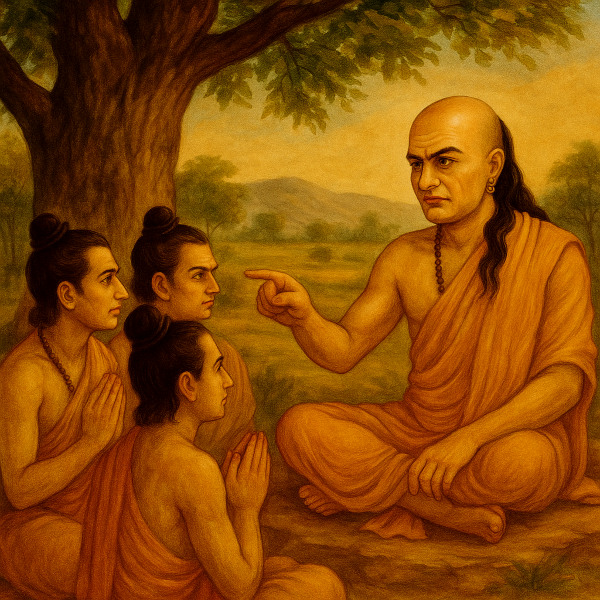
Chanakya Niti is a timeless compilation of moral, social, and political wisdom penned by the ancient Indian philosopher, strategist, and royal advisor Chanakya—also known as Kautilya or Vishnugupta. He lived during the 4th century BCE and played a pivotal role in the establishment of the Mauryan Empire by mentoring and guiding Emperor Chandragupta Maurya.
While Chanakya’s most renowned work is the Arthashastra, which focuses on statecraft and governance, Chanakya Niti is a separate body of practical wisdom intended to guide individuals on how to live effectively and intelligently in society. This text offers insights into human behavior, relationships, wealth, education, leadership, and ethics, making it relevant across ages and cultures.
The brilliance of Chanakya Niti lies in its sharp observations and realistic approach to life. Chanakya does not idealize the world; instead, he urges people to understand human nature, recognize deceit, protect their interests, and act with discretion. His teachings often blend practicality with moral clarity, making them suitable for both personal and professional growth.
Through succinct Sanskrit verses (Nitis), Chanakya provides advice that ranges from how to choose friends and deal with enemies, to managing wealth, respecting knowledge, and identifying hidden dangers. These maxims, though ancient, continue to offer profound insights into modern-day challenges.
In essence, Chanakya Niti is not just a collection of rules but a mirror to human nature and a roadmap to wise living. Whether one seeks guidance in politics, business, or personal conduct, Chanakya’s principles remain astonishingly relevant and continue to inspire leaders, thinkers, and learners around the world.
We will look into each verses of Chanakya Niti and decipher the wisdom which lies within them.
What is Chapter 1 About
The first chapter of Chanakya Neeti serves as a foundational guide to wisdom, offering sharp insights into human nature, practical living, and strategic thinking. It begins with reverence to higher knowledge and quickly transitions into blunt truths about trust, relationships, loyalty, and survival. Chanakya does not sugarcoat his words—he speaks with the clarity of a statesman and the caution of a realist. This chapter warns against misplaced trust, highlights the importance of discernment in choosing allies, and emphasizes self-preservation, foresight, and moral strength. It also celebrates the value of wisdom, no matter its source, encouraging an open but guarded mind. In essence, Chapter 1 is about laying the groundwork for a life that is alert, intelligent, and anchored in both dharma and strategy.
Chapter 1- Sloka 1
प्रणम्य शिरसा विष्णुं त्रैलोक्याधिपतिं प्रभुम्।
नानाशास्त्रोद्धृतं वक्ष्ये राजनीतिसमुच्चयम्॥ ०१-०१
Pra-nam-ya shirasa Vishnum trai-lokya-adhipatim prabhum |
Naanaa-shaastra-uddhritam vakshye raaja-neeti-samuchchayam ||
Line 1:
- प्रणम्य (praṇamya) – having bowed down / after saluting
- शिरसा (śirasā) – with (one’s) head / bowing the head
- विष्णुं (viṣṇum) – to Lord Vishnu
- त्रैलोक्याधिपतिं (trailokyādhipatim) – the Lord (ādhipati) of the three worlds (trailokya)
- प्रभुम् (prabhum) – the master / supreme ruler / lord
Line 2:
- नाना (nānā) – various / many
- शास्त्र (śāstra) – scriptures / treatises
- उद्धृतं (uddhṛtam) – extracted / drawn from / compiled
- वक्ष्ये (vakṣye) – I shall speak / I will explain
- राजनीति (rājanīti) – political science / statecraft
- समुच्चयम् (samuccayam) – collection / compilation / essence
Chanakya Says:
प्रणम्य (praṇamya)
– Having bowed down or after bowing respectfully
(It’s a respectful salutation, indicating reverence.)
शिरसा (śirasā)
– With the head
(Implies bowing with the head down, the gesture of deep respect.)
विष्णुं (viṣṇum)
– To Lord Vishnu
(The deity being worshiped; the preserver in Hindu trinity.)
त्रैलोक्याधिपतिं (trailokyādhipatiṁ)
– The Lord (adhipati) of the three worlds (trailokya)
(Refers to heaven, earth, and the underworld — symbolic of universal rule.)
प्रभुम् (prabhum)
– The Supreme Master or Lord
(An additional honorific, stressing Lord Vishnu’s supremacy.)
नानाशास्त्रोद्धृतं (nānā-śāstra-uddhṛtam)
– Collected or extracted (uddhṛtam) from various (nānā) scriptures (śāstras)
(Indicates the teachings are gathered from multiple authoritative texts.)
वक्ष्ये (vakṣye)
– I shall speak or explain
(A future tense verb: declaring the intention to teach or share.)
राजनीतिसमुच्चयम् (rājanīti-samuccayam)
– Compendium (samuccayam) of political ethics (rājanīti)
(A collected body of knowledge or principles on governance and conduct.)
“Having bowed my head to Lord Vishnu, the supreme ruler of the three worlds, I shall now explain the compendium of political ethics, drawn from various scriptures.”
Explanation:
This opening line is a traditional invocation often found in ancient Indian texts, reflecting humility and devotion. In Indian traditions, nothing is started without giving its due salutations to the preserver of the worlds. Sri. Chanakya begins by offering salutations to Lord Vishnu, who is regarded in Hinduism as the preserver and protector of the universe. By addressing him as “the Lord of the three worlds” (heaven, earth, and the underworld), Chanakya acknowledges his divine oversight over all realms of existence.
The phrase “I recite maxims of the science of political ethics” refers to the Niti Shastra—a body of knowledge on governance, strategy, and moral conduct. Sri. Chanakya emphasizes that the wisdom he’s about to share is not purely his own invention but is compiled and refined from multiple ancient texts (shastras or sastras), giving it depth, tradition, and authority.
This line sets a spiritual and scholarly tone for Chanakya Niti, indicating that it is both a moral guide and a strategic manual, grounded in divine reverence and the collective wisdom of the sages. It reminds readers that while the principles are practical, they are also sacred and meant to be applied with righteousness and discernment.
Chapter 1- Sloka 2
अधीत्येदं यथाशास्त्रं नरो जानाति सत्तमः ।
धर्मोपदेशविख्यातं कार्याकार्यं शुभाशुभम्॥ ०१-०२
Adhītyedam yathā-shāstram naro jānāti sattamah |
Dharmopadeśa vikhyātam kāryākāryam śubhāśubham ||
Line 1:
- अधीत्य (adhītya) – having studied / after learning
- इदं (idaṁ) – this (text / scripture / work)
- यथा (yathā) – according to / as per
- शास्त्रं (śāstraṁ) – scripture / sacred text / treatise
- नरः (naraḥ) – man / person
- जानाति (jānāti) – knows / understands
- सत्तमः (sattamaḥ) – the wisest / noble / virtuous man
Line 2:
- धर्म (dharma) – righteousness / moral duty
- उपदेश (upadeśa) – teaching / instruction
- विख्यातं (vikhyātaṁ) – well-known / famous
कार्य (kārya) – what is to be done / right action - अकार्य (akārya) – what is not to be done / wrong action
- शुभ (śubha) – good / auspicious
- अशुभम् (aśubham) – bad / inauspicious
Chanakya Says
अधीत्य (adhītya)
– Having studied“The man who studies this work in accordance with the scriptures becomes a noble person, renowned for his understanding of the teachings of righteousness. He comes to know what ought to be done and avoided, what is good and what is evil.”
(From the root “धी” meaning to learn or study; here it implies deep or formal study.)
इदं (idaṁ)
– This
(Refers to the present text or knowledge being spoken of—i.e., Chanakya Niti.)
यथा (yathā)
– According to or as per
(Denotes conformity with something—here, with the śāstra.)
शास्त्रं (śāstraṁ)
– Scripture, treatise, or authoritative text
(Refers to texts of learning, especially in areas like ethics, polity, and dharma.)
नरः (naraḥ)
– Man or human being
(Generic term for a person or individual.)
जानाति (jānāti)
– Knows, understands, or realizes
(A verb indicating true understanding, not just memorization.)
सत्तमः (sattamaḥ)
– The best among the good, a noble or excellent person
(Superlative form of sat—good; meaning the most virtuous or wise.)
धर्मोपदेशविख्यातं (dharma-upadeśa-vikhyātaṁ)
– Well-known (vikhyātaṁ) for the teaching (upadeśa) of dharma (righteousness)
(Refers to the fame or authority of this text in teaching right conduct.)
कार्याकार्यं (kārya-akāryaṁ)
– What should be done (kārya) and what should not be done (akārya)
(An ethical distinction between duty and wrongdoing.)
शुभाशुभं (śubha-aśubhaṁ)
– Good (auspicious) and bad (inauspicious)
(Moral/ethical assessment of actions and consequences.)
“The man who studies this work in accordance with the scriptures becomes a noble person, renowned for his understanding of the teachings of righteousness. He comes to know what ought to be done and avoided, what is good and what is evil.”
Explanation:
This sentence is emphasizing the value of proper learning and moral development that comes from studying Chanakya Niti correctly.
- “The man who studies this work in accordance with the scriptures…”
– This means that just reading the text is not enough. The person must stuतदहं सम्प्रवक्ष्यामि लोकानां हितकाम्यया । - येन विज्ञातमात्रेण सर्वज्ञात्वं प्रपद्यते ॥ ०१-०३dy it with the right attitude and understanding, guided by spiritual or moral principles found in the scriptures. It implies that intent and method of learning matter.
- “…becomes a noble person…”
– A person who studies wisely and deeply transforms into someone morally upright, respected, and virtuous.
In Sanskrit, the word sattamaḥ (used in the original verse) refers to someone who is “best among the good.” - “…renowned for his understanding of the teachings of righteousness.”
– Over time, such a person becomes recognized and respected by others for their clear understanding of dharma—the right path, moral law, or ethical living. - “He comes to know what ought to be done and avoided, what is good and what is evil.”
– This part shows the practical result of such knowledge. The person gains clear judgment:- What is kārya (to be done) and akārya (to be avoided),
- What is śubha (good, auspicious) and aśubha (bad, harmful).
This ability helps in making wise decisions in daily life, in personal and professional matters.
In Short :
This sloka tells us that if someone studies Chanakya Niti sincerely and with the right mindset, they will become wise, respected, and capable of making the right choices in life. They will understand deeply what is right or wrong—not just for themselves, but for society too.
True wisdom comes not just from reading, but from deeply reflecting and living by what you learn. As Chanakya said, it helps you know what is right and wrong—and that knowledge turns an ordinary person into someone truly noble.
Chapter 1- Sloka 3
तदहं सम्प्रवक्ष्यामि लोकानां हितकाम्यया ।
येन विज्ञातमात्रेण सर्वज्ञात्वं प्रपद्यते ॥ ०१-०३
Tad ahaṁ sampravakṣyāmi lokānāṁ hita-kāmyayā |
Yena vijñāta-mātreṇa sarva-jñatvaṁ prapadyate ||
Line 1:
- तत् (tat) – that / this (wisdom / knowledge being referred to)
- अहं (ahaṁ) – I
- सम्प्रवक्ष्यामि (sampravakṣyāmi) – shall thoroughly explain / will expound
- लोकानाम् (lokānām) – for the people / for the world
- हितकाम्यया (hita-kāmyayā) – out of desire for their welfare / wishing their well-being
Line 2:
- येन (yena) – by which / through which
- विज्ञातमात्रेण (vijñāta-mātreṇa) – merely by understanding / simply by knowing
- सर्वज्ञात्वं (sarvajñatvaṁ) – complete knowledge / omniscience / full understanding
- प्रपद्यते (prapadyate) – is attained / is achieved
Chanakya Says:
तत् (tat)
– That
(Refers to the knowledge or wisdom previously mentioned.)
अहम् (aham)
– I
(The speaker—Chanakya himself.)
सम्प्रवक्ष्यामि (sampravakṣyāmi)
– I shall clearly explain or fully speak
(Future tense verb from root “वच्” meaning to speak.)
लोकानाम् (lokānām)
– Of the people / of the worlds
(Plural genitive of loka, here referring to all people or mankind.)
हितकाम्यया (hita-kāmyayā)
– With the desire for welfare / well-being
(Compound of hita = welfare, kāmya = desire; instrumental case.)
येन (yena)
– By which or through which
(Referring to the knowledge he’s about to share.)
विज्ञातमात्रेण (vijñāta-mātreṇa)
– Merely by understanding / just by knowing
(Compound of vijñāta = understood, mātra = only; instrumental case.)
सर्वज्ञात्वं (sarvajñatvaṁ)
– Complete knowledge / all-knowingness
(From sarva = all, jñatva = state of knowing.)
प्रपद्यते (prapadyate)
– Is attained / is reached
(Verb meaning to attain or arrive at.)
Therefore, with the desire for the welfare of all people, I shall now clearly explain that knowledge, by merely understanding which, one attains complete wisdom.”
Explanation:
In this verse, Chanakya is declaring his intent. He says:
- He is going to share knowledge that is powerful and transformative.
- His purpose is not selfish—he speaks for the benefit of all humanity (lokānāṁ hita-kāmyayā). From the land of Bharatha, which believed that the whole world is own family, its not surprising that the ancient sages, saints and philosophers shared their knowledge for the benefit of all humankind, not just for a particular section or clan.
- The knowledge he shares is so potent that even simply understanding it leads to profound wisdom—an almost complete understanding of the world and human behavior (sarvajñatvam).
This sets the tone for what follows in Chanakya Niti: teachings meant to help anyone become wise, discerning, and successful in life—not through blind belief, but through clear understanding and right action. This doesn’t mean you’ll become omniscient (all-knowing), but that you will gain a clear understanding of life, human nature, right action, and wise decision-making—which is the essence of real wisdom.
In Short:
Chanakya is about to offer teachings that come from deep experience and insight, with the sincere hope of helping others. He believes that this knowledge, if understood properly, can change your life—by giving you the clarity and wisdom needed to navigate the world intelligently and ethically.
Yudhishthira and Yaksha
During their exile in the forest, the Pandavas once became extremely thirsty. They found a lake, but as each brother went to drink, they collapsed—one by one—unconscious, after ignoring a voice warning them not to drink without answering questions first.
Finally, Yudhishthira, the eldest, came to the lake. He, too, heard the voice. It was a Yaksha—a divine being—who demanded that his questions be answered before touching the water. Yudhishthira agreed and engaged in a deep dialogue, where the Yaksha posed dozens of moral, spiritual, and philosophical questions.
The Wisdom Part:
Yudhishthira answered every question calmly, drawing from dharma, logic, and deep understanding of human nature—exactly the kind of practical yet wise knowledge Chanakya promotes.
One famous question was:
Yaksha: “What is the greatest wonder?”
Yudhishthira: “Day after day, countless people die. Yet the living hope to live forever. This is the greatest wonder.”
By answering with insight and clarity—not just textbook knowledge—Yudhishthira impressed the Yaksha, who revealed himself to be Yama, the god of death, and blessed Yudhishthira by reviving his brothers and granting him protection.
Now lets look at Chanakya’s Verse (01.03):
“Therefore, with the desire for the welfare of all people, I shall now clearly explain that knowledge, by merely understanding which, one attains complete wisdom.”
- The Yaksha’s questions were like the wisdom Chanakya speaks of—meant to reveal deeper truths, not just facts.
- Yudhishthira didn’t just study dharma—he understood it, lived it, and that understanding gave him clear judgment and the ability to make the right decision in a moment of crisis.
- Merely knowing those truths—and acting upon them—brought him wisdom, protection, and divine favor.
Like Chanakya said, real knowledge doesn’t need rituals or ceremonies—just sincere understanding and right application. Yudhishthira showed how mastering such wisdom brings clarity, safety, and success—even when facing gods and death itself.
Chapter 1- Sloka 4
मूर्खशिष्योपदेशेन दुष्टस्त्रीभरणेन च ।
दुःखितैः सम्प्रयोगेण पण्डितोऽप्यवसीदति ॥ ०१-०४
Mūrkha-śiṣya-upadeśena duṣṭa-strī-bharaṇena ca |
Duḥkhitaiḥ samprayogeṇa paṇḍito’pi avasīdati ||
Line 1:
- मूर्ख (mūrkha) – foolish / ignorant
- शिष्य (śiṣya) – disciple / student
- उपदेशेन (upadeśena) – by giving instruction / teaching
दुष्ट (duṣṭa) – wicked / immoral - स्त्री (strī) – woman / wife
- भरणेन (bharaṇena) – by maintaining / supporting / living with
च (ca) – and
Line 2:
- दुःखितैः (duḥkhitaiḥ) – with sorrowful / miserable people
- सम्प्रयोगेण (samprayogeṇa) – by association / contact
पण्डितः (paṇḍitaḥ) – a learned person / wise man - अपि (api) – even
- अवसीदति (avasīdati) – sinks / perishes / gets ruined
This is one of the most quoted practical observations by Sri. Chanakya. It offers a realistic warning about certain types of associations or responsibilities that can cause even a wise person to suffer.
Chanakya Says:
मूर्ख-शिष्य-उपदेशेन (mūrkha-śiṣya-upadeśena)
– By giving instruction (upadeśena) to a foolish (mūrkha) student (śiṣya)
(This refers to the futility and frustration of trying to teach someone who is not capable or willing to learn.)
दुष्ट-स्त्री-भरणेन च (duṣṭa-strī-bharaṇena ca)
– And by maintaining (bharaṇena) a wicked or immoral woman (duṣṭa-strī)
(This suggests the emotional and moral toll of being connected with someone harmful or unethical.)
दुःखितैः (duḥkhitaiḥ)
– With miserable or sorrowful people
(People who are constantly distressed or negative.)
सम्प्रयोगेण (samprayogena)
– Through association or contact
(Being closely involved with or surrounded by them.)
पण्डितः अपि (paṇḍitaḥ api)
– Even a wise person (paṇḍitaḥ), also (api)
(This implies that wisdom alone is not protection against these difficulties.)
अवसीदति (avasīdati)
– Sinks, deteriorates, or falls
(Means suffers mentally, emotionally, or even socially.)
“Even a wise man falls into ruin by: teaching a foolish student, maintaining a wicked woman, or associating with miserable people.”
Explanation:
This verse from Chanakya Niti teaches that even a wise and learned person can suffer if they engage with the wrong people or responsibilities. Trying to teach a foolish student wastes time and brings frustration, supporting a person of bad character leads to emotional and moral turmoil, and constantly being around unhappy or negative individuals can drain even the strongest mind. Chanakya’s point is clear: wisdom must be paired with discernment. It’s not enough to be knowledgeable—you must also protect your energy by avoiding situations and associations that bring unnecessary suffering and disturbance.
Chanakya is issuing a realistic warning. He’s not making a moral judgment—he’s pointing out practical consequences of getting entangled in emotionally and mentally draining situations:
- Teaching someone who refuses to learn, wastes your energy and brings frustration.
- Being responsible for or emotionally tied to a person of bad character can corrupt or destroy your peace.
- Constant association with unhappy, negative people can pull down even the strongest minds.
This verse underlines the idea that wisdom is not just about knowing things—it’s also about choosing your associations carefully.
1. Teaching a Foolish Student (मूर्ख शिष्य उपदेशेन):
Chanakya says if you try to teach someone who is not willing or capable of learning, it only leads to frustration. “Teaching” doesn’t mean in the context of just a student-disciple relation , it could also mean advising someone, a friend, a relative or another person in the society.
- A foolish student/person doesn’t value learning.
- They resist correction and waste the teacher’s/advisors efforts.
- This drains the teacher/advisor emotionally and mentally.
Lesson: You cannot help someone who doesn’t want to help themselves. Choose your students or mentees wisely.
2. Maintaining a Wicked or Immoral Woman (दुष्ट स्त्री भरणेन):
This refers to being emotionally or financially responsible for a person , a partner be it in life, business or by association. Even nations are not immune from such toxic friendships or relationships.(In this context, a woman) who has bad character, deceitful behavior, or destructive habits.
Such a relationship can bring instability, betrayal, or dishonor.
- Constant conflict can wear down even a strong mind.
Lesson: Relationships not Just between a man and a woman, but built on mistrust, immorality, constant struggle or arguments can ruin your peace. Wisdom means knowing when to step back.
3. Association with Miserable People (दुःखितैः सम्प्रयोगेण):
This refers to constantly being around negative, unhappy, or toxic individuals.
- Misery is contagious—if you’re always surrounded by pessimism and sorrow, it affects your own thinking.
- Even wise people start doubting themselves when surrounded by hopelessness or emotional burden.
Lesson: Protect your emotional space. Compassion is important—but constant exposure to negativity can drain you.
Wisdom isn’t just about knowing what’s right. It’s about knowing where not to waste your time, energy, and heart.
In Short:
Even divine wisdom has no effect on a closed mind. The wise must know whom to teach, whom to avoid, and when to walk away, or they risk wasting their power and getting entangled in needless trouble.
Karna and His Loyalty to Duryodhana
Karna was one of the greatest warriors in the Mahabharata. Born to Kunti (before her marriage) and the Sun God, he was raised by a charioteer’s family and faced lifelong humiliation. Despite his strength and knowledge, he longed for acceptance.
Duryodhana, the Kaurava prince, recognized Karna’s talents and made him the king of Anga to win his loyalty. Karna, grateful for this support, pledged his unbreakable friendship to Duryodhana—even though he knew that Duryodhana’s actions were driven by jealousy, ego, and adharma (unrighteousness).
Let’s look at Chanakya’s Verse:
“Even a wise man falls into ruin by: teaching a foolish student, maintaining a wicked woman, or associating with miserable people.”
In Karna’s case:
- He was extremely wise, powerful, and knowledgeable—equal to Arjuna in skill.
- But his loyalty to Duryodhana (who represents दुष्ट—a wicked or unrighteous person) led him into a path of destruction.
- Despite being a dharmic person at heart, Karna chose friendship over righteousness, and this association ultimately led to his downfall and death.
Even Krishna, during the famous private conversation with Karna before the war, told him:
“You are on the wrong side, Karna. You are noble, but your company will destroy you.”
This story powerfully illustrates Chanakya’s warning—wisdom alone doesn’t save you if you align with the wrong people.
Karna’s tragedy is not due to lack of strength or intelligence—but due to emotional loyalty toward someone who embodied adharma.
He is a shining example of how even the most virtuous person can fall if they stand by those who are morally corrupt.
Realities from the Modern World:
Just as Chanakya warns of the destruction that comes from associating with the wrong individuals, history shows that toxic alliances and enmities between nations can lead to mutual ruin. When countries form partnerships based on manipulation, mistrust, or selfish gain rather than shared values and respect, the result is often betrayal, conflict, or collapse. The fall of mighty empires like the Roman or the Mauryan can, in part, be traced to internal strife fueled by deceptive diplomacy or ill-advised pacts. Chanakya’s wisdom reminds us that just as individuals must choose companions wisely, nations too must build relations rooted in truth, integrity, and long-term vision — or risk self-destruction.
A striking modern example is the alliance between the United States and Pakistan during the Cold War and post-9/11 era. Though it began as a strategic partnership, mutual distrust, conflicting agendas, and hidden support for extremist groups turned the relationship increasingly toxic. Billions in aid were spent with limited accountability, while both nations accused each other of betrayal. This flawed alliance not only strained diplomatic ties but also contributed to regional instability in South Asia and the prolonged conflict in Afghanistan. Chanakya’s wisdom reminds us that partnerships, whether personal or political, must be built on transparency and mutual respect — or they risk becoming instruments of mutual destruction.
Chapter 1- Sloka 5
दुष्टा भार्या शठं मित्रं भृत्यश्चोत्तरदायकः ।
ससर्पे च गृहे वासो मृत्युरेव न संशयः ॥ ०१-०५
Duṣṭā bhāryā śaṭhaṁ mitraṁ bhṛtyaś ca uttaradāyakaḥ |
Sasarbe ca gṛhe vāso mṛtyur eva na saṁśayaḥ ||
Line 1:
- दुष्टा (duṣṭā) – wicked / immoral
- भार्या (bhāryā) – wife / spouse
- शठं (śaṭham) – deceitful / cunning / hypocritical
- मित्रं (mitraṁ) – friend
- भृत्यः (bhṛtyaḥ) – servant / subordinate / employee
- च (ca) – and
- उत्तरदायकः (uttaradāyakaḥ) – one who talks back / argues / is defiant
Line 2:
- ससर्पे (sa-sarpe) – with a snake
- च (ca) – and
- गृहे (gṛhe) – in the house
- वासः (vāsaḥ) – dwelling / living / residence
- मृत्युः (mṛtyuḥ) – death
- एव (eva) – indeed / certainly
- न संशयः (na saṁśayaḥ) – without doubt / no question
Chanakya Says :
दुष्टा भार्या – (duṣṭā bhāryā)
“A wicked wife”
A wife who is immoral, disrespectful, or constantly creates conflict is called दुष्टा. In traditional Indian thought, the wife is seen as the foundation of domestic peace. If she becomes the source of disturbance, the entire home turns into a place of suffering.
शठं मित्रं – (śaṭhaṁ mitraṁ)– Having studied“The man who studies this work in accordance with the scriptures becomes a noble person, renowned for his understanding of the teachings of righteousness. He comes to know what ought to be done and avoided, what is good and what is evil.”
“A deceitful friend”
A friend who is cunning, dishonest, or pretends to be loyal while secretly working against you is more dangerous than an open enemy. Such a friend breaks trust and can cause great harm, especially when you are vulnerable.
भृत्यश्च उत्तरदायकः – (bhṛtyaḥ ca uttaradāyakaḥ)
“And a servant who talks back”
A servant or employee who argues instead of obeying, challenges instructions, or lacks respect can disrupt the order and discipline of a household or workplace. Such behavior undermines authority and leads to chaos.
ससर्पे च गृहे वासः – (sa-sarpe ca gṛhe vāsaḥ)
“And living in a house with a snake”
Living in a home where there is a hidden or known snake symbolizes living with constant danger. It not only represents a literal threat but also any kind of lurking danger or enemy within one’s space that is ignored or not dealt with.
“Is nothing but death; there is no doubt about it”
Chanakya concludes strongly: All the above situations are as dangerous as death itself. They destroy peace, trust, and safety. He states with emphasis — “There is no doubt about this.”
A wicked wife, a deceitful friend, a servant who argues back, and living in a house with a snake all these are certain causes of death, without a doubt.
Explanation:
This verse from Chanakya Niti highlights the grave dangers of living amidst harmful influences. It warns that having a wicked wife ( a person or an entity with which we share our core secrets, share wealth and space), a deceitful friend, a disloyal servant, or even a poisonous snake in the house ( an entity of wicked characteristics ) is as dangerous as inviting death itself. Such negative presences create constant turmoil, distrust, and suffering, disrupting peace and harmony. A wicked wife can break family unity; a false friend can betray trust and cause emotional pain; a disloyal servant can damage the household or business; and a venomous snake symbolizes lurking danger. Chanakya’s teaching is a powerful reminder that the quality of our close relationships and environment profoundly affects our wellbeing. To live a peaceful and prosperous life, it is crucial to surround oneself with trustworthy and positive influences and avoid toxic or harmful elements. This ancient wisdom remains relevant today, emphasizing the importance of vigilance in maintaining healthy relationships and a safe environment.
Shalya: The Charioteer Who Broke the Warrior’s Spirit
Shalya, the king of Madra and brother of Madri (mother of Nakula and Sahadeva), originally intended to fight for the Pandavas. However, Duryodhana cunningly tricked him by providing royal hospitality on the way to the war — making Shalya unknowingly commit to supporting the Kauravas.
Knowing Shalya was a skilled warrior and orator, Krishna devised a counter-strategy. He advised Yudhishthira to request Duryodhana to make Shalya the charioteer of Karna, who would be Duryodhana’s chief weapon against Arjuna.
Duryodhana agreed, thinking it would boost Karna’s strength. But Krishna knew Shalya’s nature: sharp-tongued, proud, and psychologically shrewd.
What Happened in the War:
During the most crucial moment of the war — when Karna finally faced Arjuna in a deadly duel — Shalya, instead of motivating Karna, did the opposite:
- He criticized Karna’s abilities, constantly compared him to Arjuna.
- He questioned his bravery, mocked his birth, and reminded him he was not a true Kshatriya.
- He demoralized Karna at the worst possible moment — when he needed strength, not sarcasm.
Despite Karna’s bravery and skill, his spirit was crushed by his own charioteer’s words. In battle, morale is half the war. Ultimately, Karna was killed by Arjuna, aided by these very lapses in confidence and support.
How it relates to Chanakya Niti
“भृत्यश्चोत्तरदायकः” — A servant who argues or disrespects his superior
“मृत्युरेव न संशयः” — It is death, without doubt.
Shalya, though in the role of a charioteer (subordinate in that position), talked back, criticized, and weakened Karna’s resolve.
Just as Chanakya warns, when someone under you undermines you, it can lead to your ruin — or even death. In Karna’s case, it quite literally did.
In Short:
In war, leadership, or even daily life, those in supporting roles, be it a wife, a partner, a friend; they are expected to uplift, not sabotage.
Chanakya’s wisdom applies beyond households — it speaks to kings, warriors, and even modern leaders:
A disloyal or disrespectful subordinate is a threat greater than an enemy.
The Snake Within: When Short-Term Strategy Becomes Long-Term Threat
Chanakya, the ancient Indian strategist, once warned: “Living in a house where a snake resides is as good as death — there is no doubt about it.” This timeless insight finds a chilling echo in modern geopolitics, particularly in the context of the Soviet–Afghan War and its aftermath.
In the 1980s, the United States and its allies supported Afghan Mujahideen fighters to counter Soviet influence in Central Asia. Billions of dollars were spent training and arming these groups — a short-term strategy to weaken a common enemy. However, buried within these alliances was a dangerous seed: the rise of radical ideologies and extremist groups like Al-Qaeda and the Taliban.
These groups, once seen as assets, eventually turned hostile. The tragic 9/11 attacks and the prolonged war in Afghanistan were direct consequences of underestimating the long-term impact of empowering such forces. A snake, once nurtured in the house, did what snakes do — it bit.
Chanakya’s ancient warning holds true even today: threats, when ignored or misjudged, grow from within and destroy what they once claimed to protect. True wisdom lies not just in fighting the visible enemy, but in recognizing the danger lurking in one’s own home.
Connection to Chanakya Niti:
“ससर्पे च गृहे वासो…” — Living with a snake in the house
The United States and its allies, knowingly or unknowingly, nurtured a dangerous ideology and armed group — the geopolitical equivalent of keeping a snake in the house. For a time, the “snake” seemed useful. But eventually, it turned around and bit.
“मृत्युरेव न संशयः” — It surely leads to destruction
The consequences of this miscalculated assessment was massive: terrorist attacks, endless war, civilian suffering, and geopolitical instability. All because a threat was welcomed into the system — and not recognized until it was too late.
Chapter 1- Sloka 6
आपदर्थे धनं रक्षेद्दारान्रक्षेद्धनैरपि ।
आत्मानं सततं रक्षेद्दारैरपि धनैरपि ॥ ०१-०६
āpadarṭhe dhanaṁ rakṣed dārān rakṣed dhanair api
ātmānaṁ satataṁ rakṣed dārair api dhanair api ॥
Line 1
- आपदर्थे (āpadarthe) – in times of trouble/difficulty
- धनं (dhanaṁ) – wealth
- रक्षेत् (rakṣed) – should protect/guard
- दारान् (dārān) – wife(s)
- रक्षेत् (rakṣed)– should protect/guard
- धनैः अपि (dhanaiḥ api) – even with wealth (means “by using wealth”)
Line 2
- आत्मानं (ātmānaṁ) – oneself (one’s own self)
- सततं (satataṁ) – always/constantly
- रक्षेत् (rakṣed) – should protect/guard
- दारैः अपि (dāraiḥ api)– even by wives
- धनैः अपि (dhanaiḥ api)– even by wealth
Chanakya Says :
आपदर्थे धनं रक्षेत् (āpada-arthe dhanaṁ rakṣet)
“In times of crisis, one should protect one’s wealth.”
→ When difficult situations arise (like war, loss, disaster), you need financial strength to navigate through them.
दारान् रक्षेत् धनैरपि (dārān rakṣet dhanair api)
“One should protect one’s family, even by spending wealth.”
→ If family is in danger, use wealth to save them. Wealth is meant to be used for their protection.
आत्मानं सततं रक्षेत् (ātmānaṁ satataṁ rakṣet)
“One must always protect oneself.”
→ Your own life and well-being are of the highest priority — without it, nothing else matters.
दारैरपि धनैरपि (dārair api dhanair api)
“Even if it means giving up wealth or family.”
→ In extreme cases, if your own survival is at stake, you may need to let go of even your closest attachments.
Chanakya teaches about of protection in wealth, life and self preservation:
- In hardship, protect your money.
- But if family is at risk, use money to save them.
- However, always protect yourself above all, even if it means sacrificing wealth or relationships.
Explanation:
This verse from Chanakya Niti teaches a practical hierarchy of protection in life. In times of difficulty, one should first safeguard their wealth, as it can help in navigating hardships. If the safety of loved ones is threatened, wealth should be willingly used to protect them. However, above all, a person must always prioritize their own life and well-being — even if it means sacrificing wealth or close relationships. Chanakya emphasizes that self-preservation is the highest duty, because only when one is alive and well can they rebuild what is lost and continue to serve others.
1. आपदर्थे धनं रक्षेत्
“In times of crisis, one should protect their wealth.”
When a person faces difficulties — such as illness, legal trouble, natural disaster, or political instability — wealth becomes an important shield. In such situations, it is crucial to preserve and manage money wisely because it can provide solutions, safety, and survival.Chanakya advises that one must prepare and protect their finances specifically for emergencies, not just for luxury or status.
2. दारान् रक्षेत् धनैरपि
“One should protect their family (especially spouse) even at the cost of wealth.”
While wealth is important, it is not more valuable than loved ones. If the life or dignity of one’s wife or family is in danger, money should be spent accordingly to ensure their safety.This teaches that relationships and people matter more than material possessions, and wealth should be used for noble and protective purposes.
3. आत्मानं सततं रक्षेत्
“One must always protect one’s own self.”
Self-preservation is the highest priority. Everything else — wealth, status, even family — becomes meaningless if the person is not alive or well. Chanakya stresses that you are your greatest asset, and only when you are safe, healthy, and alive, can you take care of others or recover from losses.
4. दारैरपि धनैरपि
“Even at the cost of spouse (family) and wealth.”
In the most extreme cases, where everything is at stake — including life — a person may be forced to abandon even their closest relationships and possessions to save themselves.This is not a cold or selfish thought, but a pragmatic one. Survival is the foundation of all responsibilities. If one dies, they can save nothing. But if they survive, they can start again and protect others in the future.
King Harishchandra: The Man Who Chose Truth Over Everything
In a world where power, wealth, and comfort often take precedence, the story of King Harishchandra from the Bhagavata Purana stands as a timeless example of integrity, sacrifice, and spiritual strength. It mirrors the wisdom of Chanakya’s verse:
“In times of trouble, protect wealth; use wealth to protect family; but above all, protect yourself — even if it means giving up both.”
Harishchandra was known for his unwavering commitment to truth. To test the limits of his virtue, the sage Vishwamitra put him through unimaginable trials. The king gave away his entire kingdom and wealth as dakshina. With nothing left, he left his palace with his wife Shaivya and son Rohitashva, embracing poverty with dignity.
Still unable to satisfy the sage’s demands, he sold his wife and child into servitude, and finally sold himself to serve as a crematorium guard — a job considered impure and degrading for a noble king.
The ultimate trial came when his son died from a snakebite. His wife, still a servant, brought the body to the cremation ground where Harishchandra worked. Bound by duty and unaware she had come, he asked for the cremation fee. When she said she had nothing left, he calmly asked for part of her garment as payment — never bending his principles, even in grief.
Moved by his unwavering dharma, the gods appeared, restored his son to life, returned his kingdom, and declared Harishchandra an immortal example of righteousness.
How it fits into Chanakya Niti
“आपदर्थे धनं रक्षेत्” – Harishchandra lost everything during his trial, but managed his hardships with calm, using what little he had wisely.
“दारान् रक्षेत् धनैरपि” – He gave away his wealth and kingdom but tried to keep his wife and son safe, even in slavery.
“आत्मानं सततं रक्षेत्” – Above all, Harishchandra protected his own values, integrity, and soul — never compromising his commitment to truth.
“दारैरपि धनैरपि” – Even at the cost of his family and wealth, he never abandoned dharma — the ultimate expression of self-preservation in the spiritual sense.
His story powerfully mirrors the ancient words of Chanakya:
Honorary Captain Bana Singh – The Lion of Siachen
In the brutal silence of the Siachen Glacier, where life struggles to breathe and war never rests, one man defied death not for glory, but for his team. Honorary Captain Bana Singh, Param Vir Chakra awardee, led a mission so daring, so courageous, that it forever changed the map—and spirit—of Indian military history.
In 1987, the Indian Army faced a grave threat. Pakistan had captured Quaid Post, a nearly inaccessible position perched at 21,000 feet. From there, they rained fire down on Indian troops below. Several attempts to reclaim it had failed, with heavy casualties.
Then came Naib Subedar Bana Singh and his select team.
Scaling vertical ice walls at night, in temperatures below –50°C and howling blizzards, Bana Singh led his men on an unthinkable path. Many perished in the cold. But he pushed forward, leading from the front, storming the bunker in hand-to-hand combat, and reclaiming the post. Today, it bears his name: Bana Post.
This incredible act of leadership and survival echoes the deep wisdom of Chanakya Niti:
Bana Singh sacrificed comfort, safety, and almost life itself, yet he endured — because he knew that his survival meant his team’s survival, and the nation’s victory. His courage was not reckless — it was disciplined. He preserved himself, not for pride, but to protect the greater cause.
His victory shows us that survival can itself be the ultimate sacrifice when it serves others. This is the core of Chanakya’s teaching:
“Preserve yourself — not for ego, but for purpose. So long as you live, others will too.”
Lets see how it relates to Chanakya Niti
“आपदर्थे धनं रक्षेत्” – The entire mission was born from emergency; saving battalions and territory was at stake.
“दारान् रक्षेत् धनैरपि” – Bana Singh risked his own life and family’s future to save his comrades and his nation.
“आत्मानं सततं रक्षेत्” – He showed mental and physical survival, preserving himself in one of the harshest war zones not for personal gain, but to protect the whole team and the nation.
“दारैरपि धनैरपि” – He gave up comfort, safety, and almost life itself — but because he survived, his team lived, and his mission succeeded.
Chapter 1- Sloka 7
आपदर्थे धनं रक्षेच्छ्रीमतां कुत आपदः ।
कदाचिच्चलते लक्ष्मीः सञ्चितोऽपि विनश्यति ॥ ०१-०७
Aapadarthe dhanam rakshe shreemataam kuta aapadah
Kadaachich chalate lakshmīh sanchito ’pi vinashyati ॥
Line 1
- आपदर्थे (āpadarthe) – in times of trouble
- धनं (dhanaṁ) – wealth
- रक्षेच्च (rakṣecc) – should protect
- श्रीमतान् (śrīmatān) – of the wealthy
- कुत् (kuta) – where
- आपदः (āpadaḥ) – is danger
Line 2
- कदाचि (kadāci) – sometimes
- चलते (calate) – moves/shifts
- लक्ष्मीः (lakṣmīḥ) – fortune/wealth
- सञ्चितः (sañcitaḥ) – accumulated/saved
- अपि (api) – even
- विनश्यति (vinaśyati) – is destroyed
In times of trouble, one should protect the wealth of the wealthy, because where there is wealth, danger also exists. Even accumulated fortune sometimes shifts or is destroyed unexpectedly.
Explanation:
आपदर्थे धनं रक्षेत्
(āpadarthe dhanaṁ rakṣet)
In times of trouble or adversity (आपदर्थे), one should protect (रक्षेत्) their wealth (धनं).
श्रीमतां कुत् आपदः
(śrīmatāṁ kuta āpadaḥ)
For the wealthy or respected (श्रीमतां), where (कुत्) is the danger or adversity (आपदः)? This questions how harm can come where wealth is well-guarded.
कदाचि चलते लक्ष्मीः
(kadāci calate lakṣmīḥ)
Yet sometimes (कदाचि), fortune or wealth (लक्ष्मीः) shifts, moves, or changes (चलते).
सञ्चितोऽपि विनश्यति
(sañcito ’pi vinaśyati)
Even the accumulated or saved wealth (सञ्चितः अपि) is destroyed or lost (विनश्यति).
This verse emphasizes the precarious nature of wealth and fortune, even under protection. The first line urges that in times of adversity, one must strive to safeguard their possessions and resources, especially if they belong to those who are prosperous and hold respect in society. The rhetorical question “कुत आपदः” (how can there be danger) suggests that with proper care and vigilance, one might assume wealth should remain safe from harm.
However, the second line provides a sobering reality — fortune, represented here as “लक्ष्मी,” is inherently unstable. No matter how much wealth is accumulated or carefully guarded, it is subject to change and can be lost unexpectedly. This loss can occur due to various reasons beyond one’s control, such as misfortune, economic downturns, or natural calamities.
The teaching reflects a deep understanding of life’s uncertainties. It encourages prudent management and protection of resources but also warns against attachment and complacency. Wealth is impermanent; it can flow and ebb like a river. Therefore, one must be wise not only in protecting wealth but also in accepting its transient nature.
This verse teaches a balanced approach: protect and manage your resources diligently, especially in challenging times, but also cultivate an awareness that material wealth is not eternal. True security lies in vigilance combined with wisdom about the impermanence of worldly possessions.
The story of King Yayati
King Yayati, a celebrated ruler from the ancient Indian epic Mahabharata, was known for his immense wealth, power, and indulgent lifestyle. Blessed with prosperity and pleasures, he enjoyed the riches of his kingdom and lived a life of luxury, symbolizing the accumulated fortune—“लक्ष्मी” —that many aspire to protect.
However, the sage Shukracharya, displeased with Yayati’s behavior and disregard for spiritual discipline, cursed him to suffer premature old age. Suddenly confronted with the realities of aging and mortality, Yayati was shocked to see his youthful vigor vanish and his body weaken. This curse disrupted his enjoyment of worldly pleasures and challenged his attachment to material wealth.
Desperate to regain his youth, Yayati approached his sons with an unusual request: he asked one of them to exchange their youth for his old age, allowing him to continue enjoying life’s pleasures. Among his sons, only Puru, the youngest, agreed to this sacrifice, accepting his father’s old age so that Yayati could regain vitality.
With his renewed youth, Yayati lived many more years indulging in pleasures and worldly pursuits. Yet, as time passed, he came to a profound realization: material wealth and sensual enjoyment, no matter how abundant, are ultimately fleeting and incapable of providing lasting happiness or peace. This epiphany led him to understand that true fulfillment lies beyond the accumulation and protection of wealth.
Accepting the impermanence of material riches, Yayati returned his youth to Puru and embraced a life of austerity and spiritual pursuit. He passed his kingdom to Puru, entrusting the legacy of material wealth to the next generation, and chose to seek deeper meaning beyond transient possessions.
This story of King Yayati beautifully echoes the teaching in Chanakya Niti: even the most carefully guarded and accumulated wealth (सञ्चित लक्ष्मी) is subject to change and loss (चलते लक्ष्मीः विनश्यति). It reminds us that while it is natural to protect and manage our resources, we must recognize the temporary nature of material fortune and seek wisdom, virtue, and detachment as the true sources of lasting peace and fulfillment.
In today’s world, where material success is often seen as the ultimate goal, King Yayati’s story serves as a timeless lesson. It encourages us to balance the pursuit of prosperity with spiritual awareness and to prepare ourselves for the inevitable changes life brings.
How it relates to Chanakya Niti:
आपदर्थे धनं रक्षेच्छ्रीमतां कुत आपदः
(āpadarthe dhanaṁ rakṣec chrīmatāṁ kuta āpadaḥ)
Meaning: In times of trouble, one must protect their wealth, especially if they are prosperous. The question arises — how can danger come if wealth is protected?
Connection: Yayati was a prosperous king, surrounded by immense wealth and pleasures. Yet, despite this wealth and his status, he faced a sudden “trouble” — the sage’s curse causing premature aging. This illustrates that no matter how well one protects wealth, unforeseen dangers (आपदः) can arise.
कदाचिच्चलते लक्ष्मीः सञ्चितोऽपि विनश्यति
(kadācic calate lakṣmīḥ sañcito ’pi vinaśyati)
Meaning: Sometimes, fortune or wealth moves or changes, and even accumulated wealth is destroyed.
Connection: Yayati’s story vividly shows this truth — despite accumulated wealth and status, his fortune shifted drastically due to the curse. Even after regaining youth temporarily, he recognized that material wealth and pleasures are transient and cannot ensure lasting happiness. The destruction here is not just physical loss but the impermanence of worldly attachments.
This verse-by-verse alignment shows how King Yayati’s experience perfectly embodies the teaching of Chanakya: wealth, no matter how abundant or guarded, is vulnerable to change and loss. The real lesson is to understand this impermanence and seek wisdom and virtue beyond material wealth.
The Cuban Missile Crisis
In 1962, the world stood precariously on the edge of nuclear war during the Cuban Missile Crisis, a defining moment in Cold War history. This confrontation between the United States and the Soviet Union vividly illustrates the timeless wisdom expressed in Chanakya Niti: that accumulated power and wealth—no matter how immense—are vulnerable to sudden shifts and require wise management.
The United States and the Soviet Union, the two superpowers of the era, had amassed vast military arsenals and political influence, symbolizing their wealth in terms of power and global dominance. Yet, this immense accumulation of power was fragile and fraught with risk. When the Soviet Union secretly deployed nuclear missiles in Cuba, just 90 miles from the U.S. mainland, it triggered an intense crisis threatening global annihilation.
At this critical juncture—akin to “आपदर्थे” (times of danger or adversity) in Chanakya’s verse—both nations were forced to carefully protect their interests and manage their formidable “wealth.” However, the crisis demonstrated that mere possession of power was insufficient; prudent diplomacy and wise negotiation were essential to avoid catastrophe.
For 13 tense days, the world held its breath as both superpowers engaged in a high-stakes game of brinkmanship. Behind the scenes, leaders like U.S. President John F. Kennedy and Soviet Premier Nikita Khrushchev weighed their options, balancing the desire to maintain strategic advantage with the imperative to prevent mutual destruction.
The resolution came through back-channel communications, strategic concessions, and a mutual understanding of the risks. The U.S. agreed—albeit secretly—to remove its missiles from Turkey, while the Soviets withdrew their missiles from Cuba. This diplomatic success underscored a profound truth: even the greatest accumulation of power (सञ्चित धन) can become perilous if not managed with foresight and wisdom.
This episode embodies the essence of Chanakya Niti’s teaching that “कदाचिच्चलते लक्ष्मीः सञ्चितोऽपि विनश्यति” — fortune and wealth are impermanent and susceptible to change or loss. The Cuban Missile Crisis reminds us that power unchecked by prudence and diplomacy can lead to devastating consequences.
In today’s complex geopolitical landscape, the crisis serves as a timeless lesson on the importance of vigilance, measured response, and the pursuit of dialogue over confrontation. It echoes the ancient wisdom that true strength lies not just in accumulating resources but in managing them wisely, anticipating risks, and acting with foresight.
Connection to Chanakya Niti:
This episode shows how even massive “wealth” in terms of military might and political power can bring the world to the brink of disaster (विनश्यति). It teaches that safeguarding power requires wisdom, prudence, and diplomacy rather than reliance on sheer accumulation.
Just as Chanakya’s verse warns that fortune shifts and can be lost despite protection, the Cuban Missile Crisis reminds us that unchecked power can become dangerous if not carefully managed with foresight and dialogue.
Chapter 1- Sloka 8
यस्मिन्देशे न सम्मानो न वृत्तिर्न च बान्धवाः ।
न च विद्यागमोऽप्यस्ति वासं तत्र न कारयेत्॥ ०१-०८
Yasmin deśe na sammānaḥ, na vṛttiḥ, na ca bāndhavāḥ |
Na ca vidyāgamaḥ api asti, vāsaṁ tatra na kārayet ||
Line 1:
- यस्मिन् (yasmin) – in which / where
- देशे (deśe) – country / place / land
- न (na) – not
- सम्मानः (sammānaḥ) – respect / honor
- न (na) – not
- वृत्तिः (vṛttiḥ) – livelihood / means of income
- न (na) – not
- च (ca) – and
- बान्धवाः (bāndhavāḥ) – relatives / friends / social connections
Line 2:
- कारयेत् (kārayet) – one should cause to happen / allow / make
- न (na) – not
- च (ca) – and
- विद्यागमः (vidyāgamaḥ) – access to education or knowledge
- अपि (api) – even
- अस्ति (asti) – is / exists
- वासं (vāsaṁ) – residence / living / staying
- तत्र (tatra) – there
- न (na) – not
Chanakya Says :
यस्मिन् देशे न सम्मानः ( yasmin deśe na sammānaḥ)
“In a place where there is no honour or respect…”
If you live somewhere that does not value or respect you — where your presence, words, or work are disregarded — it harms your self-worth and dignity.
Chanakya begins by emphasizing the importance of dignity. If society or the people around you do not value or respect you, your self-esteem and mental peace are at risk. Without respect, even achievements feel hollow.
न वृत्तिः ( na vṛttiḥ)
“…and there is no means of livelihood…”
If there are no opportunities to earn or work, you will face economic hardship and dependency, no matter how capable you are. Even if you’re respected, without a way to earn a living, survival becomes a struggle. Economic independence is vital for stability and growth.
न च बान्धवाः (na ca bāndhavāḥ)
“…and there are no relatives or supportive friends…”
Without a social circle — family, friends, or trusted people — you are alone in hardship, with no one to turn to during crises. Life without a support system — like family, friends, or well-wishers — can be emotionally draining and hinders your growth. In difficult times, the absence of close relationships makes one feel isolated and vulnerable.
न च विद्यागमः अपि अस्ति (na ca vidyāgamaḥ api asti)
“…and there is no access to learning or knowledge…”
A place that doesn’t offer learning, growth, or education is mentally and spiritually stagnant. You cannot evolve or improve there. If there’s no opportunity to learn, grow, or gain wisdom, personal development comes to a halt. Such a place restricts your futurChapter 1- Sloka 7e potential and limits your understanding of the world.
वासं तत्र न कारयेत् (vāsaṁ tatra na kārayet)
“…then one should not choose to live in such a place.”
Chanakya firmly advises: do not make your home in such a place. Even if it seems bearable, such a place will eventually destroy your potential, peace, and prosperity. Chanakya concludes firmly — even if it’s inconvenient to move, do not stay where respect, livelihood, companionship, and learning are absent. Leaving such a place is better than losing your purpose, growth, and peace.
This verse is a guide for choosing the right environment. A place worth living in must offer:
- Respect
- Livelihood
- Relationships
- Opportunity for learning
If these four are missing, your growth — materially, emotionally, and spiritually — is in danger.
Explanation
In this verse, Chanakya teaches that one should never live in a place where there is no respect, no means of livelihood, no friends or family, and no access to knowledge. Such an environment, lacking dignity, support, opportunity, and growth, is harmful to both personal and professional well-being. Even if other comforts are present, the absence of these essentials leads to frustration, stagnation, and eventual downfall. Therefore, a wise person must seek a place that nurtures their dignity, provides opportunities, fosters relationships, and encourages learning.
The Story of Dhruva and Chanakya’s Eternal Advice
Dhruva was born to King Uttānapāda, one of the sons of the great Manu, and his elder queen, Sunīti, a woman known for her noble character. However, the king’s affection was captured by his younger queen, Suruchi, who bore him another son. Suruchi was proud, ambitious, and deeply jealous of any affection shown to Sunīti or her child.
One day, the young Dhruva, like any child, sought to sit on his father’s lap. But Suruchi, full of scorn, stopped him. In a harsh and humiliating tone, she said:
“You are not born of me. If you want a place on your father’s lap or the throne, you must be born again — this time through me!”
These words struck Dhruva like thunder. The king, present but silent, said nothing. He neither defended his son nor rebuked Suruchi. At that moment, the great palace — filled with riches, servants, and status — had nothing of value for the boy. There was:
- No respect (na sammānaḥ) — He was publicly humiliated.
- No future or livelihood (na vṛttiḥ) — His path to the throne was cut off.
- No support or companionship (na bāndhavāḥ) — His own father abandoned him in silence.
- No guidance or learning (na vidyāgamaḥ) — There was no one to show him the way forward.
Instead of being broken by this rejection, Dhruva turned inward. He went to his mother Sunīti and asked what he could do. With wisdom and pain in her heart, she said, “Only God can help you now.” Inspired by her words, Dhruva left the palace — not in bitterness, but in determination — to find Lord Vishnu, the preserver of the universe.
He walked into the forest — alone, barefoot, and barely five years old — with nothing but a burning desire to be seen, heard, and blessed. Guided by the sage Nārada, he was taught how to meditate and focus his mind on the divine. Dhruva followed the instructions with incredible discipline: standing on one leg, reducing his food intake, and chanting the sacred name of Vishnu with unwavering faith.
As months passed, the sheer intensity of Dhruva’s tapasya (penance) began to shake the heavens. The gods themselves were astonished. Moved by this young soul’s sincerity, Lord Vishnu appeared before him in radiant form.
Dhruva opened his eyes and wept — not out of grief, but in divine fulfillment. Lord Vishnu embraced him and blessed him with far more than royal power. He said:
“You shall become the Dhruva Tara — the Pole Star — steady, unmoving, and guiding others for eternity.”
Thus, the child who was denied a seat on his father’s lap was offered a place in the heavens, eternal and unshakable.
The Chanakya Connection:
Dhruva’s story is a perfect embodiment of Chanakya’s verse (1.8):
“In a place where there is no respect, no means of earning, no friends or family, and no opportunity to grow in knowledge — do not live there.”
Rather than cling to a toxic environment, Dhruva chose the courage to walk away. He stepped into the unknown to seek a higher path. He found divine truth, self-worth, and an immortal place in the universe.
Sometimes, the most sacred journey begins when you walk away from where you’re not meant to stay.
Chanakya: The Sage Who Walked Away to Change a Nation
In a world that often teaches us to endure, Chanakya taught us when to walk away. Not out of weakness — but with vision, clarity, and purpose.
More than two thousand years ago, long before modern diplomacy and political science were born, a scholar from Takshashila changed the course of Indian history. His name was Chanakya, also known as Kautilya or Vishnugupta — the mastermind behind the Maurya Empire.
An Invitation Turned Insult
Chanakya was a man of immense intellect — well-versed in philosophy, politics, economics, and warfare. Hoping to offer his guidance for the betterment of the nation, he visited the court of King Dhanananda of the powerful Nanda dynasty in Magadha.
But instead of receiving the scholar with respect, the king mocked Chanakya for his appearance, background, and confidence. The arrogant ruler saw no value in the wisdom of a humble Brahmin. The court, too, followed suit — sneering at the very man who could have transformed their governance.
When Leaving Is Wisdom
At that moment, Chanakya realized the land he stood in had failed every principle of a worthy place to live:
- No सम्मान (Respect) – He was insulted before all.
- No वृत्ति (Livelihood) – His counsel was not welcomed.
- No बान्धवाः (Support or friendship) – He was alone among adversaries.
- No विद्यागम (Growth of knowledge) – His intellect had no soil to grow in.
Rather than argue or beg, Chanakya walked away.
But he walked away not in defeat — he walked away with a vow.
A Vow That Shook a Kingdom
In the silent corners of his heart, Chanakya vowed to uproot the Nanda dynasty and replace it with a just, strong, and wise ruler. He believed that Bharath (India) needed more than gold and armies — it needed vision, ethics, and strategy.
In his search for a future king, he discovered a young, bright boy named Chandragupta, born of royal blood but living in obscurity. Chanakya took him under his wing, educated him, and trained him in the art of leadership and war.
Through masterful diplomacy, guerrilla warfare, and political alliances, Chanakya orchestrated the fall of the Nandas — and crowned Chandragupta Maurya as the emperor of a united Bharat.
From Exile to Empire
What Dhanananda’s court saw as a meaningless rejection became the seed of a revolution. Chanakya’s walking away was not escape — it was elevation. He went on to write the Arthashastra, a foundational text in statecraft and economics. He built an empire not with force alone, but with strategy and wisdom.
His legacy remains a shining proof of his own teaching:
“Do not stay where your dignity is denied.
Seek the land where your wisdom can rise.”
A Lesson for Every Generation
Chanakya’s story is not just history. It’s a guide for every person stuck in the wrong place — be it a job, a toxic environment, or a place that no longer supports your growth.
There is strength in staying, yes.
But sometimes, there is greater strength in stepping away — with clarity, purpose, and fire in the heart.
Chapter 1- Sloka 9
धनिकः श्रोत्रियो राजा नदी वैद्यस्तु पञ्चमः ।
पञ्च यत्र न विद्यन्ते न तत्र दिवसं वसेत्॥ ०१-०९
Dhanikaḥ śrotriyo rājā nadī vaidyas tu pañcamaḥ |
pañca yatra na vidyante na tatra divasaṁ vaset ||
Line 1:
- Dhanikaḥ – a wealthy person, someone who has resources or money
- Śrotriyaḥ – a Vedic scholar or learned Brahmin (knower of scriptures)
- Rājā – a king or ruler (symbol of governance and protection)
- Nadī – a river or natural water source (essential for life and agriculture)
- Vaidyaḥ – a physician or doctor (healthcare)
- Tu – but / and / indeed (emphatic connector)
- Pañcamaḥ – the fifth one (completing the list of five)
Line 2:
- Pañca – five (things)
- Yatra – where
- Na – not
- Vidyante – exist / are present
- Na – not
- Tatra – there
- Divasam – (even for) a day
- Vaset – one should dwell / live
Chanakya Says :
धनिकः (Dhanikaḥ) – A Wealthy Person
A place must have people with wealth or economic resources. A wealthy person represents prosperity, employment opportunities, and financial stability. Without wealth in the community, progress and support during crises become difficult.श्रोत्रियः (Śrotriyaḥ) – A Vedic Scholar / Learned Person
The presence of someone wise, knowledgeable, and rooted in dharma (ethics) is vital. Such a person guides society with moral and intellectual clarity. A place without learning or wisdom becomes spiritually and culturally barren. A society needs moral and spiritual guidance — without it, even wealth becomes dangerous. This also symbolizes education and culture.
राजा (Rājā) – A Ruler / Administrator
A just and capable ruler (or governing body) ensures law, order, and protection. Without strong leadership, a place can descend into chaos or corruption. A place without good governance suffers from lawlessness and injustice.
नदी (Nadī) – A River / Water Source
Water is life. A natural water source (river, stream, or reliable supply) is essential for drinking, agriculture, hygiene, and sustainability. Settlements without water face disease, famine, or decline.
वैद्यः (Vaidyaḥ) – A Doctor / Healer
Good health is a foundation for all progress. A community must have a vaidya (Doctor) — someone skilled in healing and treatment. Without medical support, even small diseases can become deadly.
पञ्च यत्र न विद्यन्ते (Pañca yatra na vidyante ) – “Where these five are not found”
If any place lacks all five, or even most of these key supports, it is unfit for residence.
न तत्र दिवसं वसेत् (Na tatra divasaṁ vaset ) – “Do not stay there even for a day”
The warning is strong and urgent. Don’t delay, don’t adjust, don’t tolerate the lack of essentials. Leave such a place immediately.
Chanakya is teaching us practical wisdom:
- Don’t romanticize suffering.
- Don’t stay in places that drain your strength or dull your mind.
- Don’t live where security, knowledge, growth, and health are absent.
Where there is no wealth, no learned scholar, no ruler, no river, and no doctor, one should not reside — not even for a single day, as such a place lacks the essential elements for survival, knowledge, security, and health.
Chanakya highlights five essential elements for a safe and prosperous life:
wealth, wisdom, governance, natural resources, and healthcare.
Explanation:
Chanakya outlines five essential elements that must exist in any place for it to be livable: a wealthy person (symbolizing economic stability), a learned scholar (symbolizing wisdom and culture), a ruler or authority (for governance and law), a river (representing water, nature, and resources), and a physician (health and wellbeing). These five ensure that a society can thrive with security, knowledge, sustenance, and support in times of crisis. Chanakya warns that if any place lacks all of these, one should not stay there even for a single day, as such an environment is unfit for meaningful life or growth. This teaching is both practical and timeless, reminding us to assess our surroundings not by luxury or comfort alone, but by the essential pillars of life. It is a guide for choosing where we live, work, or invest — emphasizing survival, dignity, and long-term wellbeing.
The Story of King Sudās and the Battle of the Ten Kings (Daśarājña Yuddha)
In the ancient Rig Veda, one of the earliest known texts of human civilization, lies the account of a remarkable event known as the Battle of the Ten Kings (Daśarājña Yuddha). This is not merely a tale of war but a timeless lesson in leadership, survival, and the foundation of a flourishing society. It aligns beautifully with the wisdom expressed in Chanakya Niti, where it is said that one must not reside even for a single day in a place that lacks five vital elements: wealth, wisdom, righteous leadership, natural resources, and healthcare. These principles, though composed millennia apart, speak to the same eternal truth — that a society stands strong only when these fundamental pillars are upheld.
King Sudās, the noble ruler of the Bharata tribe, governed a region blessed with prosperity and sacred traditions. Under the guidance of the revered Rishi Vashishtha, Sudās maintained a kingdom that was not only wealthy in material terms but also rich in knowledge, spiritual depth, and moral clarity. His people lived along the banks of the Saraswati River, a life-giving force that nourished the land and represented purity, wisdom, and fertility. The presence of learned sages, strong administration, and an abiding respect for dharma made Sudās’s realm a model of balance and strength.
However, greatness often invites envy. A confederation of ten rival kings, disturbed by Sudās’s rising power and influence, formed an alliance against him. They believed that sheer numbers and brute force could overturn what Sudās had built. But what they failed to realize was that Sudās was not alone. He had with him the wisdom of his guru, the loyalty of his people, the spiritual support of Vedic rituals, and the strength of nature itself. The Saraswati River, flowing through his land, was more than a water source — it was a symbol of divine grace and continuity. In contrast, the opposing coalition, though vast, lacked unity, vision, and the moral force that holds a society together.
When the great battle commenced, it was not the side with the most warriors that triumphed, but the one aligned with truth and inner strength. Sudās’s forces, though smaller, defeated the ten kings. The Rig Veda commemorates this victory not just as a military success but as a testament to the power of righteousness and balanced governance. His land survived not because it was invincible, but because it was just, wise, and harmoniously structured. The battle became a lesson for generations — that a land grounded in prosperity, knowledge, order, and nature’s blessings can withstand even the fiercest storms.
Chanakya, centuries later, echoed the same principle in his political treatise. He warned that one must not stay even for a day in a place that lacks the essentials for life: economic support, intellectual and moral guidance, righteous leadership, natural resources like water, and healing support. King Sudās’s story becomes a perfect embodiment of this teaching. His success was not built on power alone but on a foundation where each of these elements thrived. Those who underestimated these values, like the ten kings, were defeated not by weapons but by the very imbalance within their cause.
In a world that still faces crises born from poor leadership, ignorance, environmental neglect, and inequality, this ancient story holds striking relevance. It reminds us that civilizations are not sustained by wealth alone, but by the presence of harmony between people, nature, and values. To live wisely, as Chanakya teaches, is to choose our ground carefully — to align ourselves with places, people, and principles that nurture life in its highest sense. Just as King Sudās did, we too must protect and build societies where these five pillars stand strong, for in them lies not just survival, but the true spirit of human flourishing.
Marshall Plan
In the aftermath of World War II, Europe faced unprecedented devastation. Cities lay in ruins, economies were shattered, governments were weakened or displaced, and millions of people struggled with hunger, disease, and displacement. This catastrophic scenario illustrated a grim reality: the absence of critical pillars that sustain a thriving society — wealth, wisdom, leadership, natural resources, and healthcare — as emphasized in the ancient wisdom of Chanakya. His teaching in Chanakya Niti 1.9 warns that one should not remain even a day in a place lacking these essential elements. Europe in the late 1940s was, in many ways, such a place.
The war had left industrial output in Western Europe at roughly 50% of pre-war levels. Unemployment soared, and food shortages led to widespread malnutrition. For example, in 1946, Germany’s coal production was just 25% of its 1938 output, hampering energy supplies crucial for rebuilding. Infrastructure was devastated: railways, bridges, and factories were either destroyed or severely damaged. Public health systems were overwhelmed, contributing to outbreaks of diseases like tuberculosis and typhus.
Governments struggled to re-establish order and provide services amidst political instability. The absence of effective governance created social unrest and the real threat of communist expansion during the early Cold War. Educational institutions, essential for preserving cultural wisdom and training future leaders, had also suffered, with many schools and universities closed or destroyed.
Recognizing these challenges, the United States launched the Marshall Plan in 1948, officially known as the European Recovery Program. Named after Secretary of State George C. Marshall, this initiative aimed to provide over $12 billion (approximately $130 billion in today’s dollars) in economic aid to rebuild Western European economies. This aid went beyond mere financial support — it was a comprehensive effort to restore all five pillars critical for a society’s survival and growth.
Economically, the Marshall Plan helped restore industrial production and infrastructure. Between 1948 and 1952, Western Europe’s industrial output increased by nearly 35%, and coal and steel production surged, providing the foundation for economic revival and job creation. This restored wealth—the first pillar.
The plan also emphasized wisdom by funding educational programs and promoting cooperation among European nations, facilitating the exchange of knowledge and technical expertise. Institutions of learning were rebuilt, and scientific collaboration flourished, laying groundwork for the future European integration.
Effective leadership and governance were fostered as European countries re-established democratic institutions, stabilized currencies, and implemented reforms encouraged and supported by the aid program. This political stability was vital to maintain law, order, and trust necessary for recovery.
Natural resources such as water, energy, and agricultural land were rehabilitated through infrastructure projects funded by the plan, ensuring sustainable growth and food security. For example, irrigation and electrification projects helped revive rural economies.
Healthcare systems also received significant investment, improving hospitals and public health services, reducing disease outbreaks, and increasing life expectancy. The revival of health services ensured a healthy workforce, a critical factor in rebuilding the continent.
The success of the Marshall Plan is evident. By 1952, the economies of participating countries had not only recovered but entered a period of sustained growth and rising living standards, often called the “Golden Age of Capitalism.” Western Europe became a bastion of democracy and prosperity, setting the stage for the European Union.
This historic example powerfully illustrates Chanakya’s ancient wisdom: a society without the five pillars—wealth, wisdom, leadership, natural resources, and healthcare—cannot survive or flourish. The Marshall Plan restored these foundations, enabling recovery from devastation and building a future grounded in stability and progress.
Today, this lesson remains profoundly relevant. Nations and communities facing crises can draw inspiration from both Chanakya’s teachings and the Marshall Plan’s holistic approach to rebuilding life’s essentials. Survival and success depend not on isolated efforts but on nurturing all elements that sustain human civilization.
Chapter 1- Sloka 10
लोकयात्रा भयं लज्जा दाक्षिण्यं त्यागशीलता ।
पञ्च यत्र न विद्यन्ते न कुर्यात्तत्र संस्थितिम्॥ ०१-१०
lokayātrā bhayaṁ lajjā dākṣiṇyaṁ tyāgaśīlatā |
pañca yatra na vidyante na kuryāt tatra sansthitim ||
Line 1
- लोकयात्रा (lokayātrā) — traveling or journeying in the world
- भयं (bhayaṁ) — fear
- लज्जा (lajjā) — modesty or shame
- दाक्षिण्यं (dākṣiṇyaṁ) — generosity or willingness to give
- त्यागशीलता (tyāgaśīlatā) — habit or nature of renunciation/sacrifice
Line 2
- पञ्च (pañca) — five
- यत्र (yatra) — where
- न (na) — not
- विद्यन्ते (vidyante) — exist or are found
- न (na) — not
- कुर्यात् (kuryāt) — should be done or established
- तत्र (tatra) — there
- संस्थितिम् (sansthitim) — stability, foundation, or existence
Chanakya Says :
लोकयात्रा (lokayātrā) – Means of Livelihood / Social Order
This refers to a system of proper, lawful earning and societal functioning. A place should offer honest opportunities to live with dignity, support one’s family, and contribute to society. If the system is corrupt, if hard work is not rewarded, or if there’s rampant poverty and exploitation, it becomes a harmful environment.
भयं (bhayaṁ) – Fear (of Adharma / Wrongdoing / Law)
Here, “fear” is not meant negatively; it implies a healthy respect for law, conscience, and consequences. A society where people act without fear of justice, divine law, or public accountability descends into lawlessness. Such fear restrains crime, encourages discipline, and maintains ethical behavior.
लज्जा (lajjā) – Modesty / Shame / Sense of Honor
Lajjā is a protective virtue. It’s the inner voice that prevents one from doing wrong due to a sense of decency or self-respect. A society that lacks shame or modesty will lose moral boundaries and embrace shamelessness, disrespect, and vulgarity. Modesty upholds family, social, and individual dignity.
दाक्षिण्यं (dākṣiṇyaṁ) – Generosity / Courteousness / Compassion
This refers to kindness and willingness to help others. It reflects emotional warmth in behavior. In a society where everyone is cold, greedy, and selfish, emotional suffering increases. Generosity builds community bonds, helps the needy, and reflects higher human values.
त्यागशीलता (tyāgaśīlatā) – Spirit of Sacrifice / Selflessness
This means the habitual nature of giving up one’s own comfort or interest for a greater good — be it for family, society, or dharma. No great civilization thrives without sacrifice. A society without selflessness becomes fragmented by selfish motives and ultimately collapses.
पञ्च यत्र न विद्यन्ते न कुर्यात्तत्र संस्थितिम्॥
(pañca yatra na vidyante na kuryāt tatra sansthitim)
Where these five values do not exist, one should not stay or settle in such a place.
Chanakya is advising that if a place lacks:
- means of right livelihood,
- respect for moral consequences,
- modesty and decency,
- generosity and compassion,
- and the spirit of sacrifice —
then that place is not worthy of living in, no matter how materially prosperous it may appear.
A place without morality, livelihood, fear of wrongdoing, generosity, and the spirit of sacrifice is unfit for civilized living. It will ultimately lead to downfall — for individuals and for society.
Explanation:
In Chanakya Niti, thie verse offers a timeless guideline for choosing where to live. It states that one should never reside in a place where five essential virtues are absent: livelihood (लोकयात्रा), fear of wrongdoing (भयम्), modesty (लज्जा), generosity (दाक्षिण्यम्), and a spirit of sacrifice (त्यागशीलता).
These values are the foundation of a healthy and ethical society. Livelihood ensures survival with dignity. Fear of law or moral consequence keeps behavior in check. Modesty safeguards culture and respect. Generosity fosters empathy and community spirit. And sacrifice builds relationships, families, and nations.
If a place lacks these qualities, it may lead to moral decay, chaos, and individual suffering. Chanakya warns that wealth or opportunity alone are not enough — social values matter more. This verse serves as a compass not just for where we live, but also for the kind of society we help build. It is a reminder to choose environments that support both material well-being and moral growth.
Vishvamitra: The King Who Left His Kingdom in Search of Higher Virtue
In the timeless wisdom of Chanakya Niti, verse 01-10 outlines five essential virtues that make a place worthy of living: livelihood, fear (of wrongdoing), modesty, generosity, and a spirit of sacrifice. The scripture warns that any land that lacks these should not be made one’s home, regardless of its material wealth or political strength.
A striking example of this principle is found in the transformation of King Kaushika, who later became the revered sage Vishvamitra—a journey that is as profound as it is symbolic.
Kaushika was a powerful and ambitious ruler, governing a kingdom blessed with prosperity, influence, and military might. Yet, during a journey through the countryside, he encountered Sage Vashistha, a humble hermit living in simplicity, whose peaceful presence radiated a power far greater than any army. Intrigued and later envious, Kaushika attempted to seize Vashistha’s divine cow, Kamadhenu, believing it would grant him even greater dominion. But the cow, through Vashistha’s spiritual energy, defeated Kaushika’s forces effortlessly.
Humbled and awakened, Kaushika realized that his kingdom, despite its riches, lacked the inner strength rooted in dharma. It was a place of ego, conquest, and pride—where fear of wrongdoing was absent, generosity was self-serving, sacrifice was rare, and livelihood was driven by power rather than virtue. He saw clearly that his rule, and the world he had built, were grounded in shallow values. And so, Kaushika made a bold and unheard-of decision: he renounced his throne.
He left behind the comforts of kingship and began an arduous life of penance, meditation, and spiritual discipline. His goal was not only to equal Vashistha but to overcome his own lower nature. Over years of sacrifice and perseverance, Kaushika transformed into Vishvamitra, a sage of extraordinary power, who would later play a key role in the life of Lord Rama and be honored as one of the greatest rishis in Indian tradition.
This story deeply reflects Chanakya’s advice: even a wealthy, politically stable land is unfit for living if it lacks virtue, humility, and a moral compass. Vishvamitra’s renunciation was not a rejection of power—but a rejection of empty power, of a life lacking in spiritual and ethical depth.
In today’s world, where material success is often prioritized over integrity and ethics, this story offers a powerful reminder. A place, an organization, or even a relationship that lacks the values of honest livelihood, moral accountability, modesty, kindness, and selflessness is not worth staying in, no matter how outwardly successful it appears.
The journey of Vishvamitra is not merely historical—it is eternally relevant. It teaches us that real greatness lies in the courage to walk away from what is hollow, and the commitment to pursue what is truly meaningful.
The Dalai Lama’s Choice: Exile Over Oppression
“Where there is no means of livelihood, no fear of wrongdoing, no modesty, no compassion, and no spirit of sacrifice — one should not live in such a place.”
This ancient political and ethical counsel from Chanakya, the master strategist and philosopher of the Mauryan era, finds a hauntingly real parallel in Tibet’s modern history — particularly in the events of 1959, when His Holiness the 14th Dalai Lama was forced to flee his homeland.
The Fall of a Peaceful Nation
Tibet, for centuries, was a peaceful, spiritual nation rooted in Buddhist philosophy, cultural discipline, and self-sustaining livelihood. The Dalai Lama served as both the spiritual and temporal leader, and monasteries were centers of education, healing, and governance.
However, in 1950, the People’s Republic of China, under Mao Zedong, invaded Tibet. Initially justified as a “peaceful liberation,” the occupation soon turned aggressive. Tibetan autonomy was stripped, monasteries were destroyed, and over time, more than 6,000 monasteries were desecrated during the Cultural Revolution. Livelihoods were ruined, freedoms erased, and thousands were arrested or killed.
By 1959, after years of mounting resistance and violence, a mass uprising occurred in Lhasa. In response, Chinese forces launched a brutal crackdown. Fearing for his life and the future of his people, the Dalai Lama undertook a harrowing 15-day escape across the Himalayas — disguised as a soldier — and entered India, where he was granted asylum by Prime Minister Jawaharlal Nehru.
A Nation Without the Five Pillars
By this time, Tibet had become a land where the five virtues Chanakya emphasized were lost:
- Lokayātrā (Livelihood):
Traditional means of living—monastic life, agriculture, medicine—were devastated. Local economies collapsed under Chinese control. - Bhayaṁ (Fear of wrongdoing):
The Chinese government ruled with impunity. Torture, imprisonment, and surveillance became the norm, and justice was absent. - Lajjā (Modesty / Shame):
There was no moral restraint in actions—religious symbols were burned, monks publicly humiliated, and sacred traditions mocked. - Dākṣiṇyaṁ (Compassion):
The crackdown was devoid of empathy. Tibetan voices were silenced, not heard. There was no room for dialogue or mercy. - Tyāgaśīlatā (Spirit of Sacrifice):
The ruling authority demanded obedience, not sacrifice. They acted to dominate, not to serve.
The Dalai Lama’s Response: Walking Away with Dignity
Choosing exile over violence, the Dalai Lama demonstrated what true spiritual leadership means. With 80,000 Tibetan refugees, he settled in Dharamshala, India. There, he built a government-in-exile, preserved the Tibetan language, arts, and Buddhism, and became a global ambassador for peace.
Despite immense loss, he never advocated hatred or retaliation. In 1989, he was awarded the Nobel Peace Prize for his commitment to non-violence in the face of aggression.
A Living Lesson in Chanakya Niti
The Tibetan story is a modern echo of Chanakya’s ancient principle:
When a society or regime no longer upholds virtue, justice, or compassion, it becomes spiritually unlivable — and one must have the courage to walk away.
Just as sages in ancient India left corrupt kingdoms, and Vishvamitra renounced power for purpose, the Dalai Lama turned exile into an act of resistance — one that continues to inspire the world.
The Tibetan exodus reminds us that not all battles are fought with weapons. Some are fought by preserving one’s values, culture, and dignity in the face of overwhelming force. Chanakya Niti’s guidance, though written over 2,000 years ago, rings true: a society without ethics, fear of justice, modesty, kindness, and sacrifice is not just flawed — it is dangerous to live in.
The Dalai Lama chose to leave such a place, not in defeat, but in moral triumph. His journey, like Chanakya’s wisdom, remains a beacon for those who face oppression and seek a life anchored in truth.
Chapter 1- Sloka 11
जानीयात्प्रेषणे भृत्यान्बान्धवान्व्यसनागमे ।
मित्रं चापत्तिकालेषु भार्यां च विभवक्षये ॥ ०१-११
Jānīyāt preṣaṇe bhṛtyān, bāndhavān vyasanāgame |
Mitraṁ chāpattikāleṣu, bhāryāṁ cha vibhava-kṣaye ||
Line 1
- Jānīyāt (जानीयात्) — One should recognize / understand / test
- Preṣaṇe (प्रेषणे) — While sending on a task / when assigning a mission
- Bhṛtyān (भृत्यान्) — Servants / subordinates / employees
- Bāndhavān (बान्धवान्) — Relatives / family members
- Vyasanāgame (व्यसनागमे) — At the time of adversity / crisis
Line 2
- Mitram (मित्रम्) — A friend
- Cha (च) — And
- Āpattikāleṣu (आपत्तिकालेषु) — In times of misfortune / danger
- Bhāryām (भार्यां) — One’s wife
- Cha (च) — And
- Vibhava-kṣaye (विभवक्षये) — When wealth is lost / in poverty
Chanakya Says:
जानीयात् प्रेषणे भृत्यान्
(Jānīyāt preṣaṇe bhṛtyān)
“One should know/test the servants when sending them on a task.”
- Jānīyāt – One should know / assess
- Preṣaṇe – When sending (on a mission or task)
- Bhṛtyān – Servants / subordinates / employees
This means a servant’s true nature is revealed when they are entrusted with responsibility, especially in the absence of supervision.
बान्धवान् व्यसनागमे
(Bāndhavān vyasanāgame)
“And relatives during times of misfortune or suffering.”
- Bāndhavān – Relatives / family members
- Vyasanāgame – When adversity arises / in difficult times
True relatives are known not in times of joy but when trouble strikes; whether they stand by you or disappear in the time of need.
मित्रं च आपत्तिकालेषु
(Mitraṁ cha āpattikāleṣu)
“And a friend during times of crisis or danger.”
- Mitraṁ – A friend
- Cha – And
- Āpattikāleṣu – In moments of calamity / emergency
A real friend proves their loyalty when you are in distress, not just when things are going well.
भार्यां च विभवक्षये
(Bhāryāṁ cha vibhava-kṣaye)
“And a wife when wealth is lost.”
- Bhāryāṁ – Wife / spouse
- Cha – And
- Vibhava-kṣaye – In the loss of wealth / during poverty
A partner’s true love and loyalty is tested not in prosperity, but when wealth and comfort are tested
This verse conveys that the true character of people is revealed not in times of comfort, but in times of difficulty. Servants may obey when watched, but their integrity shows in independence. Relatives may celebrate with you, but only the sincere ones stay in hardship. Friends are easy to find in fun, but rare in danger. And a spouse’s true devotion is tested not in luxury, but in poverty and loss.
Explanation:
Chanakya in this verse emphasizes that the true nature of people is revealed not in times of comfort, but during moments of challenge. A servant’s sincerity can only be judged when they are sent on a task, without supervision, where their honesty and efficiency come into play. Relatives may share joy and celebration, but their real bond is known when one faces adversity—they either offer support or distance themselves. Similarly, a friend who stands beside you in danger or crisis is a genuine ally, while others may vanish when trouble strikes. The verse also touches upon the strength of marital relationships, stating that a wife’s true devotion is tested when wealth and luxury are lost. In essence, Chanakya teaches that adversity is the true mirror of character. It is through the trials of life that loyalty, love, and integrity are proven, not through words or appearances in good times.
Draupadi’s Trial in the Kaurava Court: A Test of Loyalty and Character
The court of Hastinapura was full of opulence and grandeur, but on one fateful day, it became the arena of the gravest moral failure in the Mahabharata. Yudhishthira, the eldest Pandava and a man of dharma, had been drawn into a cunning game of dice by his cousin Duryodhana and the deceitful Shakuni. One by one, Yudhishthira gambled away his wealth, his kingdom, his brothers, and finally, his wife Draupadi.
With Draupadi lost in the bet, Duryodhana ordered her to be brought into the court. Dushasana, his brother, dragged Draupadi by her hair — a gesture of extreme disrespect. The royal assembly was full of wise men: Bhishma, Drona, Kripa, Vidura, Dhritarashtra, Karna — all present. Yet, no one raised a hand or voice to stop the insult being hurled at a queen, a daughter-in-law of the Kuru dynasty, and a noble woman of unparalleled virtue.
At this moment, Chanakya’s words resonate clearly:
“Relatives are tested in adversity, friends in danger, and a wife during the loss of wealth.”
Here, the Pandavas were impoverished and powerless, and in this situation:
- The silence of the elders — Dhritarashtra, Bhishma, and Drona — revealed that being kin by blood means little without the courage to protect. They were tested, and they failed.
- Vidura alone spoke out, condemning the act and warning Dhritarashtra of the grave consequences of such adharma. Though outnumbered and powerless, Vidura passed the test of true friendship and wisdom by standing with Draupadi and dharma.
- Karna, once a friend of the Pandavas, joined in humiliating Draupadi by calling her names. His loyalty to Duryodhana blinded him, and in that moment of crisis, he too failed the test of character.
- Draupadi herself, even in that moment of shame and helplessness, stood with strength. She questioned the legality of her being staked after Yudhishthira had lost himself. Her sharp intellect, devotion to dharma, and unwavering support for her husbands — even after their fall — showed that a wife’s strength and loyalty are best seen when all wealth is lost.
Overwhelmed and without help, Draupadi cried out to Lord Krishna, and in a divine intervention, Krishna protected her modesty by making her sari endless, frustrating Dushasana’s attempt to disrobe her.
This moment turned the tide of the epic — it planted the seed of war and declared to the world that dharma may falter, but it never fails. Those who remained silent in the face of injustice were cursed with guilt, while those who stood firm earned immortal honor.
Why This Story Mirrors Chanakya Niti
Chanakya teaches that:
- A servant’s character is seen when assigned a task.
Like Sanjaya, who served the blind king with truth, or Krishna, who served as a messenger and charioteer yet upheld dharma with power. - Relatives are tested during sorrow.
The elders of the Kuru family — despite their power — did nothing to help Draupadi, exposing the hollowness of mere blood relations. - Friends are tested in danger.
Vidura’s lone voice in the court became the echo of true friendship and conscience. - A wife is tested when all wealth is lost.
Draupadi, even after being humiliated, never left her husbands and stood as a symbol of honor, courage, and unshakable faith.
The 1971 India–Bangladesh War
This ancient verse of Chanakya Niti, quietly captures the heart of human character: “A friend is known in calamity, relatives in adversity, servants in duty, and a wife in loss of wealth.” These are not just moral instructions — they are practical truths that reveal themselves in times of great crisis. One of the most striking real-world reflections of this principle comes not from ancient India, but from the modern battlefield and diplomatic corridors of 1971, when India stood beside the people of East Pakistan — now Bangladesh — at a moment of unimaginable distress.
In 1971, East Pakistan was engulfed in turmoil. A brutal military crackdown by the Pakistani army in response to the Bengali demand for autonomy led to one of the worst humanitarian crises of the 20th century. Villages were razed, civilians massacred, and over 10 million refugees poured into India. It was a tragedy the world watched, but few acted upon. It was in this desperate moment that India rose, not as a silent observer, but as a resolute ally.
Despite economic struggles, food shortages, and intense global pressure — especially from the United States and China, who supported West Pakistan — India chose to act. It sheltered refugees, trained and equipped the Mukti Bahini and eventually entered a full-scale war to liberate East Pakistan. It did not do so for land or power, but because it recognized the moral and humanitarian necessity. This is where Chanakya’s principle comes alive. In just 13 days, Indian forces secured one of the most decisive victories in modern history, capturing 90,000 Pakistani soldiers and paving the way for the birth of Bangladesh.
This act of courage and sacrifice was not driven by political gain or territorial ambition. It was rooted in dharma — the sense of duty and justice Chanakya so often emphasized. India saw in the people of Bangladesh not just neighbors, but kin. It stood by them when no one else did. In doing so, India passed every test that Chanakya outlined — as a friend in crisis, as a relative in suffering, and as a nation that called upon its soldiers and diplomats who performed with unmatched loyalty and excellence.
Even within India, the public stood united. Despite economic hardships and resource strain, the people bore the burden of housing millions of refugees, showing resilience and compassion during a time of national pressure.
History remembers battles, borders, and treaties. But deeper than these are the moments when a nation chooses to uphold values greater than itself. In 1971, India’s actions were not only geopolitically significant — they were a profound enactment of Chanakya’s age-old wisdom. It was a time when ideals were tested, and India answered with dignity, courage, and unshakable humanity.
How it relates to Chanakya Niti:
“मित्रं चापत्तिकालेषु” – Friend in calamity:
India proved to be a true friend when no one else stepped up. It risked war, sanctions, and diplomatic isolation to support the people of East Pakistan.
“बान्धवान्व्यसनागमे” – Relatives in adversity:
India and Bangladesh share language, culture, and history — particularly in Bengal. India treated the refugees not as outsiders but as family in distress, feeding and sheltering millions despite its own food shortages.
“ज्ञानीयात्प्रेषणे भृत्यान्” – Servants in duty:
The Indian Armed Forces, intelligence agencies like RAW, and Indian diplomats worked with unmatched coordination. Soldiers crossed rivers, jungles, and minefields to liberate a people not even their own — a stunning display of discipline and dharma in service.
“भार्यां च विभवक्षये” – Wife in poverty:
While this line is about personal relationships, it symbolically reflects the people of India — who endured economic strain, refugee pressure, and political tension during the war — yet stood united behind their leaders.
The 1971 war is not just a military victory — it’s a moral triumph, where the dharma of friendship, sacrifice, and leadership was upheld against global indifference and political odds. Chanakya’s words echo across this episode — teaching us that in history, as in life, only those who stand by you in crisis are truly yours.
Chapter 1- Sloka 12
आतुरे व्यसने प्राप्ते दुर्भिक्षे शत्रुसङ्कटे ।
राजद्वारे श्मशाने च यस्तिष्ठति स बान्धवः ॥ ०१-१२
Aature vyasane praapte, durbhikshe shatru-sankate
Raajadvaare shmashaane cha, yah tishthati sa bandhavah
Line 1
- आतुरे (āture) – in illness / when someone is sick
- व्यासने (vyasane) – in adversity / misfortune / trouble
- प्राप्ते (prāpte) – when it has occurred / has come
- दुर्भिक्षे (durbhikṣe) – during famine / scarcity of food
- शत्रु-सङ्कटे (śatru-saṅkaṭe) – in danger from enemies / conflict situations
Line 2
- राज-द्वारे (rāja-dvāre) – at the king’s door / royal court / legal authority
- श्मशाने (śmaśāne) – at the cremation ground / during funeral rites
- च (ca) – and
- यः (yaḥ) – who
- तिष्ठति (tiṣṭhati) – stands / remains present
- सः (saḥ) – he
- बान्धवः (bāndhavaḥ) – is a true relative / friend / companion
Chanakya Says:
आतुरे व्यसने प्राप्ते
(Āture vyasane prāpte)
“In illness and when calamity has struck”
This part highlights the first kind of trial: personal suffering. When someone falls ill or faces a deep emotional or psychological crisis, most casual acquaintances vanish. Only those who truly care will come forward — to tend, to comfort, and to stay.
Philosophically, it teaches us to observe who remains when we are no longer strong, productive, or joyful. These are your true people.
दुर्भिक्षे शत्रुसङ्कटे
(Durbhikṣe śatru-saṅkaṭe)
“During famine and in danger from enemies”
This represents external or social adversity. Famine isn’t just literal — it symbolizes any time of scarcity, loss, or desperation, when there’s nothing to gain from being with you. Similarly, danger from enemies suggests situations where standing by you involves risk.
This part reveals: a true friend is one who does not abandon you when your life becomes dangerous, or you have nothing left to offer.
राजद्वारे श्मशाने च
(Rāja-dvāre śmaśāne ca)
“At the king’s court and the cremation ground”
These two locations are deeply symbolic.
- Rāja-dvāra (king’s court) represents times when you are in need of influence, justice, or intervention. A true companion will not hesitate to speak for you, support you, or defend your cause in high places.
- Śmaśāna (cremation ground) is where grief, death, and detachment reside. Many avoid this place — out of fear or discomfort. The one who stands with you here faces your grief, shares your silence, and does not walk away from your sorrow.
यः तिष्ठति सः बान्धवः
(Yaḥ tiṣṭhati saḥ bāndhavaḥ)
“He who stands by you — he is a true companion”
The verse concludes with clear wisdom: those who remain in all the above situations — illness, loss, danger, need, and death — are your real family, regardless of blood ties.
It teaches us to value presence over promises, actions over words. It invites us to see through illusions of closeness and to honour those who stand through testing times.
“He who stands with you in sickness, adversity, famine, danger from enemies, at the king’s door, and at the cremation ground — he is truly your relative (bāndhavaḥ).”
Explanation
This verse from Chanakya Nīti speaks of the rarest and truest form of companionship. It teaches us that in life, true bonds are not proven by words, blood, or occasional gestures, but by presence during adversity. Chanakya lists six situations—illness, misfortune, famine, danger from enemies, the king’s court, and the cremation ground. Each of these moments represents a phase where a person is most vulnerable, most alone, and often shunned. In such times, many who seemed close may disappear. But the one who remains—who walks beside you not for gain, praise, or comfort—is your true companion, your real bāndhavaḥ.
Illness and misfortune test not only the body and mind but also the strength of relationships. During famine or any form of scarcity, when resources are scarce and survival becomes the priority, only someone deeply loyal will still be willing to share what little they have. Danger from enemies is a time when standing with you may involve risk or even harm; here, true friendship is shown through courage. Standing at the king’s door implies support during legal battles, political trouble, or public humiliation—times when many will avoid you to protect themselves. And at the cremation ground, in the face of grief and finality, most retreat, unable to bear the weight of sorrow. But the one who stays, who stands quietly with you in loss, offers the highest kind of presence.
Chanakya’s verse is not just an observation—it’s a moral compass. It reminds us not only how to identify true companions but also how to be one. In a world of shifting relationships and conditional support, this teaching is both ancient and timeless. The one who stands with you through all storms—that person is your true relative. All others are merely passing names.
The Unshakable Devotion of Vidura to Yudhishthira
In the majestic palace of Hastināpura, where dharma once stood like a pillar of gold, a shadow had begun to grow. Greed, pride, and silence had woven a silent conspiracy that would shatter the fate of an empire. The Pāṇḍavas — once the pride of the kingdom — were reduced to defeated men, stripped of their kingdom, their honour, and their peace. What began as a game of dice ended in exile, and no one — not even the mighty elders of the court — raised their voices against the injustice that unfolded.
But one man did.
Vidura, the wise half-brother of Dhṛtarāṣṭra, was born of a servant woman, yet he was a giant in wisdom and virtue. He had no throne to claim, no army behind him, and no sons of his own to fight for. But he had the courage to stand for what was right. When Duryodhana orchestrated the rigged dice game and Draupadī was dragged into the royal court, humiliated before kings and elders, Vidura’s voice rang louder than all. He thundered with indignation, calling the act shameful and sinful, warning that the destruction of the Kuru dynasty had begun.
In that court — the king’s gate (rājadvāra) — Vidura stood tall, not with a sword, but with unbending truth. Even as Bhīṣma, Droṇa, and Kripa sat in silence, bound by oaths and diplomacy, Vidura did not yield. He chastised Dhṛtarāṣṭra openly, reminding him that blind love for his son would lead the kingdom to ruin. And when the king, torn between love and fear, asked for counsel in private, it was again Vidura who spoke without fear, urging him to return the kingdom to the Pāṇḍavas. His words were not just political; they were dharma given voice.
When the Pāṇḍavas were exiled to the forests, wearing bark and walking barefoot, most of Hastināpura turned away. The mighty had fallen — and few dared associate with the fallen. But Vidura did not turn his face. He visited them in secret, offering counsel, comfort, and news from the kingdom. He ensured that they had supplies and protection, even as spies of Duryodhana tried to sow discord. He stood with them in misfortune (vyasana), in their famine of dignity (durbhikṣa), and even in the crisis of enemy plots (śatru-saṅkaṭa).
When Yudhishṭhira despaired, when Draupadī burned with rage, when Arjuna’s bow hung silently from a tree, it was often Vidura’s words — remembered from their conversations — that steadied their hearts. His loyalty was not to their crown but to their cause.
Years passed. The Kurukṣetra war eventually came — and went. The Pāṇḍavas returned victorious, but hollow from loss. The throne of Hastināpura was once again theirs. But Vidura did not come seeking position or reward. He had already stepped away from court life, choosing the quiet solitude of the forest. When Yudhishṭhira finally came to visit him, Vidura, frail and serene, sat beneath a tree, eyes closed in stillness. He smiled at the king — not because he had won a war, but because he had never lost his soul.
This was Vidura’s greatness.
He stood at the king’s court when truth was under siege.
He stood in exile, in misfortune, and in danger, when silence would have been safer.
And though he did not stand at a literal cremation ground, he stood through the spiritual death of Hastināpura’s dharma, refusing to abandon the fire of righteousness even when all others let it burn down.
This is what Chanakya meant in his verse:
“He who stands with you in illness, misfortune, famine, danger, at the palace gate, and the cremation ground —
he is your true companion. All others are shadows of convenience.”
Vidura was not the Pāṇḍavas’ brother by blood. But he was their bāndhavaḥ — a true kin by virtue, by loyalty, and by unwavering presence in their darkest hours.
“The Silent Flame” – Subhas Chandra Bose and Abid Hasan’s Steadfast Journey
In a time of shifting allegiances and trembling loyalties, when the world was torn by war and nations were at the brink of revolution, one man refused to bow to the empire that had chained his country for centuries. Subhas Chandra Bose, the firebrand nationalist, chose a path that few dared to walk — a path of rebellion beyond borders, of alliances forged in desperation, and of war declared against the mightiest empire of the time. But what made his journey even more extraordinary was the presence of a companion who never left his side, not in success nor in ruin. That man was Abid Hasan Safrani.
When Bose broke from the Indian National Congress, many viewed him as a political outcast. His methods were too radical, his vision too fierce. He escaped British house arrest and journeyed in disguise through Afghanistan and Soviet Russia, eventually reaching Nazi Germany. Most would have questioned such choices or distanced themselves from their risks. But Abid Hasan, a young Indian officer studying in Europe, instead moved closer. In Chanakya’s words, he became the one who stood at the gates of power and in the shadows of suffering — for “he who stands with you in sickness, adversity, famine, danger, at the court, and the cremation ground — he alone is a true companion.”
Together, they raised the Indian Legion in Germany, dreaming of an army that would fight for India’s freedom. When Bose decided to travel in a submarine to reach Japan — a perilous and unprecedented journey — Abid went with him. They faced hunger, exhaustion, and the constant threat of death. As the INA took form in Southeast Asia, Abid stood not just as Bose’s aide but as a builder of the vision itself. He coined the salute “Jai Hind,” a phrase that would one day echo from the lips of every free Indian, but which was born in the silence of a revolution that had no certainty of success.
As the tide of the war turned and the INA was pushed back, Bose prepared to flee to continue the fight. He offered Abid a chance to leave with him. Abid declined. He said the soldiers must not feel abandoned. In a time when loyalty meant life or death, he chose to stand with those who had no one else. When Netaji vanished, Abid returned not to applause, but to interrogation, and later, obscurity. Yet he never claimed greatness, never sought rewards for his sacrifices.
Abid Hasan’s loyalty was not forged in comfort; it was tested in adversity. He stood with Bose in the corridors of international power, and remained by his cause in the wilderness of loss. He was there when the idea of Azad Hind was born and when its last hopes were buried. Like the true friend Chanakya described, Abid was present when the world offered nothing but risk, defeat, and death. He walked beside Bose in the court of kings, and stayed with his memory at the cremation ground of dreams.
In a world that often mistakes proximity for friendship and applause for loyalty, the story of Abid Hasan and Subhas Chandra Bose is a living embodiment of Chanakya’s timeless verse. It reminds us that a true companion is not the one who celebrates our victories, but the one who never lets go of our hand when the world does.
Chapter 1- Sloka 13
यो ध्रुवाणि परित्यज्य अध्रुवं परिषेवते ।
ध्रुवाणि तस्य नश्यन्ति चाध्रुवं नष्टमेव हि ॥ ०१-१३
Yo dhruvāṇi parityajya, adhruvaṁ pariṣevate
Dhruvāṇi tasya naśyanti, chādhruvaṁ naṣṭam-eva hi
Line 1
- यो (yo)
He who / the person who does such an action.
Refers to the subject of the sentence — the doer. - ध्रुवाणि (dhruvāṇi)
Stable or permanent things — values, duties, or truths.
Symbolizes what is reliable, lasting, or foundational in life. - परित्यज्य (parityajya)
Having abandoned or given up.
Indicates a deliberate act of turning away or discarding. - अध्रुवं (adhruvam)
Unstable, uncertain, or temporary.
That which is fleeting, unreliable, or momentary. - परिषेवते (pariṣevate)
Pursues, serves, or becomes attached to.
Means to follow, devote oneself to, or seek after.
Line 2
- ध्रुवाणि (dhruvāṇi)
(The same word as above) — stable or permanent things.
Here repeated to show consequence of their loss. - तस्य (tasya)
His — belonging to that person.
Refers back to “yo” — the one who abandoned dhruva. - नश्यन्ति (naśyanti)
Are destroyed, perish, or are lost.
The inevitable result of neglect or rejection. - च (cha)
And — connects the results in both directions.
Shows that both permanent and temporary things are lost. - अध्रुवं (adhruvam)
(The same temporary thing) — what he pursued instead.
Used again to show it too will not last. - नष्टम् एव (naṣṭam eva)
Is certainly destroyed — definitely perishes.
Emphasizes the futility of the pursuit. - हि (hi)
Indeed, certainly, truly.
Adds force and certainty to the conclusion.
Chanakya Says:
यो ध्रुवाणि परित्यज्य
“Yo dhruvāṇi parityajya”
He who abandons the stable, permanent, or certain things in life — like truth, integrity, relationships, duty, or values.
“Dhruva” means fixed, lasting, or dependable. This line refers to someone who consciously lets go of what is truly secure or time-tested.
अध्रुवं परिषेवते
“Adhruvam pariṣevate”
And instead, he pursues or serves the unstable, uncertain, or fleeting — like temporary gains, wealth, fame, or pleasure.
“Adhruva” means transient, momentary, unsteady. This represents things that glitter but do not endure.
ध्रुवाणि तस्य नश्यन्ति
“Dhruvāṇi tasya naśyanti”
As a result, the permanent things he gave up are lost to him — perhaps forever.
This could mean broken trust, lost principles, ruined relationships, or missed spiritual growth. Once abandoned, these foundations are hard to rebuild.
चाध्रुवं नष्टमेव हि
“Chādhruvam naṣṭam eva hi”
And the temporary thing he chased is also certainly lost — because it was never meant to last.
The line affirms that such pursuits are doomed. He loses both: the real and the illusion.
“He who gives up what is permanent and certain, and instead runs after what is temporary and uncertain loses both the permanent and the temporary.
For the permanent is lost by neglect,and the temporary was never meant to last anyway.”
Explanation
This verse conveys a profound life lesson through a simple yet powerful message. It speaks about the folly of giving up what is certain, permanent, and reliable (ध्रुवाणि – dhruvāṇi) for the sake of things that are uncertain, fleeting, and temporary (अध्रुवं – adhruvam). Chanakya warns that such a person not only loses the stable and valuable things they already had, but also fails to truly gain or retain the impermanent ones they chased after.
The “dhruva” in this verse can be interpreted as values, relationships, wisdom, inner peace, or any lasting virtue or support system in life. These are the things that offer true security and long-term benefit. However, in pursuit of immediate pleasure, fame, wealth, or other short-lived achievements — the “adhruva” — people often abandon what truly matters. They may lie, betray, break promises, or sever bonds just to achieve short-term success. But what they fail to realize is that the temporary rewards they seek are inherently unstable and will eventually disappear.
Chanakya makes it clear: you will lose both — the permanent by choice, and the temporary by its nature. What was once a source of strength or shelter is gone because you neglected it, and what you ran after slips through your fingers like sand.
The verse serves as a timeless reminder to value what truly lasts — character, truth, loyalty, and wisdom. In a world driven by instant gratification, this verse calls us to pause and ask: Are we giving up something priceless for something passing? Because in the end, we may be left with nothing at all.
The Rise and Fall of King Nahusha — A Lesson in Abandoning the Permanent
“Yo dhruvāṇi parityajya adhruvaṁ pariṣevate,
Dhruvāṇi tasya naśyanti chādhruvaṁ naṣṭam-eva hi.”
— He who gives up what is permanent and stable for what is temporary and uncertain loses both in the end.
This timeless principle comes to life in the story of King Nahusha — a cautionary tale from the Mahābhārata and various Purāṇas. Nahusha was a noble and wise king from the lunar dynasty, known for his devotion to dharma. Because of his righteousness, he was admired by all, and when Indra, the king of the gods, went into hiding after slaying the demon Vṛtra, the Devas searched for a worthy replacement. Their choice fell upon Nahusha.
Honored by this divine appointment, Nahusha ascended to the heavens and took Indra’s place. At first, he remained humble and ruled with justice and discipline. But as time passed, the pleasures, powers, and praises of heaven began to intoxicate him. Surrounded by celestial luxuries and flattery, Nahusha began to abandon his grounding in humility, patience, and reverence. These were the “dhruvāṇi” — the stable virtues that had brought him his greatness.
Instead, he turned his attention toward ego, power, and indulgence — the “adhruvam”, temporary and unstable pleasures. He even became infatuated with Indra’s wife, Shachi, and wished to make her his queen. To impress her, he ordered that the Saptarishis — seven ancient seers of immense spiritual stature — carry him in a palanquin.
Among them was Sage Agastya, short and physically frail. As the palanquin tilted due to his pace, Nahusha, blinded by pride, lost his temper and kicked the sage. In that moment, all pretenses of dharma vanished. He had forsaken respect, virtue, and the humility that once defined him.
Sage Agastya, a master of divine energy and righteousness, cursed him immediately:
“You have insulted not me, but dharma itself. May you fall from heaven and crawl on earth as a serpent!”
And so it happened. Nahusha was cast down from heaven, stripped of his celestial throne, his glory, and even his human form. He became a serpent, condemned to wander the earth until redeemed.
This fall is a direct echo of Chanakya’s warning. Nahusha gave up the permanent — dharma, humility, respect — for the impermanent — power, lust, and pride. In doing so, he lost both. He did not get to keep the temporary pleasures he chased; they vanished with his fall. And the solid foundation of dharma he once had? It was already gone the moment he abandoned it.
Thus, his story is a vivid reminder: don’t forsake what truly matters for what only momentarily dazzles. The cost of chasing the impermanent at the expense of the permanent is often everything.
The Shah of Iran – A Diplomatic Parable of Losing the Permanent for the Temporary
This timeless truth found a striking expression in one of modern history’s most dramatic political collapses — the fall of Mohammad Reza Pahlavi, the Shah of Iran, during the Iranian Revolution of 1979.
The Shah had inherited a complex, ancient civilization with deep-rooted cultural, religious, and social structures. In the early years of his rule, he presented himself as a reformer. With the White Revolution, he launched bold initiatives in education, women’s rights, land reform, and industrialization. But as the years passed, these reforms began to reflect less the will of the Iranian people and more the influence of Western models, particularly from the United States. The Shah increasingly began to pursue modernization without inclusion, wealth without balance, and power without empathy.
In doing so, he began to abandon the dhruva — the stable, lasting pillars of Iranian society: its religious leaders, traditional institutions, and the everyday sentiments of the people. Instead, he placed his trust in adhruva — fleeting alliances with Western powers, a growing cult of personality, and a massive secret police (SAVAK) that ruled through fear. His regime grew distant, glittering on the outside but hollow inside.
As dissent rose from clerics, students, and workers, the Shah misread the signs. He believed that military might and foreign support could silence unrest. But when the revolution erupted, his foreign allies stepped back, unwilling to intervene directly. The very support he had relied on proved to be conditional, fragile — and temporary. The Iranian people, long ignored, now roared. The monarchy fell.
In exile, the Shah was a king without a kingdom. He had lost the affection of his people and the backing of the West. He died in isolation, a ghost of the ruler he once was.
His story is a vivid embodiment of Chanakya’s wisdom. By abandoning what was permanent — trust, tradition, and moral authority — and chasing the temporary — image, indulgence, and foreign favor — he lost both. The secure was given up. The insecure slipped away. And what remained was regret.
This incident teaches a lasting lesson for diplomacy and leadership alike:
True power is rooted in lasting values and people’s trust — not in external shine or borrowed strength. When that trust is broken, even the tallest thrones collapse in silence.
This is a textbook reflection of Chanakya’s verse:
By abandoning the permanent (national trust, cultural roots, internal alliances) and chasing the temporary (foreign power, luxury, fear-based rule), the Shah lost both — the stable base and the unstable support.
Chapter 1- Sloka 14
वरयेत्कुलजां प्राज्ञो विरूपामपि कन्यकाम्।
रूपशीलां न नीचस्य विवाहः सदृशे कुले ॥ ०१-१४
Varayet kulajām prājño virūpām api kanyakām
Rūpa-śīlām na nīcasya vivāhaḥ sadṛśe kule
Line 1
- वरयेत् (varayet)
He should choose / select with care and wisdom.
This is a verb implying deliberate, thoughtful decision-making. - कुलजाम् (kulajām)
One born into a good family or noble lineage.
Refers to a girl of respectable origin and good upbringing. - प्राज्ञः (prRefers to the bride or prospective wife.ājñaḥ)
A wise man, an intelligent or discerning person.
Someone who thinks beyond surface-level appearance. - विरूपाम् अपि (virūpām api)
Even if she is unattractive or physically lacking beauty.
“Virūpām” = deformed or not beautiful; “api” = even. - कन्यकाम् (kanyākām)
A maiden, girl fit for marriage.
Refers to the bride or prospective wife.
Line 2
- रूपशीलाम् (rūpa-śīlām)
One who has beauty and good character or conduct.
Often implies external beauty combined with charm. - न (na)
Not — the negation word.
Used to reject or oppose an action. - नीचस्य (nīcasya)
Of a low-born man or ignoble lineage.
Someone lacking moral or social standing. - विवाहः (vivāhaḥ)
Marriage or union.
Used in the context of selecting a partner. - सदृशे कुले (sadṛśe kule)
In a family of equal status or matching background.
“Sadṛśa” means suitable or similar; “kula” means family.
Chanakya Says
वरयेत कुलजां प्राज्ञः
Varayet kulajām prājñaḥ
A wise man should choose a girl from a noble family.
Chanakya begins by stating that a prudent or intelligent person (प्राज्ञः – prājñaḥ) should prefer a girl (कन्यका – kanyaka) who is of good lineage or noble family background (कुलजा – kulajā). This stresses the value of culture, upbringing, and values passed through a good family, even more than outer traits.
विरूपामपि कन्यकाम्
Virūpām api kanyākām
Even if the girl is not beautiful or is unattractive.
“Virūpā” literally means misshapen or lacking beauty. Chanakya says that even if the girl does not possess physical charm, if she belongs to a noble family, she is still the right choice — because inner worth and family values are more important than outward appearance.
रूपशीलां न नीचस्य
Rūpa-śīlām na nīcasya
Do not choose a beautiful and well-mannered girl if she is from a low family.
Even if a girl is beautiful and well-behaved (रूप-शीलाम्), she should not be chosen if she belongs to a low family (नीचस्य – nīcasya), i.e., one lacking in virtue or values. Outward qualities cannot compensate for poor character or background that may bring long-term discord.
विवाहः सदृशे कुले
Vivāhaḥ sadṛśe kule
Marriage should take place in a family of equal standing.
The final line emphasizes that marriage is not just a union of two individuals but also of families. Therefore, it should happen between families of equal status (सदृशे कुले – sadṛśe kule) — socially, morally, and culturally — to ensure harmony and shared values.
A wise man should choose a girl from a noble family, even if she is unattractive.
But he should not marry a beautiful and well-mannered girl if she belongs to a low or unworthy family.
Marriage should always take place between families of equal status.
Explanation
At first glance, this verse seems like advice on personal marriage choices — but Chanakya’s teaching is deeply political, strategic, and diplomatic. Here, “marriage” is symbolic of alliances, especially in matters of statecraft, diplomacy, or partnerships which are personal or otherwise.
When Chanakya says, “Varayet kulajām prājñaḥ” — a wise person should prefer someone from a noble lineage — he emphasizes the importance of legacy, values, and institutional integrity. In diplomacy, forming alliances with countries, leaders, or organizations with strong traditions, reliable governance, and cultural depth is far more valuable, even if they lack glamor or immediate benefits (“virūpām api” — even if they seem unattractive at first).
In contrast, “rūpaśīlām na nīcasya” — one must avoid beautiful partnerships if they arise from base or corrupt entities. A seemingly prosperous or attractive deal or nation may bring short-term benefits, but if the core is weak, unstable, or untrustworthy, the long-term fallout can be devastating.
Finally, “vivāhaḥ sadṛśe kule” reminds us that true partnerships must be between equals — in ethics, stability, and vision. Just like unequal marriages breed conflict, unequal diplomatic alliances can lead to dependency, betrayal, or collapse.
Chanakya’s wisdom teaches: In diplomacy, choose values over appearances, depth over dazzle, and equality over submission.
The Noble Alliance: Rāma and Sugrīva
In the vast forests of Kishkindhā, exiled Prince Rāma wandered in search of his beloved wife Sītā, who had been abducted by the demon-king Rāvaṇa. With only his brother Lakṣmaṇa by his side, Rāma was grieving, uncertain of the path ahead, yet determined to act with dharma and dignity.
As they wandered deeper into the forest, they met Hanumān, the trusted minister of Sugrīva, a vanara prince hiding in fear. Sugrīva had once been the rightful ruler of Kishkindhā but was now an outcast — driven away by his own brother Vālī, who had seized the throne and exiled him. He lived atop the Ṛṣyamūka mountain, where Vālī could not go due to a curse.
At first glance, Sugrīva seemed like a poor choice of ally: a dethroned monkey-king with little to offer. But Rāma, guided by wisdom, saw something deeper — a soul burdened by injustice, a ruler wronged by fate, and above all, a heart that still held honor.
When Hanumān introduced Sugrīva, the vanara prince bowed with humility. He confessed he had no army, no wealth, and no standing. But he offered Rāma something rarer: loyalty, courage, and a commitment to justice. In return, he asked for Rāma’s help to reclaim his kingdom from Vālī.
Rāma agreed. Not because Sugrīva was powerful — but because he was right. With a single arrow, Rāma struck down Vālī and restored Sugrīva to the throne. True to his word, Sugrīva assembled the vast army of the vanaras, sending his soldiers to every corner of the earth to search for Sītā. This alliance, born in the shadows of exile, led to the eventual defeat of Rāvaṇa and the restoration of dharma.
Rāma’s decision to ally with Sugrīva was not based on power or pride. He could have sought kings with armies and gold — but chose instead the noble-hearted exile. He lived the essence of Chanakya’s wisdom:
“Varayet kulajām prājñaḥ virūpām api kanyākām…”
Choose the noble, even if they seem lacking in outward greatness. Do not ally with the glamorous if their values are corrupt.
Rāma’s story teaches us: true alliances are formed not in luxury, but in loyalty; not by status, but by shared values. And sometimes, the most powerful partnerships are forged in adversity — when the cause is just, and the hearts are pure.
Sri Lanka and China: Debt Diplomacy Trap
Let’s first restate the core message of Chanakya in diplomatic terms:
“A wise nation should align with a trustworthy and principled partner (even if not powerful or flashy), rather than being lured by appearances or short-term benefits from a partner with questionable intent or unstable foundations.”
In this timeless verse, Chanakya speaks of marriage—but his advice reaches far beyond personal relationships. He offers a diplomatic principle: choose allies based on values and integrity, not appearances or promises.
A modern reflection of this wisdom is visible in Sri Lanka’s partnership with China. Lured by attractive infrastructure loans and swift development offers, Sri Lanka engaged in multiple high-value projects—most notably the Hambantota Port. But when loan repayments became unsustainable, the port was leased to China for 99 years. What seemed like a promising alliance soon revealed deep vulnerabilities.
Had Sri Lanka chosen slower, value-based partnerships with culturally aligned countries like India or Japan, it might have preserved sovereignty and long-term stability.
Chanakya warns against forming unions with those of questionable character—even if they appear charming or resourceful. In global diplomacy, short-term gain from unreliable partners can lead to long-term compromise. Whether in national alliances or trade deals, the wisest path lies in aligning with those who share your values, even if they offer less immediate glamour.
Today, his 2,000-year-old verse remains a strategic compass: choose virtue over allure, character over convenience—whether in love, leadership, or the fate of nations.
Chapter 1- Sloka 15
नदीनां शस्त्रपाणीनांनखीनां शृङ्गिणां तथा ।
विश्वासो नैव कर्तव्यः स्त्रीषु राजकुलेषु च ॥ ०१-१५
Nadeenaam shastra-paaneenaam, nakheenam shringeenaam tathaa,
Vishvaaso naiva kartavyah, streeshu raajakuleshu cha.
Line 1
- नदीनां (nadeenaam) – rivers,
- शस्त्रपाणीनां (shastra-paaneenaam) – those who hold weapons,
- नखीनां (nakheenam) – those with claws,
- शृङ्गिणां (shringeenaam) – those with horns,
- तथा (tathaa) – likewise / also.
Line 2
- विश्वासः (vishvaasah) – trust,
- नैव (naiva) – never,
- कर्तव्यः (kartavyah) – should be placed,
- स्त्रीषु (streeshu) – in women,
- राजकुलेषु (raajakuleshu) – in royal households.
Chanakya Says
नदीनां
Nadeenaam (Rivers)
“Trust should not be placed in rivers.”
Chanakya warns that rivers, though often calm and beneficial, can be unpredictable and dangerous. They can change course, flood unexpectedly, or appear shallow and still while hiding swift currents. Symbolically, this reflects the nature of changing circumstances—what seems harmless or stable today can turn risky tomorrow.
Practical insight: Don’t take the calm for granted. Be alert even when things seem under control.
शस्त्रपाणीनांनखीनां शृङ्गिणां
Shastra-paaneenaam, Nakheenam, Shringeenaam
“Nor in those who hold weapons, have claws, or horns.”
This includes:
- Shastra-paaneenaam – armed people (warriors, soldiers, or anyone with weapons)
- Nakheenam – creatures with claws (like tigers, hawks)
- Shringeenaam – those with horns (like bulls, rams)
These beings may act peacefully, but they inherently carry the potential for violence. Trusting them blindly is unwise, as their capability to harm always exists.
Practical insight: Power without restraint should always be approached with caution—even if it appears friendly.
विश्वासो नैव कर्तव्यः
Vishvāso naiva kartavyaḥ
Trust should never be placed. It cautions against placing blind or unquChanakya would remind us: do not trust one merely because they smile or serve well—look instead at what they are capable of, and where their loyalties lie. Just as a river may seem calm but can flood, or a royal court may praise you yet betray you, Huawei’s technological charm masked strategic leverage.
In banning or restricting Huawei, countries did not act out of fear, but out of wisdom—the kind of wisdom Chanakya advised centuries ago: to respect strength, but not be blinded by surface peace. Power that is not visible is still power. And trust, when misplaced, can cost a kingdom—or a country—its very security.estioning faith—especially in contexts where the potential for danger, betrayal, or unpredictability exists.
स्त्रीषु
Streeshu (Women)
“Trust should not be placed in women.”
This line is often misunderstood. Chanakya is not condemning women as a gender but is cautioning against emotional vulnerability and blind faith in romantic or personal relationships—especially in royal or political contexts, where alliances, betrayal, and shifting loyalties were historically common.
Practical insight: In emotionally charged situations, don’t suspend judgment. Whether in love, politics, or negotiation, remain discerning and alert.
राजकुलेषु
Raajakuleshu cha (Royal households)
“Nor in royal courts or families.”
Chanakya warns that royal households, like courts of power today, are driven by ambition, rivalry, and shifting loyalties. A promise made today may be broken tomorrow if political convenience demands it. Trusting royal favor without securing your position or understanding the deeper politics is dangerous.
Practical insight: In places of power, trust is transactional. Navigate with wisdom, not sentiment.
“One should never place complete trust in the following: rivers, armed individuals, animals with claws, animals with horns, women, and royal households.”
Explanation
Chanakya in this verse delivers a sharp and realistic warning about trust—an emotion often given freely, but not always wisely. He says, “Trust should never be placed in rivers, armed individuals, creatures with claws or horns, women, or royal households.” At first glance, this may seem harsh or cynical, but its essence lies in protecting oneself from the hidden dangers of overconfidence and emotional vulnerability.
Rivers may appear calm, but they can flood or change course without warning. Their beauty and serenity mask their unpredictable nature. Similarly, a person bearing weapons—even if currently friendly—still carries the potential for violence. One must never forget what a person or thing is capable of, even if they are not showing that capacity in the moment. The same holds true for animals equipped by nature with tools of aggression. Claws and horns exist for attack or defense. To forget their nature, simply because they appear tame, is to invite danger. This sentence draws parallel to the modern world. A nation or actor possessing significant military capability—even if currently allied or peaceful—retains the inherent potential for coercion or conflict. In diplomacy and global strategy, one must always assess not just intentions, but capabilities. A state with advanced weaponry or strategic leverage may present itself as cooperative, but that power can be recalibrated swiftly in pursuit of shifting interests. Just as natural weapons like claws or horns exist for offense or defense, military assets are not built for decoration—they reflect latent power. To overlook this reality because relations appear stable is to ignore the core principle of strategic foresight. Wise diplomacy respects friendship, but never forgets what the other side is capable of. Appeasement, complacency, or emotional trust in such scenarios often leads to strategic vulnerability.
When Chanakya mentions women, it is important to understand the context of his times, especially within royal courts and political intrigues. Here, he refers not to all women, but to the potential for emotional manipulation in environments where loyalty is transactional and beauty can be used as a means of influence. In this setting, placing blind trust driven by emotion rather than discernment could weaken a wise man’s judgment and position.
In the modern context when Chanakya refers to emotional persuasion as reffered as woman or charm, it must be understood in the context of strategic influence—particularly in environments like diplomacy, business, and high-stakes negotiations where appearances and gestures often carry hidden motives. This is not a critique of any individual or group, but a recognition of how soft power, charm, or cultural diplomacy can be used to disarm, distract, or sway decisions. In such settings, placing blind trust—driven by flattery, personal rapport, or superficial goodwill—can cloud sound judgment and lead to imbalanced agreements or strategic missteps. Wise leaders must learn to look beyond presentation and emotion, and base their decisions on principles, patterns, and long-term interests.
The final caution is against royal households—the centers of power and politics. Chanakya, who witnessed the rise and fall of empires, knew well that courts are places of ambition, rivalry, and shifting allegiances. Trust given too easily in such places can quickly become a vulnerability. Today’s trusted courtier could become tomorrow’s conspirator.
At its core, this verse teaches us that appearances can deceive, and trust, while valuable, must be earned and constantly evaluated. Chanakya is not promoting fear—he is promoting awareness. The wise do not shut their hearts, but they open their eyes wider. This verse is a call to live intelligently, with clarity—not to deny trust, but to give it wisely, guarded by experience and observation.
The Game of Dice: A Royal Deception
In the halls of Hastinapura, beneath the polished floors and royal silks, a quiet storm of deceit was brewing—one that would echo across generations. After the Pandavas rose to power and glory through the Rajasuya Yagna, Yudhishthira was crowned the emperor of Indraprastha, admired for his righteousness and prosperity. His success, however, ignited a fire of envy in Duryodhana, who could not bear the sight of his cousins rising above him. But Duryodhana was not foolish enough to wage war outright. Instead, he chose a path Chanakya would have immediately recognized—the path of manipulation under the cloak of tradition.
The invitation to the dice game came clothed in formality and custom. For a kshatriya king like Yudhishthira, bound by dharma and royal obligation, refusing such an invitation was unthinkable. The court, with its elders and wise men, gave the event an air of sanctity and legitimacy. But behind this mask of decorum lay a carefully constructed trap. Shakuni, Duryodhana’s cunning uncle, would play on his nephew’s behalf. The dice were not just loaded—they were loyal to Shakuni’s will. And so the game began, not on equal terms, but on a foundation of calculated deceit.
Yudhishthira, virtuous but naïve in the ways of political subterfuge, gambled everything—first his riches, then his kingdom, and eventually his very freedom. Bound by the logic of the game and his own code of honor, he lost his brothers, himself, and finally Draupadi. At each step, those present in the court remained largely silent—great men like Bhishma and Drona looked on as injustice unfolded, their wisdom paralyzed by the weight of loyalty and politics. The royal court, a place meant to uphold dharma, became the very ground on which it was shattered.
Draupadi’s forced entry into the court, humiliated and vulnerable, revealed the full horror of the Pandavas’ misplaced trust. It took a divine miracle to preserve her dignity, as her sari became endless through Krishna’s intervention. But the damage was done. The silence of the sabha, the manipulation of customs, and the betrayal of kin—all exposed the fragile nature of trust in power-driven settings.
This entire episode stands as a perfect embodiment of the ancient counsel Chanakya gave centuries later. Trust, he warned, must not be placed blindly in rivers, those who bear weapons, wild creatures, women, or royal courts. While symbolic, each of these points to forces that appear benign but carry within them a capacity for destruction. The river may flood, the armed man may strike, beauty may beguile, and the palace may turn on its own. Yudhishthira, despite being dharmic and wise, forgot that in places of power and ambition, dharma is not always the guiding force—interest is.
Chanakya’s wisdom is not a rejection of trust, but a call for awareness.
It is a reminder that in diplomacy, governance, and life, appearances can deceive and relationships can turn. The lesson is clear: respect all, trust few, and never forget what someone—or something—is capable of. In the silence of the Kuru court that day, as Draupadi cried out for justice, Chanakya’s warning rang loud and true, centuries before it was ever written.
How it relates to this verse
“Nadīnām śastrapāṇīnām nakhīnām śṛṅgiṇām tathā,
Viśvāso naiva kartavyaḥ strīṣu rājakuleṣu ca.”
- Royal Courts (राजकुलेषु) – Yudhishthira trusted the Kuru sabha and its elders to uphold dharma. But when the moment came, power politics and silence enabled injustice. Trust in the court proved dangerous.
- Powerful Men (शस्त्रपाणीनां) – Duryodhana and Shakuni held no literal weapons that day, but their intellect, position, and deceit were their weapons. Yudhishthira, despite his wisdom, was unprepared for their cunning.
- Emotional Manipulation (स्त्रीषु) – While not about women here, the emotional bond between the Pandavas and the court, and Yudhishthira’s belief in royal ethics, blinded him to the manipulative and competitive nature of politics. This is similar to how Chanakya warns that charm or emotion can cloud one’s rational judgment.
Huawei and Global 5G Security Concerns
In the high-stakes arena of global technology and diplomacy, the rise of Huawei as a dominant player in the 5G space was, for a time, welcomed as a symbol of innovation, affordability, and progress. Countries across Europe, Asia, and Africa entered into partnerships with the Chinese telecom giant, eager to harness its cutting-edge infrastructure to leap ahead in the global digital race. Huawei’s technology was not only advanced but cost-effective—offering a compelling alternative to Western manufacturers. It appeared, on the surface, to be a win-win.
But beneath this smooth exterior lay a deeper geopolitical current. Huawei, though operating as a private company, maintains close ties with the Chinese state. The Chinese government’s National Intelligence Law (2017) mandates that any Chinese organisation must cooperate with state intelligence operations upon request. This meant that Huawei—despite its denials—could be compelled to provide access to sensitive data, communication networks, or infrastructure under Chinese law.
Intelligence agencies in the United States, the United Kingdom, Australia, and India began sounding the alarm. The concern was not that Huawei was actively spying, but that it possessed the capability to do so at will, if political tides turned. Here lies the parallel with Chanakya’s ancient warning: never trust the seemingly calm and cooperative bearer of power, for their true capacity for harm lies in what they can do, not just what they are doing.
The realization triggered a global reversal. The U.S. government banned Huawei from operating in its 5G networks and placed it on a trade blacklist. The UK, after initially approving limited access, reversed its decision and mandated the removal of all Huawei equipment from its telecom infrastructure by 2027. India excluded Huawei from its 5G trials altogether. Even nations that had signed multi-million-dollar contracts found themselves scrambling to undo what they had once welcomed, citing national security risks.
This controversy is not just about technology—it is about strategic trust and foresight. Nations trusted Huawei’s innovation, but ignored its potential strategic alignment with a rival state. The lesson is ancient and timeless: never place blind faith in a force whose loyalties may not align with your own, even if they offer convenience or appear friendly. Chanakya’s verse, warning against trusting armed men, rivers, and royal courts, finds new relevance in an era where data is the battlefield, and code is the weapon.
In the digital age, the claws and fangs are not physical—they are embedded in chips, algorithms, and network backdoors. And just like Chanakya cautioned, failing to recognize the potential danger behind a polished appearance is not just naïve—it is strategically fatal.
Chanakya would remind us: do not trust one merely because they smile or serve well—look instead at what they are capable of, and where their loyalties lie. Just as a river may seem calm but can flood, or a royal court may praise you yet betray you, Huawei’s technological charm masked strategic leverage.
In banning or restricting Huawei, countries did not act out of fear, but out of wisdom—the kind of wisdom Chanakya advised centuries ago: to respect strength, but not be blinded by surface peace. Power that is not visible is still power. And trust, when misplaced, can cost a kingdom—or a country—its very security.
Chapter 1- Sloka 16
विषादप्यमृतं ग्राह्यममेध्यादपि काञ्चनम्।
अमित्रादपि सद्वृत्तं बालादपि सुभाषितम्॥ ०१-१६
“Vishād api amṛitam grāhyam, amedhyād api kānchanam |
Amitrād api sad-vṛttam, bālād api subhāṣitam ||”
Line 1
- विषात् (viṣāt) – from poison
- अपि (api) – even
- अमृतम् (amṛtam) – nectar / elixir
- ग्रह्यम् (grāhyam) – should be accepted / taken
- अमेध्यात् (amedhyāt) – from the impure / filthy
- अपि (api) – even
- काञ्चनम् (kānchanam) – gold
Line 2
- अमित्रात् (amitrāt) – from an enemy
- अपि (api) – even
- सद्वृत्तम् (sad-vṛttam) – good conduct / noble behaviour
- बालात् (bālāt) – from a child
- अपि (api) – even
- सुभाषितम् (subhāṣitam) – wise saying / good speech
Chanakya Says
विषादपि अमृतं ग्राह्यम्
(viṣāt api amṛtam grāhyam)
“Even nectar should be accepted from poison.”
This line urges us not to reject something valuable simply because of its source. Even if wisdom, opportunity, or truth comes from a place that seems unpleasant or dangerous—like nectar from poison—it is still worth embracing. The message is: do not let prejudice prevent you from receiving what is truly beneficial.
अमेध्यादपि काञ्चनम्
(amedhyāt api kānchanam)
“Even gold should be taken from filth.”
Gold remains pure and valuable regardless of where it’s found—even in a heap of dirt or garbage. This teaches us to look beyond appearances and to recognize value, knowledge, or virtue even when it comes from unexpected or humble sources. It’s a lesson in discernment—to separate the essence from the surroundings.
अमित्रादपि सद्वृत्तम्
(amitrāt api sad-vṛttam)
“Good conduct should be learned even from an enemy.”
If someone we consider an enemy displays admirable qualities—discipline, bravery, or integrity—we should not ignore or mock it. Instead, we should learn from it. This line reminds us to be objective and humble in our learning, not allowing personal biases to blind us to what is right or praiseworthy.
बालादपि सुभाषितम्
(bālāt api subhāṣitam)
“A wise saying should be accepted even if spoken by a child.”
Truth and wisdom are not tied to age or status. Even a child—innocent and inexperienced—can speak profound truths. This line teaches us to respect truth regardless of who says it, and to remain open-minded and receptive, even when the source is younger, less powerful, or unexpected.
Even nectar should be taken from poison; even gold from a filthy place; even good conduct from an enemy; and even wise words from a child.
Explanation
This verse from Chanakya Neeti offers a profound lesson on the nature of wisdom and the importance of discernment. It teaches that one should never reject something valuable merely because it comes from an undesirable or unexpected source. Just as nectar can be extracted even from poison, we must be wise enough to accept truth, goodness, or benefit, no matter where it originates. Similarly, gold found in dirt or impurity does not lose its value. In the same way, knowledge or opportunity that arises from uncomfortable or socially unacceptable environments should not be dismissed outright. Chanakya reminds us that the essence of value lies in the object or idea itself, not in its outer wrapper.
Further, he advises that we can even learn from our enemies. If an adversary demonstrates good conduct, strategic thinking, or virtuous behavior, it is foolish to ignore it simply out of pride or prejudice. A wise person absorbs such lessons, regardless of personal biases. Lastly, the verse emphasizes that wisdom is not bound by age. A good saying or profound insight from a child is still valuable and should be acknowledged. Dismissing truth due to the age or status of the speaker only reflects arrogance.
In essence, Chanakya encourages a mindset of humility, open-mindedness, and objectivity. Wisdom does not wear a label. It may emerge from the most unlikely places and people. The truly intelligent person is not the one who boasts of knowledge, but the one who knows where to find it—even in adversity, even from enemies, even from the mouths of babes. It is a call to rise above ego and embrace truth in all its forms, wherever it may be found.
Vibhishana – Noble Conduct from the Enemy’s Side
The story of Vibhishana’s surrender to Lord Rama during the Ramayana war is a striking example of the deep wisdom enshrined in Chanakya’s verse: “Viṣād apy amṛtaṁ grāhyam, amedhyād api kāñcanam, amitrād api sadvṛttam, bālād api subhāṣitam.” Each line of this powerful verse finds resonance in Vibhishana’s actions—and Rama’s response.
Vibhishana was born into the rakshasa clan, brother to Ravana, the tyrant king of Lanka. His origins were surrounded by violence, pride, and the intoxication of power—yet he stood apart. When Ravana abducted Sita, Vibhishana repeatedly advised him to return her, arguing that no good could come from waging war against dharma. But Ravana, blinded by ego, ridiculed his brother’s wisdom and expelled him from the court. This is where the verse comes alive—noble conduct even from an enemy (amitrād api sadvṛttam) must be acknowledged. Vibhishana came from the enemy’s camp, yet his character reflected truth and righteousness.
When Vibhishana approached Rama’s camp to seek refuge, Sugriva and other vanaras warned Rama that this could be a trap. Why trust the brother of one’s sworn enemy? Yet Rama, in full awareness, said: “Even if he comes with deceit, if he has sought my shelter, I must protect him.” In that single moment, Rama embraced amṛta (nectar) even from poison (viṣād api amṛtam grāhyam). He saw purity in a place others saw danger.
Furthermore, Vibhishana came from a land engulfed in adharma, and yet, like kāñcanam (gold) found in filth (amedhyāt api), his loyalty, wisdom, and virtue were untouched. Rama not only accepted him into the fold but promised him kingship over Lanka even before the war had begun. The kingdom would belong not to the one who fought with the Lord but to the one who stood by dharma, even when alone.
Finally, Vibhishana’s initial advice to Ravana and his later counsel to Rama’s army—though often dismissed or doubted—proved vital. His strategic insights led to understanding Ravana’s weaknesses and the layout of Lanka. Even though he was from the opposing side, his subhāṣitam (wise words) were heard and followed, fulfilling the spirit of “bālād api subhāṣitam”—truth is truth, no matter who speaks it.
The story reminds us that virtue should be recognized regardless of caste, clan, enemy lines, or appearances. In a world that often clings to bias and prejudice, the Ramayana gives us a timeless ideal—judge the content, not the container. For those with discernment, nectar may lie even in poison, and loyalty may emerge even from a rival’s shadow.
From Distance to Depth: How India–Israel Defence Ties Reflect Chanakya’s Strategic Wisdom
In the realm of diplomacy and military strategy, few ancient thinkers remain as influential as Chanakya. His maxims on statecraft, found in the Chanakya Neeti, offer timeless insights into leadership and national interest. Among his most profound teachings is the verse: “Viṣād apy amṛtaṁ grāhyam, amedhyād api kāñcanam, amitrād api sadvṛttam, bālād api subhāṣitam,” which translates to: “Nectar should be accepted even from poison, gold even from filth, noble conduct even from an enemy, and wise words even from a child.” It is a principle of discernment over prejudice, of substance over sentiment. In many ways, this philosophy has been embodied in the evolution of India’s strategic partnership with Israel, particularly under the leadership of Prime Minister Narendra Modi.
For years after independence, India maintained a distant stance toward Israel, shaped by Cold War alignments, oil diplomacy, and sensitivity to the sentiments of the Arab world. Though formal diplomatic relations were established in 1992, engagements were largely quiet and cautious. Yet, even during those years of hesitation, Israel offered critical support when India needed it most. During the 1999 Kargil War, for instance, Israel supplied India with artillery shells, UAVs, and surveillance equipment—proving its reliability as a silent ally when few others responded.
It wasn’t until Modi’s premiership that this latent alignment matured into a confident and public alliance. His 2017 visit to Israel—the first by an Indian Prime Minister—marked a turning point. It was not just symbolic but substantive, laying the foundation for institutional defence collaboration, intelligence sharing, and technology co-development. Today, Israel ranks among India’s top defence partners, with major procurements including Heron drones, Spike anti-tank missiles, and the co-developed Barak-8 missile system for naval defence. More significantly, Israeli border surveillance technologies and battlefield innovations have been adapted for Indian use along the LOC and in anti-terror operations—tailored to local needs and terrain. Israeli expertise in counter-terrorism, urban warfare, and intelligence has influenced India’s military doctrine in practical ways.
This evolution is a textbook example of Chanakya’s wisdom in action. By embracing value from a partner once held at arm’s length, India exemplifies amitrād api sadvṛttam—recognising noble conduct and strategic utility from a former outsider. By adapting technology born from conflict into tools for national defence, it echoes amedhyād api kāñcanam—extracting gold from unlikely or previously uncomfortable sources. Modi’s approach reflects strategic realism, choosing cooperation where it strengthens India’s capabilities, even if it means discarding old diplomatic hesitations.
This relationship stands as a model of what happens when ancient Indian statecraft meets modern geopolitical necessity. As India navigates an increasingly complex global security landscape, its ability to identify, extract, and apply value—regardless of past bias or political discomfort—shows that Chanakya’s insights are not relics of the past, but instruments of the present. Through its partnership with Israel, India has demonstrated that wisdom still lies in discernment, and power in pragmatism.
How it relates to Chanakya’s Strategy in Modern Statecraft
The shift in India–Israel relations under Modi’s leadership is not merely diplomatic—it is philosophical. It represents a willingness to see potential over prejudice, and to prioritise national interest over ideological baggage. In doing so, India has drawn strength and strategic advantage from a partner that had long been on the periphery.
As threats grow increasingly transnational—cyber warfare, terrorism, and hybrid conflict—the Indo-Israeli partnership shows what is possible when ancient wisdom guides modern statecraft. Chanakya’s advice to see beyond the surface, to extract value from unexpected places, is not just theory—it’s playing out in real-time.
And it is this spirit—of discerning worth where others see risk—that defines the new India on the world stage: pragmatic, purposeful, and deeply rooted in its own intellectual legacy.
Chapter 1- Sloka 17
स्त्रीणां द्विगुण आहारो लज्जा चापि चतुर्गुणा ।
साहसं षड्गुणं चैव कामश्चाष्टगुणः स्मृतः ॥ ०१-१७
Strīṇāṁ dviguṇa āhāro, lajjā chāpi chaturguṇā |
Sāhasaṁ ṣaḍguṇaṁ chaiva, kāmaśchāṣṭaguṇaḥ smṛtaḥ ||
Line 1
- स्त्रीणाम् (strīṇām) – of women
- द्विगुणः (dviguṇaḥ) – twofold / double
- आहारः (āhāraḥ) – appetite / food intake
- लज्जा (lajjā) – modesty / shame
- च (ca) – and
- अपि (api) – also / even
- चतुर्गुणा (chaturguṇā) – fourfold
Line 2
- साहसम् (sāhasam) – boldness / daring
- षड्गुणम् (ṣaḍguṇam) – sixfold
- च (ca) – and
- एव (eva) – indeed / surely
- कामः (kāmaḥ) – desire / passion
- च (ca) – and
- अष्टगुणः (aṣṭaguṇaḥ) – eightfold
- स्मृतः (smṛtaḥ) – is said / is considered
Chanakya Says
स्त्रीणां द्विगुण आहारः
(strīṇām dviguṇa āhāraḥ)
“A woman’s appetite is twice as much.”
This line can be interpreted literally as physical appetite or more symbolically as the intensity of emotional, intellectual, or sensory experience. It suggests that women may absorb or process the world more deeply, reflecting a richness of inner life, needs, and expression. It invites us to respect the depth and fullness of feminine experience rather than trivialize it.
लज्जा चापि चतुर्गुणा
(lajjā chāpi chaturguṇā)
“Her modesty is fourfold.”
This refers to a woman’s innate sense of grace, restraint, and dignity—values deeply respected in traditional societies. The verse points to the elevated role modesty plays in her character—not as weakness, but as quiet strength. It emphasizes that external strength and internal discipline often go hand in hand.
साहसं षड्गुणं चैव
(sāhasam ṣaḍguṇaṁ chaiva)
“Her daring is six times more.”
Despite the modesty, when the moment demands it, a woman shows exceptional courage and resilience. This is especially seen in crisis—whether protecting her family or standing up for her beliefs. The verse praises her capacity for bold action, often underestimated in traditional narratives.
कामश्चाष्टगुणः स्मृतः
(kāmaś chāṣṭaguṇaḥ smṛtaḥ)
“Her desire is said to be eightfold.”
This final line acknowledges the powerful emotional and passionate force within a woman—not only in the romantic sense but in dedication, ambition, and love. When she desires something deeply, she pursues it with unmatched intensity. It serves as a reminder that such depth should be respected, not feared or suppressed.
In women, appetite is double, modesty is four times, boldness is six times, and desire is eight times — so it is said.
Chanakya uses feminine psychology not to stereotype, but as a metaphor for strategic depth. In today’s diplomacy, the most effective players are not those who appear loud and aggressive, but those who balance composure with conviction, modesty with might, and ambition with subtlety.
This verse offers a timeless lesson: Success—be it in personal power, leadership, or diplomacy—requires understanding the silent strength behind calm faces and the deep hunger beneath soft words.
Explanation
Chanakya uses a metaphor of female nature—not to generalize gender, but as a symbolic representation of layered strength. When mapped onto international diplomacy, this verse can mirror how nations today engage in complex, emotionally intelligent, and strategic foreign relations.
In Chanakya Neeti, the verse “स्त्रीणां द्विगुण आहारो लज्जा चापि चतुर्गुणा। साहसं षड्गुणं चैव कामश्चाष्टगुणः स्मृतः॥” offers a profound metaphor—not just about women, but about the layered nature of strength and strategy. While it literally describes certain qualities—appetite, modesty, courage, and desire—as being manifold in women, the verse symbolically reflects the traits necessary in those who master the art of influence and control, which makes it surprisingly relevant to modern diplomacy.
In the current global landscape, nations no longer project power merely through military might but through economic influence, cultural appeal, strategic alliances, and technological dominance. The “double appetite” reflects this growing hunger—not just for survival but for strategic space, soft power, and global narrative control. This is visible in initiatives like China’s Belt and Road, India’s digital diplomacy, or the West’s quest for AI leadership and resource security.
At the same time, diplomacy demands restraint—what Chanakya calls “fourfold modesty.” Countries maintain a façade of calm and civility even when engaged in intense competition. India’s carefully balanced stance in global conflicts, or the U.S. engaging in strategic talks with rivals, demonstrates how modesty becomes a tool for strength, a quiet assertion of moral or diplomatic superiority.
But beneath this restraint lies boldness. Covert operations, back-channel negotiations, or cyber interventions are examples of the “sixfold daring” Chanakya hints at. Real power often operates in silence, and diplomacy is frequently the art of saying little while doing much.
Finally, “eightfold desire” speaks to the driving ambition behind a nation’s global moves—be it leadership in climate talks, dominance in trade corridors, or ideological positioning. This desire isn’t always visible, but it fuels every negotiation, alliance, and maneuver.
Thus, Chanakya’s ancient observation becomes a mirror to modern diplomacy: where strength is veiled in civility, desire cloaked in goodwill, and power lies in the ability to balance all opposites with grace.
Durga vs Mahishasura – A Purāṇic Reflection of Chanakya’s Verse
The timeless wisdom of Chanakya, captured in the verse “स्त्रीणां द्विगुण आहारो लज्जा चापि चतुर्गुणा, साहसं षड्गुणं चैव कामश्चाष्टगुणः स्मृतः,” presents not just an observation about feminine nature, but a profound insight into the layered strength that resides in subtlety, grace, and inner fire. This layered strength finds a magnificent embodiment in the story of Goddess Durga and her battle with Mahishasura, one of the most powerful allegories in Hindu mythology. When Mahishasura, the shape-shifting demon king, defeated the gods and threw the cosmos into chaos, none among the devas could face his tyranny. It was then that the gods—each defeated in might—combined their divine energies to manifest a supreme force, a warrior goddess, Durga. What emerged was not a terrifying monster but a radiant, composed, and divinely beautiful woman. Adorned in red garments, calm-eyed, and seated gracefully on a lion, Durga’s appearance did not betray the ferocity of the storm that stirred within her. This is where Chanakya’s idea of “fourfold modesty” reveals itself—true power does not always roar; sometimes, it arrives quietly, clothed in elegance and poise.
Durga’s “double appetite” was not for indulgence, but for justice. She absorbed the weapons, powers, and purpose of every deity who had contributed to her creation. Her hunger was not selfish—it was cosmic, born of the divine instinct to restore dharma and right the imbalance in the world. The battle that followed was a testament to her “sixfold courage.” Mahishasura was no ordinary enemy. He transformed from buffalo to lion to elephant, from man to storm, embodying illusion and brute strength alike. Yet Durga, alone on the battlefield, met each of his forms with precision, patience, and fearless resolve. Every blow she struck was not just physical but symbolic—a dismantling of ego, arrogance, and adharma in all its forms. Her composure never faltered, her strategy never failed. She was not merely a warrior; she was a force of nature guided by consciousness and clarity.
At the heart of her mission was a profound “eightfold desire”—the desire not for domination, but for harmony. Unlike Mahishasura, whose ambition stemmed from pride and intoxication of power, Durga’s desire was selfless. She desired peace for the world, safety for the helpless, and balance in the cosmic order. Her passion was intense, but it was rooted in purpose, not ego. This is the essence of righteous leadership—when desire becomes a channel for transformation, not control.
Thus, through Durga, we see Chanakya’s verse come to life not as a commentary on gender but as a symbolic exploration of the qualities that make one truly powerful—layered composure, hidden strength, fearless daring, and a focused, selfless desire for the greater good. Whether in the battlefield of myth or the boardrooms and diplomatic tables of the modern world, this balance of inner fire and outer grace remains the mark of true power.
Layered Strength, Silent Resolve: The Soul of Operation Sindoor
In April 2025, the peace of the Kashmir Valley was shattered by a barbaric act of terror near Pahalgam. What made the act even more heinous was the deliberate targeting of Hindu pilgrims, some of whom were reportedly forced to chant religious verses before being executed. The entire nation stood in grief, fury simmering beneath the surface. But when India responded, it did not erupt in chaos or retaliatory rhetoric. Instead, it answered with resolve, precision, and dignity—through Operation Sindoor, a calculated military campaign that spoke less with words and more with actions. This very essence of India’s response echoes the profound ancient wisdom of Chanakya, who once said:
“स्त्रीणां द्विगुण आहारो लज्जा चापि चतुर्गुणा । साहसं षड्गुणं चैव कामश्चाष्टगुणः स्मृतः ॥”
Though this verse literally comments on the intensified traits of women—double appetite, fourfold modesty, sixfold courage, and eightfold desire—it reveals a deeper principle of layered power, where strength is not just force, but discipline, intention, and timing.
In the hours that followed the attack, India displayed the “dviguṇa āhāraḥ”—not in the literal sense of hunger, but a doubled appetite for justice, security, and the protection of its people. Intelligence networks went into overdrive, satellite surveillance was redirected, and elite units were quietly mobilized. But India did not lash out blindly. It observed, it planned, and it struck with precision. Operation Sindoor was not a moment of fury, but of strategic firepower. Nine terrorist camps across the Line of Control were targeted and neutralized in a span of 72 hours, dismantling not just those who executed the carnage, but the infrastructure that enabled it.
Even as the world watched, expecting serious escalation or confrontation, India showed restraint. There was “chaturguṇā lajjā”—fourfold modesty—not as weakness, but as silent assurance. The government made no loud declarations; there was no theatrical posturing. The operation was confirmed days later, calmly, after it had already concluded. Like Chanakya’s wisdom advises, India chose to act rather than react.
The bravery of the soldiers who crossed treacherous terrain and neutralized entrenched threats embodied “ṣaḍguṇaṁ sāhasam”—courage in sixfold measure. These were not conventional battles; they were deep-ops carried out with the knowledge that discovery could spark escalation. Yet, the Indian forces moved with silent confidence, guided by purpose, and anchored in professionalism.
And what was that purpose? It was “aṣṭaguṇaḥ kāmaḥ”—the eightfold desire. Not for revenge, but to ensure that no devotee ever again has to fear a pilgrimage. That no parent ever has to receive the shattered remains of their child because of ideology or hate. That the tricolor flies untarnished not by chance, but because brave hearts stand ready in the shadows, protecting what it means to be Indian.
Chanakya’s verse, though ancient, lives on—not just in scriptures, but in the resolve of a nation that grieves with dignity, defends with courage, and responds with wisdom. Operation Sindoor was not merely a strike—it was the reassertion of a truth carved deep into India’s civilizational soul:
We may be patient, but we are never passive. We may be silent, but we are never asleep.
Conclusion to Chapter 1 of Chanakya Neeti: Ancient Wisdom for a Grounded Life
The first chapter of Chanakya Neeti opens not with arrogance but with humility—bowing to Lord Vishnu, the master of the three worlds. This sets the tone: the knowledge that follows is not self-serving but rooted in cosmic balance, dharma, and the welfare of all beings. Chanakya, the ancient political strategist, does not write for kings alone; he writes for anyone willing to live wisely, to understand what is right and wrong (kārya-akārya), what brings auspiciousness, and what invites ruin.
From the very start, he warns us: even a wise man can fall—through the wrong disciples, dangerous liaisons, or bad company. There’s no romanticism here; Chanakya’s truths are blunt. A corrupt spouse, a deceitful friend, a servant who talks back, or even a snake in the house—these, he says, are not just inconveniences but forms of death. The wisdom here is unflinching: in a world full of hidden dangers, protect your wealth in crisis, your loved ones with that wealth, and above all—yourself. This hierarchy of self-preservation is not selfishness but clarity.
Chanakya urges discernment about where we live and whom we associate with. A place without respect, knowledge, resources, or kinship is no place to stay. A land without five essentials—wealth, learning, leadership, rivers, and healing—is not fit for even a day’s rest. In this, he blends the practical with the moral. He reminds us that real relationships are tested in crisis: in sickness, war, famine, or at the doors of kings and death. This is where we learn who truly stands with us.
He speaks of loyalty, vision, and foresight. The one who abandons what is secure for the illusion of gain will lose both. Marry for family, not just beauty. Trust must be withheld from the unpredictable—rivers, armed men, beasts, courtiers, and yes—those who manipulate emotion in power games.
But Chanakya is not a cynic. He believes in the power of wisdom from any source. Take nectar from poison, gold from filth, virtue from an enemy, and truth even from a child. This is perhaps the most revolutionary idea of the chapter—that wisdom is not bound by source, status, or identity. A truly wise person seeks truth wherever it hides.
And in one of the most striking verses, Chanakya speaks of the nature of women—not as a blanket statement, but as a reflection of the feminine principle in strategy. Hunger, modesty, courage, and desire—all magnified. He isn’t making moral judgments; he’s highlighting intensity, duality, and the power that lies beneath the surface.
As we close this first chapter, what stands out is the sheer practicality of Chanakya’s thought. His goal is not philosophy for the sake of words, but clarity for the sake of survival. He seeks to equip the reader—be it a king, a minister, or a common man—with the eyes to see the world as it is, not as we wish it to be. And in doing so, he gives us not just a guide for politics, but a compass for life.
“And thus concludes the first chapter of Chanakya Niti — a prelude where the Acharya lays the foundation of thought, urging us to see beyond appearances, to value knowledge, caution, and strategy over mere sentiment. It is here that the seeds are sown for the hard truths and sharper lessons that will follow in the chapters ahead.”
You may also like
-
PM Modi Begins Central Asia Visit With Uzbekistan State Visit and SCO Summit in Kyrgyzstan
-
PM Modi to Meet Vladimir Putin at SCO Summit in Bishkek as India-Russia Engagement Intensifies
-
Mekala in the Mahabharata: The Ancient Highland Kingdom of Amarkantak and the Maikal Hills
-
Mandapala and the Bird Family of Khandava — The Four Chicks Who Faced a Forest of Fire
-
India and Kuwait Hold Inaugural Joint Defence Committee Meeting in New Delhi
