Research

News on Science, Technology and Research in India

Cosmic Rays Propagating Through Milky Way Interact with Matter Producing Excess Antimatter Counterpart of Electron

Researchers from the Raman Research Institute (RRI), Bengaluru, an autonomous institution of the Department of Science and Technology have resolved the mystery in a new study published in the Journal of High Energy Astrophysics. Their proposal is simple –– cosmic rays while propagating through the Milky Way galaxy interact with matter producing other cosmic rays, primarily electrons and positrons. The authors Agnibha De Sarkar, Sayan Biswas and Nayantara Gupta argue that these new cosmic rays are the origin of the ‘positron excess’ phenomenon.

Study by Indian Astronomers Provides Clues to Explosion Mechanism of Supernovae

In 2011, the Nobel Prize was awarded to three scientists for discovering that the Universe is expanding at an ever-accelerating rate through observations of distant supernovae. Now a team of Indian astronomers observing such distant supernovae have narrowed down the possible mechanisms of explosion of such supernovae which provide key measures of cosmological distances.

India’s First 3D Printed House Inaugurated at IIT-Madras

India’s first 3D printed house built by IIT-Madras startup Tvasta was inaugurated on the campus Tuesday
The house, which has a built-up area of 600 square feet, has a bedroom, a hall and a kitchen. The entire house was designed using software and printed using concrete 3D printing technology.

Community Service Centre to Make Data from India’s First Solar Space Mission Accessible for Analysis

The service centre called Aditya-L1 Support Cell (AL1SC), a joint effort of Indian Space Research Organisation (ISRO) and Aryabhatta Research Institute of Observational Sciences (ARIES) an autonomous institute of the Department of Science & Technology, Government of India will be used by the guest observers in analyzing science data and preparing science observing proposals.

Cost-Effective & Efficient Technology for Recycling Aluminium Scraps Developed

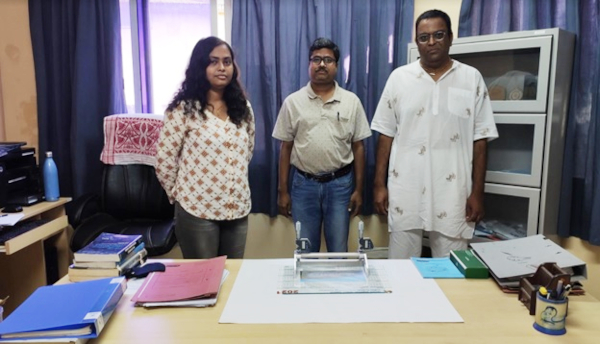
Dr. C. Bhagyanathan, Associate Professor from Sri Ramakrishna Engineering College, Coimbatore along with Dr. P. Karuppuswamy, Professor Sri Ramakrishna Engineering College and Dr. M. Ravi, Sr. Principal Scientist, CSIR-NIIST Trivandrum developed a technology system that could combine value added / non-value added and hazardous / non-hazardous wastes, aluminium alloys and assorted scraps for industrial applications and recycle them efficiently. The technology was developed with support from the Advanced Manufacturing Technologies programme of the Department of Science & Technology (DST), Government of India aligned with the ‘Make in India’ initiative. The developed technology can be used in tiny & cottage Industries, Small Scale Industries and MSME Aluminium foundries and recycling industries.

Satellite-Based Real-Time Monitoring of Himalayan Glacial Catchments can Strengthen Early Flood Warning

This should be the future strategy to reduce loss of human lives during glacial lake outburst floods (GLOF), said a study carried out by scientists from IIT Kanpur. The study carried out by Dr. Tanuj Shukla and Prof. Indra Sekhar Sen, Associate Professor from IIT Kanpur, with support from the Department of Science & Technology, Government of India, has been published in the international journal ‘Science’.

Rhino Count in Manas Touches 48 After Being Wiped Out in 2005

“The recovery is one of the biggest achievements as there was not a single casualty in the translocation. The current rhino population in Manas is 48 in the core area of 500 square kilometer of the park and there has been no case of poaching as well in the past four and half years. Before 2016, 10 rhinos were poached,” Manas Tiger Reserve field director Amal Sarmah told TOI.