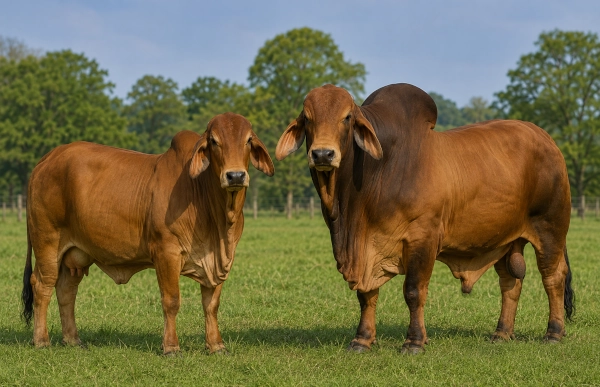
The Brahman is among the world’s most recognisable cattle breeds, distinguished by its prominent shoulder hump, loose skin, long ears and remarkable ability to remain productive in hot and humid conditions. Its appearance and environmental resilience clearly reflect the Indian zebu cattle from which it descended.
Although its genetic foundations came from India, the modern American Brahman was formally developed in the United States. It is therefore best described as an American cattle breed created primarily from Indian Bos indicus ancestry rather than as a separate indigenous breed originating within India.
Origins of the Brahman Breed
The development of the Brahman began when small numbers of Indian zebu cattle were introduced into the United States during the nineteenth and early twentieth centuries. Between 1854 and 1926, approximately 266 bulls and 22 females representing different Bos indicus types formed the principal foundation of the breed.
These cattle were valued for qualities developed through generations of adaptation to tropical India, including tolerance of heat, resistance to insects and parasites, the ability to travel in search of food and water, and survival under variable climatic conditions.
The American Brahman Breeders Association was established in 1924. J.W. Sartwelle, its first recording secretary, proposed the name “Brahman,” and breeders subsequently created a formal standard to develop a consistent animal combining environmental resilience, strength, fertility and commercial usefulness.
The Indian Breeds Behind the Brahman
The principal Indian cattle types used in developing the Brahman were the Gir, Guzerat, Nellore and Krishna Valley. The Guzerat developed from Indian Kankrej cattle, while the Nellore represented cattle derived from the Ongole breed of Andhra Pradesh.
The Gir came from Gujarat’s Kathiawar region and contributed tropical adaptability and distinctive physical characteristics. The Kankrej, another important Gujarat breed, was valued for strength, endurance and its ability to work under demanding conditions.
Ongole cattle originated in the coastal region of present-day Andhra Pradesh. Their large frame, muscular build, heat tolerance and capacity for sustained work made their genetics highly valuable beyond India. Ongole-derived cattle later influenced both the American Brahman and Brazil’s Nelore population.
Krishna Valley cattle, associated with the river valleys of northern Karnataka and adjoining areas, were developed for heavy agricultural work in difficult black-cotton soils. Their contribution to the Brahman foundation was smaller, yet it added another element of Indian draught strength and environmental adaptability.
The Brahman consequently represents a carefully selected combination of several Indian zebu traditions rather than the overseas continuation of any single Indian breed.
How to Identify Brahman Cattle
The most prominent identifying feature of Brahman cattle is the muscular hump positioned above the shoulders. The hump is generally larger and more pronounced in bulls, while cows possess a smaller and more oval-shaped hump.
The head is moderately long, with a broad muzzle, open nostrils and widely placed eyes. The ears are usually large and pendulous. Horns emerge from a broad base and commonly curve upwards, sometimes turning slightly backwards.
A well-developed dewlap extends from the lower jaw towards the chest. Loose, pliable skin is also visible beneath the body. These folds contribute to the breed’s characteristic appearance and increase the surface area available for releasing body heat.
Brahman cattle usually occur in varying shades of grey or red. Grey animals may range from pale silver to dark grey, while red Brahmans range from light reddish brown to deep red. Mature bulls are commonly darker around the neck, shoulders and thighs than cows of the same colour group. The muzzle, hooves and tail switch generally carry dark pigmentation.
The body should appear strong and balanced, with a broad back, muscular hindquarters, sound legs and well-formed feet. The official breed standard describes the desired temperament as alert yet docile.
Built for Hot Climates
The Brahman’s greatest international reputation comes from its ability to withstand tropical heat. Several physical and physiological characteristics work together to regulate body temperature.
Its short and glossy coat reflects a considerable portion of the sun’s radiation. Dark skin pigmentation beneath the coat protects deeper tissues from intense sunlight, while the loose skin increases the body surface available for cooling.
Brahman cattle also possess an effective sweating response. Their developed sweat glands allow heat to escape through evaporation, helping them continue grazing and moving during conditions that can reduce the activity and appetite of many European cattle breeds.
The skin produces an oily secretion that has traditionally been associated with reduced irritation from some insects. The breed’s capacity to tolerate parasites and difficult tropical environments contributed greatly to its expansion across regions where conventional temperate cattle frequently struggle.
Brahman cattle can also adjust to cooler conditions by producing a longer and denser seasonal coat. Their strongest advantage, however, remains their performance in hot, humid and drought-prone regions.
Behaviour and Handling
Brahman cattle are intelligent, observant and highly responsive to their surroundings. Their alertness may occasionally be mistaken for aggression, particularly when animals have received limited human contact.
Calm and regular handling generally produces manageable animals. They remember both positive and stressful experiences, making patient stockmanship especially important. Well-bred animals raised with consistent care can become quiet and easy to work with.
Their natural caution was valuable in difficult environments where awareness of predators, unfamiliar movement and changing conditions aided survival. Modern breeders select for sound temperament alongside structure, fertility and performance.
Maternal Qualities and Longevity
Brahman cows are recognised for their protective maternal behaviour and ability to raise calves under demanding climatic conditions. Their environmental adaptability allows them to maintain reproduction in regions affected by heat, seasonal forage shortages and high parasite pressure.
The breed is also associated with a long productive life. Females capable of calving regularly and raising healthy offspring over many years provide particular value in extensive livestock systems where replacement animals are expensive to produce.
The American Brahman Breeders Association evaluates maternal performance through records covering fertility, calving intervals, offspring growth and long-term productivity.
Importance in Crossbreeding
A major part of the Brahman’s global influence comes from its use in crossbreeding. When crossed with European Bos taurus breeds, Brahman cattle can pass heat tolerance, parasite resistance, longevity and environmental adaptability to their offspring.
The first-generation offspring are commonly known as Brahman F1 cattle. Such crosses are widely used in warm regions to combine the adaptability of zebu cattle with selected production qualities of European breeds.
Brahman genetics have also contributed to the creation of recognised composite breeds, including Brangus, which combines Brahman and Angus ancestry, and Simbrah, developed from Brahman and Simmental cattle.
This crossbreeding role has helped Brahman genetics spread through the Americas, Australia, southern Africa and several tropical regions of Asia.
A Global Reminder of India’s Animal Heritage
The success of the Brahman illustrates the worldwide importance of India’s indigenous cattle diversity. Indian zebu breeds evolved within markedly different landscapes—from Gujarat’s dry tracts and the Gir region to the coastal plains of Andhra Pradesh and the heavy soils of the Krishna basin.
Farmers and pastoral communities preserved animals capable of working, reproducing and surviving within these local conditions. When some of those cattle were taken overseas, their inherited adaptability became the foundation of an internationally important breed.
The modern Brahman belongs to American livestock history, while its biological foundations remain inseparable from India. Its hump, pigmentation, loose skin, heat tolerance and endurance carry the legacy of Gir, Kankrej, Ongole and Krishna Valley cattle.
The Brahman deserves recognition as a global breed built upon Indian zebu genetics. Its story demonstrates how animal genetic resources developed by Indian farming communities travelled across continents and reshaped cattle production throughout the tropical world.
References
American Brahman Breeders Association. “Breed History: The Development of the American Brahman.”
https://brahman.org/about/breed-history/
American Brahman Breeders Association. “Standard of Excellence for American Brahman Cattle.”
https://brahman.org/genetics/standard-of-excellence/
American Brahman Breeders Association. “Why Brahman: Adaptability, Maternal Strength and Hybrid Vigour.”
https://brahman.org/about/why-brahman/
Oklahoma State University. “Brahman Cattle.” Breeds of Livestock, Department of Animal and Food Sciences.
https://breeds.okstate.edu/cattle/brahman-cattle
ICAR–National Bureau of Animal Genetic Resources. “Cattle Breeds of India.”
https://nbagr.res.in/cattle-breed
Food and Agriculture Organization of the United Nations. “The Ongole Cattle: A Versatile Resource for the Tropics.”
https://www.fao.org/4/v0600t/v0600T04.htm
Food and Agriculture Organization of the United Nations. “Zebu Cattle of India and Pakistan.”
https://www.fao.org/4/an469e/an469e00.pdf
You may also like
-
Mizoram Adds Two New Amphibians as Scientists Uncover Hidden Diversity in Northeast India
-
New Metallic Golden-Green Beetle Species Discovered in Wayanad Wildlife Sanctuary
-
ZSI Publishes Major Faunal Inventory of Visakhapatnam as Urban Biodiversity Comes Into Focus
-
Rare Tibetan Fish Recorded in India for First Time From Arunachal’s High-Altitude Lake
-
India Produces Badri Calf Through OPU-IVF, Opening New Route for Conserving Uttarakhand’s Indigenous Cattle
