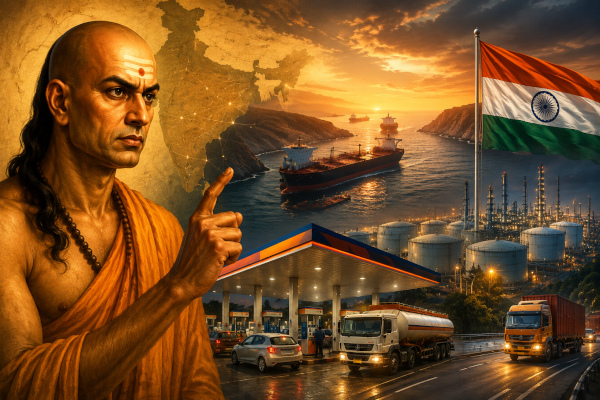
When the West Asia crisis and the fallout of the Hormuz disruption began to disturb global energy flows, India faced a familiar strategic test in a modern form. Fuel is not merely a commodity. Petrol and diesel touch transport, agriculture, industry, logistics, food supply, household movement and the daily rhythm of the economy. Any disruption in fuel distribution can quickly move from market anxiety to public disorder.
India’s response to the fuel situation showed a calibrated model of crisis management. The Government kept retail petrol and diesel prices stable to shield ordinary consumers from the sharp increase in international fuel prices. At the same time, it recognised that a wide price difference had emerged between retail fuel prices and bulk-consumer prices. Some industrial, commercial and institutional buyers began procuring fuel through normal retail outlets, creating risks of diversion, hoarding and black marketing.
The response was firm but temporary. From 12 June 2026, the Government placed a daily limit of 200 litres of High Speed Diesel per customer or vehicle at retail outlets and directed industrial, institutional and commercial consumers to procure fuel through designated consumer pumps. The objective was clear: protect retail consumers, prevent diversion and maintain equitable distribution. Once the supply situation improved, the Government withdrew the temporary restrictions with effect from 1 July 2026.
This sequence carries a distinctly Chanakyan imprint. It reflects the old Indian logic of statecraft: prepare for crisis, protect the people, restrain exploitative behaviour, maintain economic order and withdraw extraordinary controls once normalcy returns.
Chanakya Niti says:
“आपदर्थे धनं रक्षेत्”
“One should preserve resources for times of calamity.”
This principle lies at the heart of crisis governance. A state must not wait for scarcity to become visible on the street. It must prepare for pressure before pressure becomes panic. During an energy shock, public confidence is as important as physical supply. By maintaining retail price stability and regulating unusual demand at retail outlets, India acted before the fuel market could become distorted beyond control.
A second Chanakya Niti verse deepens this idea:
“आपदर्थे धनं रक्षेच्छ्रीमतां कुत आपदः ।
कदाचिच्चलते लक्ष्मीः सञ्चितोऽपि विनश्यति ॥”
“Save wealth against future calamity. Do not think that prosperity is permanent; even accumulated wealth can disappear.”
The lesson is simple: a nation cannot assume that global supply chains will always remain smooth. The Strait of Hormuz is one of the world’s most sensitive energy arteries. When such a route comes under stress, the shock travels through prices, insurance costs, freight movement, import planning and domestic distribution. Chanakya’s warning about the instability of fortune applies powerfully to energy security. Wealth, supply and comfort must be protected through foresight.
India’s handling of the fuel situation was not only about fuel. It was about preventing a chain reaction. If bulk buyers moved aggressively into retail pumps, ordinary vehicle owners, farmers, small transporters and local businesses could have faced supply pressure. A temporary cap on diesel sales was therefore not merely an administrative order. It was a protective shield for the common consumer.
Chanakya Niti gives another relevant line:
“त्यजेदेकं कुलस्यार्थे ग्रामस्यार्थे कुलं त्यजेत् ।
ग्रामं जनपदस्यार्थे आत्मार्थे पृथिवीं त्यजेत् ॥”
“Give up one for the sake of the family; give up a family for the sake of the village; give up a village for the sake of the country.”
In modern governance, this can be read as the principle of proportionate sacrifice for the larger public good. During the fuel disruption, certain large consumers were asked to move away from ordinary retail channels and use designated consumer pumps. This was not a punishment of industry. It was a prioritisation of national distribution discipline. A small inconvenience for bulk users helped protect the wider retail network.
This is where Chanakya’s realism becomes useful. In times of disruption, the state cannot treat every category of demand in the same way. A private car, a farmer’s tractor, a goods vehicle, a hospital generator, a factory and a bulk institutional buyer may all need fuel, but their procurement channels and public impact are not identical. Good governance separates these categories and manages them with precision.
Chanakya Niti also says:
“मन्त्रेण रक्षयेद्गूढं कार्ये चापि नियोजयेत्।”
“Protect a plan with counsel and put it into action with determination.”
This captures the strategic nature of India’s response. The Government did not announce panic measures. It introduced specific, limited and clearly defined restrictions. The order addressed the real point of distortion: bulk-like procurement from retail outlets. It did not disturb the entire retail system. It did not create a permanent control regime. It acted at the exact pressure point.
The temporary diesel limit of 200 litres per customer or vehicle per day was a classic crisis-control measure. It prevented abnormal lifting, discouraged hoarding and reduced the incentive for black marketing. In Chanakyan language, this is the use of disciplined authority to protect social order.
Chanakya Niti says:
“उद्योगे नास्ति दारिद्र्यं… नास्ति जागरिते भयम्।”
“There is no poverty for the industrious; there is no fear for those who remain alert.”
The most important word here is “jagarite” — alertness. A sleeping state reacts late. An alert state acts early. India’s fuel measures showed alertness to market behaviour. The government saw that stable retail prices, while protecting citizens, had created a price gap that could be exploited by bulk consumers. Instead of allowing that gap to create disorder, it intervened.
There is another Chanakyan lesson at play: excess must be avoided. Chanakya Niti says:
“अतिसर्वत्र वर्जयेत्।”
“Excess should be avoided everywhere.”
This applies beautifully to the fuel decision. The Government avoided two extremes. It did not allow uncontrolled procurement from retail pumps. It also did not keep emergency restrictions longer than necessary. Once the supply situation improved, the restrictions were withdrawn from 1 July 2026. That withdrawal is as important as the restriction itself.
Many governments know how to impose controls. Fewer know when to remove them. Chanakyan statecraft values timing. A ruler must know when to tighten and when to release. A temporary crisis requires temporary discipline, not permanent overreach. India’s withdrawal of the order after review showed that the measure was designed for stability, not for control as an end in itself.
The same logic appears in another Chanakya Niti verse:
“उपसर्गेऽन्यचक्रे च दुर्भिक्षे च भयावहे ।
असाधुजनसम्पर्के यः पलायेत्स जीवति ॥”
“He who moves away from calamity, invasion, famine and the company of harmful people survives.”
In a modern policy reading, this verse is about risk avoidance. A wise person, institution or state does not walk blindly into danger. It changes course, avoids destructive exposure and preserves life. India’s fuel response did exactly that. It avoided the danger of retail fuel diversion. It avoided panic buying. It avoided allowing black marketing to shape public access. It avoided a situation where ordinary citizens would stand in uncertainty while larger buyers absorbed retail stocks.
The Government’s action also reflected the larger Chanakyan principle of protecting the economic base. Fuel distribution is directly connected to national productivity. If diesel supply is disrupted, trucks slow down, farm operations are affected, supply chains tighten and prices can rise across sectors. By ensuring availability at retail outlets, the state protected the everyday arteries of the economy.
Here, one may also recall the broader Chanakyan statecraft tradition from the Arthashastra:
“प्रजा सुखे सुखं राज्ञः प्रजानां च हिते हितम्।”
“In the happiness of the people lies the ruler’s happiness; in their welfare lies his welfare.”
This is often quoted as the heart of Indian governance philosophy. The fuel response fits that spirit. The state absorbed international pressure to maintain stable retail prices. It acted against hoarding and diversion. It preserved access for ordinary citizens. It then withdrew controls when normal supply arrangements could resume.
The Hormuz fallout was a reminder that energy security is not only about crude oil import contracts or refinery capacity. It is also about distribution ethics. A country may have fuel in the system, but if the distribution channels are distorted, the common citizen still suffers. Chanakya understood this deeply in the language of his time: the treasury, trade, grain, roads, fortifications and public order were all connected. In today’s language, fuel, logistics, pricing, consumer protection and supply-chain discipline are connected.
India’s response therefore offers a modern case study in ancient strategic wisdom. The state did not merely react to international volatility. It managed the domestic consequences of that volatility. It separated retail consumers from bulk buyers. It discouraged exploitation. It used temporary authority in a limited manner. It reviewed the situation and restored normal supply channels.
That is why the episode can be described as Chanakyan in spirit.
It had foresight before panic.
It had discipline before disorder.
It had protection before profiteering.
It had restraint before excess.
It had withdrawal after stability.
The lesson is powerful. In times of global crisis, the strength of a nation is tested not only at its borders or ports, but also at its petrol pumps, markets and public distribution systems. Chanakya’s wisdom reminds us that governance is the art of seeing danger before it becomes visible to everyone, acting before disorder spreads and returning to normalcy once the danger has passed.
India’s fuel-crisis management during the Hormuz fallout showed precisely that: a modern state using ancient principles of prudence, public welfare and strategic restraint.
You may also like
-
Ayush Patent Filings Rise Eightfold as India Records 4,077 Applications and 711 Grants in 12 Years
-
DRDO Announces Paid Research Internships at Gwalior for Science and Engineering Students
-
PM-SETU: Government Approves ₹1,194.92 Crore to Modernise 25 ITIs Across Maharashtra, Odisha and Jammu & Kashmir
-
Indian Railways Announces 3,548 NTPC Graduate Vacancies, Applications Open Until November 6, 2026
-
National Institute of Naturopathy Opens Admissions for BNYS Programme at Pune for 2026–27
