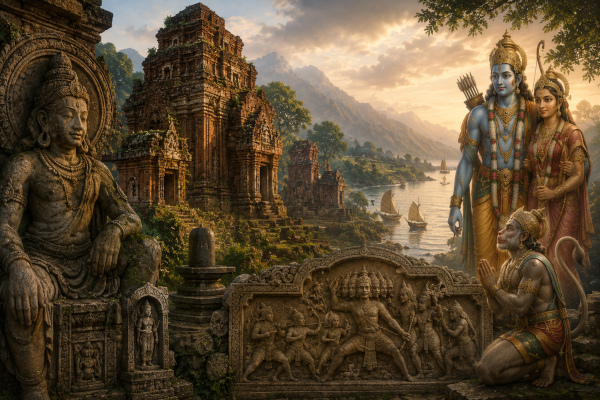
Vietnam’s connection with the Ramayana is one of the most fascinating but less widely discussed chapters in the story of India’s civilisational influence across Asia. Unlike Thailand, Cambodia or Indonesia, Vietnam did not develop a large public Ramayana performance tradition that dominates national culture today. Yet the Ramayana reached Vietnam through the ancient Champa civilisation, Hindu temple worship, Sanskritic culture, maritime trade and sacred art. Its presence can be felt most strongly in the old Cham world of central and southern Vietnam, where Indian religious ideas were absorbed into local culture and expressed through temples, sculptures and inscriptions.
The ancient Champa kingdom flourished along the coast of present-day central and southern Vietnam for many centuries. Located on important maritime routes between India, China and Southeast Asia, Champa became a powerful cultural meeting ground. Indian merchants, priests, scholars and maritime networks carried Sanskrit, Hinduism, Buddhism, temple architecture, royal rituals and epic traditions into the Cham world. Over time, the Cham people created their own refined civilisation, blending Indic religious ideas with local Austronesian culture.
The strongest visible evidence of this connection is Mỹ Sơn Sanctuary in Quảng Nam province. UNESCO describes Mỹ Sơn as a sacred Hindu temple complex dating from the 4th to the 13th centuries CE, located in a mountain basin connected with the Thu Bon river system. The site was one of the most important religious centres of the Champa kingdom and is especially associated with the worship of Shiva.
Mỹ Sơn shows how deeply Hindu sacred ideas had entered Champa. The temples were built in brick and decorated with sandstone sculptures, lintels, divine images and sacred symbols. The site was not simply an imported Indian model. It was a Vietnamese-Cham creation shaped by local artistic skill, local kingship and local sacred geography. Google Arts & Culture notes that the Champa culture of coastal Vietnam drew spiritual origins from Hinduism of the Indian subcontinent, and temples were built for Hindu divinities such as Krishna, Vishnu and above all Shiva.
This gives Vietnam’s Ramayana connection a special character. The Ramayana entered Vietnam through a culture where Shiva worship was dominant, Vishnu was also honoured, and Indic sacred stories circulated through temple art and elite religious life. Since Rama is an avatar of Vishnu, his story belonged naturally to the wider Vaishnava imagination that travelled with Hinduism. Even where full Ramayana retellings are less visible today, the religious world that carried the Ramayana was clearly present.
The Cham religious landscape placed Shiva at the centre. Shiva was worshipped through linga, temple sanctuaries and royal cults. This emphasis is visible at Mỹ Sơn, where many temples were dedicated to Shiva. In the Cham world, Shiva was not only a deity of ascetic power and cosmic transformation; he was also connected with kingship, protection and sacred legitimacy. Cham rulers used Hindu symbols to express royal authority and divine sanction.
Vishnu also had an important place in the Indic religious culture of Vietnam. Vishnu’s presence matters deeply for the Ramayana because Rama is one of Vishnu’s great incarnations. In Hindu theology, Rama appears when dharma must be restored, when royal virtue must be demonstrated, and when the world requires righteous order. The presence of Vishnu in Cham religious art created a natural space for Ramayana themes, even when surviving evidence is fragmentary.
Krishna, another avatar of Vishnu, also appears in the broader Hindu religious influence in Champa. The presence of Krishna and Vishnu shows that the Cham world was familiar with Vaishnava sacred thought. This Vaishnava environment would have allowed stories of Rama, Krishna and other Vishnu-linked traditions to circulate among priests, artists, elites and temple communities.
The Cham pantheon also included Brahma, Devi, Shakti forms, Lakshmi and guardian figures. The Metropolitan Museum of Art identifies a 10th-century stone sculpture from Vietnam’s Champa culture as “Standing Shiva or Temple Guardian,” showing how Cham religious art preserved powerful Hindu forms in stone. Such works demonstrate that Vietnam’s ancient Hindu culture was not superficial. It had a developed sculptural vocabulary, temple ritual system and sacred imagination.
Lakshmi is especially important when comparing Ramayana deities with Cham-Vietnamese Hindu culture. In the Indian tradition, Sita is often understood as an earthly manifestation of Lakshmi, the goddess of fortune, fertility, auspiciousness and royal grace. Cham art includes Lakshmi images, and this creates a meaningful cultural bridge. Where Lakshmi was honoured, the deeper symbolism of Sita as prosperity, purity and sacred feminine strength could be understood within the same spiritual family.
Sita’s role in the Ramayana also resonates with agrarian and fertility symbolism. She is born of the earth, connected with ploughing, purity and abundance. In a coastal and agricultural civilisation such as Champa, where sacred kingship, fertility, rivers and temple ritual were important, Sita’s symbolism would have carried natural cultural meaning.
Hanuman’s presence in Vietnam is less prominent than in countries like Thailand, Cambodia or Indonesia. There is no major Vietnamese public Hanuman tradition comparable to Thai Khon dance or Indonesian Wayang Kulit. Yet Hanuman belongs to the larger Ramayana world that travelled across Southeast Asia. In Champa’s Indic artistic environment, vanara, guardian and heroic motifs could have circulated through temple storytelling and regional contact with neighbouring Hindu-Buddhist cultures.
Ravana also deserves careful comparison. In the Ramayana, Ravana is a complex figure: powerful, learned, devoted to Shiva, yet destroyed by pride and adharma. This makes him particularly interesting in a Cham context where Shiva worship was central. Ravana’s devotion to Shiva would have been intelligible in a Shaiva cultural world. At the same time, the Ramayana’s moral lesson remains clear: knowledge and power must be guided by dharma.
This is one of the strongest ways to understand the Ramayana in Vietnam. The epic’s moral universe matched the religious grammar of Champa. Shiva, Vishnu, Lakshmi, divine guardians, sacred mountains, royal rituals and temple worship all formed a shared Indic framework. Within that framework, the Ramayana’s themes of dharma, kingship, loyalty, exile, war, devotion and restoration of order had a meaningful place.
Vietnam’s Cham culture also had strong links with South Indian forms of Hinduism. Scholars have often noted parallels between Cham temple architecture and South Indian temple traditions. This is important because South India played a major role in transmitting Hinduism, Sanskritic rituals and maritime cultural influence across Southeast Asia. Through these southern maritime routes, stories of Rama and other Indic deities could travel alongside trade, ritual specialists and artistic styles.
The route from Bharat to Vietnam was therefore not a single event. It was a centuries-long movement across the sea. Ships carried goods, but they also carried sacred ideas. Ports carried commerce, but they also carried priests, artisans, inscriptions and stories. Champa received these influences and created something original from them.
The result was a beautiful cultural synthesis. Cham temples are neither purely Indian nor purely local in a narrow sense. They are living evidence of exchange. Their brick towers, sandstone carvings, linga shrines, divine figures and inscriptions show how the Cham people absorbed Indic knowledge and transformed it through their own artistic genius.
Mỹ Sơn is the best surviving symbol of this synthesis. Its temples stand among mountains, forests and river-linked landscapes, creating a sacred setting that recalls Indian ideas of temple geography while remaining deeply rooted in Vietnam’s land. The sanctuary’s location in a natural basin adds to its spiritual character. It is a place where landscape, kingship and divinity meet.
The Ramayana’s place in Vietnam must therefore be understood through cultural roots rather than only through surviving literary manuscripts. Vietnam’s Ramayana connection is embedded in Champa’s Hindu civilisation, especially the sacred relationship between Shiva, Vishnu, Lakshmi and royal temple culture. Rama’s world reached Vietnam through the same routes that carried Shaiva and Vaishnava worship.
This makes Vietnam an important part of the Ramayana beyond borders series. It reminds us that the epic did not always travel in the same form. In some countries it became a national dance-drama. In others it became temple murals. In Vietnam, it appears through the deeper Indic foundations of Champa: temple architecture, Hindu deities, Sanskritic kingship, sacred art and maritime exchange.
The comparison between Ramayana deities and Cham-Vietnamese sacred culture reveals a rich pattern. Rama connects with Vishnu and righteous kingship. Sita connects with Lakshmi, fertility and sacred feminine grace. Hanuman connects with devotion, service and heroic guardianship. Ravana connects with the warning that spiritual knowledge and power must remain under dharma. Shiva connects with the Cham royal cult and also with the Ramayana’s deeper theological world, where even powerful beings must submit to cosmic order.
The Cham experience also shows the generosity of Indian civilisation. Bharat’s ideas travelled across the sea, but they did not erase local culture. They entered Vietnam and became Cham. The temples, sculptures and rituals were shaped by local hands, local imagination and local political life. This is the beauty of cultural exchange: the source remains visible, while the receiving culture creates its own expression.
Today, Vietnam’s Hindu-Cham heritage remains a powerful reminder of ancient India-Vietnam links. Mỹ Sơn Sanctuary, Cham sculptures, Sanskrit inscriptions and museum collections continue to tell the story of a time when the coast of Vietnam was part of a great Indic cultural ocean. The Ramayana belongs to that ocean of memory.
In a positive civilisational sense, Vietnam’s Ramayana connection shows how dharma travelled through art and devotion. It shows that Rama’s world was not confined by geography. Wherever Vishnu was honoured, wherever Shiva temples rose, wherever Sanskritic culture shaped kingship and worship, the ethical imagination of the Ramayana could find a home.
Vietnam’s chapter in the Ramayana story is quiet but profound. It is carved in brick, stone and sacred memory. It lives in the ruins of Mỹ Sơn, in the legacy of Champa, in the presence of Shiva and Vishnu, and in the cultural bridge that once connected Bharat with the shores of Vietnam.
You may also like
-
India and UK Expand Defence Partnership With Joint Exercises, R&D and Ten-Year Industrial Roadmap
-
India and Mauritius Sign Oil and Gas Cooperation Pact, Deepen Long-Term Energy Partnership
-
India, US Armies Set for Major Yudh Abhyas Drill Near China Border in Uttarakhand
-
Avanti in the Mahabharata: The Ancient Kingdom of Ujjain and the Malwa Region
-
Jaishankar to Visit Russia for 27th IRIGC-TEC as India and Russia Push Trade, Technology and Economic Cooperation
