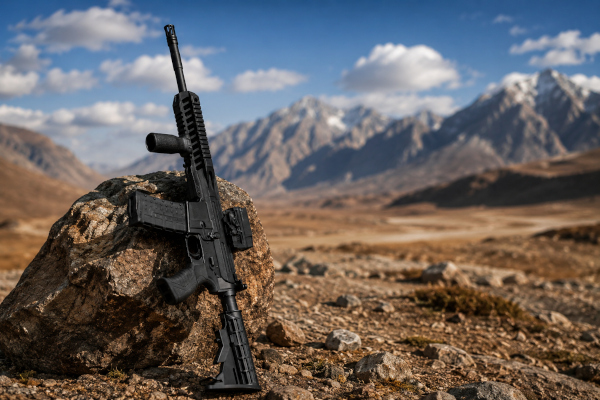
Uttar Pradesh Police has reportedly inducted 2,000 made-in-India M72 carbines from Bengaluru-based SSS Defence, marking another important step in the modernisation of state police firepower and India’s growing private-sector role in small-arms manufacturing. The carbines are chambered for 5.56×45 mm, a NATO-standard calibre widely used in modern military and law-enforcement firearms.
The delivery is being described as part of a broader police modernisation push aimed at replacing older weapons with lighter, more compact and more responsive firearms suited for contemporary security duties. Reports say the order was originally awarded in March 2025, and the handover of 2,000 units has now been completed.
The M72 is positioned as a compact carbine intended for close-quarter and rapid-response use. For a state police force, that matters because modern policing is no longer limited to conventional law-and-order deployments. Armed police units may be required for counter-terror response, high-risk urban operations, VIP security, anti-gang operations, protection of critical infrastructure and emergency interventions in crowded environments. A compact carbine gives personnel a weapon that is easier to handle in vehicles, buildings, narrow lanes and dense urban spaces compared with longer legacy rifles.
SSS Defence’s official product portfolio lists the M72 NATO as a 5.56×45 mm platform and also lists the M72-i INSAS in the same calibre family. The company presents itself as a fully integrated Indian small-arms original equipment manufacturer, with products covering carbines, assault platforms, submachine guns, sniper systems, shotguns, barrels, suppressors and upgrade kits.
The significance of the UP Police induction goes beyond the number of weapons. For decades, India’s small-arms ecosystem was dominated by government factories, imports and licensed production. The rise of private Indian firms such as SSS Defence shows a shift toward domestic design, testing, certification and manufacturing. India Today reported that SSS Defence CEO Vivek Krishnan described the M72, G72 and P72 family as completely indigenous platforms, designed and manufactured without foreign technology transfer.
The company also links the M72 name with former Defence Minister Manohar Parrikar, whose tenure is often associated with reforms that opened space for private participation in India’s defence manufacturing ecosystem. Reports say the “M” in M72 is a tribute to Parrikar, while the 72 family includes other platforms such as the G72 submachine gun and P72 rifle family.
For Uttar Pradesh Police, the induction is important because the force operates in one of India’s largest and most complex internal-security environments. A large state police organisation needs weapons that can support routine armed duties as well as specialised response roles. The M72’s reported compact form, 5.56 mm chambering and compatibility with modern accessories make it more suitable for today’s tactical policing requirements than many older weapons designed for a different era of security threats.
The development also fits into the wider Atmanirbhar Bharat narrative in security equipment. Indigenous small arms are not as glamorous as missiles, aircraft or warships, but they matter enormously at the operational level. Every police commando, special response team and armed constable depends on reliable, ergonomic and maintainable firearms. If Indian manufacturers can deliver such systems at scale, it reduces import dependence and builds a domestic industrial base for future upgrades, ammunition compatibility, accessories and lifecycle support.
SSS Defence is already being reported as gaining traction with multiple Indian security users. India Today reported that Uttar Pradesh Police had inducted 2,000 M72 units, while Meghalaya Police and Haryana Police had also procured and inducted the weapon. The same report also said the company is looking at export opportunities and has submitted the M72 family for the United Kingdom’s infantry modernisation programme.
The UP Police order therefore represents more than a state-level procurement. It signals that Indian private small-arms manufacturing is beginning to move from exhibition halls and prototypes into real operational service. If the M72 performs well in field conditions, it could strengthen confidence in Indian-designed carbines and encourage more police, paramilitary and specialised units to evaluate domestic alternatives.
In the long run, this is exactly how a defence-industrial ecosystem matures: not only through big-ticket military contracts, but through repeated orders, field feedback, design improvements and operational trust. The induction of 2,000 M72 carbines by UP Police may look like a police modernisation story on the surface, but underneath it is part of a larger shift — India’s private defence industry is slowly entering the serious business of arming Indian security forces with weapons designed and built at home.
You may also like
-
INS Sahyadri and INS Kulish Reach Philippines for ADMM-Plus Maritime Cooperation
-
India’s Defence Production Hits Record ₹1.78 Lakh Crore as Private-Sector Share Rises to 24%
-
Former DRDO Chief Samir Kamat Confirms Akash Missile Exports to Tajikistan and Turkmenistan
-
MoD Signs ₹586 Crore Contract for Indigenous Auxiliary Power Units for T-72 and T-90 Tanks
-
India–Mongolia Joint Military Exercise Nomadic Elephant 2026 Begins in Pithoragarh
