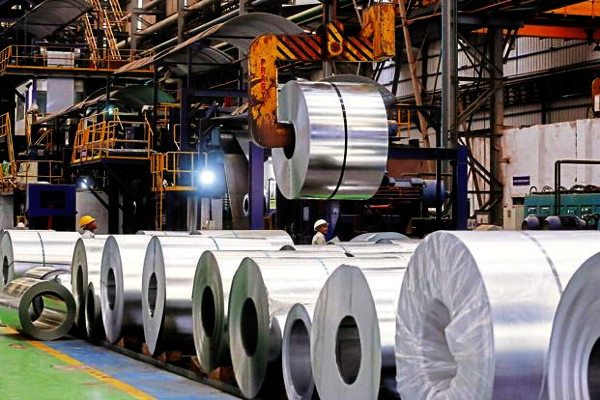
India’s steel industry has emerged as one of the strongest performers in the global metals market, with domestic crude steel output rising sharply even as several major producing economies struggled with weak demand, falling production and price uncertainty. According to the Centrum report cited by The Tribune, India’s crude steel production in March 2026 touched 15.3 million tonnes, with the report placing annual growth at around 11%. The same report said India’s FY26 crude steel production rose to about 167.8 million tonnes, underlining the country’s continued strength in a year when global steel markets remained under pressure.
The significance of India’s performance becomes clearer when placed against the global backdrop. World Steel Association data for March 2026 showed worldwide crude steel production at 159.9 million tonnes, down 4.2% year-on-year across 69 reporting countries. China, the world’s largest steel producer, produced 87 million tonnes in March but remained in contraction, while India stood out among the top producers with strong positive growth. Worldsteel’s own March data placed India’s output at 15.3 million tonnes, up 9.4%, and its January–March 2026 output at 44.7 million tonnes, up 10.8% year-on-year.
This makes India’s steel story more than a monthly production spike. It reflects a deeper structural shift driven by infrastructure spending, rail expansion, housing, automobiles, capital goods, manufacturing and rising domestic consumption. Worldsteel’s April 2026 short-range outlook described India as the fastest-growing major steel market, projecting steel demand growth of 7.4% in 2026 and 9.2% in 2027, supported by infrastructure-led construction, automotive demand, capital expenditure, rail network expansion and consumer durables.
The Centrum report also points to mixed price movements in April. Global steel prices strengthened in China, the United States and Europe, while India saw volatility after initial price hikes. Domestic hot-rolled coil prices reportedly rose around 3% month-on-month and 13% year-on-year, but later corrected partly because of slower trading at higher levels and cautious buying sentiment. Raw material costs also remained important: NMDC raised lump and fine ore prices by ₹200 per tonne in early May, while coking coal recovered after a previous correction.
India’s steel sector is benefiting from a policy and demand cycle that has been building for years. The National Steel Policy aims to build domestic crude steel capacity toward 300 million tonnes by 2030–31, while recent government communication has linked steel growth to self-reliance, infrastructure development and domestic industrial demand.
The broader message is clear: while global steel remains exposed to China’s slowdown, energy-price shocks, raw-material volatility and weak construction cycles in several economies, India is moving in the opposite direction. Its steel output is being pulled by domestic demand rather than only export dependence, giving producers a stronger cushion against global weakness. The next challenge will be to maintain this growth while managing input costs, import competition, logistics constraints and the need for cleaner steelmaking technologies.
You may also like
-
India’s Non-Fossil Power Capacity Overtakes Fossil Sources as Total Installed Capacity Reaches 552 GW
-
India Removes Registration Barrier for Export Shipments Up to ₹3 Lakh in Major MSME Trade Reform
-
Sber Says India-Russia Payments Now Settle Within Minutes as Local-Currency Trade Infrastructure Expands
-
Bengaluru’s Kerael Robotics Develops Indigenous Propulsion for Heavy-Lift UAV Platform Targeting 2,500-kg Payloads
-
India’s First Commercial Silicon-Carbide Fab Moves Ahead in Odisha With ₹3,406-Crore Investment
