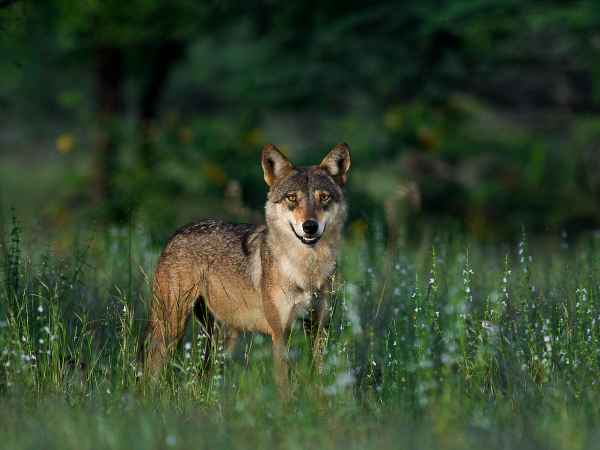
Indian and Tibetan wolves are emerging as some of the most evolutionarily important members of the global grey wolf family, with new genomic research showing that these populations carry ancient and highly distinct genetic lineages that have remained separate from other wolves for more than 100,000 years. The findings place southern Asia at the centre of grey wolf evolutionary history and raise fresh concerns about the survival of these rare wolf populations.
The study analysed wolf DNA from across Asia and found that the Indian, Tibetan and Holarctic wolf lineages form three major genetic groups. Unlike wolves in northern Asia, Europe and North America, which have often mixed genetically because wolves can travel across vast distances, the Indian and Tibetan lineages remained sharply distinct. This suggests that ancient climate shifts, glacial cycles and habitat changes may have separated these wolves long ago, leaving them with genetic identities found nowhere else.
For India, the research is especially important because the Indian wolf is not simply a local version of the common grey wolf seen in Europe or North America. It represents an old evolutionary branch with its own genetic history. The same is true of the Tibetan wolf, which survives in high-altitude landscapes linked to the Tibetan plateau and Himalayan regions. These wolves are living records of how the species adapted to different Asian landscapes over deep time.
The work also identifies southern Asia as a major hotspot of grey wolf diversity. Pakistan is particularly important because it is a contact zone where the Indian, Tibetan and Holarctic wolf lineages come close together. This makes the region one of the most genetically significant wolf landscapes in the world, offering clues about how species diverge, remain separate and sometimes exchange genes even when they live near one another.
The conservation message is urgent. Grey wolves as a species may be considered stable in a broad global sense, but that overall status hides the vulnerability of unique regional populations. The Indian wolf population is estimated at around 3,000 individuals and faces a high risk of extinction in the foreseeable future. Both Indian and Tibetan wolves are now treated as threatened under the International Union for Conservation of Nature framework.
Genomic evidence also shows that Indian and Tibetan wolves have some of the lowest levels of genetic diversity and some of the highest genetic burden among the populations studied. This reflects long-term isolation as well as more recent population decline and inbreeding. In simple terms, these wolves are ancient and unique, but their small and fragmented populations make them biologically fragile.
The Indian wolf faces intense pressure from habitat loss, shrinking grasslands, conflict with humans, decline of natural prey and poor public attention compared with more famous species such as tigers, leopards and elephants. Grassland species in India often suffer because their habitats are wrongly treated as “wastelands,” even though these open ecosystems support wolves, blackbuck, bustards, foxes and several pastoral communities.
The study changes how Indian and Tibetan wolves should be viewed. They are not peripheral populations of a widespread animal. They are ancient lineages carrying irreplaceable genetic information about the history of grey wolves. Losing them would mean losing a part of the species’ evolutionary memory.
For conservation policy, the message is clear: Indian and Tibetan wolves need targeted protection, not generic wolf conservation. Protecting grasslands, reducing human-wildlife conflict, maintaining prey bases, preventing further habitat fragmentation and recognising their genetic uniqueness should become central to future conservation planning. These wolves have survived ice-age landscapes, climatic shifts and thousands of years of ecological change. Their future now depends on whether modern conservation gives them the importance their DNA clearly proves they deserve.
Sources:
Rice University — Indian and Tibetan wolves found to have important, ancient genetics
https://news.rice.edu/news/2026/indian-and-tibetan-wolves-found-have-important-ancient-genetics
Communications Biology / Nature — Continent-wide view of genomic diversity and divergence in the wolves of Asia
https://www.nature.com/articles/s42003-025-09379-9
You may also like
-
West Bengal to Build ₹12-Crore Astro Park in Nadia and Regional Biotech Park in Kalimpong
-
IISc Researchers Design Selective Membranes to Recover Uranium From Seawater
-
Indian Scientists Show a Single Timed Operation Can Delay Quantum Entanglement Loss
-
Unusual Wave-like Heat Transport in Crystalline Solid Signals Breakthrough Converting Waste Heat in Industries
-
India Integrates 82.6 GHz Gyrotron With SST-1 Tokamak, Advancing High-Power Fusion Plasma Heating
