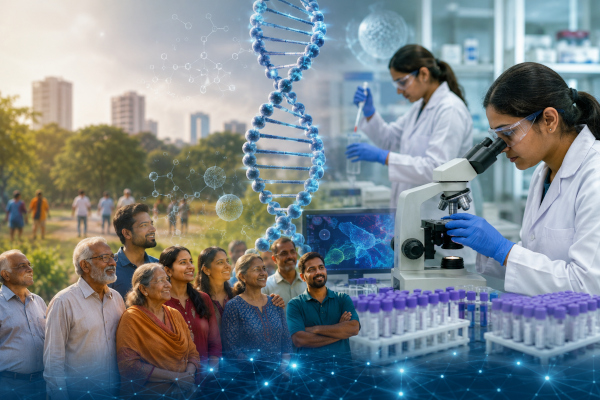
India has taken an important step in precision ageing research with the launch of the BHARAT Study, a large-scale scientific effort to identify biological markers linked to healthy ageing, resilience, frailty and age-related decline in the Indian population. The development was featured in Medical Dialogues’ Medical Bulletin dated 11 May 2026, which highlighted the study as India’s first large-scale search for ageing biomarkers.
The full name of BHARAT is Biomarkers of Healthy Aging, Resilience, Adversity, and Transitions. The study has been designed under the Longevity India initiative and is led by researchers associated with the Indian Institute of Science, Bengaluru. A peer-reviewed paper on the project, titled “The BHARAT study: a multi-modal, multi-omics investigation of aging signatures in the Indian population,” has been published in the journal Aging.
The importance of the project lies in a long-standing gap in global ageing science. Much of the world’s biological-ageing research, including molecular clocks, diagnostic reference ranges and longevity biomarkers, has been built using Western population datasets. Indian populations, despite their enormous diversity in genetics, diet, lifestyle, infection exposure, rural-urban conditions and socio-economic background, remain underrepresented in such research. The study notes that India’s elderly population is projected to reach 347 million by 2050, making India-specific ageing science a public-health necessity rather than an academic luxury.
BHARAT aims to develop and validate composite biological ageing signatures by integrating cellular, molecular, clinical and lifestyle data. Its objectives include identifying biomarkers linked to resilience and frailty, creating a frailty index tailored for Indian cohorts, building AI and machine-learning models for biological age, disease risk and mortality prediction, establishing an Indian biobank for ageing research and generating baseline values for biological features specific to India.
The study uses a hub-and-spoke model, with IISc serving as the central hub for biobanking, omics analysis, data integration and computational modelling. Partner hospitals and community organisations act as recruitment and sampling nodes. These include institutions such as MS Ramaiah Medical College, Bangalore Baptist Hospital, Sri Madhusudan Sai Institute of Medical Sciences and Research, Bangalore Medical College and Research Institute, and JSS Medical College, along with collaborators from healthcare, senior care, wellness and community networks.
What makes BHARAT scientifically significant is its multi-omics design. Instead of looking at only one marker, the study will examine several biological layers together, including epigenomics, proteomics, metabolomics, lipidomics, metagenomics, immune phenotyping and cellular ageing markers. Samples such as blood, serum, plasma, urine, stool, cheek swabs and hair will be processed and stored through a central biobanking system at IISc, allowing researchers to connect molecular signals with clinical, lifestyle and demographic data.
The project will study apparently healthy adults aged 18 years and above, with recruitment planned across different age groups, sexes, rural-urban backgrounds and dietary patterns. At present, four centres in Karnataka are operational, with approval to enrol 5,000 participants, and the design allows future expansion to more sites across India.
The long-term value of the BHARAT Study could be substantial. If successful, it may help India build its own biological-ageing reference standards, recalibrate ageing clocks for Indian populations, improve early prediction of disease risk and create more personalised strategies for healthy ageing. In a country where longevity is rising but age-related diseases are also increasing, the study could become a foundation for future geriatric medicine, preventive healthcare, diagnostics and public-health planning.
In simple terms, BHARAT is trying to answer a crucial question: how does India age biologically? The answer may not be the same as Europe, America or East Asia. By building population-specific ageing data, India is now attempting to move from imported health benchmarks to its own scientific map of ageing, resilience and long-term health.
You may also like
-
IISc Researchers Design Selective Membranes to Recover Uranium From Seawater
-
Before the Heart Falls Ill: The Ayurvedic Way of Protecting Hridaya Through Daily Living
-
Indian Scientists Show a Single Timed Operation Can Delay Quantum Entanglement Loss
-
Why Ayurveda Begins the Morning by Looking at the Tongue
-
Unusual Wave-like Heat Transport in Crystalline Solid Signals Breakthrough Converting Waste Heat in Industries
