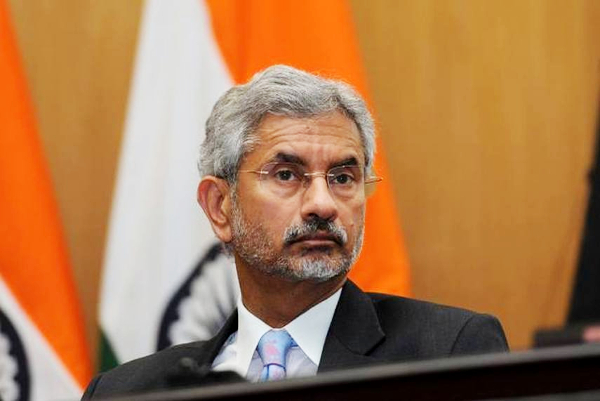
External Affairs Minister S. Jaishankar is set to inaugurate a special exhibition at the United Nations headquarters in New York highlighting India’s historic contribution to mathematics, astronomy and scientific thought. The exhibition, titled “From Shunya to Ananta (Zero to Infinity): The Indian Civilisation’s Contribution to Mathematics,” has been organised by India’s Permanent Mission to the UN and is designed to present India’s mathematical legacy as part of the shared intellectual heritage of humanity.
The exhibition traces more than 2,000 years of Indian mathematical traditions, beginning with foundational concepts such as shunya, or zero, and extending to ideas in infinity, algebraic methods, geometry, combinatorics and astronomical calculations. According to the reports, the showcase will highlight the work of major Indian scholars including Aryabhata, Brahmagupta, Bhaskara II and the Kerala School of astronomy and mathematics, placing them within the wider story of global scientific development.
The timing of the event is also diplomatically significant. Jaishankar’s New York stop comes after his official visit to Jamaica, Suriname and Trinidad and Tobago from May 2 to May 10, making the UN exhibition part of a wider outreach in which India is projecting not only its contemporary diplomatic priorities, but also its civilisational knowledge systems.
At the heart of the exhibition is the Indian idea of zero, one of the most transformative concepts in world mathematics. The concept of zero developed in India over centuries, and by the 7th century, the Indian mathematician-astronomer Brahmagupta treated zero as a number and formulated arithmetic rules for it. This breakthrough later helped shape modern arithmetic, the decimal place-value system, algebraic calculation and, eventually, the foundations of modern computing.
The exhibition also underlines a broader historical point: mathematics may be universal, but many of its key tools were shaped by Indian intellectual traditions before travelling through West Asia and into Europe. Indian decimal place-value numerals are recognised as ancestors of the modern decimal number system, while Brahmagupta’s work laid foundations in arithmetic and algebra.
For India, the exhibition is therefore more than a cultural display. It is a form of civilisational diplomacy, using the UN platform to remind the world that India’s knowledge systems were not limited to philosophy, spirituality or literature, but also included rigorous scientific and mathematical inquiry. In recent years, India has increasingly used international forums to highlight yoga, Ayurveda, linguistic heritage, traditional knowledge and ancient scientific traditions; this exhibition extends that outreach into the field of mathematics.
By taking the story of shunya to ananta to the United Nations, India is presenting its mathematical inheritance as a global legacy rather than a national museum piece. The message is clear: from zero and decimal notation to algebra, astronomy and computation, India’s intellectual past continues to live inside the numbers, algorithms and digital systems that shape the modern world.
You may also like
-
Mandapala and the Bird Family of Khandava — The Four Chicks Who Faced a Forest of Fire
-
NBEMS Announces Additional FMGE by October
-
Nahusha as a Python: When Bhima’s Strength Failed and Yudhishthira’s Wisdom Prevailed
-
IICT and Netflix Launch Scholarships for 100 Students to Build India’s Next Generation of AVGC-XR Talent
-
Bhima Meets Hanuman: When Strength Bowed Before Strength
