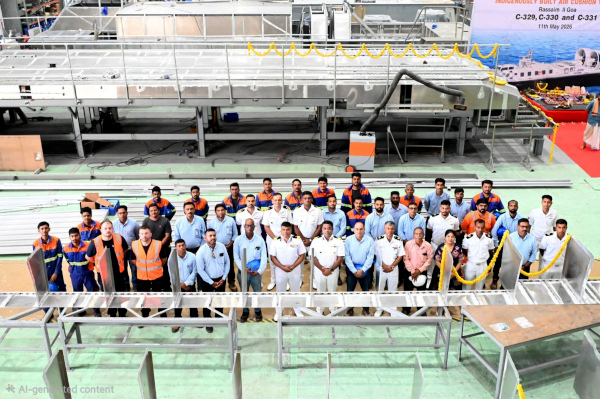
India’s coastal security modernisation received another boost on May 11, 2026, as the Indian Coast Guard conducted the Girder Laying Ceremony for the 4th, 5th and 6th Air Cushion Vehicles at the Rassaim Yard of Chowgule Shipyard in Goa. The ceremony marks an important production milestone in the Coast Guard’s programme to induct six indigenously fabricated and constructed Air Cushion Vehicles, strengthening India’s ability to patrol, respond and operate across some of the most challenging coastal and littoral environments.
The Ministry of Defence said the vessels are being manufactured in India under the Aatmanirbhar Bharat initiative with 50 percent indigenous material. This makes the programme significant not only as an operational upgrade for the Indian Coast Guard, but also as a step forward for domestic defence manufacturing and shipbuilding capability. At a time when India is placing greater emphasis on self-reliance in maritime platforms, the construction of these ACVs at an Indian yard reflects the growing role of local industry in delivering specialised assets for national security.
The contract for six Air Cushion Vehicles was signed with Chowgule & Company Private Limited, Goa, on October 24, 2024. These platforms are designed for multipurpose maritime roles and are expected to give the Indian Coast Guard greater speed, reach and flexibility in areas where conventional boats may face operational limitations. ACVs can operate over shallow waters, marshy areas and difficult coastal terrain, making them particularly useful for India’s vast coastline, island territories, river mouths, creeks and sensitive coastal zones.
Once inducted, the new ACVs will support high-speed coastal patrolling, reconnaissance, interception and interdiction missions. Their ability to operate by day and night will make them valuable for surveillance and quick-response duties, especially in areas where fast mobility is essential. The Coast Guard will also use these vehicles for search and rescue operations and for rendering assistance to ships and boats in distress, expanding its capacity to respond rapidly during maritime emergencies.
For the Indian Coast Guard, the induction of these modern air cushion vehicles comes at a time when coastal security demands are becoming more complex. India’s maritime domain includes busy shipping lanes, fishing zones, offshore assets, island territories, shallow coastal belts and ecologically sensitive areas. Platforms such as ACVs add a layer of strategic mobility by enabling operations across waters and terrain that are difficult for standard patrol craft. This gives the Coast Guard greater operational flexibility in surveillance, rescue and interdiction missions.
The programme also carries a broader industrial message. By building these vehicles in India with substantial indigenous content, the project supports the country’s push to create a stronger domestic defence production ecosystem. It brings together the requirements of the armed maritime force and the capabilities of Indian shipyards, helping reduce dependence on foreign suppliers for specialised coastal security platforms.
The Girder Laying Ceremony for the 4th, 5th and 6th ACVs therefore represents more than a construction milestone. It signals the steady progress of a strategically important platform that will enhance the Indian Coast Guard’s ability to safeguard India’s coastal zone with greater speed, adaptability and reach. As these vehicles move closer to induction, they are expected to become an important part of India’s expanding maritime security architecture.
Reference: PIB
You may also like
-
India’s Indigenous Sonar Ecosystem Powers New Generation of Indian Navy Warships
-
Murshidabad Becomes First West Bengal District to Complete Land Handover for India-Bangladesh Border Fencing
-
India’s LR-AShM Family Could Reach 3,500 Km as DRDO Develops Extended-Range Hypersonic Variants
-
Indian Composite Manufacturing Gets BrahMos Boost With ₹60-Crore Order to Allen Reinforced Plastics
-
HAL-Samtel Opens New Gurugram Facility to Expand Indigenous Defence Avionics and Display Manufacturing
