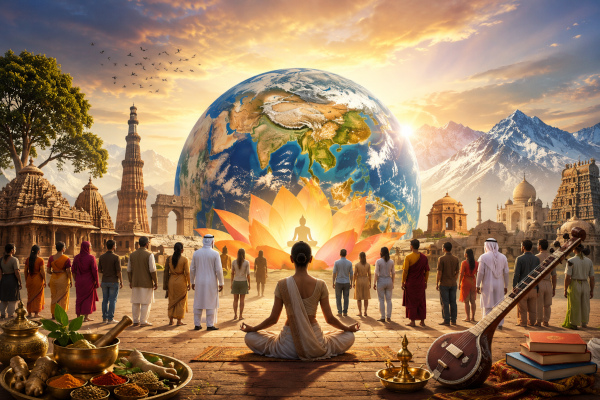
For decades, global powers have attempted to shape international influence through what political scientists call “soft power” — the ability to influence the world not through military force or economic coercion, but through attraction, culture, media, education, values, and perception. The United States projected Hollywood, global universities, technology culture, and liberal democratic ideals. Japan exported technological sophistication and pop culture. South Korea built a powerful cultural footprint through K-pop, cinema, and entertainment. China invested heavily in Confucius Institutes, infrastructure diplomacy, and state-backed global cultural outreach. India, however, appears to be evolving a very different model — one that may ultimately prove deeper, more emotionally resonant, and historically enduring than conventional soft power itself.
Rather than relying solely on entertainment, branding campaigns, or state-managed influence, India is increasingly drawing strength from something much older: civilisational continuity. This emerging form of outreach can best be described as “civilisational diplomacy” — the projection of an ancient and continuously evolving cultural ecosystem through spirituality, philosophy, wellness traditions, pluralism, historical memory, diaspora networks, democratic coexistence, and cultural confidence accumulated over thousands of years.
Unlike many modern nation-states whose identities are primarily rooted in recent political history, India carries one of the world’s oldest surviving civilisational traditions. This distinction matters enormously in global diplomacy because it gives India’s outreach a fundamentally different character. Most countries project culture. India projects continuity — the feeling of belonging to a civilisation that has survived invasions, colonialism, political fragmentation, religious diversity, technological transformation, and globalisation while still retaining a recognisable philosophical and cultural core.
This is one of the main reasons India’s global influence increasingly feels different from conventional state-led soft power campaigns. When India promotes yoga, Ayurveda, meditation, Buddhism, classical arts, Indian cuisine, temple heritage, or spiritual philosophy, it is not exporting recently manufactured state products. These systems evolved organically over centuries and spread naturally across Asia, Africa, and eventually the wider world long before the existence of modern diplomacy or international branding exercises. The global popularity of yoga illustrates this perfectly. Within just a few decades, yoga transformed from a niche practice into one of the world’s largest wellness movements. Millions now practice it across continents not because governments mandated it, but because it addresses modern concerns involving stress, mental health, flexibility, lifestyle imbalance, and emotional wellbeing. India simply positioned itself as the civilisational source of something the world had already embraced naturally.
The same pattern is increasingly visible with Ayurveda. As industrialised societies struggle with rising lifestyle diseases, digestive disorders, stress-related illnesses, obesity, burnout, metabolic dysfunction, and mental fatigue, there has been growing interest in preventive wellness systems. Ayurveda’s emphasis on digestion, seasonal balance, food as medicine, herbal support, circadian living, and preventive care suddenly appears remarkably modern despite being ancient. Practices once viewed as traditional household routines in India — turmeric milk, jeera water, herbal teas, fermented foods, spice-tempered cooking, mindful eating, and seasonal dietary adaptation — are now entering global wellness culture under the language of functional nutrition and holistic health.
This gives India’s outreach unusual authenticity. Traditional soft power often depends heavily on image management and cultural consumption. Civilisational diplomacy operates differently. It engages deeper questions involving meaning, balance, identity, coexistence, spirituality, and human wellbeing. Indian civilisation historically produced philosophical systems that explored not merely governance or economics, but the nature of consciousness, suffering, ethics, health, inner stability, and humanity’s relationship with the universe itself. In an age increasingly marked by anxiety, loneliness, ecological stress, and hyper-industrialised lifestyles, such systems appear increasingly relevant worldwide.
Another major reason India’s civilisational diplomacy works effectively is because it is highly decentralised. Much of India’s influence abroad does not flow solely through embassies or government institutions. It spreads through millions of individuals and communities carrying fragments of Indian civilisation into global society. Yoga teachers, Ayurveda practitioners, spiritual organisations, temple networks, Indian cuisine, cinema, literature, classical music, meditation traditions, festivals, and especially the Indian diaspora collectively form an enormous informal diplomatic ecosystem.
The Indian diaspora has become one of the most powerful civilisational bridges in the modern world. Indian-origin communities now occupy influential positions across the United States, Britain, Canada, the Gulf, Africa, Southeast Asia, Australia, and Europe. Unlike older colonial diasporas associated with conquest or extraction, much of the contemporary Indian diaspora became globally influential through education, medicine, engineering, technology, finance, entrepreneurship, and professional achievement. This has generated a generally positive perception of Indian communities internationally while simultaneously strengthening familiarity with Indian civilisation itself.
Diaspora communities also preserve and transmit civilisational memory. Temples, festivals, food traditions, languages, classical arts, and family customs become living cultural ecosystems abroad. A Diwali celebration in London, a temple festival in Toronto, a yoga retreat in Norway, or an Ayurveda centre in Germany all become subtle extensions of India’s civilisational presence without requiring direct state control.
India’s democratic and pluralistic structure further strengthens this appeal. Indian civilisation historically evolved through coexistence rather than rigid uniformity. Hindu, Buddhist, Jain, Sikh, Islamic, Christian, Jewish, and Zoroastrian traditions all interacted within the subcontinent over centuries. Philosophical disagreement itself became part of Indian intellectual life. Ancient India hosted debates between materialists, Buddhists, Vedantins, Jains, Shaivites, and numerous schools of thought without necessarily destroying civilisational continuity. This gives India’s civilisational identity a flexibility and adaptability that often feels more organic than highly centralised ideological systems.
The rise of geopolitical fragmentation has also increased the relevance of India’s civilisational diplomacy. Across much of the Global South, many countries are increasingly wary of rigid geopolitical alignments dominated by major powers. India frequently positions itself not merely as another nation-state competing for influence, but as a civilisational actor advocating strategic autonomy, multipolarity, sovereignty, development partnerships, and cultural diversity. This message resonates strongly in parts of Asia, Africa, and Latin America where historical memories of colonialism and external domination remain deeply sensitive.
India’s influence across Asia also possesses unusual historical depth. Indian civilisation spread historically not primarily through overseas conquest, but through trade, pilgrimage, scholarship, maritime networks, and cultural exchange. Indian ideas shaped temple architecture, epics, legal systems, languages, artistic motifs, philosophy, and spiritual traditions across Southeast Asia. The Ramayana survives in countless forms across Indonesia, Thailand, Cambodia, and beyond. Buddhist traditions originating in the Indian subcontinent spread across East Asia centuries before modern geopolitical systems emerged. Modern Indian diplomacy increasingly revives these historical connections through Buddhist circuits, cultural restoration projects, maritime heritage initiatives, and civilisational partnerships.
Technology has accelerated this process dramatically. Social media, digital education, streaming platforms, online wellness communities, and global tourism have made Indian civilisation more accessible than at any point in history. Meditation apps, yoga tutorials, Ayurveda consultations, temple documentaries, Sanskrit studies, spiritual podcasts, and Indian philosophy discussions now circulate globally in real time. Ironically, modern technology may be amplifying ancient civilisational systems rather than erasing them.
At the same time, modern industrial civilisation itself appears to be creating conditions that make India’s civilisational traditions more attractive globally. Hyper-competitive economies, digital overload, fragmented communities, environmental stress, and mental-health crises have generated growing dissatisfaction with purely material definitions of progress. Systems that integrate physical health, emotional balance, spirituality, food, community, and philosophical meaning therefore attract increasing attention. Indian civilisation historically specialised in integrating these dimensions rather than separating them sharply.
This does not mean India’s civilisational diplomacy is free from challenges. Commercialisation, oversimplification, and cultural reductionism can distort complex traditions. Yoga may become disconnected from its philosophical roots. Ayurveda may be reduced to superficial wellness marketing. Historical narratives may become politicised. Yet despite these risks, India possesses one extraordinary advantage few modern powers can replicate: it does not need to invent civilisational depth because it already exists organically across centuries of accumulated cultural memory.
Traditional soft power persuades people to admire a country. Civilisational diplomacy operates at a deeper level. It invites people to emotionally, spiritually, intellectually, and culturally participate in a living civilisational experience. That may ultimately explain why India’s influence often feels more enduring than conventional branding alone. India is not simply projecting power outward. It is reviving a civilisational conversation that much of the world increasingly finds relevant again in an age searching for balance, meaning, and continuity.
You may also like
-
India and Kuwait Hold Inaugural Joint Defence Committee Meeting in New Delhi
-
India-Canada Economic Partnership Gains Momentum as Both Sides Target C$70 Billion Trade by 2030
-
India-Russia Partnership Broadens Across Energy, Industry and Technology as Both Sides Pursue $100 Billion Trade Goal
-
India and Japan Target JPY 10 Trillion Investment as Semiconductor and Advanced Manufacturing Partnership Deepens
-
Sri Lanka Navy Chief Visits India to Deepen Maritime Cooperation, Training and Indian Ocean Security
