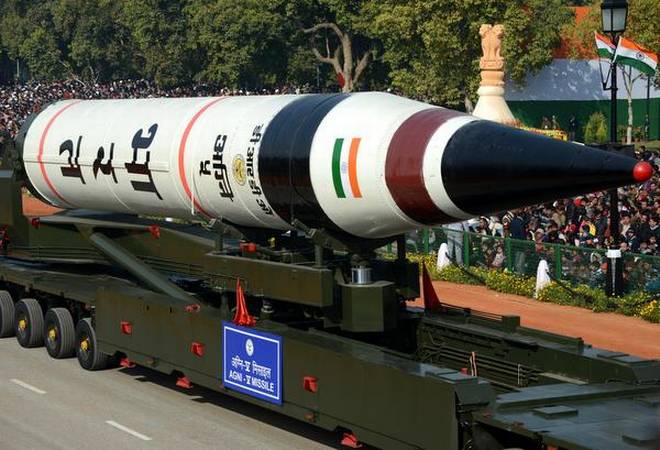
India’s successful testing of a Multiple Independently Targetable Reentry Vehicle (MIRV)-capable Agni missile marks one of the most important strategic milestones in the country’s nuclear deterrence history. Though India has steadily expanded its missile capabilities over the past two decades, the emergence of MIRV technology fundamentally changes the nature of its long-range strategic arsenal and signals the arrival of a far more sophisticated phase in India’s nuclear doctrine. The development also carries profound implications for Asian deterrence dynamics involving China, Pakistan, missile defence systems, and the future balance of power across the Indo-Pacific.
The successful test, conducted under Mission Divyastra, demonstrated India’s ability to deploy multiple nuclear warheads from a single ballistic missile platform, with each warhead capable of independently targeting separate locations. Until now, most of India’s ballistic missiles were believed to carry a single warhead. MIRV capability dramatically increases the lethality, survivability, and penetration potential of strategic missile systems while simultaneously complicating enemy missile-defence calculations. (pib.gov.in)
To understand why MIRVs are so strategically significant, it is necessary to first understand the basic evolution of ballistic missile technology. Traditional ballistic missiles generally carry a single warhead that follows a predictable trajectory after launch. MIRV systems, by contrast, release multiple reentry vehicles during the terminal phase of flight. These warheads can manoeuvre independently and strike separate targets hundreds of kilometres apart. A single missile can therefore threaten multiple cities, air bases, command centres, or missile silos simultaneously.
This dramatically enhances strategic efficiency. Instead of launching multiple missiles to attack multiple targets, a nation can use a single MIRVed platform to saturate enemy defences and overwhelm interception systems. For missile-defence networks attempting to intercept incoming threats, MIRVs create enormous complexity because one missile effectively becomes many.
India’s MIRV breakthrough is especially important because it comes amid rapidly evolving Asian strategic competition. China has significantly modernised its nuclear forces over the last decade, expanding missile inventories, developing hypersonic systems, strengthening silo infrastructure, and deploying advanced MIRVed intercontinental ballistic missiles such as the DF-41. Beijing’s growing missile arsenal and anti-access/area-denial architecture increasingly influence India’s strategic planning.
The emergence of MIRV-equipped Agni systems therefore appears closely connected to India’s need to maintain credible deterrence against a much larger and technologically advancing Chinese missile force. China’s expanding missile-defence and surveillance capabilities may have accelerated India’s pursuit of warhead diversification and penetration capabilities.
From a deterrence perspective, MIRVs improve what strategists call “second-strike capability” — the ability to retaliate even after absorbing a first strike. Survivable retaliatory capability forms the core of credible nuclear deterrence. If adversaries believe a country’s nuclear arsenal can be neutralised through preemptive attacks or missile defence systems, deterrence weakens. MIRVs help restore deterrence credibility by increasing the probability that at least some warheads will penetrate enemy defences.
This is particularly relevant as missile-defence systems become more advanced globally. Modern air and missile-defence architectures increasingly involve layered interception systems combining radar networks, space-based tracking, anti-ballistic missile interceptors, electronic warfare, and AI-assisted target management. MIRVs complicate these systems enormously because defenders must distinguish between real warheads, decoys, penetration aids, and manoeuvring reentry vehicles under extremely compressed timelines.
India’s MIRV capability therefore represents not just offensive enhancement, but also a response to the global evolution of missile-defence ecosystems.
The Agni platform itself already forms the backbone of India’s land-based nuclear deterrent. The Agni series evolved progressively from short-range ballistic missiles to sophisticated long-range strategic systems capable of reaching deep into Asia. The latest MIRV-capable variants likely incorporate major advances in:
- guidance systems,
- navigation accuracy,
- miniaturised warhead integration,
- reentry vehicle engineering,
- thermal shielding,
- and command-control architecture.
Miniaturisation is particularly important because MIRV systems require compact nuclear warheads capable of fitting multiple payloads onto a single missile bus. Achieving reliable miniaturisation demands advanced engineering, computational modelling, material sciences, and highly sophisticated weapons design capability. The success of Mission Divyastra therefore indicates substantial technological maturity within India’s strategic missile programme.
Another critical implication lies in survivability through numerical efficiency. MIRVs allow nations to maintain credible deterrence without necessarily increasing launcher numbers proportionally. A smaller number of missiles can threaten a much larger target set. This has major implications for force structure planning, logistics, storage, deployment flexibility, and survivability during crises.
For Pakistan, India’s MIRV capability introduces a new level of strategic pressure. Islamabad has already developed systems such as the Ababeel missile, which it claims possesses MIRV capability, largely in response to India’s expanding missile-defence initiatives. The South Asian deterrence environment is therefore increasingly entering a technologically competitive phase involving:
- missile defences,
- tactical nuclear systems,
- cruise missiles,
- hypersonics,
- MIRVs,
- and AI-assisted surveillance systems.
This raises concerns among arms-control analysts who fear greater instability during crises due to compressed decision timelines and increased technological complexity.
However, India’s strategic doctrine remains officially rooted in “credible minimum deterrence” and “No First Use.” Indian policymakers consistently argue that the country’s nuclear arsenal exists solely for deterrence rather than warfighting. From New Delhi’s perspective, MIRV capability strengthens deterrence stability by ensuring survivable retaliation rather than enabling offensive escalation.
Nevertheless, the introduction of MIRVs inevitably alters strategic calculations across Asia. China, Pakistan, and even extra-regional powers will closely study India’s evolving missile architecture. The development signals that India is no longer merely maintaining a basic nuclear deterrent, but gradually entering the ranks of highly sophisticated strategic missile powers.
The broader geopolitical context also matters enormously. Asia is currently witnessing simultaneous military modernisation across multiple major powers:
- China’s nuclear expansion,
- North Korean missile advances,
- US Indo-Pacific force restructuring,
- Japanese defence transformation,
- South Korean missile modernisation,
- and expanding missile-defence networks.
India’s MIRV achievement therefore occurs within a rapidly militarising strategic environment where missile survivability, deterrence credibility, and technological sophistication increasingly shape regional power balances.
There is also a strong technological sovereignty dimension to the achievement. India’s missile and strategic weapons programmes have historically evolved under sanctions, technology denial regimes, and external restrictions. Indigenous development of advanced guidance systems, reentry vehicles, propulsion technologies, navigation systems, and strategic computing architectures therefore carries substantial national significance. The MIRV breakthrough demonstrates not merely military capability, but also the maturation of India’s indigenous strategic-industrial ecosystem.
This achievement may also influence India’s future sea-based deterrent posture. Submarine-launched ballistic missiles equipped with MIRVs would substantially strengthen India’s nuclear triad — the combination of land-based missiles, aircraft-delivered nuclear systems, and submarine-based deterrence. Among these, submarine-launched systems are generally considered the most survivable because of their concealment and mobility. Future integration of MIRV capability into sea-based platforms could dramatically enhance India’s second-strike survivability.
The emergence of AI, satellite surveillance, quantum technologies, cyber warfare, and space-based missile tracking systems further intensifies the importance of survivable strategic deterrence. Future missile systems will increasingly operate within highly contested information environments involving:
- real-time surveillance,
- predictive targeting,
- AI-assisted interception,
- electronic warfare,
- and cyber vulnerabilities.
MIRVs therefore represent part of a broader transition toward more complex strategic warfare architectures rather than isolated technological upgrades.
The symbolism of Mission Divyastra itself is significant. The term evokes imagery from ancient Indian epics where advanced celestial weapons possessed extraordinary destructive and strategic power. India’s strategic establishment increasingly combines modern technological ambition with civilisational symbolism, reflecting a broader narrative of indigenous capability and strategic self-confidence.
Ultimately, India’s entry into the MIRV era signals the arrival of a far more mature and technologically advanced nuclear deterrence posture. The development does not necessarily indicate aggressive intent, but it unmistakably reflects the reality that the strategic environment surrounding India has become more demanding, technologically competitive, and unstable.
In the coming decades, Asian deterrence may increasingly revolve around:
- missile survivability,
- AI-enabled command systems,
- hypersonic weapons,
- autonomous surveillance,
- space-based sensors,
- and sophisticated nuclear delivery platforms.
India’s MIRV-capable Agni missile therefore represents more than a successful weapons test. It marks India’s transition into a new strategic era where deterrence credibility will depend not merely on possessing nuclear weapons, but on maintaining technologically resilient, survivable, and adaptive strategic systems capable of operating in one of the world’s most contested geopolitical environments.
Source:
https://www.pib.gov.in/PressReleasePage.aspx?PRID=2014260
https://missilethreat.csis.org/missile/agni-v
https://www.armscontrol.org/factsheets/missile-defense-systems-country
https://www.sipri.org/yearbook
https://www.iiss.org/publications/the-military-balance
https://www.britannica.com/technology/MIRV
https://carnegieendowment.org/research/2024/03/indias-evolving-nuclear-deterrent
https://www.rand.org/topics/ballistic-missile-defense.html
You may also like
-
India’s Indigenous Sonar Ecosystem Powers New Generation of Indian Navy Warships
-
Murshidabad Becomes First West Bengal District to Complete Land Handover for India-Bangladesh Border Fencing
-
India’s LR-AShM Family Could Reach 3,500 Km as DRDO Develops Extended-Range Hypersonic Variants
-
Indian Composite Manufacturing Gets BrahMos Boost With ₹60-Crore Order to Allen Reinforced Plastics
-
HAL-Samtel Opens New Gurugram Facility to Expand Indigenous Defence Avionics and Display Manufacturing
