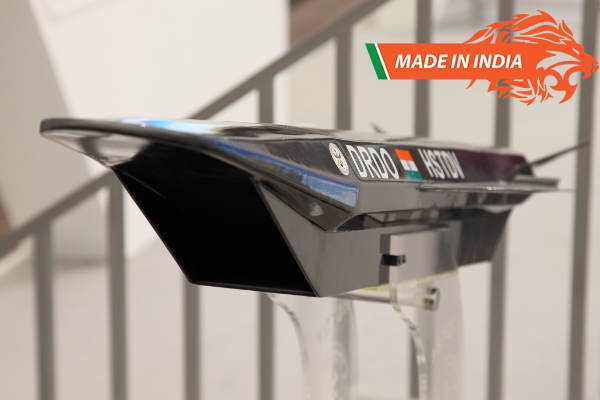
India’s hypersonic missile development programme has crossed another important technical milestone, with the Defence Research and Development Organisation successfully conducting a long-duration test of an Actively Cooled Full-Scale Scramjet Combustor in Hyderabad. The test was carried out by DRDO’s Defence Research & Development Laboratory at the Scramjet Connect Pipe Test facility on May 9, 2026, achieving a runtime of over 1,200 seconds.
The latest test builds on DRDO’s earlier successful scramjet trial of over 700 seconds conducted in January 2026, showing a major improvement in endurance and thermal-management capability. In hypersonic systems, sustaining combustion at extremely high speeds and temperatures is one of the hardest engineering challenges. A longer runtime indicates that the combustor design, active cooling system and ground-test infrastructure are moving closer to the performance levels required for future operational hypersonic cruise missiles.
A scramjet, or supersonic combustion ramjet, is an air-breathing engine designed for flight at hypersonic speeds, generally above Mach 5. Unlike conventional rocket motors that carry both fuel and oxidiser, a scramjet uses oxygen from the atmosphere, allowing sustained high-speed flight in the atmosphere. This makes the technology highly valuable for long-range hypersonic cruise missiles, where speed, manoeuvrability and reduced reaction time for enemy air-defence systems are crucial.
The Ministry of Defence described the test as a major breakthrough in hypersonic missile development. Defence Minister Rajnath Singh congratulated DRDO, industry partners and academic collaborators, saying the achievement provides a strong foundation for India’s Hypersonic Cruise Missile Development Programme. DRDO Chairman Dr Samir V. Kamat also congratulated the teams involved in the successful ground test.
The significance of this achievement lies not only in the duration of the test but also in the complexity of an actively cooled full-scale combustor. At hypersonic speeds, the engine structure faces extreme heat loads. Active cooling is essential because the combustor must survive prolonged exposure to very high temperatures while maintaining stable combustion. Successfully running such a system for more than 1,200 seconds shows progress in materials, fuel-flow management, cooling design and high-temperature testing capability.
For India, this test strengthens the technological base needed for future hypersonic weapons, including cruise missiles capable of high-speed, low-reaction-time strikes. It also places greater emphasis on indigenous propulsion research, advanced test facilities and collaboration between DRDO laboratories, private industry and academia. News On AIR and DD News both reported the test as a major boost to India’s hypersonic missile programme, underlining its importance in the country’s next-generation defence technology roadmap.
In strategic terms, hypersonic systems are considered important because they can compress enemy decision-making time, challenge conventional air-defence networks and offer faster strike options against high-value targets. While India still has several stages to complete before fielding an operational hypersonic cruise missile, the successful long-duration scramjet combustor test marks a serious step forward in mastering one of the most difficult parts of the technology chain.
You may also like
-
India’s Indigenous Sonar Ecosystem Powers New Generation of Indian Navy Warships
-
Murshidabad Becomes First West Bengal District to Complete Land Handover for India-Bangladesh Border Fencing
-
India’s LR-AShM Family Could Reach 3,500 Km as DRDO Develops Extended-Range Hypersonic Variants
-
Indian Composite Manufacturing Gets BrahMos Boost With ₹60-Crore Order to Allen Reinforced Plastics
-
HAL-Samtel Opens New Gurugram Facility to Expand Indigenous Defence Avionics and Display Manufacturing
