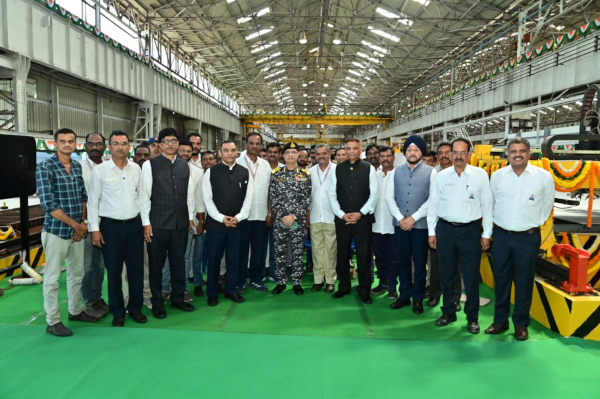
The Indian Navy’s fleet modernisation programme has crossed another important milestone with the steel cutting ceremony of the fifth and final Fleet Support Ship at Hindustan Shipyard Limited, Visakhapatnam. The ceremony was held on May 8, 2026, in the presence of Vice Admiral Sanjay Sadhu, Controller of Warship Production and Acquisition, along with senior officials from the Indian Navy and HSL.
The steel cutting ceremony marks the formal start of construction activity for the last vessel in the five-ship Fleet Support Ship programme. These ships are among the most important auxiliary platforms being built for the Indian Navy because they will directly support long-duration naval deployments at sea. The Indian Navy had signed the contract with Hindustan Shipyard Limited in August 2023 for the acquisition of five Fleet Support Ships, with deliveries scheduled to begin from mid-2027.
Fleet Support Ships are not frontline combatants in the traditional sense, but they are critical to blue-water naval power. A navy can operate far from its home ports only if its warships can be refuelled, resupplied and sustained at sea. The new FSS vessels will carry fuel, water, ammunition and stores, allowing Indian naval task forces to remain deployed for longer periods without needing to return frequently to harbour.
The ships will have a displacement of more than 40,000 tonnes, placing them among the largest support platforms planned for the Indian Navy. Their induction is expected to significantly enhance the fleet’s operational endurance, strategic reach and mobility, particularly in the Indian Ocean Region where India has growing maritime responsibilities and security interests.
The Ministry of Defence had signed the original contract with HSL on August 25, 2023, at an overall cost of approximately ₹19,000 crore. The Cabinet Committee on Security had approved the acquisition earlier that month, on August 16, 2023. The 2023 announcement described the project as a major boost to India’s defence self-reliance, since the vessels are being indigenously designed and constructed by Hindustan Shipyard Limited.
The importance of the Fleet Support Ship programme lies in its connection to India’s blue-water navy ambitions. As the Indian Navy expands its mission profile across the Indo-Pacific, it requires large replenishment platforms capable of supporting aircraft carriers, destroyers, frigates and other fleet units during extended deployments. Without such ships, long-range naval operations become more dependent on port access and fixed logistics chains.
The new ships will also have important secondary roles. According to the Ministry of Defence, they will be equipped to support Humanitarian Assistance and Disaster Relief operations as well as Non-Combatant Evacuation Operations. This means the platforms can be used to deliver relief material quickly after natural disasters and assist in evacuating people from crisis zones.
This dual-use capability is especially relevant for India. The Indian Navy has often been among the first responders during cyclones, earthquakes, tsunamis and regional emergencies in the Indian Ocean neighbourhood. Large support ships with storage, endurance and logistics capacity can become crucial assets during such missions.
The project is also significant for India’s domestic shipbuilding ecosystem. The Ministry of Defence has stated that the Fleet Support Ships will have a completely indigenous design and will source the majority of their equipment from Indian manufacturers. This is expected to benefit the wider shipbuilding industry, including MSMEs and associated industrial suppliers.
When the contract was signed in 2023, the government said the project would generate nearly 168.8 lakh man-days of employment over eight years. This makes the FSS programme not just a naval capability project, but also a major industrial and employment-generating initiative for India’s defence manufacturing sector.
For Hindustan Shipyard Limited, the programme represents a major step in handling large and complex naval construction. Building 40,000-tonne-plus support ships requires advanced design, systems integration, hull construction, quality control and supply-chain coordination. Successful execution will strengthen HSL’s position in India’s strategic shipbuilding landscape.
The steel cutting of the fifth and final ship therefore signals that the full programme is now moving deeper into the construction pipeline. Once delivered and inducted, these vessels will give the Indian Navy a stronger logistics backbone, enabling longer deployments, faster operational turnaround and wider maritime reach.
In strategic terms, the Fleet Support Ship programme is an important part of India’s shift from coastal defence to sustained blue-water operations. Warships project power, but support ships keep that power alive at sea. With the construction of the final FSS now underway, India is building the logistical foundation needed for a more capable, self-reliant and far-reaching navy.
You may also like
-
Structural Optimisation Reportedly Cuts HAL LUH Vibration by Up to 50%
-
IAF Opens Race to Develop Indigenous High-Altitude Pseudo Satellite for Persistent Surveillance
-
BDL Confirms ASRAAM Missile Facility Fully Operational as Major IAF Requirement Looms
-
DRDO’s Junput Missile Test Facility Back on Track as Bengal Clears 8.73-Acre Coastal Range
-
Pune-Based N3X Labs Flies Scaled WRATH Prototype as Autonomous Aerial Programme Moves Into Hardware Testing
