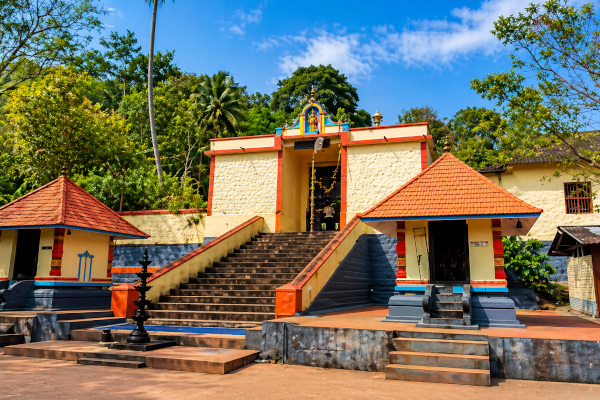
Deep inside the forest belt of eastern Kollam district, close to the Achankovil River, stands one of Kerala’s most unusual and powerful Sastha temples — the Achankovil Sree Dharmasastha Temple. Unlike the more widely known image of Lord Ayyappa as the celibate yogi of Sabarimala, Achankovil presents Sastha in a rare and deeply symbolic form: a householder deity, seated with his consorts Poorna and Pushkala. This alone gives the temple a distinctive place in Kerala’s Ayyappa tradition. Official Sabarimala sources describe Achankovil as one among the five important Sastha temples of Kerala, along with Kulathupuzha, Aryankavu, Sabarimala and Kanthamala.
The temple is believed by tradition to have been consecrated by Parasurama, the legendary sage-warrior who is also connected in Kerala lore with the creation of the land itself. This gives Achankovil the aura of an ancient sacred geography rather than merely a local shrine. Kerala Tourism describes it as a forest temple dedicated to Lord Ayyappa, surrounded by lush greenery and linked strongly with healing lore, especially the belief that the deity protects devotees from poison and snakebite.
The most striking legend of Achankovil is that Lord Sastha here is worshipped as Maha Vaidya, the great divine physician. Devotees believe that the sandalwood paste and holy water associated with the deity have special healing power against snake poison. The idol itself is central to this belief: Achankovil Ayyappa is traditionally described as holding chandanam and theertham, which devotees receive as sacred medicine. The official Sabarimala portal notes that the temple is famous for curing poisonous snakebites and that the chandanam and theertham are considered to have medicinal properties by devotees.
This belief has created one of the temple’s deepest mysteries. Achankovil lies in a forest region where snakes are part of the natural landscape, yet local tradition strongly holds that those bitten by snakes who reach the temple and receive the prasadam are protected by the grace of Sastha. A Times of India report from 2014 recorded local claims that the temple has long been associated with snakebite healing, while also noting the rationalist view that such claims are disputed and should not be treated as proven medical fact. For a responsible modern reading, this mystery should be understood as sacred tradition and living folklore; medically, snakebite is always an emergency and victims should seek hospital treatment without delay.
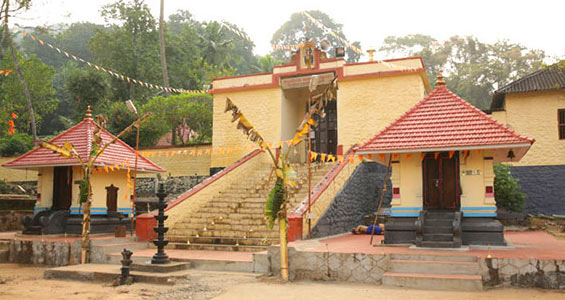
Architecturally, Achankovil is not a temple that overwhelms the devotee with monumental stone towers. Its power comes from its forest setting, sacred enclosure and old Kerala-Tamil borderland character. The temple stands inside dense greenery, close to the river, giving it the feeling of a shrine guarded by nature itself. Since Achankovil lies near the Tamil Nadu border, its festivals and rituals carry strong Tamil influences, something noted by both the official Sabarimala portal and DTPC Kollam.
One of the temple’s unusual features is the presence of the 18 sacred steps. DTPC Kollam notes that Achankovil differs from some other Ayyappa temples because females over the age of ten are permitted to enter the temple and climb the 18 steps. This makes the shrine distinct within Kerala’s wider Sastha worship tradition and adds another layer to its identity as a temple of family life, healing and inclusion.
The deity’s form is itself a theological statement. At Sabarimala, Ayyappa is the ascetic yogi. At Kulathupuzha, he is traditionally associated with childhood. At Aryankavu, he is linked with youthful divinity. At Achankovil, he becomes the Grihastha Sastha, the lord who accepts domestic life, responsibility, protection and healing. With Poorna and Pushkala beside him, Sastha is not distant from worldly life; he enters it, blesses it and guards it. This makes Achankovil especially meaningful for devotees seeking protection for family, health, fertility, safety and relief from fear.
The temple’s festival calendar adds colour to this sacred world. The main annual festival is celebrated for ten days during the Malayalam month of Dhanu, falling around December-January. The rituals are known for their Tamil influence, and the temple attracts devotees from both Kerala and Tamil Nadu. The location also makes the pilgrimage scenic: Kerala Tourism highlights the forest journey to Achankovil and nearby natural attractions such as Manalar Waterfalls and Kumbhavurutty Waterfalls.
The mysteries surrounding Achankovil are not the kind built on hidden treasure or ghostly fear. They are quieter, older and more sacred. Why is this particular forest shrine so strongly associated with healing poison? Why is Sastha here shown not as a celibate ascetic but as a married guardian with Poorna and Pushkala? Why does this temple preserve such a strong blend of Kerala and Tamil ritual culture? Why has the belief in its snakebite cure survived across generations in a forest region where snake encounters are part of lived reality? These questions form the spiritual aura of Achankovil.
For devotees, the answer is simple: Achankovil Sastha is the lord who stands between danger and life. He is not merely worshipped as a warrior, judge or ascetic; he is worshipped as a healer seated in the forest, holding chandanam and theertham like medicine. The surrounding wilderness becomes his temple wall, the river becomes his sacred witness, and the silence of the forest becomes part of the prayer.
Achankovil Sastha Temple is therefore one of Kerala’s most atmospheric Ayyappa shrines — a place where mythology, medicine, ecology and devotion meet. It belongs to the sacred circuit of Sastha worship, but it also stands apart because of its rare iconography, healing legend, Tamil-Kerala border culture and deep forest setting. For the pilgrim, it is not just a temple to be visited; it is a reminder that in the Indian sacred imagination, the forest is never empty. It is alive with gods, serpents, rivers, medicines, vows and mysteries.
How to Reach Achankovil Sastha Temple
Achankovil Sastha Temple is located in the forest region of eastern Kollam district, close to the Kerala–Tamil Nadu border. The most common route from the Kerala side is through Punalur, from where devotees proceed towards the forest road leading to Achankovil. Travellers from Kollam, Thiruvananthapuram or central Kerala can first reach Punalur by road or rail and then continue by bus, taxi or private vehicle. From the Tamil Nadu side, the temple can be approached through the Shencottai/Tenkasi belt, passing through the ghat and forest route towards Achankovil. The nearest major railway access is usually through Punalur, while Thiruvananthapuram International Airport is among the nearest major airports for long-distance travellers. Since the temple lies deep in a forest zone, pilgrims should check road conditions, forest-entry restrictions and local transport availability before travelling, especially during the monsoon and festival seasons. Kerala Tourism describes Achankovil as a forest temple in Kollam, while DTPC Kollam notes that it is situated beside the Achankovil River inside dense forest terrain.
Reference:
https://www.keralatourism.org/destination/achankovil-temple-kollam/437/
https://sabarimala.kerala.gov.in/node/547
https://www.dtpckollam.com/destination/achankovil-sree-dharmasastha-temple
https://timesofindia.indiatimes.com/city/thiruvananthapuram/this-kollam-temple-offers-unique-cure-for-snakebites/articleshow/42393746.cms
You may also like
-
Sindhu: The Indus Kingdom of Jayadratha in the Mahabharata
-
Kuninda or Kulinda: The Himalayan Realm of the Mahabharata in Uttarakhand and Himachal Pradesh
-
Durga versus Mahishasura: Weapons, Battlefield Tactics and the Triumph of Shakti
-
Kuluta: The Kullu Valley Kingdom of the Mahabharata
-
Trigarta: The Kangra–Jalandhar Kingdom of the Mahabharata
