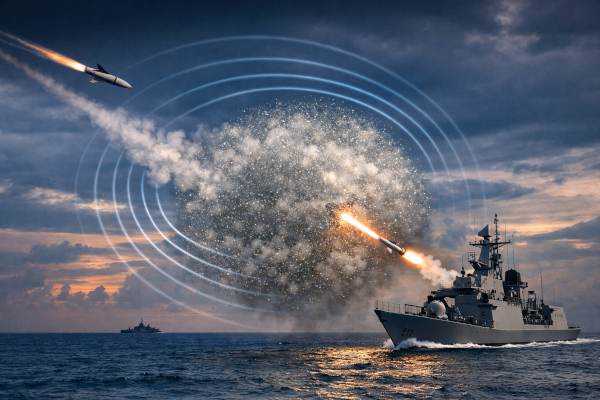
The Medium Range–Microwave Obscurant Chaff Rocket (MR-MOCR) is a specialised naval countermeasure developed by DRDO’s Defence Laboratory, Jodhpur, and handed over to the Indian Navy on June 26, 2024. DRDO and the Ministry of Defence describe Microwave Obscurant Chaff (MOC) as a niche technology that obscures radar signals and creates a microwave shield around platforms and assets, thereby reducing radar detection. In defence terms, that places MR-MOCR in the soft-kill survivability category: a defensive system designed to shape the electromagnetic picture around a warship and make hostile sensing and seeker behaviour far less efficient during a threat engagement.
At the heart of the round lies a special type of fibre payload. Official descriptions say these fibres have a diameter of a few microns and carry unique microwave obscuration properties. Once the rocket is fired, it generates a microwave-obscurant cloud in space, spreads over a sufficient area, and maintains adequate persistence time. Those published characteristics point to a carefully engineered balance among payload packing density, release mechanics, cloud formation, area coverage, and dwell time. In practical terms, the weapon works by placing a tailored electromagnetic screen at a tactically useful point in space, which is far more demanding than simply ejecting conventional chaff into the air.
The trial profile reveals how DRDO matured the system. According to DRDO and PIB, Phase-I trials from Indian Navy ships demonstrated the blooming of the MOC cloud and its persistence in space. DRDO’s industry-partner page adds that this phase included visual expansion measurement of the cloud from INS platforms. Phase-II trials then demonstrated Radar Cross Section reduction of an aerial target by 90 per cent, after which the system was cleared by the Indian Navy and qualifying quantities were handed over. That sequence matters because it shows a progression from cloud-generation physics to a target-signature outcome that carries direct operational meaning.
The most important technical phrase in the official description is that the obscurant cloud creates an effective shield against hostile threats with radio-frequency seekers. That strongly suggests MR-MOCR is designed for the terminal battlespace in which a seeker is trying to classify, hold, and refine a target solution against a naval platform. Within that framework, a microwave-obscurant cloud can complicate the seeker’s view by altering target contrast, increasing electromagnetic clutter, degrading the stability of the return, and forcing the incoming threat to solve a much messier picture. That analytical reading flows directly from the official description of a microwave shield, RF-seeker relevance, and the reported RCS reduction during trials.
From an engineering standpoint, MR-MOCR sits at the intersection of materials science, rocket payload design, and electromagnetic signature management. The fibre element must retain its designed behaviour through storage, launch shock, and dispersal, then form a cloud with the right density and persistence. The rocket’s casing, ignition sequence, opening event, and payload release pattern together govern cloud geometry, while the fibre’s microwave response governs how effectively that geometry translates into obscuration. Because the system is a medium-range round, the defended ship also gains spatial control over where the cloud forms, which expands the commander’s options in building a defensive envelope around the platform.
MR-MOCR also carries broader significance for India’s naval technology base. DRDO’s industry-partner page states that the design and validation were completed against a QR received from the Indian Navy, and DRDO’s official product listings continue to carry Microwave Obscurant Chaff Technology among current offerings. That indicates a capability that has moved from laboratory work into validated naval relevance. In strategic terms, the system strengthens India’s indigenous competence in a narrow and technically demanding segment of naval warfare—one that combines payload engineering, electromagnetic effects, and sea-based operational validation into a compact defensive round with clear fleet utility.
References:
- Press Information Bureau, Ministry of Defence. “DRDO hands over Medium Range-Microwave Obscurant Chaff Rocket to Indian Navy.” 26 June 2024.
https://www.pib.gov.in/PressReleasePage.aspx?PRID=2028794 - DRDO Newsletter, August 2024. “DRDO Hands Over Medium Range-Microwave Obscurant Chaff Rocket to Indian Navy.”
https://www.drdo.gov.in/drdo/sites/default/files/publication-document/NL_Aug2024.pdf - Defence Research and Development Organisation (DRDO). “Industry-Partner – Microwave Obscurant Chaff Technology.”
https://drdo.gov.in/drdo/en/industry-partner?page=4 - Defence Research and Development Organisation (DRDO). “Products.”
https://www.drdo.gov.in/drdo/en/offerings/products
You may also like
-
India’s Indigenous Sonar Ecosystem Powers New Generation of Indian Navy Warships
-
Murshidabad Becomes First West Bengal District to Complete Land Handover for India-Bangladesh Border Fencing
-
India’s LR-AShM Family Could Reach 3,500 Km as DRDO Develops Extended-Range Hypersonic Variants
-
Indian Composite Manufacturing Gets BrahMos Boost With ₹60-Crore Order to Allen Reinforced Plastics
-
HAL-Samtel Opens New Gurugram Facility to Expand Indigenous Defence Avionics and Display Manufacturing
