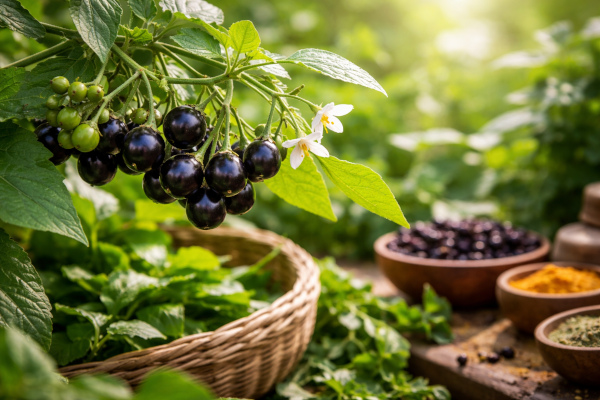
Manithakkali, known botanically as Solanum nigrum and commonly called black nightshade, is one of those plants that rarely arrives with fanfare. It does not look majestic. It does not carry the glamour of imported “superfoods.” It grows quietly, sometimes in gardens, sometimes on the edges of fields, sometimes in places so ordinary that people walk past it without seeing what it is. And yet, in many South Indian homes, especially in Tamil households, Manithakkali has long been treated with a kind of intimate respect. It is a plant of recovery, of kitchen medicine, of small acts of care. When someone had mouth ulcers, body heat, digestive irritation, or a general sense of internal discomfort, Manithakkali often found its way to the plate not as a dramatic cure, but as a gentle, familiar answer.
That is part of its enduring beauty. Manithakkali belongs to an older Indian understanding of food, one that does not sharply separate nourishment from healing. It is not just a herb and not just a vegetable. It lives in the space between the two. Modern scientific reviews now describe Solanum nigrum as a plant rich in bioactive compounds and pharmacological promise, but traditional households knew its importance long before laboratories began cataloguing its chemistry. The leaves and ripe berries have been used as food in many places, while the plant’s traditional medicinal uses have included support for digestive discomfort, inflammation, fever, ulcers, and liver-related conditions. At the same time, the scientific literature also emphasizes caution, because S. nigrum contains glycoalkaloids and other active compounds, and safety depends on proper identification, ripeness, preparation, and dose.
What Manithakkali Actually Is
Solanum nigrum belongs to the Solanaceae family, the same large plant family that includes tomato, brinjal, chilli, and potato. It is generally a small herbaceous plant with soft stems, green leaves, tiny white star-like flowers, and clusters of berries that turn dark purple to black when ripe. Reviews note that both the leaves and berries are edible, though the leaves need proper cooking and the plant as a whole must be handled knowledgeably because of its alkaloid content.
This is one reason Manithakkali has survived best in communities that actually know it. Traditional use is rarely careless. It comes with inherited rules: which parts are eaten, when the berries are safe, how the leaves are cooked, and what should be avoided. In modern wellness culture, people sometimes make the mistake of thinking that “natural” automatically means harmless. Manithakkali teaches the opposite lesson. Traditional food wisdom is often careful wisdom.
Nutrition: More Than Just a Medicinal Plant
One of the most interesting things about black nightshade is that it is not valued only for medicinal reasons. It is also regarded as an edible leafy plant with meaningful nutritional value. Reviews on edible nightshade species describe them as rich in micronutrients and antioxidative compounds, including vitamins and minerals such as iron, calcium, and vitamin-related antioxidant compounds, although the exact composition varies by species, locality, cultivation conditions, and maturity stage.
Scientific reviews specifically on Solanum nigrum also note that its leaves and berries contain diverse phytochemicals, including flavonoids, phenolics, glycoproteins, polysaccharides, saponins, and glycoalkaloids. These are not “nutrients” in the simple everyday sense, but they are biologically active plant compounds that help explain why the plant continues to attract nutritional and pharmacological interest.
That is why Manithakkali is best understood as a medicinal food rather than merely a medicinal herb. Its value does not only lie in concentrated extract form or in the language of supplements. Historically, its strength may have come from being eaten gently and regularly in the right form. A plant like this nourishes slowly. It does not perform. It supports.
Traditional Uses: A Plant Remembered Through Care
Across South Asia and other traditional systems, Solanum nigrum has been associated with a wide range of uses. Review literature documents traditional use for inflammation, fever, stomach complaints, ulcers, liver disorders, skin problems, and infections, while ethnomedicinal studies record its use in food-based and folk healing practices.
In South Indian domestic memory, however, its image is often even more specific. Manithakkali is associated with cooling the system, soothing mouth ulcers, calming an irritated stomach, and helping someone who is recovering from internal heat or digestive unease. This is why it appears so often in simple home-style preparations rather than elaborate festive cooking. It belongs to days of convalescence, not celebration. It is humble food, but deeply affectionate food.
That emotional dimension matters. Some plants are remembered because they are luxurious. Others are remembered because they arrived when someone was unwell. Manithakkali belongs to the second category. It is remembered through tenderness.
What Modern Research Says
Modern scientific interest in Solanum nigrum has expanded significantly. Reviews describe antioxidant, anti-inflammatory, hepatoprotective, antimicrobial, immunomodulatory, and gastroprotective potential in various experimental studies, with some research also exploring anticancer and antidiabetic possibilities. But the important phrase here is “experimental studies.” Much of the evidence comes from laboratory or animal work, and the literature consistently notes that more standardized toxicology, formulation work, and clinical studies are needed before strong medical claims can be made for general use.
That balanced view is the right one. Manithakkali is not a miracle plant and not a fraud either. It is a traditional plant with genuine scientific interest. It deserves respect, not hype.
One of the recurring themes in the literature is its role in digestive and liver support. Reviews often mention its traditional use in liver complaints and ulcer-related conditions, and modern research has tried to examine these associations more closely. That does not mean one should self-medicate with it for serious illness, but it does help explain why generations continued to trust it for milder, recurring discomforts.
The Important Caution: Not All Nightshade Use Is Safe
This is the part that must never be skipped. Black nightshade should not be romanticized recklessly. Solanum nigrum contains glycoalkaloids and other active compounds, and scientific reviews explicitly note safety concerns related to plant part, maturity, dose, and preparation. Unripe berries, improper identification, or concentrated use without guidance may be harmful. The leaves, too, should be properly cooked rather than consumed casually in raw form.
This caution becomes even more important because many people confuse one nightshade species with another. The Solanum genus is large, and not every look-alike plant is safe to eat in the same way. Traditional communities often know the difference because that knowledge is inherited. Outside that context, guesswork is dangerous.
So the right attitude toward Manithakkali is neither fear nor blind enthusiasm. It is informed respect.
Culinary Uses: Where Healing Meets Taste
One of the loveliest things about Manithakkali is that it enters life through the kitchen. In Tamil food culture, the leaves are commonly cooked into keerai preparations, kuzhambu, kootu, soups, and mashed side dishes, often with a light hand so the plant’s gentle bitterness remains but does not overwhelm. The ripe berries may be used fresh in some contexts, while dried berries are also used in traditional cooking. These culinary forms matter because they reveal how old food cultures handled potent plants: not through excess, but through balance. Oil, tamarind, dal, coconut, spices, and slow cooking all help place the plant inside a broader food logic.
The taste of Manithakkali is part of its character. It is not aggressively bitter like some medicinal greens, nor bland like ordinary spinach. It has a distinct earthy depth with a soft edge of bitterness that feels medicinal without being unpleasant. That is why it works so well in recovery food. It tastes like something that is doing good quietly.
And that may be the secret of why it has lasted. A medicinal plant survives in kitchens only if people are willing to eat it.
Why Plants Like This Still Matter
In today’s world, plants are often marketed in extremes. Either they are sold as magical cures, or they are ignored as backward relics. Manithakkali belongs in neither category. It is better than trendiness and better than dismissal. It represents a very old Indian habit of paying attention to small plants that support everyday health in modest but meaningful ways.
Its importance is also ecological and cultural. Plants like Manithakkali remind us that biodiversity is not only about forests and rare species. It is also about the edible-medicinal plants that once surrounded homes, kitchen gardens, and village edges. When those disappear, we lose more than a food item. We lose a memory system.
Manithakkali is a plant of understatement. It does not command the eye, but it earns trust. It does not thunder its healing powers, but it has lingered for generations in the most intimate place possible: the home kitchen. Science now confirms that Solanum nigrum is chemically rich and pharmacologically interesting, while tradition reminds us that it has long been used with care, caution, and quiet confidence. Between those two worlds stands the true identity of Manithakkali — not a miracle, not a myth, but a deeply rooted medicinal food whose value lies in its humility.
Sometimes the most powerful plants are not the rarest ones. They are the ones that stayed close to people for centuries, small enough to be overlooked, faithful enough to be remembered.
References
- Chen X, Zhang L, Li M, et al. Solanum nigrum Linn.: An Insight into Current Research on Pharmacological Activities and Clinical Applications. Molecules. 2022.
https://pmc.ncbi.nlm.nih.gov/articles/PMC9424827/ - Alagesaboopathi C. Ethnomedicinal plants and their utilization by villagers in Kumaragiri Hills of Salem district of Tamilnadu, India. African Journal of Traditional, Complementary and Alternative Medicines. 2009.
https://europepmc.org/article/pmc/2816461 - Ogunsuyi OB, Oboh G, Ademosun AO, Okereke SC. Green leafy vegetables from two Solanum spp. (Solanum nigrum L and Solanum macrocarpon L) ameliorate scopolamine-induced cognitive and neurochemical impairments in rats. Food Science & Nutrition. 2018.
https://pmc.ncbi.nlm.nih.gov/articles/PMC6021738/ - Yuan B, et al. Rapid screening of toxic glycoalkaloids and micronutrients in edible nightshades (Solanum spp.).
https://pmc.ncbi.nlm.nih.gov/articles/PMC9322221/ - Ahmed S, et al. Unlocking the therapeutic potential of Solanum species as anti-inflammatory agents. 2025.
https://pmc.ncbi.nlm.nih.gov/articles/PMC12931810/
You may also like
-
Karanja — Ayurveda’s Bitter Oil Tree for Skin, Wounds and Kapha-Vata Balance
-
Bengaluru’s SugarStrings.ai Develops Cheek-Swab DNA Test Screening Thousands of Genetic Disorders
-
Green Pyramid Biotech Turns Sophorolipid Research Into a Natural Food-Safety Platform
-
Ashoka — Saraca asoca: Ayurveda’s Celebrated Tree for Rakta and Women’s Health
-
New Smart Technology can Make Diagnosis of Alzheimer’s disease (AD) More Accessible
