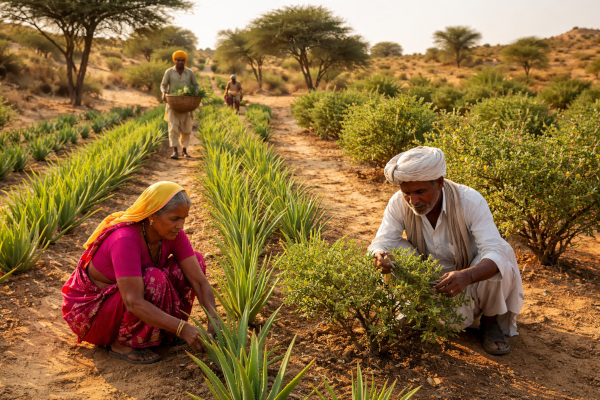
In a renewed push to strengthen India’s medicinal plants sector, the Government of India has expanded support for the cultivation, conservation, and market development of desert medicinal plants such as Guggul and Aloe vera. The initiative is being driven by the National Medicinal Plants Board (NMPB) under the Ministry of Ayush, which is working to improve planting material, farmer awareness, post-harvest infrastructure, and market linkages across several states, especially in desert, arid, and semi-arid regions.
At the centre of this effort is the government’s broader strategy to promote medicinal plants through value-chain development rather than just isolated cultivation drives. Through its Regional-cum-Facilitation Centres (RCFCs), the NMPB has been supplying Quality Planting Material (QPM) to farmers and conducting training programmes on Good Agricultural Practices (GAP) and value addition. The focus is on helping farmers not only grow medicinal plants but also improve quality, reduce losses, and earn better returns from the produce.
The government has also extended project-based support to State Forest Departments in states such as Gujarat, Haryana, Punjab, Madhya Pradesh, and Rajasthan for the in-situ conservation of medicinal plants in their natural habitats. This support is being provided under the Central Sector Scheme on Conservation, Development and Sustainable Management of Medicinal Plants. As part of this effort, medicinal plant species are being protected and strengthened through Medicinal Plants Conservation and Development Areas (MPCDAs) as well as plantation and resource augmentation work in forest areas.
The scheme itself is wider in scope than many may realise. It supports training, workshops, seminars and conferences, along with forward and backward linkages in the medicinal plants supply chain, in-situ and ex-situ conservation, livelihood support through local community institutions, research and development, and the promotion, marketing and trade of medicinal plants produce. In effect, the government is trying to build an ecosystem around medicinal plants rather than treating them as a narrow agricultural segment.
One of the notable tools launched to support this ecosystem is the e-CHARAK mobile application and web portal, which has been designed to make market access easier for medicinal plant growers and traders. The platform serves as an information and exchange system for stakeholders in the medicinal plants sector and supports multiple local languages. It also provides fortnightly market prices for 100 medicinal plants from 25 herbal markets across India. According to the latest figures, e-CHARAK has 11,119 registered users, has recorded over 3.05 crore visitors, carries 7,588 posted items, and has facilitated 71,14,690 buyer-seller interactions. These numbers suggest that the platform is gradually becoming a meaningful digital marketplace for the sector.
While the NMPB clarified that direct cultivation activities are not formally supported under the Central Sector Scheme, it has, since 2023-24, backed projects under the Forward and Backward Linkage in Supply Chain of Medicinal Plants (Integrated Component). This support includes infrastructure for raising quality planting material, farmer awareness through IEC activities, post-harvest management and marketing infrastructure, and facilities for quality testing and certification of raw material.
So far, the NMPB has approved 15 project proposals across different states under this integrated component from 2023-24 onward, with the aim of covering approximately 2,000 hectares under medicinal plants cultivation through the supply of quality planting material. The approved states include Andhra Pradesh, Jammu & Kashmir, Mizoram, Uttarakhand, Karnataka, Tamil Nadu, Kerala, Madhya Pradesh, Gujarat, Rajasthan, Uttar Pradesh, and Haryana. Most of these projects have received support of around ₹120 lakh each, though some allocations vary. Rajasthan and Gujarat, which are especially relevant to desert and arid medicinal plants, are among the states receiving repeated support under the programme.
Alongside infrastructure support, the government has also invested in awareness-building and farmer training. Between 2020-21 and 2024-25, the NMPB supported 138 projects across the country for organising training programmes, seminars, and workshops for the promotion of medicinal plants cultivation. The total sanctioned amount for these IEC activities stands at ₹1,171.94 lakh.
The state-wise distribution of these training-related projects shows a broad national spread. Tamil Nadu received the highest number with 21 sanctioned projects, followed by Delhi with 17, Odisha with 9, and Assam, Karnataka, and Madhya Pradesh with 8 each. In terms of sanctioned amounts, Delhi received ₹151.53 lakh, Assam ₹151.14 lakh, Karnataka ₹114.87 lakh, and Tamil Nadu ₹98.85 lakh. Rajasthan, which remains important in the context of desert medicinal plants, saw 5 IEC projects sanctioned over the five-year period, with a total outlay of ₹29.85 lakh. Gujarat received 2 projects worth ₹22 lakh.
What makes this initiative important is that desert medicinal plants are not just commercially valuable, but also ecologically and culturally significant. Plants such as Guggul, known for their medicinal use in traditional systems, and Aloe vera, which has both medicinal and commercial applications, are well suited to dryland conditions. Supporting these crops can therefore serve multiple goals at once: conserving biodiversity, promoting traditional knowledge systems, strengthening rural livelihoods, and encouraging cultivation models suited to water-stressed regions.
The government’s approach indicates a shift toward creating a stronger supply chain for medicinal plants — from planting material and conservation to market access and digital trade platforms. For farmers in arid and semi-arid regions, this could gradually open up new livelihood options beyond conventional cropping systems. For the Ayush sector, it helps create a more reliable raw material base rooted in both sustainability and traceability.
In practical terms, the message from the latest initiative is clear: India is trying to build a more organised medicinal plants economy, and desert species are becoming an important part of that vision. With support now extending across conservation, training, planting material, post-harvest infrastructure, and online market access, the sector may be moving toward a more structured and commercially viable future.
You may also like
-
Tata Power Renewables Commissions 72.5 MW Solar Project in Rajasthan to Support Tata Steel’s Decarbonisation
-
NTPC Targets 244 GW by 2037 With ₹16.86-Lakh-Crore Expansion Across India’s Energy Sector
-
UPI Completes a Decade as Transaction Value Surges More Than 4,000-Fold
-
AGNIT Semiconductors: Building India’s Gallium-Nitride Chip Capability for Radar, Communications and Power Electronics
-
Karanja — Ayurveda’s Bitter Oil Tree for Skin, Wounds and Kapha-Vata Balance
