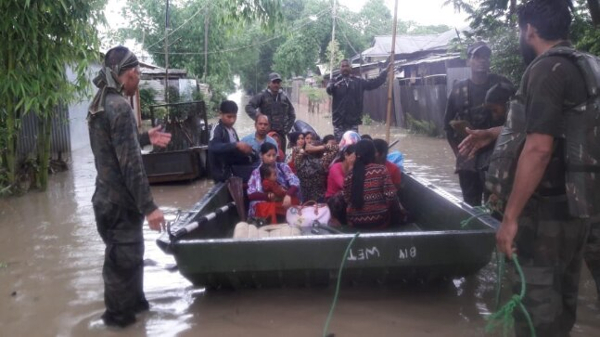
India has significantly strengthened its disaster preparedness infrastructure with district-level early warning systems for floods and cyclones now operational across vulnerable districts, the government informed Parliament. The announcement was made by Jitendra Singh while replying to a question in the Lok Sabha.
Responding to a query raised by Rajiv Pratap Rudy, the minister said that the government has deployed technology-driven forecasting and early warning systems to ensure timely alerts and strengthen disaster preparedness in regions prone to floods and cyclones.
IMD Providing District-Wise Weather Warnings
According to the minister, the India Meteorological Department (IMD) plays a key role in issuing early weather warnings. The department prepares district-wise forecasts four times daily, with predictions extending up to seven days, particularly for events such as heavy rainfall and cyclones.
These warnings are disseminated through multiple channels to ensure wide accessibility. The information is shared via the Common Alerting Protocol (CAP), mobile applications, official websites, social media platforms, SMS alerts, and messaging services, allowing authorities and citizens to receive timely weather alerts.
The IMD also generates real-time weather monitoring data and graphical products, enabling disaster management agencies to track developing weather systems and initiate preparedness measures in vulnerable districts.
Flood Forecasting Through 350 Monitoring Stations
For flood forecasting, the Central Water Commission (CWC) acts as the nodal agency. At present, the commission issues flood forecasts through 350 forecasting stations across the country.
These include 150 inflow forecasting stations located at major dams and barrages and 200 level forecasting stations on major rivers, set up in consultation with state governments and Union Territories.
To further improve preparedness, the CWC has developed basin-wise flood forecasting models based on rainfall-runoff mathematical simulations, enabling seven-day advance advisory forecasts along with short-range flood predictions of up to 24 hours. This additional lead time allows local administrations to organise evacuations and implement preventive measures.
“C-Flood” Platform Provides Village-Level Forecasting
The minister also highlighted the C-Flood digital platform, a web-based system designed to provide two-day advance flood inundation forecasts at the village level.
The platform integrates two-dimensional hydrodynamic modelling, satellite-derived datasets, and ground-based hydrological observations to generate accurate flood predictions. It also provides detailed inundation maps and water-level estimates, helping authorities assess potential flood impacts.
In its initial phase, the system currently covers the Godavari River, Tapi River, and Mahanadi River basins.
The platform uses a colour-coded alert system—yellow, orange, and red—to indicate increasing levels of flood severity, enabling quicker response planning by disaster management authorities.
Flood Watch India App Delivering Real-Time Alerts
In addition to web-based platforms, the government has also launched the Flood Watch India application in August 2023 to provide real-time flood-related information.
The application delivers flood forecasts from 200 forecasting stations, while also providing flood monitoring data from over 500 stations and reservoir storage information for 150 major reservoirs across the country. The app serves both disaster management authorities and the general public by offering timely updates that enable preventive action.
Special Communication Systems for Cyclone and Fishermen Alerts
Addressing concerns about cyclone preparedness, the minister noted that India has established robust communication networks for the dissemination of cyclone warnings. These alerts are transmitted through websites, mobile applications, SMS notifications, social media, press releases, and media briefings.
Special arrangements have also been made to ensure fishermen operating in coastal and deep-sea areas receive timely warnings. Weather alerts are broadcast through All India Radio, while fishermen receive direct alerts via SMS and the NavIC satellite navigation system through the Indian National Centre for Ocean Information Services.
Strengthening Last-Mile Disaster Communication
The government is also focusing on improving last-mile dissemination of disaster warnings. State Disaster Management Authorities and State Emergency Operation Centres further transmit alerts through local disaster communication networks to ensure vulnerable communities receive timely information.
Measures being implemented include improving mobile connectivity in remote regions, installing local siren-based alert systems, strengthening satellite communication support for fishermen, and expanding public awareness programmes on disaster preparedness.
Financial support for strengthening these systems is provided through the State Disaster Response Fund and the State Disaster Mitigation Fund, while additional assistance can be accessed through the National Disaster Response Fund and the National Disaster Mitigation Fund as per established guidelines.
Technology Enhancing Disaster Preparedness
With district-level forecasting systems, advanced hydrological modelling platforms, and mobile-based alert services now in place, India is increasingly relying on technology-driven early warning systems to reduce disaster risks and improve emergency response capabilities.
According to the government, these initiatives are playing a crucial role in ensuring that vulnerable communities receive timely warnings and authorities are better equipped to respond to floods, cyclones, and extreme weather events.
Reference:
- Press Information Bureau – “District-level Early Warning Systems for Floods and Cyclones Operational Across Vulnerable Districts,” March 11, 2026.
You may also like
-
PMAY-U Crosses One Crore Delivered Homes as Urban Housing Programme Expands
-
Overcoming Tariffs and the Weaponisation of Markets: How India’s FTA Network Is Building Trade Resilience
-
NHAI to Bring AI, Live Location Tracking and Smart Emergency Dispatch to 1033 Highway Helpline
-
Quad Moves Indo-Pacific Logistics Network Toward Operational Stage With Tokyo Exercise
-
Chanakya’s Warning for Modern India: Why Internal Disorder Is the Cheapest Weapon Against a Rising Power
