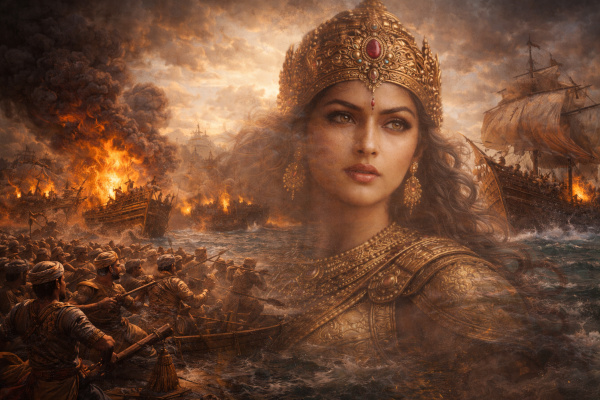
In the sixteenth century, when the Portuguese Empire was tightening its grip over the Indian Ocean, a small coastal kingdom in present-day Karnataka refused to bow. Its ruler was not a mighty emperor commanding vast armies, but a regional queen — Rani Abbakka Chowta of Ullal. Long before the word “freedom fighter” entered India’s political vocabulary, Abbakka was fighting a sustained war against European expansion, defending trade sovereignty, and challenging one of the world’s most formidable naval powers.
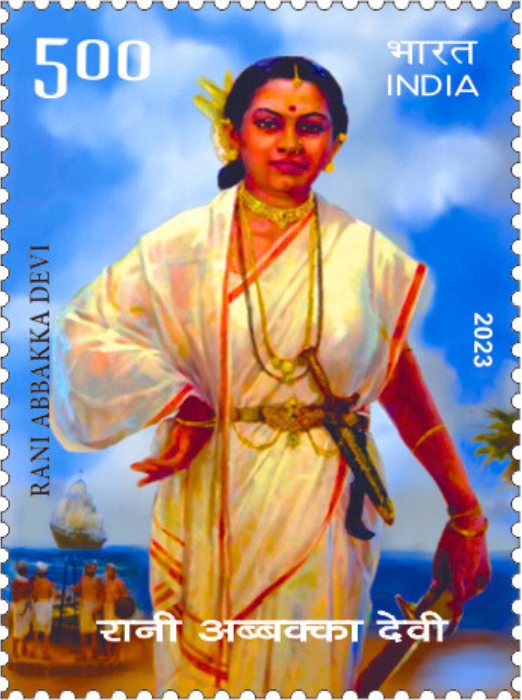
The arrival of Vasco da Gama in 1498 opened a new chapter in global trade. By the mid-1500s, the Portuguese Estado da Índia, headquartered in Goa, controlled key ports along the western coast. Their strategy was clear: monopolise the spice trade, enforce the cartaz (naval pass) system, and compel local rulers to pay tribute. Pepper, cardamom, and other spices from the Malabar and Kanara coasts were among the most valuable commodities in global commerce. Control of ports meant control of revenue — and control of revenue meant power.
Ullal, though small, was strategically located near the mouth of the Netravati River, close to modern Mangaluru. It was a trading hub with commercial connections to Arabia and beyond. When Portuguese authorities demanded tribute and exclusive trading rights, Abbakka refused. Her resistance was not symbolic; it was economic and strategic.
Belonging to the Chowta dynasty, which followed a matrilineal system of succession, Abbakka inherited both authority and responsibility. But it was her leadership that defined her reign. Portuguese records from the 1550s and 1560s describe repeated expeditions against Ullal — evidence of how seriously they viewed her defiance. Unlike several neighbouring rulers who entered into treaties, Abbakka formed alliances with the Zamorin of Calicut and regional Muslim merchants whose livelihoods were threatened by Portuguese monopolies.
Her military strategy was sophisticated. The Portuguese possessed heavily armed units equipped with cannons. Abbakka’s forces, by contrast, relied on smaller, faster boats capable of navigating shallow coastal waters. Night raids became her hallmark. By attacking supply lines and exploiting local geographic knowledge, her navy disrupted Portuguese operations along the coast.
In 1568, one of the fiercest confrontations occurred. Portuguese forces attacked and burned parts of Ullal. Believing they had crushed resistance, they withdrew — only for Abbakka to regroup and launch a counterattack on the Portuguese garrison at Mangalore. Colonial accounts acknowledge losses and setbacks, an unusual concession in imperial documentation.
Historians note that Portuguese campaigns against Ullal spanned several decades, from the 1550s into the 1580s. That persistence alone demonstrates how effectively Abbakka resisted domination. While precise casualty figures are difficult to establish due to fragmentary records, the repeated mobilisations underscore the scale of conflict.
Her downfall, according to regional traditions, came through betrayal within her extended family. Captured and imprisoned, she reportedly continued to resist even in confinement. Though Portuguese influence along the Karnataka coast gradually expanded, they never erased the memory of her defiance.
What makes Rani Abbakka historically significant is not merely that she fought — but when she fought. Her resistance predates the Revolt of 1857 by nearly three centuries. She represents one of the earliest recorded instances of organised armed opposition to European colonial authority in India. Moreover, she commanded naval operations in a century when maritime dominance defined global geopolitics.
Today, her legacy is increasingly acknowledged. Statues of Abbakka stand in coastal Karnataka. The Indian Navy has honoured her name in recognition of her maritime resistance. Yet, nationally, she remains far less known than later figures of anti-colonial struggle.
Her story forces a broader reflection on Indian history. Resistance did not begin in 1857. It did not emerge suddenly in the nineteenth century. It simmered in ports and principalities, in spice markets and river mouths, wherever sovereignty was threatened.
End Notes and References
- K. S. Mathew, Portuguese Trade with India in the Sixteenth Century (Manohar Publishers, 1983).
- Pius Malekandathil, The Portuguese Cochin and the Maritime Trade of India, 1500–1663 (Manohar Publishers, 2001).
- Sanjay Subrahmanyam, The Career and Legend of Vasco da Gama (Cambridge University Press, 1997).
- Government of Karnataka, Department of Tourism – Historical accounts of Rani Abbakka Chowta: https://karnatakatourism.org
- Indian Navy acknowledgment of Rani Abbakka’s maritime legacy: https://indiannavy.nic.in
- Portuguese Estado da Índia administrative records (16th century), archived in Goa State Central Library and referenced in multiple maritime history studies.
You may also like
-
Kirata: The Himalayan and Eastern Hill Peoples of the Mahabharata
-
Flydubai FZ1073 Attack: Captain Smit Machchhar’s Calls With Modi and Netanyahu as UAE Probe Names Terror Plot
-
Kamarupa — The Historic Kingdom of the Brahmaputra Valley and the Eastern Himalayas
-
Bharat Vandana Park: Delhi’s ‘Mini India’ Brings the Nation’s Heritage Together in One Landscape
-
Pragjyotisha — Bhagadatta’s Kingdom of the Brahmaputra Valley
