The Indian Air Force (IAF) demonstrated its combat readiness and technological superiority during Exercise ‘Vayushakti-26’ at the Pokhran Field Firing Range in Jaisalmer, Rajasthan. The large-scale firepower demonstration underscored India’s evolving air power capabilities across the full spectrum of modern warfare — from offensive strikes and air defence to special operations and humanitarian missions.
The event was graced by the President of India, Droupadi Murmu, who attended as the Chief Guest. She was accompanied by Rajasthan Governor Haribhau Kisanrao Bagde, Defence Minister Rajnath Singh, and several senior civil and military dignitaries, including Chief of Defence Staff Anil Chauhan. Defence attaches from friendly foreign nations, veterans, and school children also witnessed the high-intensity showcase.
A First: Combat Theatre Simulation
For the first time, Vayushakti was executed along a defined operational storyline, transforming the exercise into a simulated live combat theatre. The carefully choreographed sequence integrated offensive air strikes, air defence operations, special forces missions, and humanitarian assistance — highlighting the IAF’s capability as a multi-domain force and India’s first responder in crisis situations.
Earlier in the day, President Murmu undertook a sortie in the indigenously developed Light Combat Helicopter (LCH) Prachand, symbolizing India’s growing self-reliance in defence manufacturing under the “Atmanirbhar Bharat” vision.
Precision, Power and Technological Edge
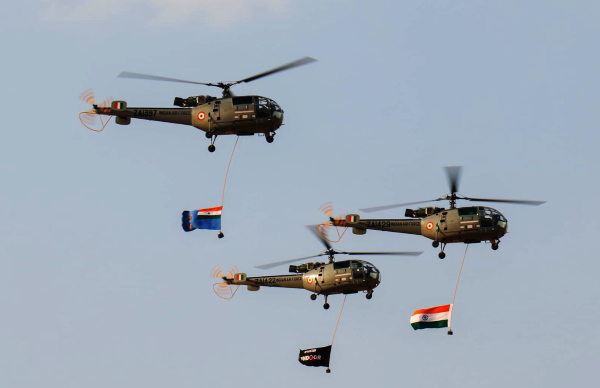
The exercise opened with the National Song and National Anthem, followed by a ceremonial flypast by Chetak helicopters carrying the National Flag, Air Force Ensign, and Operation Sindoor Flag. A thunderous sonic boom by a Rafale fighter aircraft set the tone for the day’s action.
More than 130 aircraft participated in the day-and-night exercise. Frontline fighters including Dassault Rafale, Sukhoi Su-30MKI, Dassault Mirage 2000, Mikoyan MiG-29, and SEPECAT Jaguar carried out precision strikes on simulated enemy targets using advanced air-to-ground munitions and long-range strike capabilities.
Transport and special mission aircraft such as Lockheed Martin C-130J Super Hercules, Airbus C-295, and Boeing C-17 Globemaster III demonstrated rapid deployment and evacuation capabilities. Indigenous platforms like the Advanced Light Helicopter Dhruv and LCH Prachand further emphasized India’s domestic defence manufacturing strengths.
XPOL.jpeg)
(1)JTHY.jpeg)
DYSP.jpeg)
(1)1TD3.jpeg)
QATK.jpeg)
Seamless Air Defence and Joint Operations
Air defence operations featured coordinated engagements between airborne assets and ground-based systems, including the Akash missile system and SPYDER missile system. These were supported by Army air defence assets, showcasing seamless jointmanship between air and ground forces.
As dusk fell, Garud Special Forces and Para SF units were inserted by Mi-17 helicopters to execute simulated urban intervention and hostage rescue missions. The night phase saw precision strikes and integrated air-landed operations, reinforcing the IAF’s ability to dominate the battlespace around the clock.
The exercise concluded with a symbolic ceasefire flypast by a C-17 aircraft, followed by a visually striking drone display celebrating the legacy and evolution of Indian air power.
Strengthening India’s Strategic Deterrence
Guided by its core values — “Achook, Abhedya aur Sateek” (Accurate, Impenetrable and Precise) — Exercise Vayushakti-26 validated the Indian Air Force’s operational doctrine, technological edge, and joint integration capabilities.
More than a demonstration of firepower, Vayushakti-26 reaffirmed the IAF’s critical role as a pillar of India’s comprehensive national power and strategic deterrence in an increasingly complex security environment.
Source: PIB
Image Courtesy: PIB
You may also like
-
JCBL Receives DRDO Technology for Indigenous 20-Tonne Heavy Drop System for C-130J and C-17
-
DRDO Moves 30 kW Laser Weapon Towards Production, Industry Partner Selection Planned Within Six Months
-
IG Defence Validates KAL Long-Range Strike Drone’s Integrated Systems in Pokhran Trial
-
Vajra Air Defence Warriors Validate AKASHTEER Sensor-to-Shooter Network in Day-Night Firing Drills
-
INS Sahyadri and INS Kulish Reach Philippines for ADMM-Plus Maritime Cooperation
