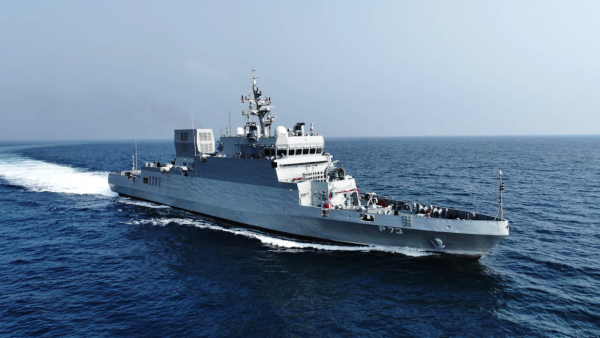
CHENNAI / NEW DELHI, February 23, 2026 — The Indian Navy is set to mark a significant milestone in strengthening the nation’s coastal defence and anti-submarine capabilities with the induction of its latest indigenous warship, Anjadip. The vessel — the third in the Anti-Submarine Warfare Shallow Water Craft (ASW-SWC) project — is scheduled to be formally commissioned at Chennai Port on 27 February 2026 in a ceremony led by Admiral Dinesh K Tripathi, Chief of the Naval Staff.
A Major Step for ‘Aatmanirbhar Bharat’ in Defence
Built by Garden Reach Shipbuilders & Engineers (GRSE), Kolkata, Anjadip exemplifies India’s commitment to self-reliance in defence manufacturing. The warship has been designed and constructed domestically as part of India’s ongoing efforts to enhance its indigenous defence industrial base — a key aim of the Aatmanirbhar Bharat initiative.
At 77 metres in length and equipped with a powerful water-jet propulsion system, Anjadip can reach speeds of up to 25 knots, enabling rapid response and sustained maritime operations.
Advanced Anti-Submarine Capabilities
The primary role of Anjadip is anti-submarine warfare (ASW), especially in littoral zones — the coastal and shallow waters that are strategically vital to India’s maritime security. Often described in defence circles as a “Dolphin Hunter”, the vessel is fitted with an indigenous Anti-Submarine Warfare weapon and sensor suite, including the Hull Mounted Sonar Abhay, lightweight torpedoes, and ASW rockets to detect, track, and neutralise submarine threats.
In addition to its specialised ASW role, the warship has the versatility to support coastal surveillance, low-intensity maritime operations (LIMO), and search and rescue missions, underscoring its value as a multi-role asset for the Indian Navy.
Geostrategic Importance
The induction of Anjadip significantly bolsters India’s capabilities across its eastern maritime theatre, including critical sea approaches of Tamil Nadu and Puducherry, and plays into broader efforts to build a strong coastal deterrence posture. Analysts say such indigenous platforms are crucial as India focuses on building a balanced fleet capable of addressing emerging underwater and surface threats in the Indian Ocean Region.
A ‘Builder’s Navy’ in the Making
The ASW-SWC project forms part of India’s wider naval modernisation strategy aimed at evolving into a “Builder’s Navy” — one that designs and constructs advanced platforms domestically, reducing dependence on foreign technology while enhancing operational readiness.
What This Means for India’s Naval Defences
- Enhanced Coastal Security: Anjadip’s ASW role strengthens surveillance and response in shallow waters.
- Indigenous Capability: Built in India, the warship heralds a shift toward self-sufficiency in advanced naval platforms.
- Multipurpose Operations: Apart from ASW, the vessel supports surveillance and humanitarian missions.
This commissioning reflects India’s broader national security priorities, reinforcing both maritime defence and the vision of a self-reliant defence industrial ecosystem.
You may also like
-
IG Defence Validates KAL Long-Range Strike Drone’s Integrated Systems in Pokhran Trial
-
Vajra Air Defence Warriors Validate AKASHTEER Sensor-to-Shooter Network in Day-Night Firing Drills
-
INS Sahyadri and INS Kulish Reach Philippines for ADMM-Plus Maritime Cooperation
-
India’s Defence Production Hits Record ₹1.78 Lakh Crore as Private-Sector Share Rises to 24%
-
Former DRDO Chief Samir Kamat Confirms Akash Missile Exports to Tajikistan and Turkmenistan
