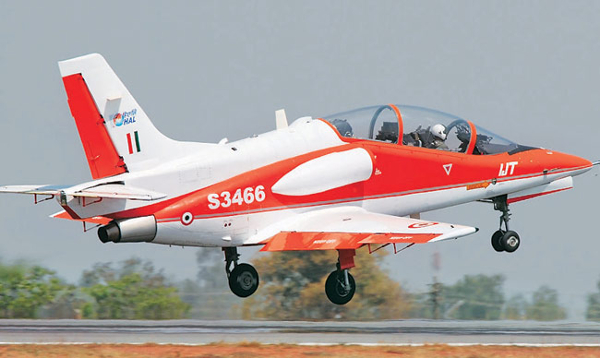
BENGALURU: The indigenous Intermediate Jet Trainer (IJT) designed and developed by defence PSU Hindustan Aeronautics Limited (HAL) commenced spin flight testing in Bengaluru. The flight was piloted by HAL’s test pilots Gp Capt (retd) HV Thakur and Wg Cdr (retd) P Avasti.
The IJT is being developed to replace the ageing Kiran aircraft fleet of the Indian Air Force (IAF). The spin testing of an aircraft is the most crucial phase of its flight testing.
“…Accordingly, the testing will be gradually progressed to assess the behaviour of the aircraft till six turn spins to either side to meet the targeted requirement. The IJT has already been tested to its full envelope in terms of speed, altitude and load factor (‘g’ envelope) and has also been integrated with drop tanks as well as bombs,” HAL said on Monday.
For the spin test, HAL redesigned the aircraft by moving the vertical tail aft and extending the rudder surface. These changes for ensuring a satisfactory spin behaviour required extensive redesign of the rear fuselage and the rudder.
“The changes have been incorporated in two aircraft with the involvement and clearance from certification agencies at every stage. Post modification, the two aircraft underwent significant flight tests to assess the general handling with the new configuration of fin and rudder,” HAL added.
These aircraft have now been incorporated with the necessary safety devices (Anti-Spin Parachute Systems). During the first flight, initially the aircraft was taken through one turn spin to the left and right hand sides to test the spin characteristics.
Source: ToI
You may also like
-
DRDO Opens Indigenous Electro-Mechanical Actuator Technologies to Indian Industry
-
Hical Technologies Expands Rafale and Aerospace Manufacturing with New Bengaluru Facility
-
IZI Enterprise Wins DRDO Order for VANA Surveillance Drones
-
ideaForge Enters Long-Range ISR and UCAV Segment with ZOLT Hybrid and ZOLT Combat Drone
-
Kaveri 2.0 Could Give India a Common Technology Base for Fighter and Transport Aircraft Engines
)