India’s long-awaited mine-countermeasure modernisation has received a major industrial push with Larsen & Toubro entering a strategic collaboration with France-based Exail to offer an advanced Unmanned Mine Counter-Measure Suite for the Indian Navy’s upcoming Mine Counter Measure Vessel programme. The announcement is important not because it is a final shipbuilding contract, but because it identifies one of the most critical technology pathways for the Navy’s future mine-warfare fleet: autonomous and remotely operated systems that can detect, classify, identify and neutralise naval mines while keeping crews away from the danger zone.
The L&T–Exail partnership is aimed at the Navy’s planned acquisition of 12 Mine Counter Measure Vessels, with L&T acting as the prime contractor and Exail serving as the technology partner. L&T has said the unmanned suite will be offered to all shipyards participating in the Indian Navy’s upcoming MCMV programme, making the collaboration a technology and systems-integration play rather than a standalone platform announcement.
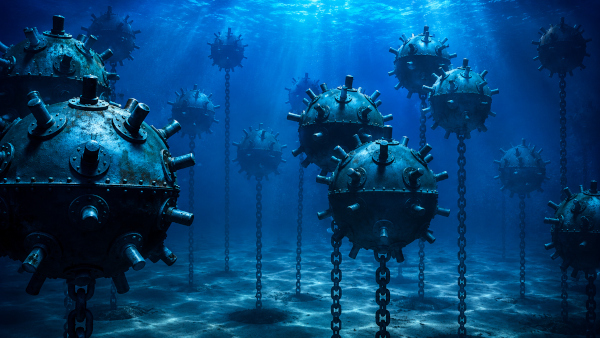
For the Indian Navy, this matters because mine warfare is one of the quietest but most dangerous threats in the maritime battlespace. Naval mines do not need to chase ships, emit signals or reveal themselves like missiles or aircraft. They can sit on the seabed, float in the water column, be moored at depth, or be laid near harbour approaches and shipping lanes. A handful of well-placed mines can paralyse port operations, delay fleet movement, threaten merchant vessels, and force a navy into slow, dangerous clearance operations before larger warships can safely enter or exit an area.
The Indian Navy’s own Request for Information for 12 MCMVs makes the intended role of these ships very clear. The vessels are expected to conduct mine-countermeasure operations using unmanned MCM suites, along with channel mapping, route survey and sanitisation, search and rescue, humanitarian assistance and disaster relief, mine laying, local naval defence and constabulary tasks such as coastal surveillance, maritime interdiction and boarding operations.
This shows that the future Indian MCMV is not being imagined as an old-style minesweeper that simply drags gear through a suspected minefield. It is being shaped as a multi-role, low-signature, unmanned-systems mothership capable of operating outside the minefield while sending robotic systems into the danger area. The official RFI describes stand-off MCM operation as a critical design driver and states that the MCMV should remain outside the minefield while its unmanned MCM suite operates inside it.
That single design principle marks the biggest shift in modern mine warfare. Earlier generations of minesweepers had to enter dangerous waters, relying on low magnetic and acoustic signatures to reduce risk. New-generation mine-countermeasure concepts try to move the human crew and the parent vessel away from the minefield altogether. The ship becomes the command node. The unmanned surface vessel becomes the forward-deployed workhorse. Autonomous underwater vehicles scan below the surface. Remotely operated vehicles inspect and neutralise suspicious contacts. Software fuses the picture, plots the threat and guides the mission.
Exail’s own unmanned mine-countermeasure system fits this modern doctrine. The company describes its UMIS concept as a drone-based, stand-off approach that combines unmanned surface, underwater and aerial vehicles with towed sonars and sweeping technologies. It also says the system is integrated through command-and-control software for managing mine-countermeasure operations across maritime and coastal zones.
At the heart of such a suite is the mine-warfare kill chain. First comes detection, usually through high-resolution sonar or synthetic aperture sonar that can scan the seabed and water column for mine-like objects. Then comes classification, where the system separates likely mines from rocks, debris, anchors or wreckage. Identification follows, often using optical sensors or close-range inspection by an ROV. Finally, the mine is neutralised, either by a remotely deployed charge, expendable mine-disposal vehicle or other controlled method. Exail states that its interoperable unmanned MCM architecture covers the operational chain from detection and classification to identification and neutralisation.
For India, this has deep operational relevance. The country’s naval geography is unusually exposed to mine-warfare scenarios. India has a long coastline, major ports, naval bases on both seaboards, island territories in the Arabian Sea and the Bay of Bengal, offshore energy infrastructure, and heavy dependence on sea-borne trade. In a crisis, an adversary does not need to defeat the Indian Navy in a fleet battle to create disruption. Mining a harbour approach, naval anchorage, tanker route or choke point can force delays, impose economic cost and complicate military mobilisation.
The threat becomes even more serious when viewed against submarine warfare. Modern conventional submarines can lay mines covertly. Surface vessels, fishing boats, special operations teams and non-state actors can also become mine-laying vectors in shallow waters. This makes mine countermeasures not a niche capability but a core requirement for sea-control, harbour defence, expeditionary readiness and commercial maritime resilience.
India’s requirement is also not new. The Navy has been seeking modern mine-countermeasure vessels for years. The current official RFI for 12 vessels mentions anticipated delivery timelines between 2030 and 2037 and a planned order split between two shipyards in an 8:4 ratio, depending on the acquisition process. Media reporting has also described the plan as a major revival of India’s minesweeper requirement, with an estimated value around ₹44,000 crore, while noting the capability gap left by the retirement of earlier mine-warfare vessels.
This is where L&T’s role becomes important. Mine-countermeasure vessels are not just hulls; they are systems-of-systems platforms. The real challenge lies in integrating sonar payloads, unmanned craft, underwater vehicles, launch-and-recovery arrangements, mission software, low-signature ship design, data links, command consoles and maintenance support into a reliable naval package. L&T’s press release specifically highlights its strengths in defence engineering, indigenous manufacturing, complex systems integration and lifecycle support.
Exail brings the foreign-technology side of the equation. The company has positioned itself globally in unmanned maritime systems and mine-warfare technologies, and L&T’s release says Exail’s MCM technologies are already in operation with several navies and validated through real-world deployments. For the Indian programme, that experience is valuable because unmanned MCM is not simply about buying drones. It requires proven command architecture, reliable autonomy, safe launch-and-recovery systems, sonar processing, target recognition, mission planning and operator training.
The Indian Navy’s separate RFI for unmanned MCM suites gives a clearer picture of the kind of equipment being sought. It states that the Ministry of Defence intended to procure 12 unmanned MCM suites comprising autonomous surface vessels, heavyweight autonomous underwater vehicles and remotely operated vehicles for use onboard Indian naval MCMVs. It also places the procurement within Indian acquisition categories under Defence Acquisition Procedure 2020, including Buy Indian-IDDM, Buy Indian and Buy & Make Indian.
That acquisition structure is crucial for the domestic defence industry. It signals that India does not want a purely imported black-box mine-warfare solution. The preference is for local manufacturing, Indian integration, lifecycle support, and gradual sovereign capability in a field where dependence on foreign support during conflict would be risky. L&T’s announcement also explicitly links the partnership with Aatmanirbhar Bharat and Make in India, saying the programme will include strong local industrial collaboration and capability development.
Technically, the future MCMV will likely be judged on three broad parameters: how safely it can operate near a mine threat, how effectively its unmanned systems can search and neutralise mines, and how well it can integrate data into a trusted tactical picture. The ship itself needs low acoustic, magnetic and pressure signatures, because mines can be triggered by the physical signature of a passing vessel. The Indian Navy’s RFI identifies minimum acoustic, magnetic and pressure signature as part of the ship’s design requirements.
But the ship’s most important asset will be its unmanned toolbox. An autonomous surface vessel can tow sonar or sweeping gear into suspected waters without exposing the mothership. An AUV can quietly map the seabed and detect mine-like objects with precision. An ROV can be sent for close inspection and neutralisation. A UAV or shipborne drone can help with surface surveillance, communications relay or visual monitoring. When these assets are managed through a unified command system, the MCMV becomes a floating mine-warfare control centre.
This is exactly the direction in which modern navies are moving. The minefield is no longer treated as a place where sailors must physically go first. It is treated as a hazardous data environment to be mapped, analysed and cleared by robotic systems before manned ships enter. The result is safer, faster and more scalable mine clearance. It also allows a navy to conduct route survey and harbour sanitisation before a major deployment, amphibious operation or commercial reopening.
The L&T–Exail arrangement also strengthens the India-France defence technology corridor. India and France already cooperate across aviation, submarines, naval systems and strategic technologies. Mine warfare is less glamorous than fighter aircraft or submarines, but it is equally decisive in a conflict. A navy that cannot clear mines can be blocked from using its own ports. A fleet that cannot guarantee safe channels may be delayed even before it reaches the battle area. In that sense, the mine-countermeasure fleet is not a secondary support arm; it is an enabler of every major naval operation.
The economic-security angle is equally strong. India’s ports handle energy imports, container traffic, fertilisers, food supplies, raw materials and exports. A mine scare near a major harbour can push insurance costs, delay shipping schedules and create pressure on fuel and trade flows. Therefore, MCMVs are not only military assets; they are maritime economic-security platforms. Their presence assures merchant shipping, protects naval mobilisation, and gives the government options in a crisis.
For India’s shipbuilding ecosystem, the programme could become a high-value integration opportunity. Unlike simpler patrol vessels, MCMVs demand specialised materials, careful signature management, mission-system integration and close coordination between shipyard, unmanned-system supplier, sonar provider, software integrator and Navy operators. If executed properly, the programme can create a domestic industrial base for autonomous maritime warfare that could later extend into harbour protection, seabed surveillance, anti-submarine support, offshore infrastructure security and unmanned ocean monitoring.
However, the programme must be understood realistically. The L&T–Exail partnership is an enabling move, not the end of the acquisition process. The Indian Navy’s MCMV project still depends on formal procurement steps, shipyard participation, technical evaluation, cost negotiations, contract award, construction, trials and induction. The Navy’s RFI itself makes clear that detailed specifications would be given later through the Request for Proposal stage to qualified shipyards.
Still, the strategic direction is unmistakable. India’s future mine-warfare fleet will not be built around manpower-heavy minesweeping alone. It will be built around stand-off operations, autonomous systems, underwater robotics, mission software and integrated command networks. The L&T–Exail collaboration fits directly into that doctrine.
The broader message is that Indian naval modernisation is moving beyond visible combat power. Aircraft carriers, destroyers, submarines and missiles dominate headlines, but a navy’s real warfighting credibility also depends on less visible enablers: replenishment ships, survey vessels, rescue systems, cyber networks and mine-countermeasure platforms. MCMVs belong to this silent backbone. They do not project power in the dramatic sense, but they decide whether power can move safely through contested waters.
In the Indian Ocean Region, where major powers, regional rivals, submarine fleets and commercial shipping routes intersect, mine warfare will remain a low-cost, high-impact threat. The L&T–Exail unmanned MCM suite offers India a route toward a more survivable, technologically modern and domestically supported answer. If the programme moves from partnership to procurement and timely execution, the Indian Navy’s next MCMV fleet could become one of the most important undersea-security upgrades of the coming decade.References:
References:
https://nsearchives.nseindia.com/corporate/PAM_14052026124116_PressRelease14052026.pdf
https://www.exail.com/product-range/umis-unmanned-mcm-mine-countermeasure-integrated-system
https://www.exail.com/product-range/unmanned-surface-vehicles-for-mine-countermeasures
https://www.exail.com/resources/usv-uncrewed-surface-vessel-6624
You may also like
-
JCBL Receives DRDO Technology for Indigenous 20-Tonne Heavy Drop System for C-130J and C-17
-
DRDO Moves 30 kW Laser Weapon Towards Production, Industry Partner Selection Planned Within Six Months
-
IG Defence Validates KAL Long-Range Strike Drone’s Integrated Systems in Pokhran Trial
-
Vajra Air Defence Warriors Validate AKASHTEER Sensor-to-Shooter Network in Day-Night Firing Drills
-
INS Sahyadri and INS Kulish Reach Philippines for ADMM-Plus Maritime Cooperation
