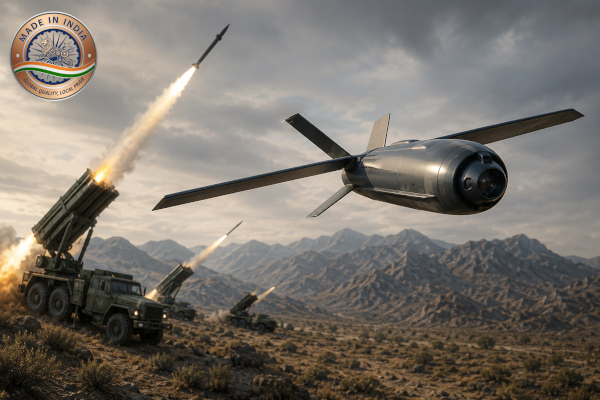
India’s artillery battlefield is moving beyond the age of simple area bombardment. The future of land firepower will increasingly depend on weapons that can be launched in numbers, travel deep into contested airspace, search for targets, and strike with precision after receiving real-time battlefield cues. In that emerging category, Rudra, a barrel-launched loitering munition system developed by Machfly Aerospace, represents an important Indian attempt to fuse the logic of rocket artillery with the flexibility of unmanned strike warfare.
The Rudra barrel-launched loitering munition is an Indian defence system developed by Machfly Aerospace, an Indian aerospace start-up associated with IIT Jammu. According to Machfly’s own description, Rudra is designed as a barrel-launched loitering munition that can be deployed from Pinaka and other multi-barrel launch systems, giving artillery units a new precision-strike option beyond conventional rockets. The system is listed with a RATO + turbojet propulsion configuration, indicating a launch profile where rocket-assisted take-off provides the initial boost, while the turbojet supports sustained flight for deeper battlefield reach.
Rudra is described by Machfly Aerospace as a barrel-launched loitering munition designed to deliver several-fold range enhancement without a corresponding increase in cost. The company says the system supports salvo launches and is optimised for deep beyond-visual-line-of-sight strike missions in contested environments. Its listed propulsion architecture is RATO plus turbojet, while its launch compatibility is given as Pinaka / multi-barrel systems.
That description places Rudra in a very specific and valuable niche. It is not a conventional rocket, because it is meant to loiter and hunt rather than simply follow a ballistic path to a fixed grid. It is not a normal tactical drone either, because it is intended to be launched from a barrel or multi-barrel rocket system rather than from a runway, rail, catapult, or hand-held tube. Its battlefield promise lies in combining the launch density of artillery with the target-searching behaviour of a loitering munition.
The Pinaka connection gives Rudra its real operational significance. Pinaka is already one of India’s most important indigenous rocket artillery platforms, and Tata Advanced Systems lists the launcher with shoot-and-scoot capability, auto-levelling and stabilisation, an onboard inertial navigation system, and the ability to fire a salvo of 12 rockets in 44 seconds. A munition like Rudra, if successfully integrated with such a launcher class, could change a rocket battery from an area-saturation weapon into a distributed precision-strike node.
The tactical shift is profound. Traditional multiple-launch rocket systems are built to overwhelm a zone with explosive volume. A barrel-launched loitering munition salvo could instead disperse into the battlespace, search for exposed or mobile targets, and attack only when the target is confirmed. This gives artillery commanders a weapon that can be fired like a rocket but used more like a hunter-killer unmanned aircraft.
Rudra’s RATO-plus-turbojet propulsion concept is central to this profile. The RATO phase would provide the initial launch impulse needed to exit the tube and transition into flight, while the turbojet would support sustained powered flight after launch. In military terms, this points toward a system designed for longer reach and greater persistence than many battery-powered small loitering munitions, though public information does not yet confirm exact range, endurance, warhead weight, seeker type, or guidance architecture.
Its most likely battlefield value would be against time-sensitive and mobile targets. Modern command posts, air-defence vehicles, radar units, artillery batteries, missile launchers, logistics convoys and electronic warfare systems rarely remain stationary for long. A conventional rocket must strike where the target is expected to be; a loitering munition can enter the target area, wait, search, and attack after the target exposes itself.
This is especially relevant in a battlefield shaped by counter-battery radars, drones, satellite surveillance and electronic warfare. High-value enemy systems now move quickly, radiate briefly and hide aggressively. Rudra’s concept answers that problem by giving artillery units a weapon that does not need to complete the kill chain at the moment of launch. It can be launched into a suspected engagement zone and then complete the final search-and-strike phase closer to the target.
The BVLOS mission profile mentioned by Machfly is equally important. Beyond-visual-line-of-sight strike capability allows a force to attack deeper targets without sending a manned aircraft into dense air-defence envelopes. For India, such a system could be relevant across varied terrain: mountain valleys along northern borders, desert battlefields in the west, semi-urban conflict zones, and forward areas where fast target engagement is critical.
Rudra also fits into the larger global lesson from recent wars: armies need affordable precision at scale. Expensive missiles remain essential for strategic or hardened targets, but most battlefield targets cannot be attacked economically with high-end missiles alone. Loitering munitions fill the middle space between artillery rockets, cruise missiles and drones by giving commanders a comparatively lower-cost option for precision engagement.
For India’s artillery arm, the system could create a new layer between Guided Pinaka and conventional unmanned aerial systems. DRDO completed flight tests of the Guided Pinaka Weapon System in November 2024 as part of validation trials, assessing parameters such as range, accuracy, consistency and rate of fire for multiple target engagement in salvo mode. Rudra points to a different but complementary direction: not merely improving rocket accuracy, but adding loitering intelligence to the artillery ecosystem.
The comparison is useful. Guided Pinaka improves the precision of a rocket fired at a known target. Rudra, by design philosophy, would be more useful when the target is moving, hidden, or likely to appear after launch. One strengthens the rocket artillery strike arm; the other could give the same force an organic aerial hunting capability.
A barrel-launched design also offers a major logistical advantage if it can use existing multi-barrel infrastructure. Dedicated drone launchers, runways, catapults and support vehicles add complexity to field deployment. A munition designed for Pinaka or similar multi-barrel systems could use artillery formations that already have mobility, command networks, fire-control routines and shoot-and-scoot doctrine.
The salvo-launch feature matters because loitering munitions become far more dangerous when used in numbers. A single munition can attack one target. A coordinated salvo can saturate air defences, search multiple sectors, confuse enemy movement and force commanders to reveal radars or communications links. Even before impact, the presence of overhead loitering weapons can slow enemy manoeuvre and create tactical paralysis.
Rudra’s psychological effect could therefore be as important as its explosive effect. Troops under conventional artillery fire take cover until the barrage ends. Troops under loitering munition threat must assume that the weapon is still watching, waiting and selecting. That uncertainty can disrupt movement, delay logistics, suppress radar use and force the enemy to spend expensive air-defence resources on smaller targets.
The system also has clear relevance for counter-artillery and suppression of enemy air defence missions. Enemy gun positions, rocket launchers, mobile radars and short-range air-defence vehicles often expose themselves briefly before relocating. A loitering munition launched from a standoff artillery position could remain in the area long enough to catch such systems during their vulnerable movement or firing cycle.
In mountain warfare, Rudra could offer a different kind of advantage. Conventional artillery has to deal with ridgelines, reverse slopes and difficult target visibility. A loitering munition can approach from above, search valleys, watch road axes and strike targets hidden from direct observation. This makes the concept especially relevant for India’s high-altitude and broken-terrain security environment.
In desert warfare, the same munition could support mechanised formations by hunting logistics vehicles, command nodes, armoured concentrations and mobile artillery. The wide-open terrain of the desert rewards surveillance and long-range precision, but it also allows enemy units to move quickly. A loitering strike system launched in salvo mode could help close that mobility gap.
Still, Rudra must be assessed with caution. Publicly available information confirms the product concept, launch mode, propulsion type and intended mission profile, but it does not confirm induction by the Indian armed forces, serial production, operational deployment, final specifications, seeker details or procurement numbers. At this stage, the most accurate description is that Rudra is a promising indigenous barrel-launched loitering munition concept under development, not yet a publicly confirmed fielded weapon system.
The technical challenges are serious. A barrel-launched munition must survive launch shock, deploy control surfaces reliably, transition from boosted launch to powered flight, maintain navigation, resist jamming, transmit or receive target data, and complete terminal attack with precision. Each stage is difficult; combining all of them in a cost-effective munition suitable for salvo launch is a demanding engineering problem.
Electronic warfare will be one of the biggest tests. Any BVLOS loitering munition operating in a contested environment must deal with jamming, spoofing, datalink disruption and satellite-navigation interference. Rudra’s eventual credibility will depend not only on range or warhead size, but on whether it can complete missions when the enemy is actively attacking its navigation and communication chain.
The seeker and warhead configuration will determine its final battlefield role. A smaller warhead may be ideal for radars, communication vehicles, soft-skinned targets and exposed systems. A heavier or specialised warhead would be needed against armour, bunkers or hardened infrastructure. Since no official public payload figure is available, it would be premature to classify Rudra as an anti-tank weapon, bunker-buster or radar-killer without qualification.
Its industrial significance is equally important. Machfly Aerospace represents the new private-sector and start-up layer of India’s defence innovation ecosystem, where small companies are moving into high-speed UAVs, propulsion systems and unmanned strike concepts. The company’s public material places Rudra alongside its wider work in advanced aerospace systems, showing how India’s unmanned warfare space is no longer limited to large public-sector programmes.
For the Indian Army, a matured Rudra-type system could add a new dimension to artillery doctrine. Fire units would no longer be limited to neutralising coordinates; they could influence a deeper battlespace by launching autonomous or semi-autonomous strike assets from existing launcher classes. That would bring artillery closer to the centre of the sensor-to-shooter kill web.
For India’s defence planners, the larger attraction is cost-effective mass. A country facing multiple high-altitude, desert and maritime-border security challenges cannot rely only on expensive imported missiles or manned aircraft for every precision-strike requirement. Indigenous loitering munitions offer a way to multiply strike options while preserving strategic autonomy.
Rudra’s greatest promise is therefore doctrinal. It suggests a future where rocket launchers become drone dispensers, artillery batteries become precision-strike hubs, and munitions are expected to think, search and wait before they kill. If successfully developed, integrated and fielded, Rudra could give India a weapon that is launched like artillery, flies like an unmanned aircraft, and strikes like a precision munition.
At its core, Rudra is not just another drone and not merely a modified rocket. It is part of a broader transformation in land warfare, where the line between artillery, missiles and unmanned systems is becoming increasingly blurred. For India, that fusion could be decisive: an indigenous system capable of adding reach, persistence and intelligence to the country’s already growing rocket-artillery ecosystem.
Sources:
https://www.machflyaerospace.com/rudra/
https://www.machflyaerospace.com/
https://www.tataadvancedsystems.com/pinaka-multi-barrel-rocket-launcher
https://www.pib.gov.in/PressReleasePage.aspx?PRID=2073384
https://www.newsonair.gov.in/drdo-completes-flight-tests-of-guided-pinaka-weapon-system/
You may also like
-
Historic First as IPS Officer Sanjukta Parasor Becomes First Woman to Lead CRPF’s Elite CoBRA Force
-
Bengaluru’s Kerael Robotics Develops Indigenous Propulsion for Heavy-Lift UAV Platform Targeting 2,500-kg Payloads
-
Solar Industries Makes R21.8-Billion Global Expansion Move With Acquisition of South Africa’s Omnia Holdings
-
DRDO Takes Astra Mk1, Akash-NG and Indigenous Sensors to Africa Aerospace & Defence 2026
-
Apollo Micro Systems Gets DRDO ToT for Semi-Active Laser Homing System; VIGHANA Naval Mine Moves Into Production
