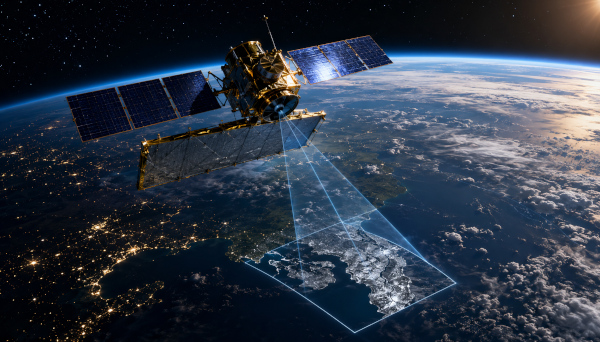
India’s private space sector is rapidly evolving from a launch-support ecosystem into a strategic national-security capability provider, and among the most closely watched startups in this transformation is GalaxEye. The company’s ambitious “Mission Drishti” programme is emerging as one of India’s most important indigenous efforts to develop persistent, all-weather, multi-sensor Earth observation capability from space — a technology domain with enormous implications for defence, border security, maritime surveillance, disaster response, and strategic intelligence.
Mission Drishti is centred around the development and deployment of advanced multi-sensor imaging satellites capable of combining Synthetic Aperture Radar (SAR) and optical imaging technologies into a unified Earth-observation architecture. The objective is to overcome one of the biggest operational limitations faced by traditional optical satellites: the inability to see through clouds, smoke, haze, darkness, and adverse weather conditions. In a country like India — with monsoon-heavy regions, mountainous terrain, maritime chokepoints, and long contested borders — the strategic value of uninterrupted surveillance capability is immense.
Conventional electro-optical satellites provide highly detailed imagery but depend heavily on daylight and clear weather. SAR satellites, by contrast, actively transmit microwave signals toward Earth and analyse the reflected signals to generate imagery. Because microwave frequencies penetrate clouds and are largely independent of sunlight, SAR platforms can operate day and night in nearly all weather conditions. The drawback historically has been that SAR imagery is harder to interpret visually and often lacks the intuitive clarity of optical imagery.
Mission Drishti attempts to bridge this gap through what GalaxEye describes as a “multi-sensor fusion” approach. The company’s architecture seeks to combine SAR and optical payload data into integrated intelligence products capable of delivering both high reliability and human-readable situational awareness. This creates the possibility of near-persistent observation of sensitive regions with significantly enhanced target detection and monitoring capability.
The strategic implications for India’s defence ecosystem are substantial. Persistent space-based surveillance has become one of the defining features of modern warfare and military planning. The Russia-Ukraine conflict, maritime tensions in the Indo-Pacific, and the increasing use of drones and dispersed mobile military systems have demonstrated the importance of real-time reconnaissance and tracking capability. Nations increasingly require satellites that can continuously monitor troop movements, logistics corridors, missile deployments, naval traffic, infrastructure activity, and strategic assets regardless of weather or time of day.
For India, such capability is particularly important across multiple theatres. Along the Line of Actual Control (LAC) with China, cloud cover and mountainous terrain often complicate optical surveillance operations. In the Indian Ocean Region, persistent monitoring of shipping lanes, submarines, grey-zone maritime activity, and foreign naval deployments is becoming increasingly important amid growing geopolitical competition. A fused SAR-optical architecture could significantly enhance India’s Maritime Domain Awareness (MDA) network and support the Indian Navy, Coast Guard, and intelligence agencies with near-real-time observation capability.
Mission Drishti also aligns closely with India’s larger national-security push toward indigenous geospatial and intelligence capability. Historically, India relied significantly on foreign commercial imagery providers for certain categories of high-resolution satellite intelligence. However, strategic planners increasingly recognise that sovereign ISR (Intelligence, Surveillance and Reconnaissance) capability is essential for operational independence during crises or conflict situations.
The emergence of private Indian firms like GalaxEye represents a broader transformation triggered by India’s space-sector reforms. Following the creation of IN-SPACe and the opening of the Indian space ecosystem to private participation, startups have begun entering domains once dominated exclusively by state agencies. India is now witnessing the rise of private launch providers, satellite manufacturers, propulsion developers, defence-space startups, and advanced geospatial analytics firms.
GalaxEye itself was reportedly founded by researchers connected to the Indian Institute of Space Science and Technology ecosystem and has attracted growing attention within India’s strategic and venture-capital communities. The company has publicly stated its aim of building one of the world’s first commercial constellations integrating multi-sensor imaging architectures for continuous Earth observation.
Mission Drishti is expected to involve not just a single satellite, but eventually a scalable constellation architecture capable of improving revisit rates and enabling persistent coverage. In satellite surveillance, revisit rate — the frequency with which a satellite can image the same location — is critically important. A constellation of multiple satellites dramatically reduces observation gaps and improves the ability to monitor dynamic targets such as naval task forces, missile launchers, logistics convoys, or rapidly evolving battlefield conditions.
From a technical standpoint, multi-sensor fusion requires highly sophisticated onboard computing, data-processing pipelines, calibration systems, and AI-assisted analytics. Combining SAR and optical data streams into coherent, actionable intelligence products is computationally demanding. Advanced algorithms are required to correlate datasets, reduce false positives, compensate for distortions, and generate usable outputs for military and civilian applications.
Artificial intelligence and machine learning are therefore expected to play a major role in Mission Drishti. Automated target recognition, anomaly detection, infrastructure-change analysis, ship tracking, border-intrusion monitoring, and disaster mapping are all areas where AI-enhanced geospatial analytics can dramatically improve operational efficiency. Such systems become even more valuable when integrated with military command-and-control networks and broader ISR ecosystems.
The maritime-security dimension of Mission Drishti could become especially significant for India. The Indian Ocean is increasingly becoming a contested strategic theatre involving China, the United States, regional navies, energy-security routes, submarine operations, and growing commercial traffic. Persistent satellite coverage can assist in identifying suspicious vessel movements, monitoring strategic chokepoints, tracking illegal fishing fleets, observing port activity, and enhancing anti-piracy operations.
The technology also has strong dual-use potential beyond military applications. Disaster management agencies can use all-weather imaging during floods, cyclones, landslides, and forest fires when cloud cover often renders traditional optical imaging ineffective. Agriculture, infrastructure planning, urban expansion monitoring, mining oversight, and environmental analysis are additional areas where multi-sensor imaging architectures can provide high-value data.
India’s push toward indigenous space-based ISR also intersects with broader global trends in defence-space integration. Modern militaries increasingly view space not merely as a support domain but as an operational theatre critical for communication, navigation, surveillance, missile warning, and targeting support. Countries are investing heavily in resilient satellite constellations, distributed space architectures, and rapid-launch capability to avoid dependence on a few vulnerable large satellites.
Mission Drishti therefore represents more than a commercial startup project. It reflects the growing convergence between India’s national-security priorities, private-sector technological innovation, and strategic autonomy ambitions in the Indo-Pacific era. If successful, the programme could help position India among the limited number of nations possessing sophisticated indigenous multi-sensor persistent Earth-observation capability.
As India expands its defence-modernisation efforts and strengthens its role as a major Indo-Pacific power, space-based ISR systems like Mission Drishti may become as strategically important as fighter aircraft, submarines, drones, or missile systems. In the future battlespace — where information dominance increasingly determines operational success — the ability to see continuously, rapidly, and independently from orbit may prove to be one of the most decisive strategic advantages of all.
Reference:
https://en.wikipedia.org/wiki/Synthetic-aperture_radar
You may also like
-
India’s Indigenous Sonar Ecosystem Powers New Generation of Indian Navy Warships
-
Murshidabad Becomes First West Bengal District to Complete Land Handover for India-Bangladesh Border Fencing
-
India’s LR-AShM Family Could Reach 3,500 Km as DRDO Develops Extended-Range Hypersonic Variants
-
Indian Composite Manufacturing Gets BrahMos Boost With ₹60-Crore Order to Allen Reinforced Plastics
-
HAL-Samtel Opens New Gurugram Facility to Expand Indigenous Defence Avionics and Display Manufacturing
