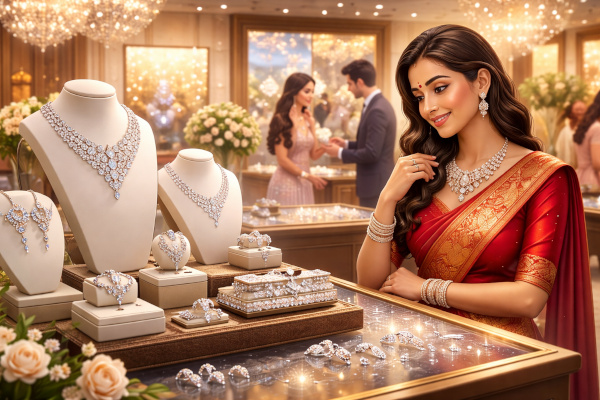
India has emerged as the world’s second-largest diamond jewellery market, capturing a 12% share of global demand in 2025, up from 10% in 2019. That rise has pushed the country ahead of China and Japan, which now account for about 5% each, while the United States remains the dominant market with a 53% share. The shift, highlighted by the 2025 De Beers India Diamond Acquisition Study and reported by IBEF, signals a major change in the global jewellery demand map, with India increasingly moving from a manufacturing powerhouse to a major consumer market in its own right.
The domestic market is also expanding in value. According to data cited by GJEPC from the De Beers study, India’s natural diamond jewellery market was officially estimated at ₹785 billion in 2024 and is projected to reach ₹1,520 billion by 2030, implying a 12% compound annual growth rate. The same study says the addressable market already includes 67 million women across SEC A and B households in Tier 1 to Tier 5 cities, with average spending per diamond piece at roughly ₹1.4 lakh.
A large part of that growth is being driven by younger consumers and changing buying behaviour. Generation Z accounts for 51% of total market value and millennials for another 35%, meaning the two groups together now control 86% of the Indian diamond jewellery market by value. Ownership among Indian women has also risen to 15%, up from 11% in 2022. The market is no longer defined only by bridal or heirloom buying: 52% of acquired diamonds are now worn every day, while outside the wedding segment, 64% of natural diamond jewellery is self-purchased by women.
The economic backdrop helps explain the momentum. De Beers’ India study says the number of Indian households earning above US$20,000 a year is expected to rise sharply from 32 million in 2025 to 67 million by 2030, widening the pool of consumers able to spend on premium discretionary products. Demand is also spreading beyond the metros, with Tier 3 to Tier 5 cities increasing their contribution to market value even though Tier 1 and Tier 2 cities still account for more than half the market.
There is, however, a contrast between rising domestic demand and current export pressures. Reuters reported on April 15 that India’s gems and jewellery exports fell 3.3% in FY2025-26 to US$27.72 billion, the lowest in five years, as shipments to the United States dropped 45% amid tariff-related disruptions. Cut and polished diamond exports fell 8.5% to US$12.16 billion, even though India continues to handle nine out of every ten diamonds processed globally. That contrast suggests India’s diamond story is entering a new phase: exports remain crucial, but the domestic consumer market is becoming an increasingly important engine of growth for the industry.
Sources:
https://www.ibef.org/news/india-becomes-second-largest-diamond-jewellery-market-with-12-global-share
https://gjepc.org/solitaire/de-beers-report-indias-diamond-jewellery-market-on-track-to-cross-inr-1-5-trillion-by-2030/
https://economictimes.indiatimes.com/industry/cons-products/fashion-/-cosmetics-/-jewellery/india-becomes-second-largest-diamond-jewellery-market-with-12-global-share-overtakes-china-and-japan/articleshow/130168077.cms
https://www.reuters.com/world/india/india-gems-jewellery-exports-fall-five-year-low-us-tariffs-2026-04-15/
You may also like
-
ICAR Scientists Develop Indigenous Protective Gloves for Cotton Farmers, Sign Commercial Manufacturing Agreement
-
BHEL–Coal India Joint Venture Begins Construction of ₹25,016 Crore Indigenous Coal Gasification Project in Odisha
-
PM Modi to Inaugurate RBI’s Tier IV Data Centre and Cybersecurity Training Institute in Bhubaneswar
-
India Creates 11 Crore Digital Farmer IDs Five Months Ahead of Target, Strengthening AgriStack Infrastructure
-
Chak-Hao Black Rice of Manipur and Nagaland: The Aromatic Purple Heritage Grain with GI Recognition
